Agaricus blazei Practical Use
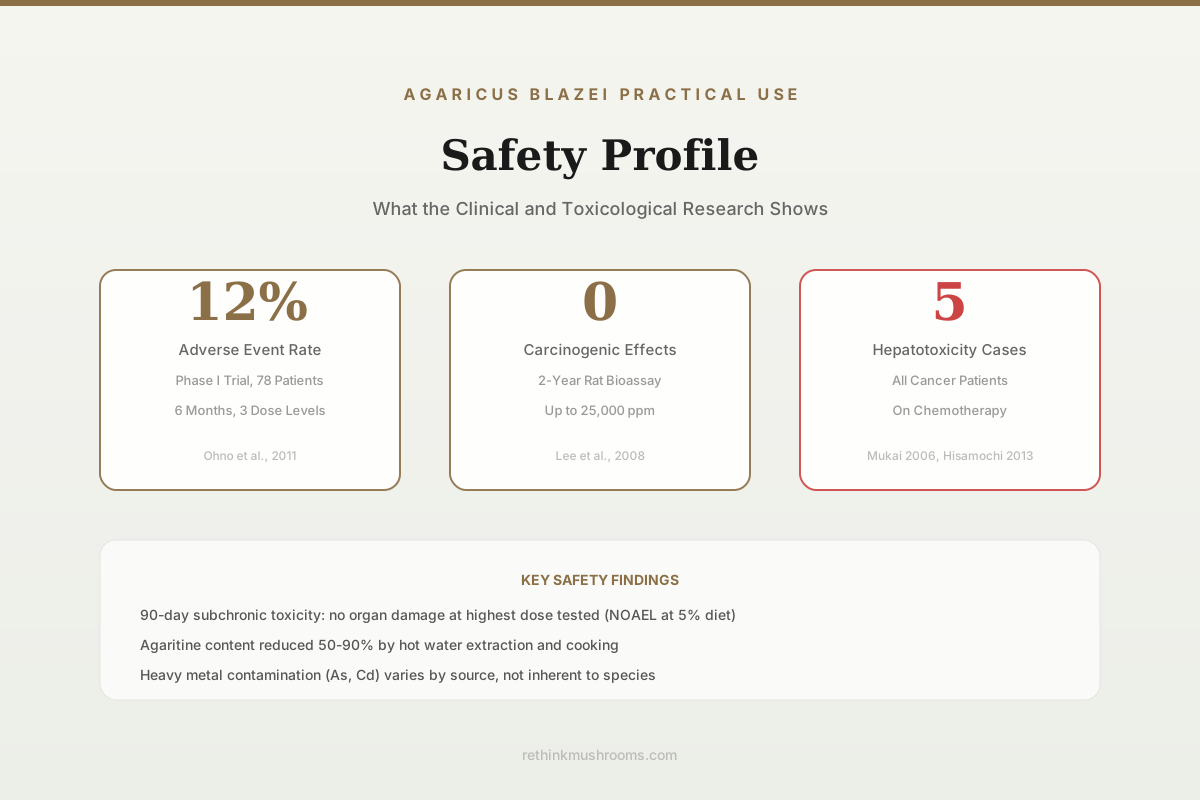
12% Adverse Events
In the only Phase I clinical trial of Agaricus blazei Murill, 9 of 78 cancer patients in remission experienced adverse events over 6 months, mostly digestive. None were dose-dependent.
Ohno et al., Evidence-Based CAM, 2011
78 Patients
6-month Phase I trial, three dose levels
90-Day Rat
no subchronic toxicity at highest dose tested
3 Cases
severe hepatotoxicity reported in cancer patients
Ohno et al., Evidence-Based CAM, 2011
 View as image ↗
Agaricus blazei Murill (ABM), known as Himematsutake in Japan and Cogumelo do Sol in Brazil, is one of the most commercially popular medicinal mushrooms worldwide. Japanese consumers alone spend an estimated $450 million annually on ABM products, primarily as a complementary therapy in cancer care.[1] That scale of consumption makes safety data critical. The evidence base includes one Phase I clinical trial, several randomized controlled trials reporting safety as secondary outcomes, two-year carcinogenicity testing in rats, subchronic toxicity testing, and a small number of hepatotoxicity case reports. For details on how ABM interacts with specific medications, see the drug interactions article. For guidance on amounts used in clinical research, the dosage guide covers every published dosing protocol.
Key Takeaways
- In the only Phase I dose-escalation trial, 9 of 78 cancer patients (12%) experienced adverse events over 6 months at doses of 1.8, 3.6, or 5.4 g/day. Most were digestive (nausea, diarrhea). None occurred in a dose-dependent pattern (Ohno et al., Evidence-Based CAM, 2011)
- A 90-day subchronic toxicity study in F344 rats at doses up to 2,965 mg/kg/day found no consistent organ toxicity, no histopathological changes, and established a NOAEL at the highest dose tested (Kuroiwa et al., Food and Chemical Toxicology, 2005)
- A two-year carcinogenicity bioassay in F344 rats fed up to 25,000 ppm ABM powder found no carcinogenic effects at any dose level (Lee et al., Food and Chemical Toxicology, 2008)
- Three cancer patients on chemotherapy developed severe hepatotoxicity while taking ABM extract; two died of fulminant hepatitis. Rechallenge in one surviving patient caused recurrence (Mukai et al., Japanese Journal of Clinical Oncology, 2006)
- ABM products contain agaritine, a hydrazine derivative with genotoxic potential in vitro, though concentrations decrease substantially with hot water extraction and cooking (Nagaoka et al., Chemical and Pharmaceutical Bulletin, 2006)
- A 2008 literature review flagged heavy metal contamination (arsenic, cadmium) in commercial ABM products as a concern separate from the mushroom's inherent pharmacology (Firenzuoli et al., Evidence-Based CAM, 2008)
Safety Evidence, Stratified · Agaricus blazei
The Adverse-Event Signal Runs Opposite to How Controlled the Evidence Is
Reading top to bottom, the studies get less controlled — and only at the bottom, in uncontrolled case reports of chemotherapy patients, does a severe signal appear. Nothing serious has surfaced in a placebo-controlled trial or in animal toxicology.
Controlled human trials
Low signal [1][2][3][4]Phase I dose-escalation (n = 78, to 5.4 g/day, 6 mo) plus RCTs totaling ~200 subjects, 7 weeks to 12 months
Mild, mostly digestive
12% adverse-event rate in the Phase I trial (nausea, diarrhea); no serious adverse events attributable to ABM in any controlled study
Animal toxicology
Low signal [8][9]90-day subchronic study and a full 2-year carcinogenicity bioassay in F344 rats
No toxicity threshold reached
NOAEL set at the highest dose tested (~2,965 mg/kg/day); no carcinogenicity at up to 25,000 ppm over two years
Uncontrolled case reports
High signal [5][6]5 reported cases of severe liver injury, all in cancer patients on chemotherapy or multiple supplements
Severe, sometimes fatal
3 cases with 2 deaths from fulminant hepatitis (one positive rechallenge); 2 further cases with an autoimmune-like pattern
How to read it: the tiers are not ranked by dose or duration but by evidentiary control. Case reports cannot separate ABM from concurrent chemotherapy, altered hepatic metabolism, and multi-supplement use, so the severe signal at the bottom is a hypothesis about a confounded population — not a measured event rate.
Sources: Ohno 2011 [1]; Hsu 2007 [2]; Hsu 2008 [3]; Mahmood 2019 [4]; Mukai 2006 [5]; Hisamochi 2013 [6]; Kuroiwa 2005 [8]; Lee 2008 [9]. Figures are the sample sizes, doses, durations, and adverse-event findings reported in those studies.
The Phase I Clinical Trial: The Only Dedicated Safety Study
Only one clinical trial has been specifically designed to evaluate ABM safety as its primary endpoint. Ohno and colleagues enrolled 78 cancer patients in remission across multiple Japanese institutions.[1] Patients received 1.8 g, 3.6 g, or 5.4 g of ABM granulated powder daily for 6 months. Adverse events were graded using NCI-CTCAE v3.0, the standard oncology toxicity scale.
Nine patients (12%) experienced adverse events. The most common were nausea and diarrhea. One patient developed liver dysfunction classified as a food allergy to ABM. No adverse events showed dose-dependent patterns, meaning higher doses did not produce more side effects. Laboratory parameters (liver enzymes, kidney function, blood counts) remained stable across all three dose groups throughout the 6-month period.
The trial has clear limitations. All participants were cancer patients in remission, meaning they had recently completed chemotherapy and/or radiation. Their baseline physiology was not representative of healthy supplement users. The sample size of 78 was adequate for detecting common adverse events (those occurring in >5% of users) but insufficient for rare events. The 6-month duration leaves long-term safety unaddressed.
Safety Data from Randomized Controlled Trials
Several RCTs designed to test ABM's therapeutic effects have reported safety data as secondary outcomes, expanding the human evidence base beyond the Phase I trial.
Hsu and colleagues conducted a randomized, double-blind, placebo-controlled trial in 72 subjects with type 2 diabetes.[2] Participants received 1,500 mg ABM extract daily alongside metformin and gliclazide for 12 weeks. The trial reported improved insulin resistance (HOMA-IR decreased by 22.5% vs. placebo) with no significant adverse events in the treatment group. Liver and kidney function tests remained normal throughout.
In a separate 12-month open-label study, Hsu and colleagues administered ABM extract to four patients with chronic hepatitis B.[3] AST and ALT levels normalized over the study period. While the sample was tiny, the 12-month duration provides the longest continuous human safety observation for ABM. No adverse events were reported.
Mahmood and colleagues randomized 60 birch-allergic blood donors to ABM-based AndoSan extract or placebo for 7 weeks.[4] No serious adverse events occurred in either group. The trial's healthy population (blood donors meet strict health criteria) makes it more relevant to typical supplement users than oncology studies.
Collectively, these trials cover approximately 200 human subjects across durations of 7 weeks to 12 months, with no consistent pattern of serious adverse events attributable to ABM. The total human exposure in controlled studies remains small relative to commercial consumption.
Hepatotoxicity: The Case Reports
The most serious safety signal comes from case reports, not controlled trials. Mukai and colleagues reported three cancer patients who developed severe hepatic dysfunction while consuming ABM extract.[5] Two patients died of fulminant hepatitis. In one surviving patient, liver function recovered after stopping ABM, then deteriorated again when she restarted it, establishing a positive rechallenge.
All three patients had advanced cancer and were receiving or had recently completed chemotherapy. This confounds the attribution: chemotherapy agents are themselves hepatotoxic, and cancer patients have altered hepatic metabolism. The rechallenge case provides the strongest evidence for a causal link, but it remains a single observation.
Hisamochi and colleagues reported two additional cases in 2013: a 60-year-old woman with severe hepatitis associated with ABM and Ganoderma lucidum extracts, and a 75-year-old man with drug-induced liver injury linked to ABM and fucoidan.[6] Both patients were being monitored for malignancies. Liver biopsies showed histological patterns resembling autoimmune hepatitis, suggesting an immune-mediated rather than direct toxic mechanism. Both patients were taking multiple supplements simultaneously, making isolated attribution to ABM difficult.
The pattern across all five reported cases: cancer patients, concurrent chemotherapy or multiple supplement use, and severe liver injury. No cases of hepatotoxicity have been reported in placebo-controlled clinical studies, and no cases have been reported in otherwise healthy individuals. The Firenzuoli 2008 review reached this same conclusion: the hepatotoxicity signal is limited to "a single or very few clinical case reports among cancer patients who have undergone chemotherapy."[7] For a broader view of ABM's effects on the liver, including its hepatoprotective research and liver enzyme normalization data, those articles cover the other side of this equation.
Animal Toxicology: Subchronic and Chronic Studies
90-Day Subchronic Toxicity
Kuroiwa and colleagues fed F344 rats aqueous ABM extract at concentrations of 0.63%, 1.25%, 2.5%, and 5% of diet for 90 days, corresponding to approximately 360 to 2,965 mg/kg body weight daily.[8]
No deaths occurred. No treatment-related changes appeared in body weight, food consumption, urinalysis, hematology, or organ weights. Serum blood urea nitrogen was slightly increased in males at higher doses, but no corresponding histopathological changes were observed in kidneys. The NOAEL was set at the highest dose tested (5% of diet), meaning the study found no toxicity threshold even at maximum dosing.
Two-Year Carcinogenicity Bioassay
Lee and colleagues conducted the definitive long-term safety study: a full two-year bioassay in F344 rats at ABM doses of 2,500, 5,000, and 25,000 ppm in diet.[9] This study design is the standard regulatory framework for evaluating carcinogenic potential.
No treatment-related increases in tumor incidence occurred at any dose level. No dose-dependent organ toxicity was observed. Survival rates were comparable across all groups. The study concluded that lyophilized ABM does not have carcinogenic activity in rats under the tested conditions. Given that agaritine (see below) has theoretical mutagenic potential, this two-year negative result is particularly significant.
Antigenotoxicity Evidence
Ishii and colleagues tested ABM in multiple genotoxicity and carcinogenicity models simultaneously.[10] In the Comet Assay (DNA damage test), ABM showed antigenotoxic activity, meaning it protected DNA rather than damaging it. In the Aberrant Crypt Foci test (a colorectal cancer precursor assay), ABM demonstrated anticarcinogenic effects. The study also confirmed phagocytic and immunomodulatory activity, consistent with ABM's known beta-glucan mechanisms.
The Agaritine Question
Agaritine (beta-N-[gamma-L(+)-glutamyl]-4-(hydroxymethyl)phenylhydrazine) is an aromatic hydrazine present in all Agaricus species, including the common button mushroom (Agaricus bisporus). It has received disproportionate attention in ABM safety discussions because hydrazine derivatives can be genotoxic.
Nagaoka and colleagues developed an HPLC method to measure agaritine in commercial ABM products.[11] They found considerable variation: some products contained up to 1,791 microg/g dry weight. Japan's Ministry of Health flagged products with high agaritine levels for consumer warnings.
The context for interpreting these numbers matters. Agaritine is heat-labile and water-soluble. Hot water extraction, the traditional preparation method for ABM, substantially reduces agaritine content. Cooking (boiling, frying, microwaving) reduces agaritine by 50-90% depending on method and duration. The two-year rat carcinogenicity study[9] used lyophilized ABM (which retains agaritine) at high doses for two years and found no carcinogenic effects. This suggests that even with agaritine present, the net genotoxic risk from whole ABM consumption is low in rodent models.
The Agaritine Question · Agaricus blazei
A Genotoxic Compound That Preparation Largely Removes
Agaritine is present in every Agaricus species, including the common button mushroom. It is heat-labile and water-soluble, so the traditional hot-water extraction and ordinary cooking strip most of it out before consumption.
Agaritine remaining after preparation
100% → 10–50%≤1,791 µg/g
Highest agaritine measured in commercial products, dry weight (Nagaoka 2006) [11]
50–90%
Reduction in agaritine from hot-water extraction and cooking, by method and duration
0
Carcinogenic effects in a 2-year rat bioassay on agaritine-retaining lyophilized ABM (Lee 2008) [9]
How to read it: the two-year bioassay is the load-bearing fact. It used lyophilized ABM, which keeps agaritine intact, at high doses for two years — and still found no tumors. That does not prove agaritine is harmless in vitro, but it bounds the net genotoxic risk of whole ABM consumption as low in a rodent model.
Sources: Nagaoka 2006 [11] (HPLC agaritine measurement); Lee 2008 [9] (2-year F344 rat carcinogenicity bioassay). The 50–90% reduction reflects the heat-labile, water-soluble behavior of agaritine described in the article body.
The Firenzuoli review noted that agaritine's diazonium metabolite can form DNA adducts in vitro, but that the relevance to oral consumption at dietary doses remains unproven.[7] Whether ABM supplements should be held to a stricter standard than common table mushrooms (which also contain agaritine) is an unresolved regulatory question.
Heavy Metal Contamination
The Firenzuoli 2008 review raised a distinct safety issue: ABM's capacity to accumulate heavy metals from soil.[7] Mushrooms as a class are bioaccumulators, concentrating metals at levels exceeding surrounding substrate. ABM products have tested positive for elevated arsenic, cadmium, mercury, and lead. Memorial Sloan Kettering Cancer Center's herbal monograph on ABM notes that tested samples have contained high levels of inorganic arsenic.
This is not an inherent property of ABM's pharmacology. It reflects cultivation conditions, substrate composition, and manufacturing quality control. Products grown on contaminated substrate or in polluted environments will concentrate those contaminants. Third-party testing for heavy metals is the relevant consumer safeguard, not avoidance of the species itself. The 7 red flags article covers how to evaluate supplement quality more broadly.
Immunomodulation as a Double-Edged Mechanism
ABM's primary bioactive mechanism, beta-glucan-mediated immune stimulation, is also its primary theoretical safety concern for specific populations. Da Silva de Souza and colleagues reviewed 17 clinical studies and noted that ABM's immunomodulatory effects, while beneficial in immunosuppressed contexts, could theoretically exacerbate autoimmune conditions or interact with immunosuppressive medications.[12]
ABM beta-glucans activate NK cells, macrophages, and dendritic cells through Dectin-1 and complement receptor 3. This immune activation has been documented in multiple human studies. For individuals taking calcineurin inhibitors (tacrolimus, cyclosporine), mTOR inhibitors, or other immunosuppressants after organ transplantation, ABM supplementation introduces a direct pharmacological conflict. No clinical trials have tested ABM in transplant recipients, but the immunological mechanism makes the concern rational rather than speculative.
ABM also inhibits CYP3A4, the cytochrome P450 enzyme responsible for metabolizing roughly half of all prescription drugs.[7] CYP3A4 inhibition could increase blood levels of statins, calcium channel blockers, HIV protease inhibitors, and many other medications. The clinical significance of this interaction has not been quantified in human studies. The full list of known interactions is covered in the drug interactions article.
What the Evidence Does and Does Not Establish
The overall safety picture for ABM is bifurcated. In controlled research settings with defined products at doses up to 5.4 g/day for up to 12 months, the adverse event profile is mild and primarily digestive. Animal toxicology at doses far exceeding human use shows no carcinogenicity and no organ toxicity.
The hepatotoxicity case reports, while alarming, share a common profile: cancer patients on chemotherapy using uncontrolled commercial products, often alongside multiple supplements. No controlled study has reproduced this signal. Whether ABM was the cause, a contributor, or an incidental factor in those cases cannot be determined from case reports alone.
The uncontrolled variables in the supplement market (agaritine content, heavy metal contamination, product adulteration, extract concentration) create safety risks that are manufacturing issues rather than pharmacological ones. A hot water extract tested for heavy metals and produced under GMP conditions is a different product from an unregulated powder of unknown provenance.
The Bottom Line
Agaricus blazei has a mild adverse event profile in controlled clinical research, with Phase I data covering 78 patients over 6 months and additional RCT safety data across roughly 200 subjects. Animal studies show no carcinogenicity or subchronic toxicity. The hepatotoxicity signal is limited to case reports in chemotherapy patients using uncontrolled products. Agaritine content and heavy metal contamination are manufacturing quality issues rather than inherent species risks. The immunomodulatory mechanism that drives ABM's therapeutic research also creates rational concerns for immunosuppressed individuals and those on CYP3A4-metabolized medications.
Frequently Asked Questions
Sources & References
- 1RTHM-00229·Ohno, Satoshi et al. (2011). “Phase I Clinical Study of the Dietary Supplement, Agaricus blazei Murill, in Cancer Patients in Remission..” Evidence-based complementary and alternative medicine : eCAM.Study breakdown →PubMed →↩
- 2RTHM-00114·Hsu, Chung-Hua et al. (2007). “The mushroom Agaricus Blazei Murill in combination with metformin and gliclazide improves insulin resistance in type 2 diabetes: a randomized, double-blinded, and placebo-controlled clinical trial..” Journal of alternative and complementary medicine (New York.Study breakdown →PubMed →↩
- 3RTHM-00137·Hsu, Chung-Hua et al. (2008). “The mushroom Agaricus blazei Murill extract normalizes liver function in patients with chronic hepatitis B..” Journal of alternative and complementary medicine (New York.Study breakdown →PubMed →↩
- 4RTHM-00579·Mahmood, Faiza et al. (2019). “Agaricus blazei-Based Mushroom Extract Supplementation to Birch Allergic Blood Donors: A Randomized Clinical Trial..” Nutrients.Study breakdown →PubMed →↩
- 5RTHM-00105·Mukai, Hirofumi et al. (2006). “An alternative medicine, Agaricus blazei, may have induced severe hepatic dysfunction in cancer patients..” Japanese journal of clinical oncology.Study breakdown →PubMed →↩
- 6RTHM-00287·Hisamochi, Akiko et al. (2013). “Drug-induced liver injury associated with Agaricus blazei Murill which is very similar to autoimmune hepatitis..” Clinical journal of gastroenterology.Study breakdown →PubMed →↩
- 7RTHM-00131·Firenzuoli, F et al. (2008). “The Medicinal Mushroom Agaricus blazei Murrill: Review of Literature and Pharmaco-Toxicological Problems..” Evidence-based complementary and alternative medicine : eCAM.Study breakdown →PubMed →↩
- 8RTHM-00083·Kuroiwa, Y et al. (2005). “Lack of subchronic toxicity of an aqueous extract of Agaricus blazei Murrill in F344 rats..” Food and chemical toxicology : an international journal published for the British Industrial Biological Research Association.Study breakdown →PubMed →↩
- 9RTHM-00141·Lee, I P et al. (2008). “Lack of carcinogenicity of lyophilized Agaricus blazei Murill in a F344 rat two year bioassay..” Food and chemical toxicology : an international journal published for the British Industrial Biological Research Association.Study breakdown →PubMed →↩
- 10RTHM-00218·Ishii, Priscila Lumi et al. (2011). “Evaluation of Agaricus blazei in vivo for antigenotoxic, anticarcinogenic, phagocytic and immunomodulatory activities..” Regulatory toxicology and pharmacology : RTP.Study breakdown →PubMed →↩
- 11RTHM-00106·Nagaokaa, Megumi Hamano et al. (2006). “Measurement of a genotoxic hydrazine, agaritine, and its derivatives by HPLC with fluorescence derivatization in the agaricus mushroom and its products..” Chemical & pharmaceutical bulletin.Study breakdown →PubMed →↩
- 12RTHM-00468·da Silva de Souza, Aline Cristine et al. (2017). “Agaricus blazei Bioactive Compounds and their Effects on Human Health: Benefits and Controversies..” Current pharmaceutical design.Study breakdown →PubMed →↩