Supplement Buying Guide
73.7% Failed
When researchers tested 19 reishi supplements sold in the United States, 14 of them (73.7%) had measurable ingredients that did not match their label claims. The failures were in triterpene content, polysaccharide composition, or both.
Wu et al., Scientific Reports, 2017
13 of 19
products positive for starch-like fillers (Wu 2017)
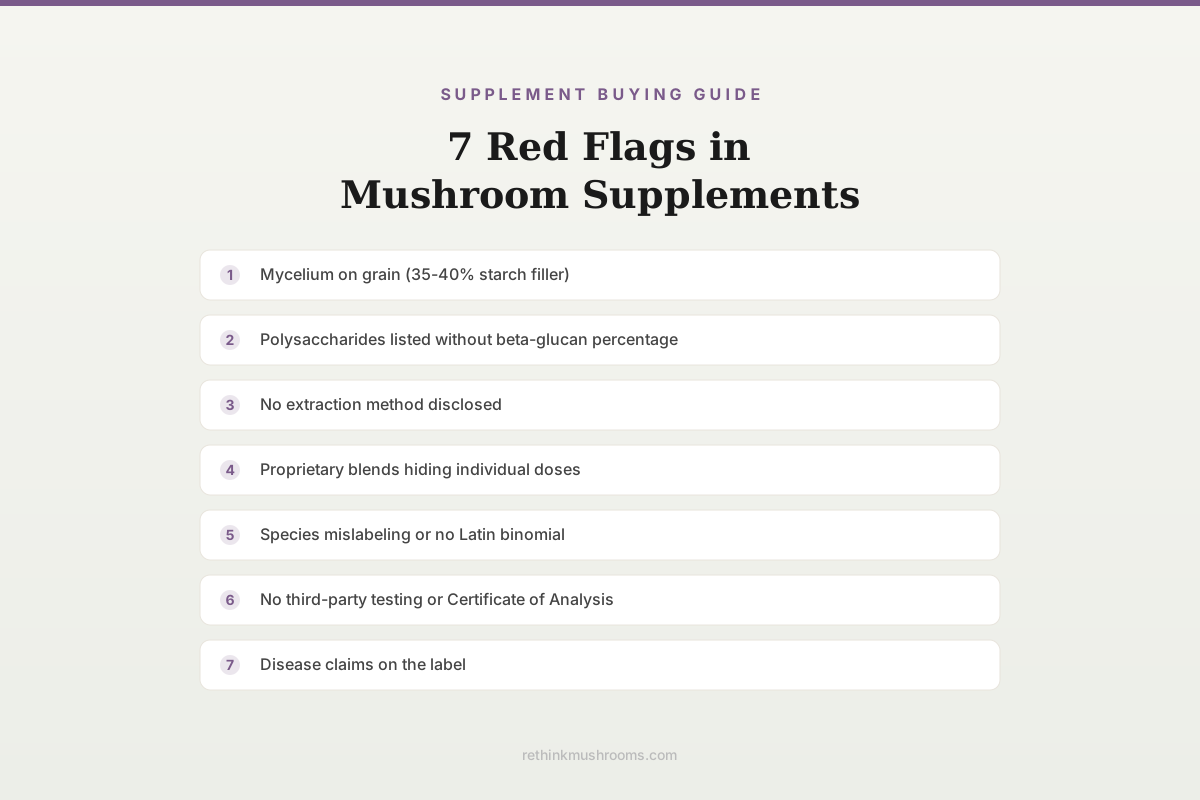
7 Red Flags
backed by published research
0 FDA Testing
required before supplements sell
Wu et al., Scientific Reports, 2017
 View as image ↗
The mushroom supplement market has a quality problem that published research quantifies. Wu and colleagues tested 19 Ganoderma lucidum (reishi) dietary supplements purchased in the United States in 2017 and found that only 5 (26.3%) had measurable ingredients consistent with their labels.[1] That means roughly three out of four reishi products failed on triterpene content, polysaccharide composition, or both. This is not an isolated finding. DNA barcoding, chemical profiling, and beta-glucan assays have all exposed quality gaps across the industry. For a broader look at the scale of the quality crisis, that topic gets its own deep dive. The label reading guide covers what good labels look like. This article covers what bad ones look like.
Key Takeaways
- Only 26.3% of 19 tested reishi supplements matched their label claims for triterpenes and polysaccharides; 13 of 19 products tested positive for starch-like fillers (Wu et al., Scientific Reports, 2017)
- Validated AOAC methods can separate beta-glucans from alpha-glucans (starch and glycogen) in mushroom and mycelial products, which makes it possible to flag grain-derived starch in supplements (McCleary and Draga, Journal of AOAC International, 2016)
- DNA barcoding of seven supplements sold as Ganoderma lucidum found Ganoderma lingzhi DNA in all of them — the species name on the label does not match the species in the bottle (Gunnels et al., PLOS ONE, 2020)
- A 2025 multi-analytical study found "stark compositional deviations" between wildcrafted chaga and fermented grain products labeled as chaga (Windsor et al., IJMS, 2025; authors employed by chaga supplement company Nammex — disclosure noted in the paper)
- Beta-glucan content varies several-fold across mushroom species — Tricholoma portentosum topped the Megazyme assay at 34.97 g/100 g dry mass while ranking shifted under the Congo red method (Mironczuk-Chodakowska et al., IJERPH, 2020)
- Substrate chemistry, strain, and developmental stage cause wide metabolite variation between mycelium and fruiting bodies (Berger et al., Microorganisms, 2022)
Red Flag 1: "Mycelium Biomass" or "Mycelium on Grain" in the Ingredients
This is the most common quality issue in mushroom supplements and the most thoroughly documented in published research.
McCleary and Draga developed a validated method for measuring beta-glucan in mushroom and mycelial products, published in the Journal of AOAC International in 2016.[2] Their method separately measures total glucan, alpha-glucan (starch and glycogen), and beta-glucan by difference, which makes it possible to detect grain-derived starch in mycelial products. The Wu et al. 2017 reishi audit applied a similar logic at the retail level: an iodine-starch screen flagged starch-like polysaccharides in 13 of 19 commercial reishi supplements before alpha-amylase digestion, with the signal disappearing after digestion — a chemical fingerprint of grain filler rather than authentic Ganoderma material.[1]
The reason is straightforward. When mycelium is grown on sterilized grain (rice, oats, or sorghum), the fungal tissue cannot be separated from the grain substrate. The entire mass is dried, ground, and encapsulated. A substantial portion of the final product is grain, not mushroom. Fungi store carbohydrate as glycogen and trehalose rather than as starch, so authentic fruiting-body material has a fundamentally different alpha-glucan signature than grain-based mycelial products. Berger and colleagues confirmed this pattern in a 2022 review comparing metabolite profiles between mycelium and fruiting bodies across button mushroom, oyster mushroom, and shiitake.[3] They found that substrate chemistry, strain, and developmental stage all cause wide variation in metabolite concentrations in mycelial products. Fruiting body composition was more consistent across growing conditions.
If a label says "mycelium biomass," "myceliated grain," "mycelium (Oryza sativa)," or lists rice, oats, or grain in the "Other Ingredients," the product is mycelium-on-grain. For a detailed breakdown of what these label terms mean, that guide decodes the full vocabulary.
Red Flag 2: "Polysaccharides" Listed Without a Beta-Glucan Percentage
A label that says "standardized to 40% polysaccharides" sounds impressive. The problem is that polysaccharides is a broad category that includes both beta-glucans (the bioactive compounds in medicinal mushrooms) and alpha-glucans, which includes starch from grain.
Cerletti, Esposito, and Iacoviello reviewed the evidence for mushroom beta-glucan effects on human health in Nutrients in 2021.[4] The bioactive forms are (1,3)- and (1,6)-linked beta-D-glucans, which are structurally distinct from the alpha-glucans in grain starch. A mycelium-on-grain product with 35-40% starch could legitimately claim a high polysaccharide number while containing minimal bioactive beta-glucans. The starch is a polysaccharide. It just is not a bioactive one.
A trustworthy label will state a specific beta-glucan percentage measured by a validated method, not a general polysaccharide claim. The McCleary and Draga Megazyme assay is the standard method for distinguishing beta-glucans from starch in mushroom products.[2]
Red Flag 3: No Extraction Method Disclosed
If a mushroom supplement label does not mention its extraction method, it may be raw powder (dried and ground mushroom with no extraction step) or the manufacturer may be withholding information. Extraction method determines which compounds end up in the final product.
Hot water extraction dissolves polysaccharides including beta-glucans. Ethanol extraction targets triterpenoids and sterols. Dual extraction uses both methods to capture a broader compound range. Each produces a different product profile from the same starting material. For a comparison of how extract ratios relate to quality, that article covers the numbers.
A label that describes its extraction method (hot water, dual extract, or a specific process) is disclosing something verifiable. A label that says nothing about how the product was made is not.
Red Flag 4: Proprietary Blends That Hide Individual Doses
A "proprietary mushroom blend" listing reishi, lion's mane, cordyceps, chaga, turkey tail, and maitake at a combined 500 mg tells you the total weight of six mushrooms but not how much of each is present. One species could account for 400 mg while the other five provide 20 mg each.
Mirończuk-Chodakowska and Witkowska measured beta-glucan content across 21 mushroom species in 2020 using both Megazyme and Congo red methods.[5] Tricholoma portentosum topped the Megazyme assay at 34.97 g per 100 g dry mass, with the lowest-content species several-fold lower; assay choice meaningfully shifted the species ranking, with Lactarius deliciosus topping the Congo red ranking at 17.11 g per 100 g. A blend that is 80% of a low-beta-glucan species and 20% of a high-beta-glucan species will perform very differently than the reverse. Without knowing the species-by-species breakdown, the blend claim is not evaluable.
Clinical research on medicinal mushrooms typically uses a defined dose of a single species or standardized extract. A multi-mushroom blend at sub-clinical doses of each species is not the same product that was studied. Understanding how to choose a supplement based on the evidence requires knowing what dose of which species was tested.
Red Flag 5: Species Mislabeling or No Species Identification
Not all mushroom supplements contain what they claim. Gunnels and colleagues used DNA barcoding (ITS region sequencing) to identify the species in commercial reishi supplements in 2020.[6] All seven powdered or dried products they tested — each sold as Ganoderma lucidum — actually contained Ganoderma lingzhi DNA, the East Asian species commonly traded as "reishi" but distinct from G. lucidum sensu stricto. The mismatch is taxonomic rather than fraudulent in most cases, but it does mean the species name on the label is not what is in the bottle. ITS-based phylogenetic analysis proved to be a cost-effective authentication method, but most supplement companies do not perform or publish this testing.
Windsor and colleagues extended this type of multi-assay analysis to chaga (Inonotus obliquus) supplements in 2025.[7] Using HPTLC, LC-ELSD, LC-QToF-MS, NMR spectroscopy, UV-Vis spectrophotometry, and iodine-starch assays, they found "stark compositional deviations" between wildcrafted chaga canker and fermented grain products labeled as chaga — the fermented grain products had fundamentally different chemical profiles from wild chaga. Reader note: five of the six authors are employed by Nammex, a chaga supplement supplier with a direct commercial interest in distinguishing wildcrafted product from grain-based competitors. The chemistry methods are standard and the conflict of interest is disclosed in the paper, but the framing should be read with that incentive in mind.
A product that lists only a common name ("mushroom complex," "functional mushroom blend") without specifying the Latin binomial for each species (Ganoderma lucidum, Hericium erinaceus, Inonotus obliquus) is leaving out identifiable information. A product that specifies the species but has not been independently verified may still contain the wrong one.
Red Flag 6: No Third-Party Testing or Certificate of Analysis
The FDA does not require pre-market testing of dietary supplements in the United States. Supplement manufacturers are responsible for their own quality control but are not required to publish test results.
Wu et al. demonstrated why this matters: 73.7% of the reishi supplements they tested failed to match their labels.[1] López-García and colleagues used MALDI-TOF mass spectrometry in 2016 to compare polysaccharide profiles across commercial mushroom supplements and found that products with identical label claims had different molecular weight distributions.[8] Maitake and Cordyceps supplements showed the highest molecular weight polysaccharides, while other species showed lower values. The label alone could not predict these differences.
A Certificate of Analysis (CoA) from a named third-party laboratory is the most direct way to verify claims. The CoA should include: the specific compounds tested (beta-glucan, triterpenes, heavy metals), the testing method used, the batch number, and a date. A company that cannot or will not provide a CoA for its current batch is asking you to take its word for it. For detailed guidance on how to find and interpret lab reports, that article walks through the process.
Red Flag 7: Health Claims on the Label
In the United States, dietary supplements may carry structure/function claims ("supports immune health") but cannot make disease claims ("treats cancer," "cures infection"). A mushroom supplement label that makes specific disease claims is either operating outside FDA guidelines or marketing to consumers who will not check.
The distinction matters beyond legality. Products that rely on aggressive health claims rather than verifiable quality data (beta-glucan percentages, extraction methods, CoA availability) are leading with marketing rather than evidence. Cerletti et al. documented real immunomodulatory and anti-inflammatory effects of mushroom beta-glucans in their 2021 review.[4] The evidence exists. The question is whether a specific product contains the compounds that produced those effects, and that requires testing data, not label claims.
A company with a strong product will lead with its test results and compound specifications. A company with a weak product will lead with its claims.
The Bottom Line
Published research has documented a consistent pattern of quality failures in mushroom supplements: mislabeled species, high starch content from grain filler, polysaccharide claims that obscure low beta-glucan content, and products that do not match their labels on chemical analysis. The seven red flags covered here (mycelium-on-grain, polysaccharide claims without beta-glucan data, no extraction method, proprietary blends, species mislabeling, no third-party testing, and unsupported health claims) are all detectable from the label or the company's website before purchase. The research is clear on what constitutes a quality mushroom product: verified beta-glucan content, specified extraction method, fruiting body sourcing, and independent testing data.
Frequently Asked Questions
Sources & References
- 1RTHM-00499·Wu, Ding-Tao et al. (2017). “Evaluation on quality consistency of Ganoderma lucidum dietary supplements collected in the United States..” Scientific reports.Study breakdown →PubMed →↩
- 2RTHM-00438·McCleary, Barry V et al. (2016). “Measurement of β-Glucan in Mushrooms and Mycelial Products..” Journal of AOAC International.Study breakdown →PubMed →↩
- 3RTHM-00743·Berger, Ralf G et al. (2022). “Mycelium vs. Fruiting Bodies of Edible Fungi-A Comparison of Metabolites..” Microorganisms.Study breakdown →PubMed →↩
- 4RTHM-00676·Cerletti, Chiara et al. (2021). “Edible Mushrooms and Beta-Glucans: Impact on Human Health..” Nutrients.Study breakdown →PubMed →↩
- 5RTHM-00637·Mirończuk-Chodakowska, Iwona et al. (2020). “Evaluation of Polish wild Mushrooms as Beta-Glucan Sources..” International journal of environmental research and public health.Study breakdown →PubMed →↩
- 6RTHM-00615·Gunnels, Tess et al. (2020). “The ITS region provides a reliable DNA barcode for identifying reishi/lingzhi (Ganoderma) from herbal supplements..” PloS one.Study breakdown →PubMed →↩
- 7RTHM-02209·Windsor, Coleton et al. (2025). “What This 2025 Chaga Supplement Authentication Study Actually Found.” International journal of molecular sciences.Study breakdown →PubMed →↩
- 8RTHM-00437·López-García, Marta et al. (2016). “MALDI-TOF to compare polysaccharide profiles from commercial health supplements of different mushroom species..” Food chemistry.Study breakdown →PubMed →↩