Mushroom Supplement Quality
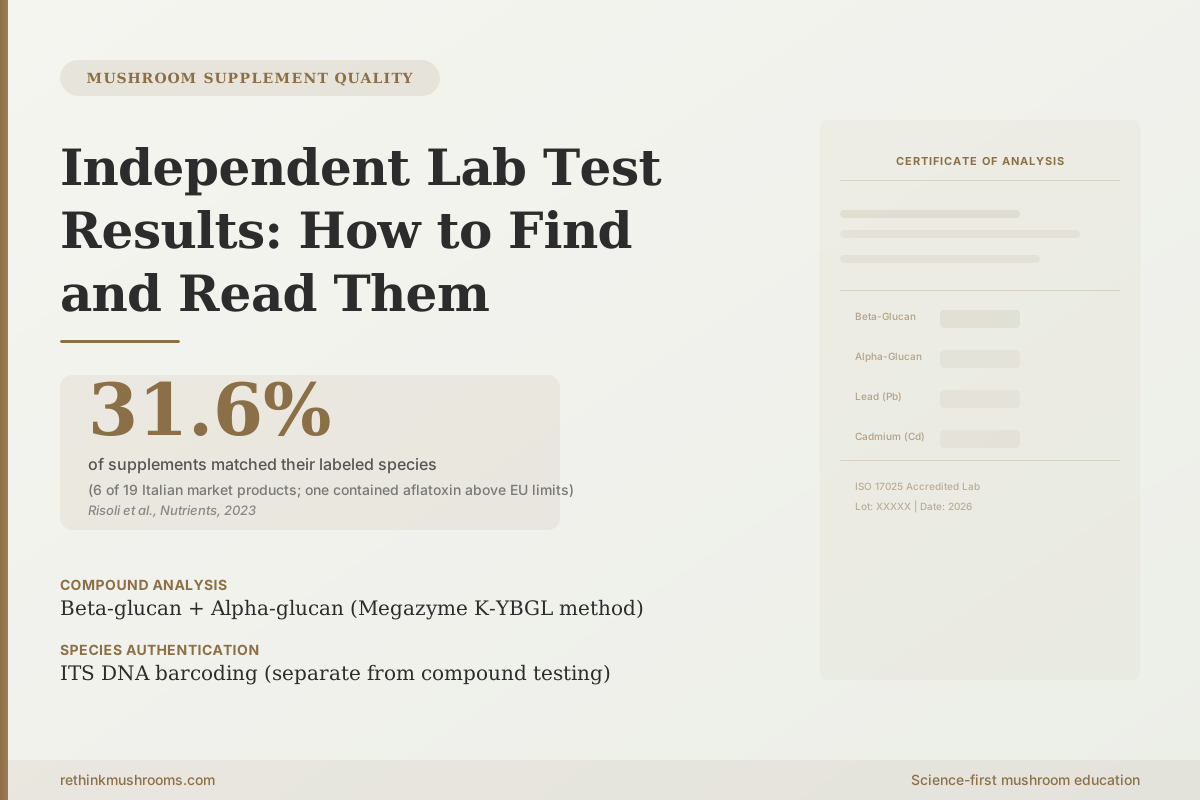
31.6% of supplements matched their label
Only 6 of 19 Italian mushroom supplement samples matched the species stated on the label. One product contained aflatoxins exceeding European Commission legal limits. A COA tells you what's actually in the capsule — if you know how to read it.
Risoli et al., Nutrients, 2023
2 tests
needed: compound analysis AND DNA species authentication — one cannot replace the other
Alpha-glucan
the starch column on a COA that reveals mycelium-on-grain products
ISO 17025
the accreditation standard that distinguishes real testing labs from unverifiable ones
Risoli et al., Nutrients, 2023
 View as image ↗
In 2023, Italian researchers opened what they called Pandora's Box: they purchased 19 mushroom supplement products from 6 Italian companies and sent them to an independent laboratory.[7] Only 6 of the 19 samples — 31.6% — contained what the label claimed. One product carried aflatoxin levels exceeding the European Commission's legal safety limits. The problem was not a single rogue manufacturer. It was systemic.
A Certificate of Analysis (COA) is the document that is supposed to prevent exactly this situation. It is a lab report showing what a supplement was found to contain when tested by an independent laboratory. But a COA only means something if you can verify the lab, understand what was tested, and know which columns reveal quality problems. Most buyers see "third-party tested" on a product page and assume the work is done. It is not.
This article is a practical guide to mushroom supplement COA interpretation. It covers what to look for, what each panel means, why species authentication is a separate test from compound analysis, and how to verify that the lab is accredited. It is part of the broader How to Choose a Mushroom Supplement: The Science-Based Buyer's Guide.
Key Takeaways
- Only 31.6% of Italian market mushroom supplements matched their labeled species; one contained aflatoxin exceeding EU legal limits — Risoli et al., Nutrients, 2023
- The most important number on a mushroom COA is the beta-glucan percentage, measured via the validated AOAC enzymatic method (Megazyme K-YBGL) — McCleary & Draga, AOAC International, 2016
- A high alpha-glucan reading on a COA indicates grain starch from mycelium-on-grain substrate — the enzymatic method specifically separates alpha-glucan (starch) from beta-glucan
- Species authentication via ITS DNA barcoding is a separate test from compound analysis — one can pass while the other fails — Gunnels et al., PLOS ONE, 2020
- Wild-harvested mushrooms show elevated lead, cadmium, and mercury compared to cultivated species in Chinese market surveys; the heavy metals panel matters most for wild-sourced products — Liu et al., Journal of Food Science, 2021
- A single analytical test is insufficient — 2025 research on Chaga supplements found major variation between products and confirmed that beta-glucan, species ID, and heavy metals require separate testing methods — Windsor et al., International Journal of Molecular Sciences, 2025
What a Certificate of Analysis Is (And Why the Document Alone Proves Nothing)
A Certificate of Analysis is a lab report documenting that a specific product lot was tested by an independent laboratory, with the results listed. It should show the product name, the lot number tested, the test date, the name and accreditation number of the testing laboratory, and a set of results with measurement values and acceptable ranges.
The COA is the standard of transparency that distinguishes responsible manufacturers from the many that do not test at all. But the document itself has no force. Any PDF can be edited. Any lab name can be fabricated. Any numbers can be typed in. The COA only has meaning when the lab can be independently verified and when you understand which results actually indicate product quality.
A 2024 review of the Chinese commercial mushroom market documented widespread counterfeiting and mislabeling, including the use of lower-grade species sold as premium medicinal mushrooms and the use of non-mushroom fillers.[8] The review found that visual inspection cannot detect adulteration at the ingredient level, and that chemical and molecular testing is necessary to confirm what is actually in a product. This is not a problem isolated to one country. The Risoli 2023 Italian market study shows the same pattern in Europe.[7]
Three things are required for a COA to be meaningful: an accredited lab (verifiable), a complete set of tested markers (not just one), and a product lot number that matches what you bought.
For context on what the scale of the quality problem looks like across markets: The Mushroom Supplement Quality Crisis: Why Most Products Fail.
The Beta-Glucan Column: The Number That Actually Tells You What's in the Capsule
Beta-glucans are the primary bioactive compounds in medicinal mushroom supplements. They are the compounds responsible for the immunomodulating, antitumor, and other documented biological effects of these fungi. A COA that does not report beta-glucan content as a specific percentage is not giving you the critical information.
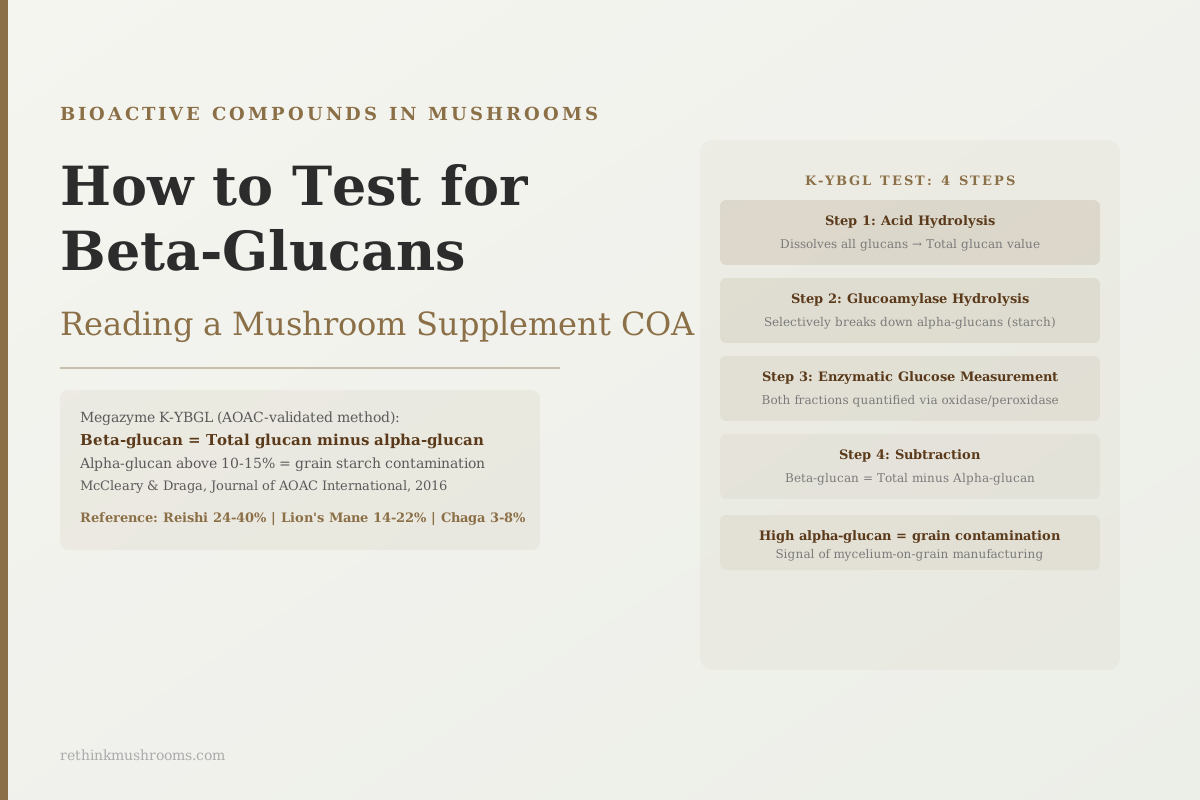
The validated method for measuring beta-glucan in mushroom products is the AOAC enzymatic assay developed by McCleary and Draga, published in the Journal of AOAC International in 2016.[1] The method works in three steps:
First, total glucan content is measured by acid hydrolysis, which breaks all glucan polymers (both alpha and beta forms) into free glucose units that can be quantified.
Second, alpha-glucan content is measured separately using glucoamylase, an enzyme that specifically breaks down alpha-glucan (the form found in starch and glycogen) into glucose. The glucose released by glucoamylase = alpha-glucan content.
Third, beta-glucan content is calculated by subtraction: total glucan minus alpha-glucan equals beta-glucan.
This distinction matters enormously for mushroom supplements. Starch is an alpha-glucan. A product made from mycelium grown on grain (oats, rice, or wheat) contains significant starch from the grain substrate that never gets fully separated from the mushroom material. That starch shows up as alpha-glucan in the test. A product labeled "40% polysaccharides" could contain 35% starch (alpha-glucan) and only 5% actual beta-glucan.
Kanno and colleagues in 2020 developed an alternative protein-based beta-glucan quantification method and compared it to the enzymatic approach.[9] The results correlated but differed systematically between methods. This has a practical implication: a COA that reports "beta-glucan: 30%" without stating which method was used is an incomplete document. Beta-glucan percentages from different testing methods are not always directly comparable. The COA should specify the method, and the standard reference for mushroom supplements is the Megazyme K-YBGL enzymatic assay (the McCleary method).
For a deeper explanation of how beta-glucan testing works and what the percentages mean: How Beta-Glucan Testing Works: Megazyme and Other Methods. For what good beta-glucan percentages look like by species: Beta-Glucan Percentages on Labels: What the Numbers Mean.
The Alpha-Glucan Column: The Starch Signal That Most Buyers Miss
Most consumers who look at a mushroom supplement COA look at the beta-glucan row and stop there. The alpha-glucan row is the one that reveals the most important quality problem in the market.
Alpha-glucan in a mushroom supplement comes primarily from two sources: naturally occurring glycogen in the mushroom tissue (a small amount, present in all fungi), and starch from grain substrate when the product is made from mycelium grown on oats, rice, or wheat.
A fruiting body product has low alpha-glucan. A mycelium-on-grain product has high alpha-glucan. The McCleary enzymatic method specifically measures and separates these, which is why a properly executed COA using this method will show both numbers.[1]
How to Read a COA
The K-YBGL Subtraction, and What the Alpha-Glucan Column Reveals
Reading the alpha-glucan value
Fruiting body or cleanly processed mycelium
Wood substrates contain no digestible starch; endogenous mushroom glycogen is low.
Meaningful grain starch present
Indicates a mycelium-on-grain product where substrate was not fully separated.
Substantial substrate contamination
Most of the reported "glucan" is starch regardless of the beta-glucan figure shown alongside it.
A COA that reports only "polysaccharides %" or a single "beta-glucan %" without the alpha-glucan breakdown cannot tell you how much of that number is active compound versus grain starch.
Method: McCleary & Draga (2016), J. AOAC International — Megazyme K-YBGL assay
 View as image ↗
Practical interpretation:
- Alpha-glucan under 5%: normal for a fruiting body or liquid fermentation mycelium product
- Alpha-glucan 10-20%: elevated; potentially a mixed product or mycelium on a small amount of grain substrate
- Alpha-glucan above 20%: characteristic of a mycelium-on-grain product where significant grain starch remains
A COA that reports only total polysaccharides — without the alpha-glucan/beta-glucan breakdown — cannot be used to answer the most important quality question. It is the equivalent of a blood test that reports only total white blood cells without distinguishing which type.
For the full label-reading context: What to Look for on a Mushroom Supplement Label.
Species Authentication: The DNA Test That Compound Analysis Cannot Replace
Measuring beta-glucan content tells you how much bioactive compound is in a product. It does not tell you which species the mushroom material came from. That is a separate question requiring a separate test.
Loyd and colleagues in 2018 applied DNA-based species identification to commercial reishi (Ganoderma lucidum) supplements sold in the United States.[3] Products labeled as Ganoderma lucidum — the specific medicinal species from which most reishi research data comes — were found to contain other Ganoderma species with different bioactive compound profiles. The products could have passed a beta-glucan quantification test while still being mislabeled at the species level.
Gunnels and colleagues in 2020 validated the specific method used for this type of authentication: ITS (internal transcribed spacer) DNA barcoding.[2] The ITS region is a short stretch of ribosomal DNA that varies between fungal species but is conserved within species, making it a reliable genetic barcode. The team confirmed ITS barcoding reliably distinguishes Ganoderma species in processed herbal supplement material, where the mushroom DNA has been dried, extracted, and encapsulated. This is important because DNA can degrade during processing; the Gunnels validation confirms ITS barcoding still works on finished supplement products.
The practical takeaway: a COA showing only beta-glucan content does not tell you whether the species on the label is the species in the capsule. The best supplement COA documentation includes both a compound analysis report and a separate DNA authentication result. These are often presented as two different documents from two different tests, sometimes by different labs.
Not all supplement brands provide DNA authentication. Its absence is not automatically a disqualifying red flag, but its presence is meaningful evidence of quality commitment. The Risoli 2023 Italian market study, which found 68.4% species mislabeling, used both chemical and DNA methods to reach its conclusions — the species failures could not have been detected by compound testing alone.[7]
Heavy Metals: What the Contamination Panel Should Show
Medicinal mushrooms accumulate heavy metals from their growing substrate and environment. Cultivated mushrooms grown on controlled substrates (agricultural waste, wood pellets, straw) have lower contamination risk than wild-harvested mushrooms, but both require testing.
Liu and colleagues in 2021 measured lead, cadmium, mercury, and arsenic in both cultivated and wild-grown mushrooms from China.[5] Some wild-harvested species exceeded safety thresholds for cadmium — a heavy metal that bioaccumulates in kidney tissue with long-term exposure. Cadmium bioaccumulation is particularly pronounced in wild mushrooms compared to cultivated ones, making the origin of raw material directly relevant to the contamination risk.
Zhu and colleagues in 2011 found similar patterns in wild-harvested mushrooms from Yunnan Province: variable but sometimes elevated lead, cadmium, and mercury, with concentration depending on both species and harvest location.[6] Mushrooms grown in areas with historical industrial activity or agricultural chemical use carry higher baseline contamination.
A complete COA heavy metals panel should list at minimum: lead (Pb), cadmium (Cd), mercury (Hg), and arsenic (As). The panel should compare measured values to an established reference standard — USP limits, California Proposition 65 limits, or the testing lab's own validated limits — and indicate whether the product passes.
The Windsor 2025 study on commercial Chaga supplements reinforces this point from a different angle.[4] Chaga (Inonotus obliquus) is a wild-harvested mushroom by nature. The researchers analyzed multiple commercial Chaga products using complementary methods — beta-glucan, betulin content, melanin content, and DNA authentication — and found major variation between products. The study also found that no single analytical method was sufficient to characterize Chaga quality: a product could pass beta-glucan testing while failing species authentication. For wild-harvested mushrooms especially, heavy metals testing is not optional.
For a comprehensive look at heavy metals research in mushroom supplements: Heavy Metals in Mushroom Supplements: Lead, Cadmium, and Arsenic Testing Results.
ISO 17025: What Lab Accreditation Means and How to Verify It
ISO 17025 is the international standard for the competence of testing and calibration laboratories. A lab with ISO 17025 accreditation has been assessed by an independent accreditation body to confirm it meets requirements for technical competence, measurement accuracy, personnel qualifications, equipment calibration, and test method validation.
The accreditation matters because without it, there is no external verification that the lab's methods are valid, its equipment is accurate, or its staff is qualified to conduct the tests they report.
How to verify ISO 17025 accreditation for a specific lab:
- Find the accreditation number. This should be on the COA document itself, often in the header or footer.
- Go to the website of the international body that oversees laboratory accreditation in the relevant country. In the US, the primary bodies are A2LA (American Association for Laboratory Accreditation) and ANAB (ANSI National Accreditation Board). Both have searchable online databases.
- Enter the accreditation number or the lab name and confirm that the lab is currently accredited and that its accreditation covers the specific tests shown on the COA (beta-glucan, heavy metals, etc.).
Red flags on a COA that warrant further investigation:
- No laboratory name, just a generic lab code
- No accreditation number
- Accreditation body is not a recognized national or ILAC-MRA member body (ILAC is the International Laboratory Accreditation Cooperation — its MRA member list is publicly available)
- The lot number on the COA does not match the lot number on the product packaging
- Test date is more than 12 months old
- Results show round numbers throughout (e.g., exactly 30.0% beta-glucan, exactly 0.00 heavy metals) without any decimal variation — real test results typically have variation in the final digits
Reading a Mushroom Supplement COA: A Six-Point Checklist
The following framework covers the minimum evaluation before accepting a COA as meaningful evidence of product quality.
1. Locate the COA. It should be available on the brand's website (ideally searchable by lot number or QR code on the label), not just upon request. If a brand requires you to email for a COA, treat this as a weak signal — transparent brands publish test results proactively.
2. Verify the lab's ISO 17025 accreditation. Using the lab's name and accreditation number, search the relevant national accreditation database (A2LA, ANAB, UKAS for UK, etc.). Confirm the lab is currently accredited and that the accreditation scope covers mushroom product testing.
3. Check the beta-glucan column. Look for a specific beta-glucan percentage, not just total polysaccharides. Confirm the testing method is stated (Megazyme K-YBGL or equivalent enzymatic method). If only polysaccharides are reported without the beta-glucan breakdown, the COA does not show the most important number.
4. Check the alpha-glucan column. High alpha-glucan (above 10–15%) indicates grain starch from mycelium-on-grain substrate. This is the most actionable signal for detecting a low-quality product. A fruiting body product should have low alpha-glucan.
5. Review the heavy metals panel. Confirm the panel covers lead, cadmium, mercury, and arsenic. Check that values are compared to a stated reference limit and that the product passes. For wild-harvested mushrooms (chaga, wild reishi, wild lion's mane), this panel carries extra weight.
6. Confirm the lot number. The lot number on the COA should match the lot number printed on your product's label or packaging. If the lot numbers do not match, the COA tested a different production run than the product you received.
For a complete overview of what every label signal means before you reach the COA stage: 7 Red Flags in Mushroom Supplements: What to Avoid.
The Bottom Line
A Certificate of Analysis is the primary tool for evaluating mushroom supplement quality, but it only works when you know which columns matter. The beta-glucan and alpha-glucan breakdown (McCleary enzymatic method) is the most actionable compound panel: it reveals mycelium-on-grain starch contamination directly. Species authentication via ITS DNA barcoding is a separate test that checks species identity rather than compound concentration — one Italian market survey found 68% of products mislabeled at the species level. A complete quality evaluation requires both tests, a heavy metals panel, and verification that the testing laboratory holds ISO 17025 accreditation.
Frequently Asked Questions
Sources & References
- 1RTHM-00438·McCleary, Barry V et al. (2016). “Measurement of β-Glucan in Mushrooms and Mycelial Products..” Journal of AOAC International.Study breakdown →PubMed →↩
- 2RTHM-00615·Gunnels, Tess et al. (2020). “The ITS region provides a reliable DNA barcode for identifying reishi/lingzhi (Ganoderma) from herbal supplements..” PloS one.Study breakdown →PubMed →↩
- 3RTHM-00981·Loyd, Andrew L et al. (2018). “Identifying the "Mushroom of Immortality": Assessing the Ganoderma Species Composition in Commercial Reishi Products..” Frontiers in microbiology.Study breakdown →PubMed →↩
- 4RTHM-02209·Windsor, Coleton et al. (2025). “What This 2025 Chaga Supplement Authentication Study Actually Found.” International journal of molecular sciences.Study breakdown →PubMed →↩
- 5RTHM-00705·Liu, Sijie et al. (2021). “Pollution level and risk assessment of lead, cadmium, mercury, and arsenic in edible mushrooms from Jilin Province, China..” Journal of food science.Study breakdown →PubMed →↩
- 6RTHM-00242·Zhu, Fangkun et al. (2011). “Assessment of heavy metals in some wild edible mushrooms collected from Yunnan Province, China..” Environmental monitoring and assessment.Study breakdown →PubMed →↩
- 7RTHM-01778·Risoli, Samuele et al. (2023). “Mushroom-Based Supplements in Italy: Let's Open Pandora's Box..” Nutrients.Study breakdown →PubMed →↩
- 8RTHM-01935·Liu, Jinlin et al. (2024). “The Situation of Counterfeited and Mislabeled Commercialized Edible Mushrooms in China and the Development of Possible Controls..” Foods (Basel.Study breakdown →PubMed →↩
- 9RTHM-00625·Kanno, Takashi et al. (2020). “Quantification of β-Glucan from Culinary-Medicinal Mushrooms Using Novel Artificial β-Glucan Recognition Protein..” International journal of medicinal mushrooms.Study breakdown →PubMed →↩