Mushroom Coffee
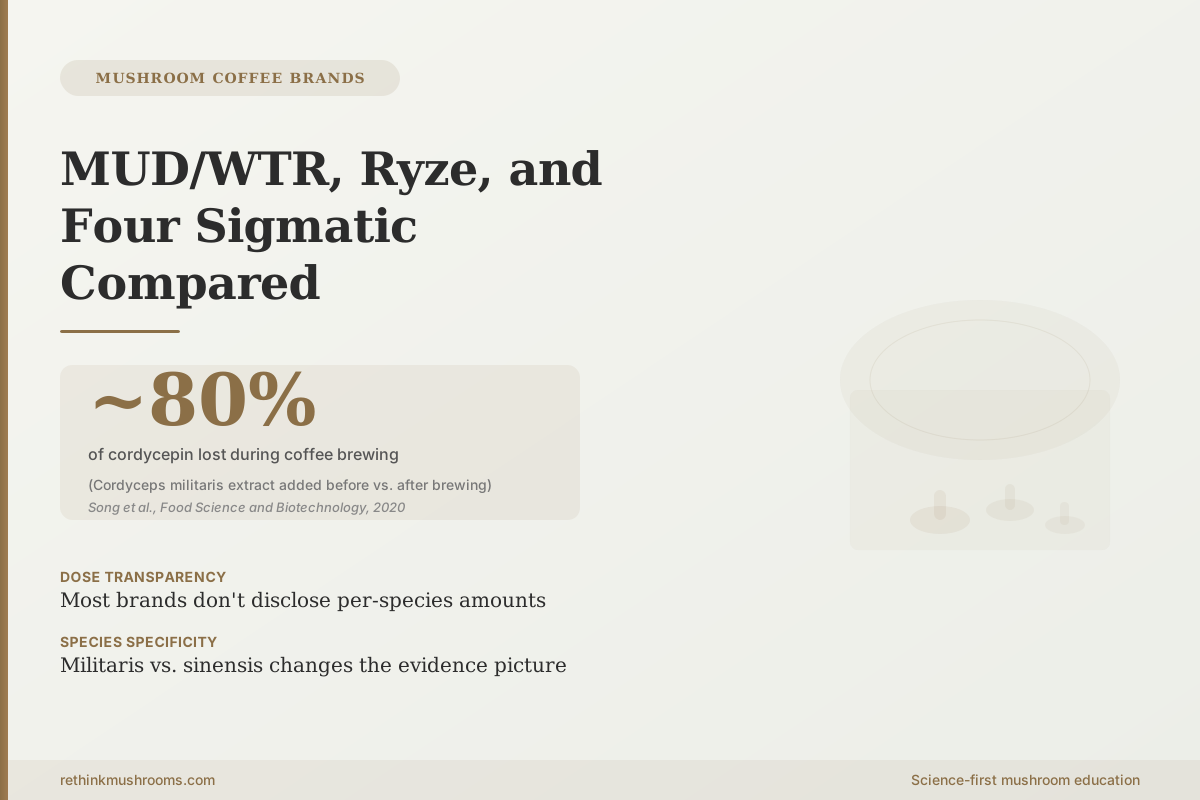
~80% cordycepin lost during coffee processing
Coffee processing reduces cordycepin content by approximately 80% compared to raw Cordyceps mushrooms. Beta-glucan drops 50-75%. Here is what that means for the three most popular mushroom coffee brands, and how to evaluate what you're actually getting.
Song, Preventive Nutrition and Food Science, 2020
2 RCTs
tested mushroom beverages specifically; most brand claims rest on capsule/tablet trial data
Reishi + caffeine
a combination no clinical trial has directly tested; Reishi promotes sleep via serotonin (Yao 2021)
2026 RCT
first double-blind trial on a mushroom blend for stress, fatigue, and sleep (Hisamuddin 2026)
Song, Preventive Nutrition and Food Science, 2020
 View as image ↗
The mushroom coffee category exists because the underlying research is real. Lion's Mane does appear to affect cognition in randomized trials. Cordyceps does improve exercise tolerance in some clinical studies. The evidence is not fiction. The question for any specific product is more granular: does this beverage, in this form, at this dose, deliver any of what the research demonstrates?
A 2020 study that actually analyzed a finished Cordyceps coffee product found cordycepin — one of Cordyceps militaris's primary bioactive compounds — was reduced by approximately 80% compared to raw mushroom extract during coffee processing.[3] Beta-glucan content dropped 50–75%. The researchers at Preventive Nutrition and Food Science developed their own functional Cordyceps coffee and measured what survived the brewing and processing steps. The answer: much less than in the raw mushrooms.
No competitor review of MUD/WTR, Ryze, or Four Sigmatic has applied this finding to the brand analysis. This one will. For broader context on what mushroom coffee is and how the category works, see Mushroom Coffee: What Is It and Does It Actually Work?.
Key Takeaways
- Coffee processing reduces cordycepin by approximately 80% and beta-glucan by 50-75% compared to raw Cordyceps mushrooms. This is the most important processing fact most reviews omit. Source: Song, Preventive Nutrition and Food Science, 2020
- The only peer-reviewed trial testing a Cordyceps-containing beverage (not capsules) showed immune effects at a disclosed dose. Source: Ontawong et al., Scientific Reports, 2024
- Two independent RCTs found Lion's Mane produced cognitive effects in healthy adults at doses substantially above what mushroom coffee products typically disclose. Sources: Surendran et al., Frontiers in Nutrition, 2025; Docherty et al., Nutrients, 2023
- Reishi promotes sleep via gut microbiota-dependent serotonin pathways in animal models, making it pharmacologically at odds with caffeine in the same product. Source: Yao et al., Scientific Reports, 2021
- A 2026 double-blind RCT on a mushroom blend found measurable adaptogenic effects for stress, fatigue, and sleep, providing the closest clinical benchmark for mushroom coffee brand claims. Source: Hisamuddin et al., Brain and Behavior, 2026
- Chaga's high oxalate content is a documented safety consideration for daily consumption. Source: Fordjour et al., Frontiers in Pharmacology, 2023
The Evidence Framework: What Would a Mushroom Coffee Need to Deliver Its Claims?
Before comparing brands, the scientific framework needs to be established. Three questions matter for any mushroom coffee product:
1. What survives processing? Song's 2020 analysis showed that coffee processing significantly degrades heat-sensitive bioactives. A 2024 direct analysis by Kała and colleagues of Cordyceps militaris and Lion's Mane coffee products found detectable levels of indole compounds, phenolic acids, and sterols in the finished coffee — evidence that some bioactives do survive.[2] A 2025 systematic review specifically covering medicinal mushroom applications in functional beverages noted that compound stability in food matrices depends on pH, temperature, and the presence of other compounds.[1] Some compounds survive processing better than others. But the baseline assumption — that raw mushroom extract bioactivity transfers fully to a finished coffee product — is not supported by the data.
2. What dose does the evidence use? Clinical trials use specific doses, and those doses are the benchmark for any commercial product. The Cordyceps beverage RCT from Ontawong and colleagues in 2024 tested an actual liquid-format Cordyceps product and found immune effects — the only peer-reviewed study using a beverage format rather than capsules, and the closest available analog to what mushroom coffee consumers are actually drinking.[11] Most brand claims rest on capsule and tablet trial data, not beverage-format data.
3. Is the dose disclosed? Most brands use proprietary blends that list mushrooms without specifying how much of each. A product can list six mushrooms and provide 50mg of each in a combined 300mg blend. Without dose disclosure, it is impossible to know whether the amount used falls within the range tested in clinical trials.
The Species-by-Species Evidence
Lion's Mane: The Strongest Clinical Case
Lion's Mane (Hericium erinaceus) has the most robust clinical evidence of any mushroom in the coffee category.
Surendran and colleagues in 2025 tested a standardized Lion's Mane extract on cognition and mood in healthy younger adults in a double-blind placebo-controlled design.[4] Acute cognitive effects were found — this is the most relevant population for typical mushroom coffee consumers, and 2025 is the most recent data available. Docherty and colleagues in 2023 found similar results in 41 healthy adults aged 18–45: participants completed cognitive tasks faster after a single dose, though stress reduction after 28 days did not reach statistical significance.[5]
The case for Lion's Mane effects on cognition in healthy adults is supported by two RCTs. Whether mushroom coffee servings deliver enough Lion's Mane in a bioavailable enough form after processing to replicate these effects is the question brands do not answer. For the specific compounds driving Lion's Mane's brain effects: Hericenones and Erinacines: Lion's Mane's Brain-Boosting Compounds.
Cordyceps: Energy Claims and the Honest Null Result
Cordyceps militaris has clinical support for energy and exercise performance claims. Hirsch and colleagues in 2017 found that Cordyceps militaris supplementation improved tolerance to high-intensity exercise and produced higher VO2max values after three weeks compared to placebo.[6]
Species identity matters here. Hirsch 2017 tested Cordyceps militaris specifically. Research on other Cordyceps species, including Cordyceps sinensis, has produced more mixed results. Products that list only "Cordyceps" without naming the species prevent consumers from assessing which study population their product matches.
The Ontawong 2024 beverage RCT provides the most directly relevant evidence for mushroom coffee evaluation: it tested an actual Cordyceps militaris beverage (not capsules) for immune effects in healthy adults and found measurable immune marker changes.[11] This is the only peer-reviewed trial in which the delivery format — a drinkable liquid — mirrors how mushroom coffee is consumed. For a full breakdown of Cordyceps energy evidence: Cordyceps for Fatigue: Clinical Evidence on Energy Levels.
Reishi in Coffee: A Pharmacological Puzzle
Reishi (Ganoderma lucidum) has good evidence for stress reduction. Mitra and colleagues in 2024 ran an RCT on Reishi supplementation for psychological stress in college students and found improvements in stress markers at 1,000mg/day.[8]
But there is a pharmacological question that no competitor raises. Yao and colleagues in 2021 demonstrated in mice that Reishi promotes sleep via a gut microbiota-dependent pathway that involves serotonin signaling.[7] Serotonin-mediated sedation and caffeine's adenosine-blocking stimulation pull the nervous system in opposite directions. Whether these mechanisms cancel each other out, interact, or produce some intermediate effect in humans has not been tested. Products that include Reishi in a caffeinated morning beverage are combining a sleep-promoting compound with a wakefulness-promoting one. This may still be beneficial, it may be neutral, or it may reduce the effectiveness of both. The research does not answer this question.
Chaga: The Antioxidant Claim and the Oxalate Consideration
Chaga (Inonotus obliquus) has documented antioxidant, anti-inflammatory, and antiviral properties reviewed in a 2023 Frontiers in Pharmacology paper by Fordjour and colleagues.[10] The evidence base is primarily preclinical (animal and lab studies), with limited human trial data.
The Fordjour review also notes Chaga's high oxalate content as a safety consideration. Oxalates are compounds that bind with calcium to form kidney stones in susceptible individuals. Daily Chaga consumption, which would occur with a daily mushroom coffee habit, is a relevant exposure level. For people with kidney disease or a history of calcium oxalate kidney stones, daily Chaga in any format warrants awareness.
MUD/WTR: The Coffee Alternative
MUD/WTR is not mushroom coffee in the traditional sense. It is a coffee alternative built on a cacao and masala chai base, with approximately 35–40mg of caffeine per serving from black tea (compared to 150–200mg in a standard cup of coffee). Its mushroom blend typically includes Lion's Mane, Chaga, Reishi, and Cordyceps.
The brand makes adaptogenic and "calm energy" claims. Evaluating those claims against the evidence:
The Reishi-caffeine paradox applies here. MUD/WTR includes Reishi in a caffeinated product. The lower caffeine level compared to coffee may reduce the pharmacological conflict documented above, but the question remains open.
Dose transparency is limited. MUD/WTR has not typically disclosed individual mushroom dose amounts per serving. The 2026 double-blind RCT on a mushroom blend for stress, fatigue, and sleep (Hisamuddin et al.) provides the closest clinical analog for MUD/WTR's adaptogenic claims. That trial used a specific dose; MUD/WTR's comparable dose is not publicly verifiable.[9]
Chaga is present. For daily users with kidney concerns, the oxalate content note from Fordjour 2023 applies.
Ryze: The Volume Leader
Ryze discloses a total mushroom blend weight of 1,500mg per serving across six mushroom species: Lion's Mane, Cordyceps, Reishi, Shiitake, Turkey Tail, and King Trumpet. It uses real Arabica coffee as the base.
1,500mg spread across six species averages 250mg per species if distributed equally. Whether the distribution is equal, or weighted toward certain species, is not publicly disclosed.
The Ryze approach of disclosing total blend weight is more transparent than brands that use proprietary blends with no weight disclosure at all. But total blend weight across six species is a different and less informative number than individual species doses. Both RCTs finding Lion's Mane cognitive effects in healthy adults (Surendran 2025, Docherty 2023) used doses substantially higher than 250mg per serving would imply even if all 1,500mg went to Lion's Mane alone.
The processing factor also applies. Ryze uses real coffee, meaning the Song 2020 processing degradation findings are directly relevant: the bioactives in the mushroom extract added to the coffee may be further reduced during the brewing process.
For the quality question of fruiting body versus mycelium content across mushroom coffee brands: Fruiting Body vs. Mycelium: The Great Mushroom Supplement Debate.
Four Sigmatic: The Category Pioneer
Four Sigmatic, founded in Finland in 2012, created the commercial mushroom coffee category. The brand has diversified into multiple product lines: Think (Lion's Mane focus), Perform (Cordyceps energy), and Defend (Chaga immunity), each with different mushroom combinations and caffeine levels.
Four Sigmatic has been more transparent on dosing than many competitors. Certain products disclose 250mg of a specific mushroom per serving. Some product lines specify dual-extracted fruiting bodies, which addresses the quality concern about grain-grown mycelium substrate.
The 250mg per serving in some Four Sigmatic products still falls below the clinical trial doses. The Surendran 2025 RCT on acute cognitive effects of Lion's Mane in healthy adults provides the most optimistic benchmark: if acute effects occur at lower doses in healthy adults, 250mg might be relevant.[4] The dose used in Surendran et al. should be compared against any product's specific disclosed amount.
The Kała 2024 compositional analysis of Cordyceps + Lion's Mane coffee products found detectable bioactives in finished mushroom coffee, which is consistent with what Four Sigmatic's approach would predict: dual-extracted fruiting bodies provide more bioactives going in, so more survive processing.[2]
The Dose Transparency Gap: What All Three Brands Share
All three brands face the same fundamental evaluation problem: the research establishing beneficial effects of these mushrooms used specific doses, and most products either do not disclose specific doses or disclose doses below clinical thresholds.
The Hisamuddin 2026 double-blind RCT, the most methodologically rigorous trial yet on a mushroom blend for adaptogenic claims, provides the most clinically relevant benchmark for mushroom coffee brand claims.[9] That trial tested a specific mushroom blend at a specific dose for stress, fatigue, and sleep in humans. Brands making adaptogenic claims without disclosing whether their product reaches that dose are making claims that cannot be externally verified.
This is not fraud. Many supplement brands operate this way and within regulatory limits. It is a transparency gap that makes evidence-based evaluation of specific products difficult.
What can be evaluated without individual dose disclosure:
- Which species are present: brands that specify militaris (not sinensis) for Cordyceps are more likely to produce effects consistent with the positive trial data
- Whether extraction method is disclosed: dual-extracted fruiting bodies retain more bioactives than raw powder or mycelium-on-grain biomass
- Whether the total mushroom content per serving is disclosed: a total weight of 250mg across five mushrooms is different from 1,500mg total
- Whether Chaga is present in a daily product: relevant for anyone with kidney history
For a broader look at what to demand from supplement labels: Do Mushroom Coffee Products Have Enough Mushroom to Matter?.
The Bottom Line
MUD/WTR, Ryze, and Four Sigmatic each build their products around mushrooms with real clinical evidence — primarily Lion's Mane for cognition, Cordyceps for energy and exercise, Reishi for stress, and Chaga for antioxidant effects. Coffee processing degrades bioactive content substantially versus raw mushrooms, and most products operate at doses below clinical trial thresholds. The primary evaluation criteria are dose transparency, species specificity (militaris vs. sinensis for Cordyceps), and extraction method. The pharmacological question of Reishi in caffeinated products — Reishi promotes sleep via serotonin, caffeine promotes wakefulness via adenosine — has not been studied in humans and applies to all three brands.
Frequently Asked Questions
Sources & References
- 1RTHM-02215·Yang, Jing-Ya et al. (2025). “Innovative applications of medicinal mushrooms in functional foods and nutraceuticals: a focus on health-boosting beverages..” Frontiers in cellular and infection microbiology.Study breakdown →PubMed →↩
- 2RTHM-00882·Kała, Katarzyna et al. (2024). “Coffee with Cordyceps militaris and Hericium erinaceus Fruiting Bodies as a Source of Essential Bioactive Substances..” Pharmaceuticals (Basel.Study breakdown →PubMed →↩
- 3RTHM-00656·Song, Hyo-Nam (2020). “Functional Cordyceps Coffee Containing Cordycepin and β-Glucan..” Preventive nutrition and food science.Study breakdown →PubMed →↩
- 4RTHM-00952·Surendran, Geyan et al. (2025). “Acute effects of a standardised extract of Hericium erinaceus (Lion's Mane mushroom) on cognition and mood in healthy younger adults: a double-blind randomised placebo-controlled study..” Frontiers in nutrition.Study breakdown →PubMed →↩
- 5RTHM-00821·Docherty, Sarah et al. (2023). “The Acute and Chronic Effects of Lion's Mane Mushroom Supplementation on Cognitive Function, Stress and Mood in Young Adults: A Double-Blind, Parallel Groups, Pilot Study..” Nutrients.Study breakdown →PubMed →↩
- 6RTHM-00473·Hirsch, Katie R et al. (2017). “Cordyceps militaris Improves Tolerance to High-Intensity Exercise After Acute and Chronic Supplementation..” Journal of dietary supplements.Study breakdown →PubMed →↩
- 7RTHM-00731·Yao, Chunyan et al. (2021). “Ganoderma lucidum promotes sleep through a gut microbiota-dependent and serotonin-involved pathway in mice..” Scientific reports.Study breakdown →PubMed →↩
- 8RTHM-00895·Mitra, Sudeep et al. (2024). “Efficacy of Lingzhi or Reishi Medicinal Mushroom Ganoderma lucidum (Agaricomycetes) Supplementation on Psychological Stress and Selective Fitness Profile Parameters in Female College Students in West Bengal, India..” International journal of medicinal mushrooms.Study breakdown →PubMed →↩
- 9RTHM-00959·Hisamuddin, Ahmad Safiyyu'd-Din et al. (2026). “Adaptogenic Effects of Mushroom Blend Supplementation on Stress, Fatigue, and Sleep: A Randomised, Double-Blind, and Placebo-Controlled Trial..” Brain and behavior.Study breakdown →PubMed →↩
- 10RTHM-01694·Fordjour, Eric et al. (2023). “Chaga mushroom: a super-fungus with countless facets and untapped potential..” Frontiers in pharmacology.Study breakdown →PubMed →↩
- 11RTHM-00899·Ontawong, Atcharaporn et al. (2024). “A randomized controlled clinical trial examining the effects of Cordyceps militaris beverage on the immune response in healthy adults..” Scientific reports.Study breakdown →PubMed →↩