Lion's Mane Bioactive Compounds
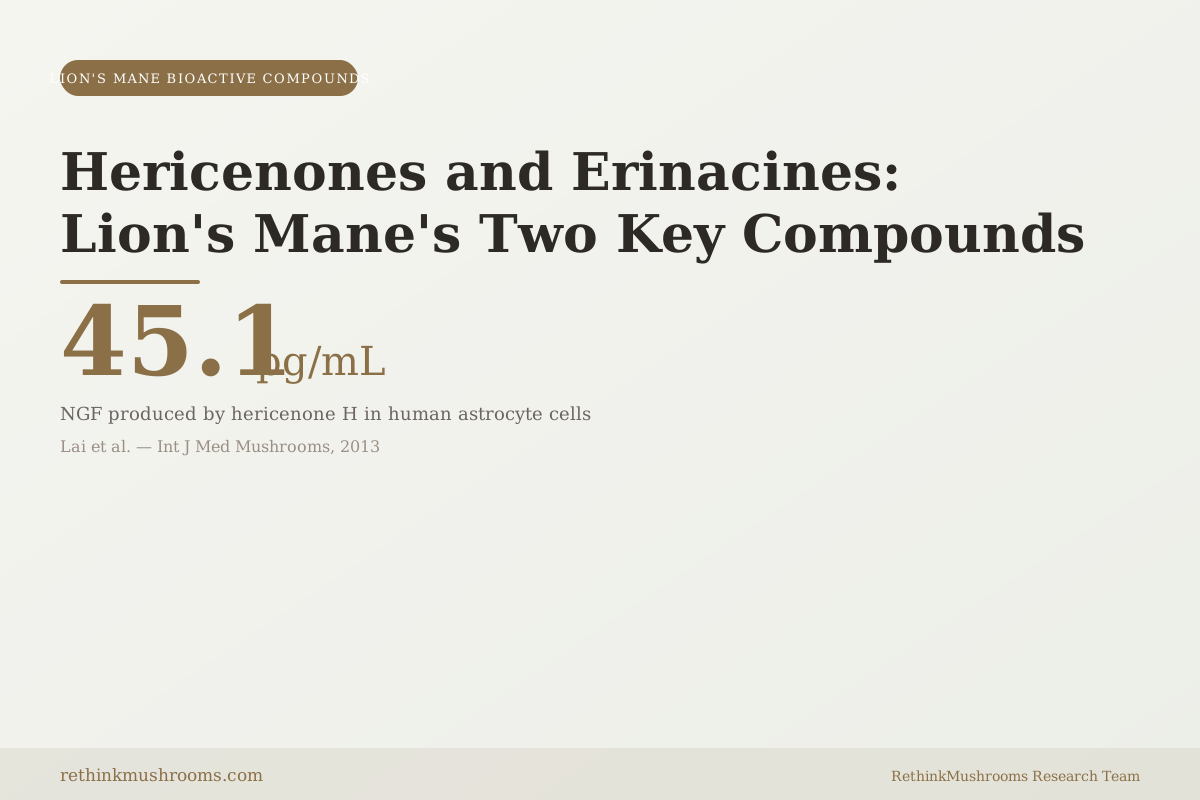
45.1 pg/mL
Hericenone H, the most potent single hericenone measured, produced 45.1 pg/mL of nerve growth factor in astrocyte cells. Combined with low-dose NGF, it matched the neurite outgrowth effect of 50 ng/mL NGF protein alone.
Lai et al., Int J Med Mushrooms, 2013
Fruiting body
where hericenones are found; the meroterpenoid compound class is fruiting-body exclusive (Friedman, 2015)
Mycelium
where erinacines are found; the cyathane diterpenoid compound class is mycelium-exclusive (Friedman, 2015)
Both BBB-penetrant
both compound classes cross the blood-brain barrier by passive diffusion due to low molecular weight
Lai et al., Int J Med Mushrooms, 2013
 View as image ↗
In 2009, Mori and colleagues ran a 16-week double-blind, placebo-controlled trial giving lion's mane or placebo to 30 patients with mild cognitive impairment.[3] The lion's mane group showed significantly improved cognitive scores at weeks 8, 12, and 16 (p less than 0.001). When supplementation stopped, the improvement reversed. The trial established that something in lion's mane measurably affects cognition in humans, but it didn't identify which compounds were responsible.
The answer is two compound classes with different sources, different structures, and partially different mechanisms: hericenones, found exclusively in the fruiting body, and erinacines, found exclusively in the mycelium. Understanding what each does is essential for evaluating any lion's mane supplement, because a fruiting body product and a mycelium product deliver fundamentally different chemistry to the brain.
For the broader landscape of bioactive compounds across medicinal mushrooms, beta-glucans and other key mushroom bioactives covers the full spectrum. For the therapeutic implications of lion's mane NGF research, lion's mane and nerve growth factor: the complete research guide covers the NGF angle in depth.
Key Takeaways
- Mori et al. (2009, Phytotherapy Research, n=30) found lion's mane significantly improved cognitive scores vs. placebo at weeks 8, 12, and 16 (p less than 0.001) in MCI patients; improvements reversed after stopping supplementation, suggesting effects require continued compound presence.
- Friedman (2015, JAFC) established the compound taxonomy: hericenones A-H are meroterpenoids exclusive to fruiting bodies; erinacines A-I and beyond are cyathane diterpenoids exclusive to mycelium. Both classes are low molecular weight and cross the blood-brain barrier by passive diffusion.
- Lai et al. (2013, Int J Med Mushrooms) quantified NGF output: hericenone H produced 45.1 pg/mL and hericenone C produced 23.5 pg/mL in astrocyte cells; combined with low-dose NGF, hericenone-induced neurite outgrowth matched the effect of 50 ng/mL NGF protein.
- Martínez-Mármol et al. (2023, J Neurochemistry) found hericerin derivatives activate a pan-neurotrophic signaling pathway in hippocampal neurons via ERK1/2, independent of NGF protein, updating the mechanism model and explaining direct hippocampal effects not accounted for by the astrocyte-NGF pathway alone.
- Ryu et al. (2021, Scientific Reports) found lion's mane mycelium extracts promoted oligodendrocyte maturation and myelin basic protein expression, identifying a nerve-repair mechanism beyond NGF stimulation via support for nerve fiber insulation.
- Docherty et al. (2025, Front Nutr) found a single dose of standardized lion's mane fruiting body extract improved cognitive processing speed and mood versus placebo in healthy younger adults, suggesting acute as well as chronic cognitive effects.
The Two Compound Classes: Where Each Is Found and Why It Matters
Hericenones and erinacines are structurally unrelated compounds from different parts of the mushroom. This distinction is more important for supplement evaluation than almost anything visible on a product label.
Hericenones are aromatic meroterpenoids, built on a geranyl-resorcinol backbone: an aromatic resorcinol ring with a geranyl terpene side chain attached. Eight distinct hericenones have been isolated and characterized from Hericium erinaceus, designated A through H. They are found exclusively in the fruiting body. Friedman's 2015 comprehensive review in the Journal of Agricultural and Food Chemistry established this tissue distribution definitively.[1]
Erinacines are cyathane diterpenoids, built on a fused 5-6-7 carbon ring system called the cyathane skeleton. More than 15 distinct erinacines have been identified from Hericium erinaceus mycelium, labeled A through K and P through S. They are found exclusively in the mycelium. Chen and colleagues (2017) identified the genomic basis for this: three distinct terpene biosynthesis gene clusters in the H. erinaceus genome encode the cytochrome P450 enzymes responsible for building the cyathane skeleton, and these gene clusters are active in mycelium tissue but not in fruiting bodies.[4]
What this means for supplements:
| Property | Hericenones | Erinacines |
|---|---|---|
| Source | Fruiting body only | Mycelium only |
| Compound class | Meroterpenoids | Cyathane diterpenoids |
| Known compounds | 8 (A through H) | 15+ (A-K, P-S) |
| Primary mechanism | NGF secretion in astrocytes; direct ERK1/2 in hippocampal neurons | Direct BBB penetration; NGF and BDNF synthesis |
| BBB crossing | Yes, passive diffusion | Yes, passive diffusion |
A fruiting body supplement contains hericenones but no erinacines. A mycelium supplement contains erinacines but no hericenones. A full-spectrum preparation containing verified amounts of both fruiting body and mycelium contains both compound classes.
For the hericenone compound library in detail, hericenones A-H: the full fruiting body compound library covers each compound individually. For erinacine chemistry and isolation, isolation and characterization of lion's mane diterpenoids covers the diterpenoid side.
How Hericenones Stimulate Nerve Growth Factor
Hericenones work one step upstream from neurons: they stimulate astrocyte cells (the brain's most abundant support cells) to produce and secrete more nerve growth factor. That NGF then diffuses to nearby neurons and activates their own growth and maintenance programs.
Lai and colleagues (2013) quantified this in 1321N1 human astroglial cells, measuring NGF secretion from individual hericenones.[2] The potency varied by compound: hericenone H produced 45.1 pg/mL of NGF; hericenone C produced 23.5 pg/mL; hericenone D produced 10.8 pg/mL. The fruiting body contains a mixture of all eight hericenones, so the total NGF-inducing activity of a real supplement depends on the ratio of compounds in the preparation.
The downstream signaling from NGF runs through MEK/ERK and PI3K/Akt pathways. When Lai's team combined low-dose NGF (5 ng/mL) with hericenones, the resulting neurite outgrowth matched what 50 ng/mL NGF protein alone would produce. The hericenones were amplifying the effect of the NGF present, not simply substituting for it.
For the NGF mechanism in full detail, hericenone C and NGF synthesis: the key mechanism covers the astrocyte pathway through to neuronal effects.
The 2023 Update: Pan-Neurotrophic Signaling in Hippocampal Neurons
For more than two decades, the astrocyte-mediated NGF secretion model was the accepted explanation for how hericenones affect the brain. A 2023 paper added a second, faster-acting mechanism.
Martínez-Mármol and colleagues published in the Journal of Neurochemistry that hericerin derivatives (structurally related to the hericenones) directly activated a pan-neurotrophic signaling pathway in central hippocampal neurons via ERK1/2 phosphorylation.[7] The key finding: this ERK1/2 activation was independent of NGF protein. The compounds stimulated multiple neurotrophic signaling cascades in hippocampal neurons directly, without requiring the intermediate astrocyte-NGF step.
The team also measured functional outcomes: rodents treated with hericerin derivatives showed improved spatial memory on behavioral tests.
This finding expands the mechanism model in two important ways. First, it provides a pathway that operates directly in neurons rather than through astrocyte intermediaries. Second, it may explain the acute cognitive effects that Docherty et al. (2025) later found in healthy humans after a single dose, effects that are harder to attribute to NGF accumulation over days.
No competitor in the functional mushroom content space has covered this 2023 mechanistic update. The model in current circulation stops at NGF secretion.
How Erinacines Work: From Gut to Brain
Erinacines cross the blood-brain barrier directly and activate neurotrophic pathways inside brain tissue. They don't depend on the astrocyte intermediate step.
Roda and colleagues (2018) provided a systematic review of erinacine activities in Evidence-Based Complementary and Alternative Medicine.[6] Erinacines A, B, C, E, F, H, and I all stimulate NGF synthesis. But their effects extend further: erinacine A reduces amyloid-beta deposition and upregulates insulin-degrading enzyme (which clears amyloid); erinacine E reduces neuropathic pain; erinacine S protects against ischemic brain injury.
Chiu and colleagues (2018) detailed the downstream signaling for erinacine A specifically: it activated the BDNF/PI3K/Akt/GSK-3beta pathway in hippocampal tissue, promoted hippocampal neurogenesis, and produced antidepressant-like behavioral effects in mice.[5] The BDNF (brain-derived neurotrophic factor) activation is significant because BDNF supports neuron survival and synaptic plasticity across more brain regions than NGF does.
Ryu and colleagues (2021) identified a third mechanism from a different angle: lion's mane mycelium extracts promoted oligodendrocyte maturation and increased myelin basic protein expression in cell models.[10] Oligodendrocytes form the myelin sheath around nerve fibers, the insulation that enables fast, reliable electrical signaling. Supporting their maturation is structurally different from NGF or BDNF stimulation, and represents a nerve-repair pathway relevant to conditions involving myelin disruption.
For the pharmacokinetics of how erinacines reach the brain, how erinacines cross the blood-brain barrier covers the evidence. For the clinical implications of erinacines specifically, erinacines: the compounds that cross the blood-brain barrier covers the therapeutic angle.
The Clinical Evidence: Three Human Trials
Three randomized, controlled human trials have tested lion's mane preparations for neurological outcomes.
Mori 2009 (n=30, MCI, 16 weeks): the most-cited trial.[3] Patients received 3g/day of dried H. erinaceus fruiting body. The lion's mane group showed significantly better cognitive scores at weeks 8, 12, and 16 (p less than 0.001 at week 16). At the 4-week post-supplementation assessment, the cognitive advantage had declined toward baseline. The reversal pattern is consistent with a compound maintaining an active process rather than inducing a permanent structural change.
Lee 2020 (early Alzheimer's, 49 weeks): a pilot RCT using erinacine A-enriched mycelium in Frontiers in Aging Neuroscience.[11] The erinacine A group showed improved activities of daily living scores, reduced amyloid-beta deposition on imaging, and improved MMSE cognitive scores compared to placebo at 49 weeks. This is the only RCT using a verified erinacine preparation in a neurodegenerative disease context. It is a small pilot; it establishes direction, not certainty.
Docherty 2025 (healthy young adults, single dose): a double-blind RCT in Frontiers in Nutrition using standardized fruiting body extract.[9] A single dose improved cognitive processing speed and mood relative to placebo. The acute timeframe rules out NGF accumulation as the mechanism and is consistent with the direct ERK1/2 hippocampal pathway that Martínez-Mármol et al. identified.
Phan et al. (2023) in the International Journal of Molecular Sciences synthesized the evidence across both compound classes.[8] Their review documents consistent neurotrophic and neuroprotective evidence, identifies erinacine A as having the clearest BBB penetration data, and notes that the human clinical evidence remains limited but mechanistically coherent.
The Fruiting Body vs. Mycelium Question
The compound split between fruiting body and mycelium is the most practically important detail for supplement evaluation.
A fruiting body supplement contains hericenones (plus beta-glucans and other fruiting body compounds) but no erinacines. A mycelium supplement, if properly sourced and verified, contains erinacines but no hericenones. Full-spectrum preparations containing verified amounts of both can deliver both compound classes.
The qualification matters most on the mycelium side. Many mycelium-on-grain products sold in the US market are substantially grain starch rather than mycelium tissue. The erinacine content in such products is often negligible. A mycelium supplement with certified erinacine content and a CoA documenting the concentration is a different product from an unverified mycelium-on-grain product, regardless of what the label says.
Neither fruiting body nor mycelium is inherently superior. They target overlapping but distinct mechanisms. The Mori 2009 MCI trial used fruiting body. The Lee 2020 Alzheimer's pilot used erinacine-enriched mycelium. Both produced meaningful results in their respective populations. What matters most is whether the specific product contains measurable amounts of the compounds claimed.
The Bottom Line
Two compound classes drive lion's mane's neurological effects: hericenones from the fruiting body, which stimulate NGF secretion in astrocytes and directly activate hippocampal ERK1/2 via a pan-neurotrophic pathway (Martínez-Mármol, 2023); and erinacines from the mycelium, which cross the blood-brain barrier and activate both NGF and BDNF pathways plus oligodendrocyte maturation. Three human RCTs show cognitive improvements with lion's mane preparations across different populations and durations. The 2023 Martínez-Mármol pan-neurotrophic ERK1/2 discovery updates the mechanism model that had been field consensus since the early 2000s, explaining acute cognitive effects that the NGF secretion model alone cannot account for.
Frequently Asked Questions
Sources & References
- 1. Source details for this reference are not yet available.
- 2. Source details for this reference are not yet available.
- 3. Source details for this reference are not yet available.
- 4. Source details for this reference are not yet available.
- 5. Source details for this reference are not yet available.
- 6. Source details for this reference are not yet available.
- 7. Source details for this reference are not yet available.
- 8. Source details for this reference are not yet available.
- 9. Source details for this reference are not yet available.
- 10. Source details for this reference are not yet available.
- 11. Source details for this reference are not yet available.