Lion's Mane Bioactive Compounds
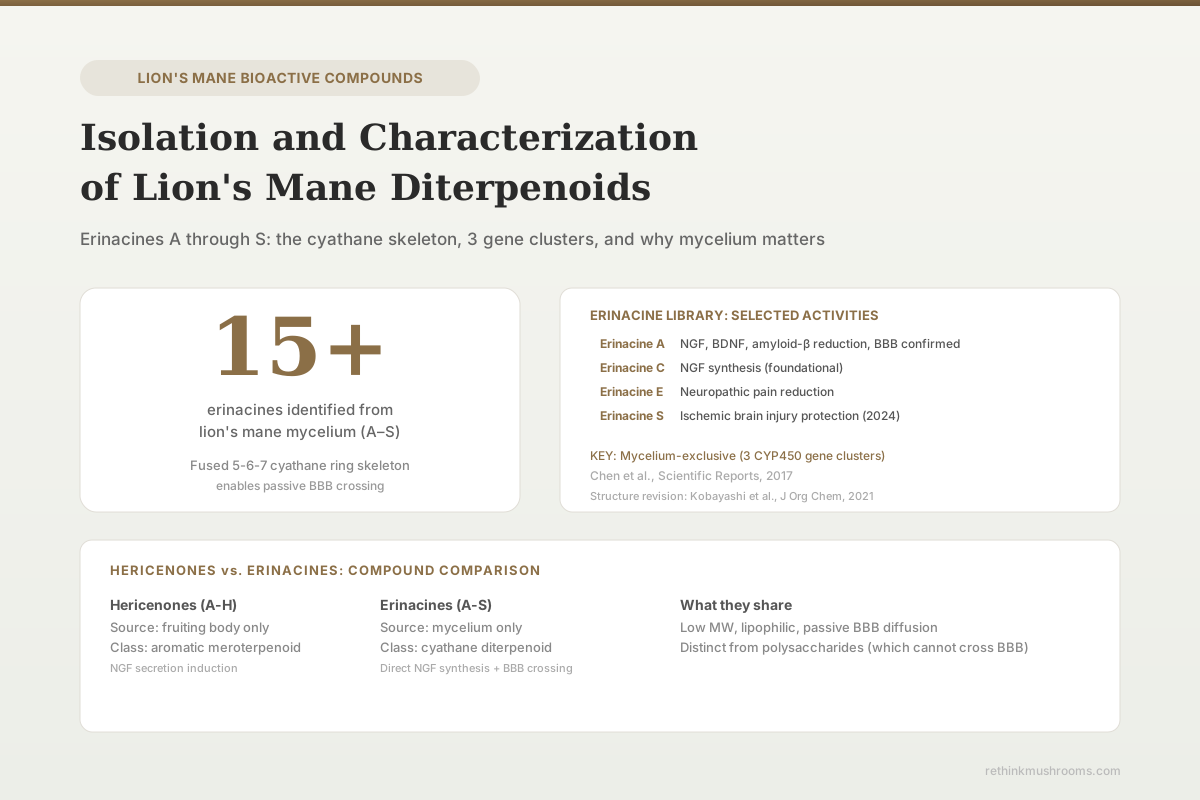
15+ erinacines identified from lion's mane mycelium (A through S)
Chen and colleagues discovered in 2017 that three distinct terpene biosynthesis gene clusters and a CYP450 enzyme family in the Hericium erinaceus genome are responsible for erinacine production, explaining at the genetic level why erinacines occur exclusively in mycelium, not in fruiting bodies.
Chen et al., Scientific Reports, 2017
Cyathane skeleton
erinacines are built on a fused 5-6-7 carbon ring system giving them low molecular weight and lipophilicity for passive diffusion across the blood-brain barrier; a structural property distinct from hericenones and absent in polysaccharides
Structure revised 2021
Kobayashi and colleagues corrected the structures of hericenones A and B after 30 years: the carbonyl sits at the meta position to the phenolic hydroxyl, not ortho as originally assigned, changing decades of structure-activity assumptions
Wang 2025 confirmed
LC-MS/MS with synthetic authentic standards confirmed all hericenones C-H in fruiting body extracts and mapped biosynthetic intermediates; n-hexane fraction is optimal for hericenone recovery (Wang et al., J Nat Prod, 2025)
Chen et al., Scientific Reports, 2017
 View as image ↗
Lion's mane (Hericium erinaceus) produces two structurally distinct classes of small bioactive compounds: hericenones (meroterpenoids from the fruiting body) and erinacines (cyathane diterpenoids from the mycelium). Both classes have documented effects on nerve growth factor production and neuronal health, but through different mechanisms and from different parts of the mushroom.
Erinacines are the chemically more unusual of the two. They are built on the cyathane carbon skeleton, a fused ring system first identified in bird's nest fungi (Cyathus species), and their production in lion's mane is encoded by dedicated gene clusters that are activated in mycelium but not in fruiting bodies. As of 2024, at least 15 distinct erinacines have been characterized, from erinacine A (the most studied) through erinacine S (identified in 2024 with ischemia-protective activity).
This article covers the chemical structure, biosynthetic basis, isolation methods, and compound diversity of lion's mane diterpenoids. For the health effects and clinical evidence, see hericenones and erinacines: lion's mane's brain-boosting compounds. For context on how triterpenes differ from diterpenoids in mushrooms more broadly, see mushroom triterpenes: the bitter compounds with powerful effects.
For the broader context of what these compounds do once they reach the brain, see lion's mane and nerve growth factor: the complete research guide.
Key Takeaways
- Erinacines are cyathane diterpenoids, built on a fused 5-6-7 tricyclic carbon ring system, exclusive to lion's mane mycelium; hericenones are aromatic meroterpenoids exclusive to lion's mane fruiting bodies; both compound classes have low molecular weight enabling passive diffusion across the blood-brain barrier (Friedman, JAFC, 2015)
- Three distinct terpene biosynthesis gene clusters in the Hericium erinaceus genome encode erinacine production via a large CYP450 enzyme family; the differential expression of these clusters in mycelium versus fruiting body explains the mycelium-exclusive distribution of erinacines (Chen et al., Sci Rep, 2017)
- Kobayashi and colleagues corrected the assigned structures of hericenones A and B in 2021 through total synthesis, determining that the carbonyl sits meta (not ortho) to the phenolic hydroxyl, fixing a 30-year error in the literature that affected structure-activity interpretation of this compound class (Kobayashi et al., J Org Chem, 2021)
- Wang and colleagues confirmed all hericenones C-H in fruiting body extracts using LC-MS/MS with synthetic authentic standards in 2025, mapping biosynthetic intermediates and identifying the n-hexane fraction as optimal for hericenone recovery, establishing a modern reference method for characterization (Wang et al., J Nat Prod, 2025)
- Erinacine A is the most studied compound: it crosses the blood-brain barrier, reduces amyloid-β and BACE1 in Alzheimer's mouse models (Tsai-Teng et al., J Biomed Sci, 2016), activates BDNF/PI3K/Akt/GSK-3β signaling in hippocampus (Chiu et al., IJMS, 2018), and was effective in post-injury administration in traumatic brain injury models (Lee et al., IJMS, 2020)
- Erinacine S, characterized in 2024, showed neuroprotective effects in ischemic brain injury distinct from erinacine A's Alzheimer's profile, illustrating how the 15+ member erinacine library has diverse and non-overlapping therapeutic activities (Chen et al., J Nutr Biochem, 2024)
Two Families, Two Sources: The Compound Inventory
Friedman's 2015 comprehensive review established the definitive structural classification of lion's mane bioactive compounds.[1]
Hericenones (A through H): Aromatic meroterpenoids. They are derivatives of geranyl-resorcinol: a geranyl side chain attached to a resorcinol (1,3-dihydroxybenzene) core. This structure makes them moderate-polarity small molecules with MW around 400-500 Da. They are found exclusively in fruiting bodies. Their primary documented mechanism is stimulating nerve growth factor (NGF) secretion in astrocyte cells.
Erinacines (A through S): Cyathane diterpenoids. They are built on a fused tricyclic ring system (5-6-7 carbon rings), with various hydroxyl, aldehyde, and ester modifications at different ring positions differentiating the individual compounds. MW ranges approximately 300-450 Da. They are found exclusively in mycelium. Their primary documented mechanism is direct NGF synthesis induction in neurons and the broader neurotrophic signaling described in 2023.
Both classes are classified as small molecules capable of crossing the blood-brain barrier by passive diffusion, based on their MW and lipophilicity profiles. This distinguishes them from lion's mane polysaccharides (beta-glucans), which are large molecules that cannot cross the BBB and work through peripheral immune mechanisms.
For the health-effects comparison of hericenones versus erinacines, see erinacines: the compounds that cross the blood-brain barrier and hericenones and NGF synthesis: how lion's mane stimulates nerve growth.
The Cyathane Skeleton: What Makes Erinacines Structurally Unusual
The cyathane carbon skeleton was first characterized in Cyathus species (bird's nest fungi) before its discovery in lion's mane. It consists of three fused carbocyclic rings: a cyclopentane (5-carbon), a cyclohexane (6-carbon), and a cycloheptane (7-carbon). This 5-6-7 fusion is unusual in natural product chemistry, where 6-6 and 6-5 ring systems are far more common.
The fused tricyclic core gives erinacines a compact three-dimensional structure with moderate lipophilicity. Lipophilicity is the property that determines whether a compound can dissolve in biological lipid membranes. The blood-brain barrier is a lipid-rich structure, and compounds with insufficient lipophilicity are excluded. The cyathane skeleton's compactness and the specific substitution patterns in erinacines produce the logD values consistent with passive membrane permeability.
This is why erinacines can reach the brain through oral supplementation while most large polysaccharides cannot. The cyathane skeleton is not just a structural curiosity; it is the molecular basis for erinacines' central nervous system activity.
Why Erinacines Only Come from Mycelium: The Genomic Explanation
The exclusivity of erinacines to lion's mane mycelium was long observed empirically before Chen and colleagues provided the genomic explanation in 2017.[2]
Using genomic and transcriptomic analysis of Hericium erinaceus, the group identified three distinct terpene biosynthesis gene clusters in the genome. These clusters encode a large family of cytochrome P450 (CYP450) enzymes responsible for the stepwise oxidative modifications that convert simple terpene precursors into the diverse erinacine structures. The key finding: these gene clusters are differentially regulated between mycelium and fruiting body developmental stages. They are actively transcribed in mycelium and largely inactive in fruiting body tissue.
This explains why erinacines are absent from fruiting bodies even though the genome encoding their production is present: the genes are simply not switched on during fruiting body development. The regulatory mechanisms controlling this tissue-specific gene expression are not fully characterized, but the observation is consistent across multiple strains.
The practical implication is direct: supplements made from fruiting body only cannot contain meaningful amounts of erinacines, regardless of how the mushroom was grown. The erinacine biosynthetic pathway requires the mycelial growth phase and the specific transcriptional environment present during that phase.
The Erinacine Library: A Through S
The erinacine family has expanded considerably since the initial isolation of erinacines A, B, and C in 1994. As of 2024, at least 15 structurally distinct erinacines have been characterized, each differing in the oxidation state, stereochemistry, or substituents at specific ring positions:
| Erinacine | Primary Documented Activity |
|---|---|
| A | NGF synthesis, amyloid-β reduction, BDNF activation, BBB penetration confirmed |
| B | Metabolic product of erinacine A; NGF synthesis |
| C | NGF synthesis; early compound with foundational activity data |
| E | Neuropathic pain reduction in animal models |
| F, H, I | NGF synthesis inducers |
| P | Isolated and characterized; specific activity under investigation |
| S | Ischemic brain injury protection (Chen et al., 2024) |
Erinacine A is the most studied and the compound most often quantified in mycelium-based supplement testing. Its breadth of documented activities includes NGF synthesis induction, reduction of amyloid-beta plaques and BACE1 (a protease implicated in Alzheimer's) in animal models, BDNF/PI3K/Akt/GSK-3β pathway activation, and post-injury neuroprotection in traumatic brain injury models.
Erinacine S illustrates how the broader library extends beyond erinacine A's profile. Chen and colleagues characterized erinacine S's neuroprotective effects in ischemic brain injury in 2024, demonstrating the protective activity and confirming the structural diversity of the library has functional diversity to match.[7]
Evidence for Blood-Brain Barrier Crossing
The Alzheimer's research using erinacine A provides indirect evidence of BBB crossing: if erinacine A were not reaching the brain, it could not reduce amyloid-beta plaques or increase insulin-degrading enzyme (IDE) expression in brain tissue. Tsai-Teng and colleagues demonstrated these brain-specific effects in APPswe/PS1dE9 transgenic mice in 2016.[5]
Chiu and colleagues provided the pathway-level confirmation in 2018: erinacine A-enriched mycelium activated the BDNF/PI3K/Akt/GSK-3β signaling cascade in mouse hippocampus, producing antidepressant-like behavioral effects and hippocampal neurogenesis.[6] BDNF signaling in hippocampus requires the compound to cross the BBB and reach hippocampal neurons.
Lee and colleagues demonstrated in 2020 that post-injury administration of erinacine A reduced cerebral infarct volume and neurological deficits in an animal traumatic brain injury model.[4] The post-injury protocol, administered after the injury occurred, requires BBB crossing to be rapid enough for a therapeutic window. The finding confirms that erinacine A reaches brain tissue in a clinically relevant timeframe.
For the detailed pharmacokinetics and mechanism of BBB crossing, see how erinacines cross the blood-brain barrier.
Modern Characterization: LC-MS/MS and Authentic Synthetic Standards
The analytical methodology for confirming erinacine and hericenone content in supplements and extracts has improved substantially with the adoption of LC-MS/MS (liquid chromatography-tandem mass spectrometry) combined with synthetic authentic standards.
Wang and colleagues demonstrated this approach for hericenones in 2025.[3] The key methodological advance: using synthetically prepared authentic standards for hericenones C-H allowed unambiguous identification of these compounds in fruiting body extracts, confirming their presence with a level of chemical certainty that UV-absorbance-based methods cannot achieve. The study also mapped biosynthetic intermediates in the extracts and determined that the n-hexane fraction captures hericenones most efficiently, providing a practical guide for extraction optimization.
The 2021 Kobayashi total synthesis of hericenones C-H is directly relevant here: total synthesis not only provides compounds for biological testing but also confirms molecular structure through the only method that is independently verifiable: building the molecule from scratch.[8] The structure revision of hericenones A and B in that paper corrected an error in the original 1990s isolation literature: the carbonyl at the benzylic position is meta to the phenolic hydroxyl, not ortho as previously assigned. Thirty years of structure-activity relationship assumptions about these two compounds were built on an incorrect structure.
This type of revision is not unusual in natural product chemistry. Isolation-based structure assignment (using NMR alone without synthesis) has known limitations, and the lion's mane case illustrates why synthetic verification matters for building accurate mechanistic models.
The Bottom Line
Lion's mane diterpenoids (erinacines) are cyathane-class compounds built on a fused 5-6-7 tricyclic ring system, with 15+ members identified from mycelium. Their mycelium exclusivity is explained by three terpene gene clusters and a CYP450 enzyme family that are active in mycelium but suppressed in fruiting body tissue (Chen et al., 2017). Erinacine A is the most studied: it crosses the BBB, reduces amyloid-beta and BACE1 in Alzheimer's models (Tsai-Teng et al., 2016), activates BDNF/PI3K/Akt in hippocampus (Chiu et al., 2018), and shows post-injury neuroprotection (Lee et al., 2020). Erinacine S (2024) has distinct ischemia-protective activity. Modern characterization uses LC-MS/MS with synthetic standards (Wang et al., 2025). Total synthesis by Kobayashi (2021) corrected the 30-year misassignment of hericenone A and B structures.
Frequently Asked Questions
Sources & References
- 1. Source details for this reference are not yet available.
- 2. Source details for this reference are not yet available.
- 3. Source details for this reference are not yet available.
- 4. Source details for this reference are not yet available.
- 5. Source details for this reference are not yet available.
- 6. Source details for this reference are not yet available.
- 7. Source details for this reference are not yet available.
- 8. Source details for this reference are not yet available.