Lion's Mane (Hericium erinaceus)
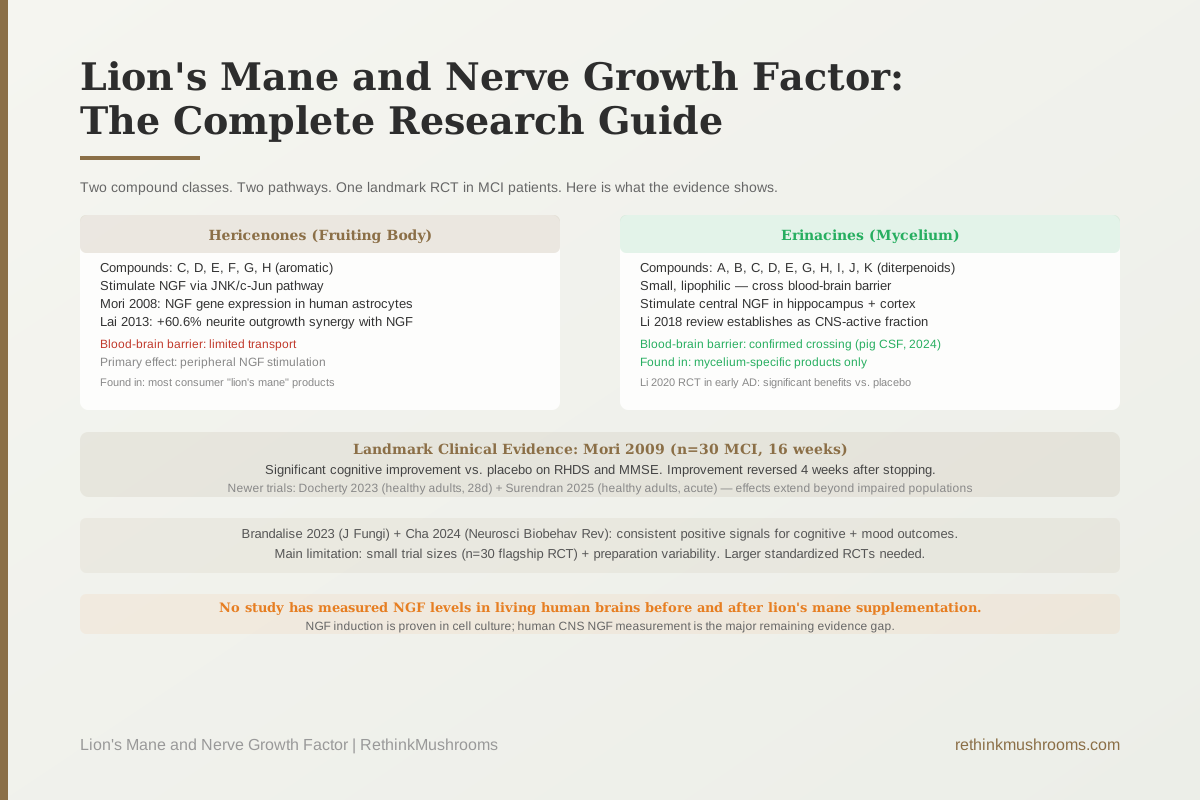
16 weeks of lion's mane supplementation significantly improved cognitive function in MCI patients; scores declined after stopping (Mori 2009)
Mori and colleagues conducted the landmark RCT: 30 elderly adults with mild cognitive impairment randomized to 3g/day lion's mane powder or placebo for 16 weeks showed significantly higher scores on cognitive assessments. The effect reversed after the trial ended, suggesting ongoing supplementation is required.
Mori et al., Phytotherapy Research, 2009
hericenones vs. erinacines
two distinct compound classes with different sources and different brain-access properties: understanding this distinction explains why product source material matters
JNK/c-Jun pathway
Mori 2008: the specific signaling pathway by which lion's mane compounds induce NGF gene expression in human glial cells
60.6% neurite increase
Lai 2013: fruiting body extract combined with trace NGF produced 60.6% more neurite outgrowth than NGF alone, showing synergistic enhancement
Mori et al., Phytotherapy Research, 2009
 View as image ↗
Nerve growth factor (NGF) is a protein that neurons cannot live without. It keeps the brain's cholinergic neurons alive and functional, promotes the growth of nerve fibers, and maintains the synaptic connections that support learning and memory. In Alzheimer's disease and related conditions, NGF signaling is disrupted: the protein is produced but cannot reach the neurons that need it, and the neurons gradually deteriorate.
Giving people NGF directly does not work. NGF is a large protein that cannot cross the blood-brain barrier, the protective filter between the bloodstream and the brain. Injecting it into the brain tissue of Alzheimer's patients caused side effects including pain and unintended nerve fiber growth. What researchers have wanted for decades is a small molecule that can cross the blood-brain barrier and stimulate the brain's own NGF production from inside.
Lion's mane mushroom contains two distinct compound classes that do this: hericenones from the fruiting body and erinacines from the mycelium. They work through different pathways and have different abilities to reach the brain. Understanding the difference matters for evaluating the evidence and for interpreting what different lion's mane products might do.
For a broader overview of lion's mane research, see What Is Lion's Mane Mushroom? A Science-Based Overview.
Key Takeaways
- Mori and colleagues (Phytotherapy Research, 2009) conducted the landmark RCT: 30 elderly Japanese adults with mild cognitive impairment given 3g/day lion's mane powder for 16 weeks showed significantly higher scores on the Revised Hasegawa Dementia Scale versus placebo; scores declined 4 weeks after supplementation ended, suggesting ongoing use is necessary
- Mori and colleagues (Biological and Pharmaceutical Bulletin, 2008) identified the NGF induction mechanism in human astrocytoma cells: H. erinaceus extracts induce NGF gene expression via the JNK signaling pathway, specifically through phosphorylation of JNK and its substrate c-Jun and increased c-fos expression
- Lai and colleagues (International Journal of Medicinal Mushrooms, 2013) showed that aqueous fruiting body extract combined with trace NGF (10 ng/mL) produced 60.6% more neurite outgrowth than NGF alone in NG108-15 cells, demonstrating that lion's mane compounds synergistically enhance existing NGF activity rather than merely substituting for it
- Li and colleagues (Behavioural Neurology, 2018) synthesized evidence establishing erinacine-enriched mycelia as the CNS-active fraction: erinacines are small lipophilic diterpenoids that cross the blood-brain barrier and stimulate NGF production centrally, while hericenones (from fruiting body) are less reliably transported across the barrier
- Li and colleagues (Frontiers in Aging Neuroscience, 2020) conducted the only human RCT specifically using erinacine A-enriched mycelium in early Alzheimer's disease patients and found significant cognitive benefits versus placebo alongside reduced inflammatory markers
- Two 2023-2024 independent reviews (Brandalise 2023, Cha 2024) confirm positive signals for lion's mane across cognitive disorders and mood, while identifying small trial sizes and methodological variation as the main limitations of the current evidence base
Why NGF Cannot Be Taken as a Supplement
Before the lion's mane evidence makes sense, the fundamental pharmacology problem it is solving needs to be clear.
NGF is a protein with a molecular weight of around 26 kDa. The blood-brain barrier excludes proteins of this size from crossing from the bloodstream into brain tissue. This means that taking NGF orally does nothing for the brain: the digestive system breaks it down into amino acids, and any NGF that reaches the bloodstream cannot cross into the brain anyway.
Researchers tried direct delivery. Clinical trials in Alzheimer's patients in the 1990s and 2000s used gene therapy or direct intracranial infusion to deliver NGF to the brain. These approaches produced some cognitive benefits, but also caused off-target nerve fiber growth and pain, because NGF acts on peripheral pain nerves as well as central neurons.
The alternative approach is to stimulate the brain to produce its own NGF. If a small molecule can cross the blood-brain barrier and upregulate NGF gene expression inside the brain, it avoids the delivery problem entirely. This is what erinacines from lion's mane mycelium appear to do, and it is why this mushroom has generated serious scientific interest for neurological applications.
Two Compound Classes: Why the Source Part of the Mushroom Matters
Lion's mane contains two structurally distinct classes of neuroactive compounds, and they are not found in the same part of the mushroom.
Hericenones (named C, D, E, F, G, H) are aromatic compounds found in the fruiting body, the visible mushroom cap and stem. They stimulate NGF synthesis in neural and glial cells in vitro. However, they are larger and less lipophilic (fat-soluble) than the erinacines, which limits their ability to passively diffuse through the blood-brain barrier's lipid membrane.
Erinacines (named A, B, C, D, E, G, H, I, J, K and others) are cyathane diterpenoids found in the mycelium, the vegetative root-like network of the fungus that is not the visible mushroom. They are smaller and more lipophilic, which allows them to cross the blood-brain barrier. Once inside the brain, they stimulate NGF production in the hippocampus and cerebral cortex directly.
Li and colleagues established this distinction in a 2018 systematic review in Behavioural Neurology, confirming erinacine-enriched mycelia as the CNS-active fraction and establishing that erinacines produce the central neurotrophic effects while hericenones primarily act on peripheral tissues.[4]
The practical implication: a product made from fruiting body contains hericenones but not erinacines. A product made from mycelium contains erinacines. A product combining both contains both compound classes. "Lion's mane supplement" on a label does not specify which is present, and this distinction determines which mechanism is active.
For the compound-level details on each class, see Hericenones and NGF Synthesis: How Lion's Mane Stimulates Nerve Growth and Erinacines: The Compounds That Cross the Blood-Brain Barrier.
The NGF Induction Mechanism: What Mori 2008 and Lai 2013 Found
The mechanistic foundation for lion's mane NGF stimulation comes from two studies published before the clinical trial era.
Mori and colleagues published a 2008 study in Biological and Pharmaceutical Bulletin testing H. erinaceus extracts in 1321N1 human astrocytoma cells, which are derived from human brain glial cells.[2] This cell type is relevant because astrocytes in the brain are among the primary producers of NGF. The study found that H. erinaceus extracts:
- Induced NGF gene expression
- Did so through phosphorylation of JNK (c-Jun N-terminal kinase) and its substrate c-Jun
- Increased c-fos expression, another component of the AP-1 transcription factor complex that drives NGF gene transcription
The JNK/c-Jun/AP-1 pathway is a well-characterized intracellular signaling cascade that responds to cellular stress and growth signals. This finding showed that lion's mane compounds activate a known gene regulation pathway to turn on NGF production, rather than working through an unknown mechanism.
Lai and colleagues published a complementary 2013 study in the International Journal of Medicinal Mushrooms using NG108-15 cells, a rat/mouse hybrid cell line used as a model for peripheral neurons.[3] The key finding: aqueous extract from H. erinaceus fruiting body combined with a trace amount of NGF (10 ng/mL, a concentration below the threshold for significant neurite outgrowth alone) produced 60.6% greater neurite outgrowth compared to that NGF concentration alone.
The implication is that lion's mane compounds do not merely substitute for NGF: they amplify existing NGF signaling. This synergistic enhancement means even small background NGF levels can produce larger effects when lion's mane is present.
The Landmark Clinical Trial: Mori 2009 in MCI Patients
The clinical cornerstone of lion's mane NGF research is a 2009 randomized controlled trial by Mori and colleagues published in Phytotherapy Research.[1]
The study enrolled 30 elderly Japanese adults who met criteria for mild cognitive impairment (MCI), a state of cognitive decline that exceeds normal aging but does not meet criteria for dementia. MCI is a recognized risk state for Alzheimer's disease: approximately 10-15% of MCI patients per year convert to dementia.
Participants were randomized to receive either 3g/day of lion's mane powder (four 250mg tablets, three times daily) or placebo tablets for 16 weeks. Cognitive function was assessed with the Revised Hasegawa Dementia Scale (RHDS) and the Mini-Mental State Examination (MMSE), standard validated instruments for detecting cognitive impairment.
After 16 weeks, the lion's mane group showed significantly higher cognitive scores than the placebo group. The control group showed no improvement. After the trial ended, participants were followed for 4 more weeks without supplementation: the improvement in the lion's mane group declined significantly. This dose-response and washout pattern is characteristic of an active pharmacological effect rather than placebo response.
Honest assessment: the trial enrolled 30 participants. This is a small study by modern standards. The population was specifically elderly Japanese adults with mild cognitive impairment, and the effects may not generalize to other populations. The lion's mane used was fruiting body powder, not erinacine-enriched mycelium, which raises the question of what the contribution of hericenones versus erinacines was in this product.
The Mori 2009 study remains the most cited clinical evidence for lion's mane cognitive effects, 16 years after publication, because a larger replication RCT in MCI patients has not been published. For the full MCI clinical evidence overview, see Lion's Mane and Mild Cognitive Impairment: Clinical Trial Results.
The Most Recent Trials: Effects in Healthy Adults
The Mori 2009 trial enrolled patients with existing cognitive impairment. Two more recent RCTs extended the evidence to healthy younger adults without baseline deficits.
Docherty and colleagues published a double-blind pilot RCT in Nutrients in 2023 enrolling 41 healthy young adults aged 18-45.[6] Participants received 1.8g of lion's mane supplementation for 28 days. The lion's mane group showed significantly improved performance on a Stroop task (measuring executive attention and cognitive speed) and reported reduced subjective stress compared to placebo. This suggests cognitive effects are not limited to impaired populations, though the effect size was modest in healthy participants.
Surendran and colleagues published the most recent RCT in Frontiers in Nutrition in 2025, using a double-blind randomized placebo-controlled design in healthy younger adults with a standardized lion's mane extract.[7] A single acute dose produced measurable improvements in cognitive performance and mood, providing evidence that the effects can be detected quickly and are not purely attributable to weeks-long neurogenesis.
Together, these two trials show that the cognitive effects of lion's mane are not restricted to people with MCI. However, the effect sizes are larger and more consistently detected in populations with existing deficits. This is consistent with the NGF mechanism: if brain NGF is already adequate, adding more stimulation to an already-functioning system produces smaller incremental benefits.
The Erinacine A-Enriched Trial: Li 2020 in Early Alzheimer's
The only published human trial specifically using erinacine A-enriched mycelium comes from Li and colleagues in Frontiers in Aging Neuroscience in 2020.[5]
This pilot double-blind placebo-controlled trial enrolled patients with early-stage Alzheimer's disease and administered erinacine A-enriched H. erinaceus mycelia specifically, not fruiting body. The trial found significant cognitive benefits versus placebo alongside reduced inflammatory markers.
The Li 2020 study is important for two reasons. First, it provides the first human data on the erinacine fraction specifically, confirming that the BBB-crossing compound class produces clinical effects in the target population. Second, it extends the clinical evidence from MCI to diagnosed early AD, the population where NGF restoration is most clinically meaningful.
The limitation: this is a pilot study, and detailed data on sample size and dose were not available in the published summary. Larger trials following this design are the obvious next step.
What Two Independent Reviews Conclude
Two independent reviews from high-quality journals provide an external assessment of where the evidence stands.
Brandalise and colleagues published a 2023 review in the Journal of Fungi titled "From Bench to Bedside and Beyond, How Far from the Shoreline?" specifically assessing the translation gap in lion's mane evidence.[8] The reviewers confirmed positive effects across cognitive disorders, Alzheimer's disease, ischemic stroke, Parkinson's disease, and depression in preclinical research. They identified the key gaps needed for clinical translation: larger RCTs with standardized preparations, established dose-response relationships, and biomarker studies.
Cha and colleagues published a 2024 review in Neuroscience and Biobehavioral Reviews, a high-impact journal, covering mushroom effects on mood and neurocognitive health across the lifespan.[9] The review found positive signals for lion's mane on mood and cognition across age groups, but specifically noted methodological limitations including small sample sizes and preparation variability as the primary constraints on making stronger clinical conclusions.
Both reviews reached the same conclusion: the evidence points in a consistent direction, but the trials to date are too small and too variable in preparation to support clinical guidelines.
What the Evidence Does and Doesn't Establish
What the research shows:
- Lion's mane compounds stimulate NGF gene expression in human glial cells via the JNK/c-Jun pathway (Mori 2008)
- Synergistic enhancement of neurite outgrowth with trace NGF at 60.6% above control (Lai 2013)
- Significant cognitive improvement in a 16-week RCT in 30 MCI patients (Mori 2009); reversed after stopping
- Cognitive effects in healthy young adults detected acutely (Surendran 2025) and after 28-day supplementation (Docherty 2023)
- Erinacine A-enriched mycelium specifically produced clinical benefits in early AD patients (Li 2020 pilot)
- Two 2023-2024 independent reviews confirm consistent directional evidence with methodological caveats
What the evidence does not establish:
- Whether lion's mane actually increases NGF levels in living human brains (no human CSF or brain biopsy NGF measurement study has been published for lion's mane)
- The optimal dose for cognitive protection or enhancement in any specific population
- Long-term efficacy or safety data beyond the study periods described above
- Whether standard fruiting body products produce the same central NGF effects as erinacine-enriched mycelium preparations
- Whether cognitive benefits in MCI prevent or delay progression to Alzheimer's disease
For the neurological disease applications in depth, see NGF Deficiency and Neurological Disease: Can Lion's Mane Help?. For the emerging second neurotrophic pathway beyond NGF, see Lion's Mane and Progranulin: A Second Neurotrophic Pathway Beyond NGF.
The Bottom Line
Lion's mane mushroom stimulates nerve growth factor (NGF) production through two compound classes: hericenones from fruiting body (JNK/c-Jun pathway, Mori 2008) and erinacines from mycelium (BBB-crossing, direct central NGF stimulation). Lai 2013 showed 60.6% synergistic neurite outgrowth enhancement. The landmark Mori 2009 RCT (n=30 MCI patients, 16 weeks) showed significant cognitive improvement that reversed after stopping. Li 2020 extended evidence to early AD with erinacine A-enriched mycelium. Recent RCTs (Docherty 2023, Surendran 2025) confirm effects in healthy young adults. Independent reviews (Brandalise 2023, Cha 2024) confirm consistent positive direction with small trial sizes as the key limitation.
Frequently Asked Questions
Sources & References
- 1RTHM-00165·Mori, Koichiro et al. (2009). “Improving effects of the mushroom Yamabushitake (Hericium erinaceus) on mild cognitive impairment: a double-blind placebo-controlled clinical trial..” Phytotherapy research : PTR.Study breakdown →PubMed →↩
- 2RTHM-00268·Mori, Koichiro et al. (2008). “Nerve growth factor-inducing activity of Hericium erinaceus in 1321N1 human astrocytoma cells..” Biological & pharmaceutical bulletin.Study breakdown →PubMed →↩
- 3RTHM-00295·Lai, Puei-Lene et al. (2013). “Neurotrophic properties of the Lion's mane medicinal mushroom, Hericium erinaceus (Higher Basidiomycetes) from Malaysia..” International journal of medicinal mushrooms.Study breakdown →PubMed →↩
- 4RTHM-00973·Li, I-Chen et al. (2018). “Neurohealth Properties of Hericium erinaceus Mycelia Enriched with Erinacines..” Behavioural neurology.Study breakdown →PubMed →↩
- 5RTHM-00631·Li, I-Chen et al. (2020). “Prevention of Early Alzheimer's Disease by Erinacine A-Enriched Hericium erinaceus Mycelia Pilot Double-Blind Placebo-Controlled Study..” Frontiers in aging neuroscience.Study breakdown →PubMed →↩
- 6RTHM-00821·Docherty, Sarah et al. (2023). “The Acute and Chronic Effects of Lion's Mane Mushroom Supplementation on Cognitive Function, Stress and Mood in Young Adults: A Double-Blind, Parallel Groups, Pilot Study..” Nutrients.Study breakdown →PubMed →↩
- 7RTHM-00952·Surendran, Geyan et al. (2025). “Acute effects of a standardised extract of Hericium erinaceus (Lion's Mane mushroom) on cognition and mood in healthy younger adults: a double-blind randomised placebo-controlled study..” Frontiers in nutrition.Study breakdown →PubMed →↩
- 8RTHM-01662·Brandalise, Federico et al. (2023). “Hericium erinaceus in Neurodegenerative Diseases: From Bench to Bedside and Beyond, How Far from the Shoreline?.” Journal of fungi (Basel.Study breakdown →PubMed →↩
- 9RTHM-00868·Cha, Sara et al. (2024). “A review of the effects of mushrooms on mood and neurocognitive health across the lifespan..” Neuroscience and biobehavioral reviews.Study breakdown →PubMed →↩