Lion's Mane and Alzheimer's Disease
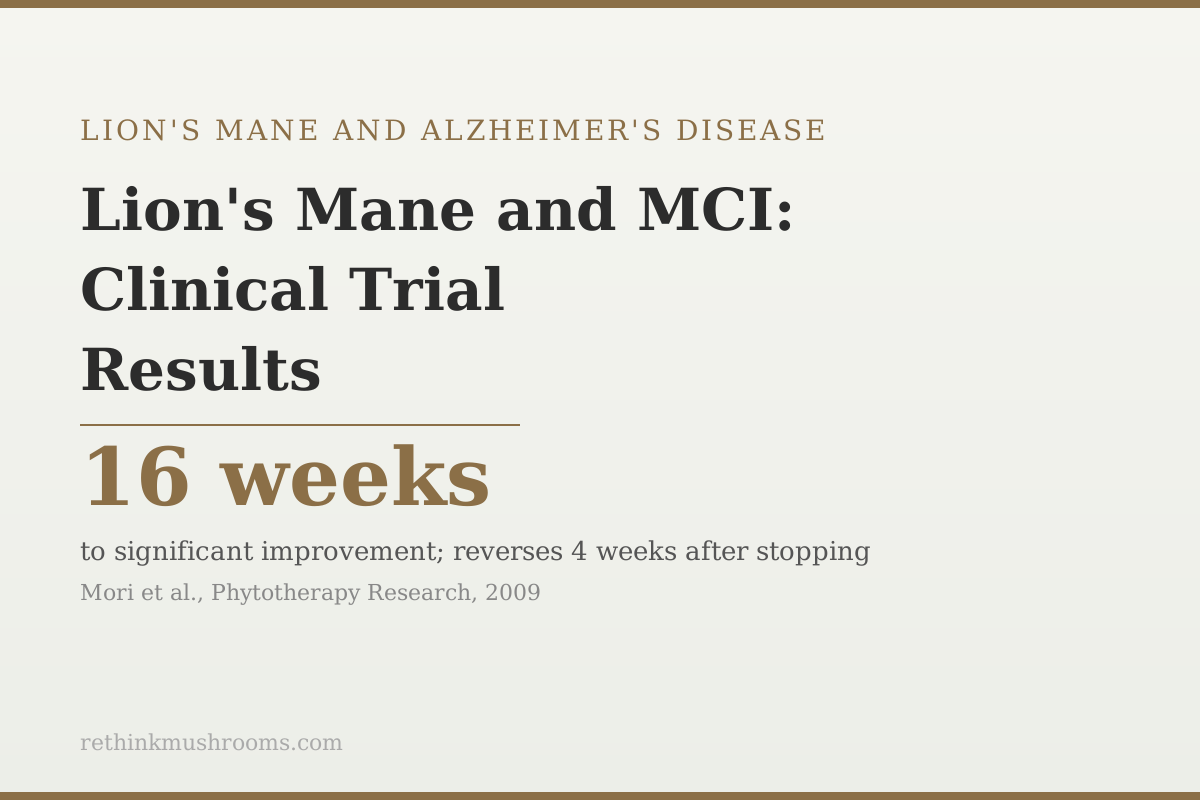
16 weeks to significant MCI improvement; 4 weeks for effects to reverse after stopping (Mori et al., 2009)
Mori and colleagues' 2009 double-blind placebo-controlled trial in 30 mild cognitive impairment patients found significant improvement at weeks 8, 12, and 16 with lion's mane. When supplementation stopped, scores declined back toward baseline within 4 weeks. This washout reversal is the most important clinical detail about lion's mane and MCI, and almost no coverage mentions it.
Mori et al., Phytotherapy Research, 2009
3g/day
dose used in Mori 2009 (whole fruiting body tablets), compared to 1.05g/day erinacine A-enriched mycelium preparation in Li 2020 early Alzheimer's trial; different preparations deliver different compound profiles
12-week RCT
Saitsu and colleagues (2019) independently replicated the cognitive benefit in a separate 12-week randomized, double-blind, placebo-controlled trial, with significant improvement on the Mini-Mental State Examination (MMSE)
Bench-to-bedside gap
Brandalise et al. (2023) review of H. erinaceus in neurodegenerative diseases identified the specific evidence gaps that need to be filled before clinical practice recommendations can be made
Mori et al., Phytotherapy Research, 2009
 View as image ↗
The lion's mane and MCI literature is often summarized as "the Mori 2009 trial showed cognitive improvement." That summary omits the most important clinical detail: cognitive scores declined back toward baseline within four weeks of stopping. The improvement was not permanent. It was dependent on continued use.
This is not bad news. It is essential information for anyone deciding whether to supplement long-term. A compound that works by continuously supporting hippocampal neuroplasticity will show regression when that support is removed. Understanding this changes how to think about lion's mane supplementation for MCI: not as a one-time course but as ongoing maintenance of a biological process. For the broader lion's mane overview, see what is lion's mane mushroom: a science-based overview.
Key Takeaways
- Mori and colleagues (2009) conducted a 16-week double-blind placebo-controlled RCT in 30 MCI patients (randomized 1:1, 15 lion's mane vs 15 placebo) using 3g/day lion's mane (whole fruiting body tablets); significant cognitive improvement on the Revised Hasegawa Dementia Scale (HDS-R) was documented at weeks 8, 12, and 16 compared to placebo
- The washout reversal: cognitive scores declined significantly within 4 weeks of stopping supplementation, indicating the benefit requires continued use rather than providing permanent correction
- Saitsu and colleagues (2019) independently replicated the cognitive benefit in a separate 12-week randomized, double-blind, placebo-controlled trial, with significant improvement on the Mini-Mental State Examination (MMSE)
- Li and colleagues (2018) reviewed the neurohealth properties of erinacine-enriched mycelium, providing the mechanistic context for why mycelium-specific preparations may differ from whole fruiting body preparations in their clinical effects
- Mori 2009 used 3g/day whole fruiting body; the Li 2020 early Alzheimer's trial used 1.05g/day erinacine A-enriched mycelium; these are different preparations delivering different compound profiles, making dose comparisons complex
- Brandalise and colleagues (2023) reviewed H. erinaceus evidence in neurodegenerative diseases and identified the specific evidence gaps (larger trials, longer duration, standardized preparations) that separate current evidence from clinical practice recommendations
The Mori 2009 RCT: Every Number That Matters
The Mori 2009 trial is the most-cited study in lion's mane cognitive research and the only double-blind placebo-controlled RCT specifically in mild cognitive impairment patients from before 2020.[1]
Population: 30 Japanese adults with diagnosed MCI, ages 50-80, randomized 1:1 into two 15-person groups (lion's mane or placebo).
Intervention: H. erinaceus powder in tablet form, 250mg per tablet, 4 tablets three times daily (3g per day total), for 16 weeks.
Cognitive assessment: The Revised Hasegawa Dementia Scale (HDS-R), a validated cognitive screening tool used widely in Japanese clinical practice for elderly and MCI populations. HDS-R scores range from 0-30, with lower scores indicating more impairment.
Primary result: The lion's mane group showed statistically significant improvement in HDS-R scores compared to placebo at weeks 8, 12, and 16. The difference was meaningful and grew over the treatment period, consistent with a mechanism that builds over weeks rather than producing an immediate effect.
The washout finding: At a follow-up assessment four weeks after the trial ended (when participants had stopped taking lion's mane), scores in the treatment group had declined significantly toward pre-trial levels. The placebo group showed no corresponding change.
The washout finding is the detail that almost no coverage includes. It matters because it changes the use case: lion's mane for MCI is not a correction to take for a few months and stop. It is ongoing maintenance of cognitive function that requires continued supplementation to sustain.
Mori et al., 2009 · 16-week RCT + 4-week washout
The washout reversal: benefit tracks the dosing, not a permanent correction
- Wk 8 · significant vs placebo
- Wk 12 · significant
- Wk 16 · significant (peak, still dosing)
- Wk 16 + 4 · significant decline after stopping
Source: Mori et al., Phytotherapy Research 23(3):367–72 (2009), PMID 18844328. N = 30 (15 lion's mane, 15 placebo). Curve shows the reported direction and significance of change; the trial reported significance, not per-week HDS-R values, so the vertical axis is unnumbered.
What the Reversal After Stopping Tells Us About the Mechanism
The regression pattern after stopping is mechanistically informative.
Lion's mane stimulates nerve growth factor (NGF) and brain-derived neurotrophic factor (BDNF) production. These growth factors support hippocampal neuroplasticity: the ongoing maintenance and growth of neural connections in the brain's primary memory-processing region. In MCI patients, hippocampal neuroplasticity is compromised.
When lion's mane supplements the NGF/BDNF signal that supports this neuroplasticity, cognitive function improves as the neuroplasticity is restored. When supplementation stops, the elevated NGF/BDNF signal fades, and the underlying deficit in hippocampal neuroplasticity reasserts itself. The brain returns to the state that produced the MCI presentation.
This is not a failure of the compound. It reflects the biology of the condition. MCI involves ongoing deficits in the molecular processes supporting hippocampal integrity. Lion's mane compensates for those deficits while it is present. The compensation ends when the supplementation ends.
Li and colleagues (2018) reviewed the neurohealth properties of erinacine-enriched mycelium and documented the multiple pathways through which erinacines support neuronal health: NGF induction, neuroprotection against oxidative stress, anti-neuroinflammatory effects.[4] These are ongoing biological maintenance functions, not one-time repairs, which mechanistically explains why continuous supplementation is needed to maintain the cognitive benefit.
Saitsu 2019: A Second RCT That Replicates the Cognitive Benefit
Saitsu and colleagues (2019) ran a separate randomized, double-blind, placebo-controlled trial in Japanese adults, testing H. erinaceus fruiting body supplementation over 12 weeks.[2]
The direction of effect was consistent with Mori 2009. Of the three assessments used, the Mini-Mental State Examination (MMSE) showed a statistically significant improvement in cognitive function in the lion's mane group versus placebo, while the other two measures (the Benton visual retention test and a standard verbal paired-associate learning test) did not reach significance. A second independent RCT reaching the same direction of effect matters because it moves the finding beyond a single trial: replication is what separates a promising signal from a reliable one.
It is worth being precise about what Saitsu 2019 did not measure, because the sleep angle often gets misattributed to this trial. Saitsu 2019 assessed cognition only. The sleep evidence comes from a different study: Vigna and colleagues (2019) gave H. erinaceus to overweight and obese adults for eight weeks and reported improvements in sleep and mood alongside shifts in circulating BDNF and its precursor pro-BDNF.[6] That population is not the MCI population Mori studied, so the sleep result should not be read as an MCI outcome. It is, however, mechanistically suggestive: sleep disruption and cognitive decline are bidirectionally related, because poor sleep impairs hippocampal memory consolidation while hippocampal damage from early neurodegeneration disrupts sleep architecture. Whether lion's mane meaningfully improves sleep in MCI patients specifically has not been tested in a dedicated trial.
The Preparation Question: Fruiting Body vs. Erinacine A-Enriched Mycelium
The Mori 2009 trial used 3g per day of whole fruiting body tablet. The Li 2020 early Alzheimer's pilot used 1.05g per day of erinacine A-enriched mycelium (three 350mg capsules containing 5mg/g erinacine A) over a 49-week double-blind treatment period.[5] These numbers are not comparable because the preparations are fundamentally different.
Whole fruiting body contains hericenones (the compounds that stimulate NGF through surface receptor signaling) and beta-glucan polysaccharides, but relatively low concentrations of erinacines.
Erinacine A-enriched mycelium contains high concentrations of erinacines, the lipophilic compounds that cross the blood-brain barrier directly and stimulate NGF production in brain cells.
Li 2018 specifically reviewed the neurohealth profile of erinacine-enriched preparations and noted the distinction between their pharmacology and that of standard fruiting body extracts.[4] Because erinacines cross the blood-brain barrier directly, while hericenones access the brain less efficiently, erinacine-enriched preparations may produce stronger direct neurotrophin stimulation at lower nominal doses.
This means supplement label comparisons are not straightforward for lion's mane. A product labeled "1g lion's mane mycelium concentrate" and one labeled "3g lion's mane whole mushroom" are not equivalent on a mg-per-mg basis. The compound profiles, concentrations, and mechanisms differ between preparation types. For an article with deeper mechanistic coverage, see lion's mane and amyloid beta: mechanisms of neuroprotection.
What We Still Don't Know: The Bench-to-Bedside Gap
Brandalise and colleagues (2023) reviewed the state of H. erinaceus evidence in neurodegenerative diseases, examining how close the field is to translating preclinical and early clinical findings into clinical practice recommendations.[3]
The review identified the specific gaps that remain: small sample sizes in existing trials (Mori 2009 had 30 participants), short durations (16 weeks may not capture long-term effects or safety), lack of standardized preparations across studies, and absence of large multicenter trials that would provide population-level evidence.
The current evidence establishes that lion's mane can improve cognitive function in MCI patients in short-term controlled conditions. It does not yet establish the optimal dose, the optimal preparation type, the minimum treatment duration for clinical benefit, or whether benefits persist over years of use. These are the questions that larger future trials will need to answer.
This is not a dismissal of the existing evidence. Mori 2009 is a well-designed RCT that produced a significant and replicable finding. It is an honest description of where the evidence is and where the research frontier lies.
The Bottom Line
Mori 2009 remains the definitive MCI trial for lion's mane: 30 patients (15 vs 15), 3g/day whole fruiting body, 16 weeks, significant HDS-R score improvement. The most important underreported finding: scores declined significantly within 4 weeks of stopping, indicating continuous supplementation is required to maintain benefit. Saitsu 2019 independently replicated the cognitive benefit in a separate 12-week RCT, with significance on the MMSE. Li 2018 explained the mechanistic distinction between fruiting body (hericenones) and erinacine A-enriched mycelium preparations, making dose comparisons across studies non-trivial. Brandalise 2023 identified the sample size and duration gaps that remain before clinical practice recommendations can be made.
Frequently Asked Questions
Sources & References
- 1RTHM-00165·Mori, Koichiro et al. (2009). “Improving effects of the mushroom Yamabushitake (Hericium erinaceus) on mild cognitive impairment: a double-blind placebo-controlled clinical trial..” Phytotherapy research : PTR.Study breakdown →PubMed →↩
- 2RTHM-00585·Saitsu, Yuusuke et al. (2019). “Improvement of cognitive functions by oral intake of Hericium erinaceus..” Biomedical research (Tokyo.Study breakdown →PubMed →↩
- 3RTHM-01662·Brandalise, Federico et al. (2023). “Hericium erinaceus in Neurodegenerative Diseases: From Bench to Bedside and Beyond, How Far from the Shoreline?.” Journal of fungi (Basel.Study breakdown →PubMed →↩
- 4RTHM-00973·Li, I-Chen et al. (2018). “Neurohealth Properties of Hericium erinaceus Mycelia Enriched with Erinacines..” Behavioural neurology.Study breakdown →PubMed →↩
- 5RTHM-00631·Li, I-Chen et al. (2020). “Prevention of Early Alzheimer's Disease by Erinacine A-Enriched Hericium erinaceus Mycelia Pilot Double-Blind Placebo-Controlled Study..” Frontiers in aging neuroscience.Study breakdown →PubMed →↩
- 6RTHM-00590·Vigna, Luisella et al. (2019). “Hericium erinaceus Improves Mood and Sleep Disorders in Patients Affected by Overweight or Obesity: Could Circulating Pro-BDNF and BDNF Be Potential Biomarkers?.” Evidence-based complementary and alternative medicine : eCAM.Study breakdown →PubMed →↩