Lion's Mane and Alzheimer's Disease
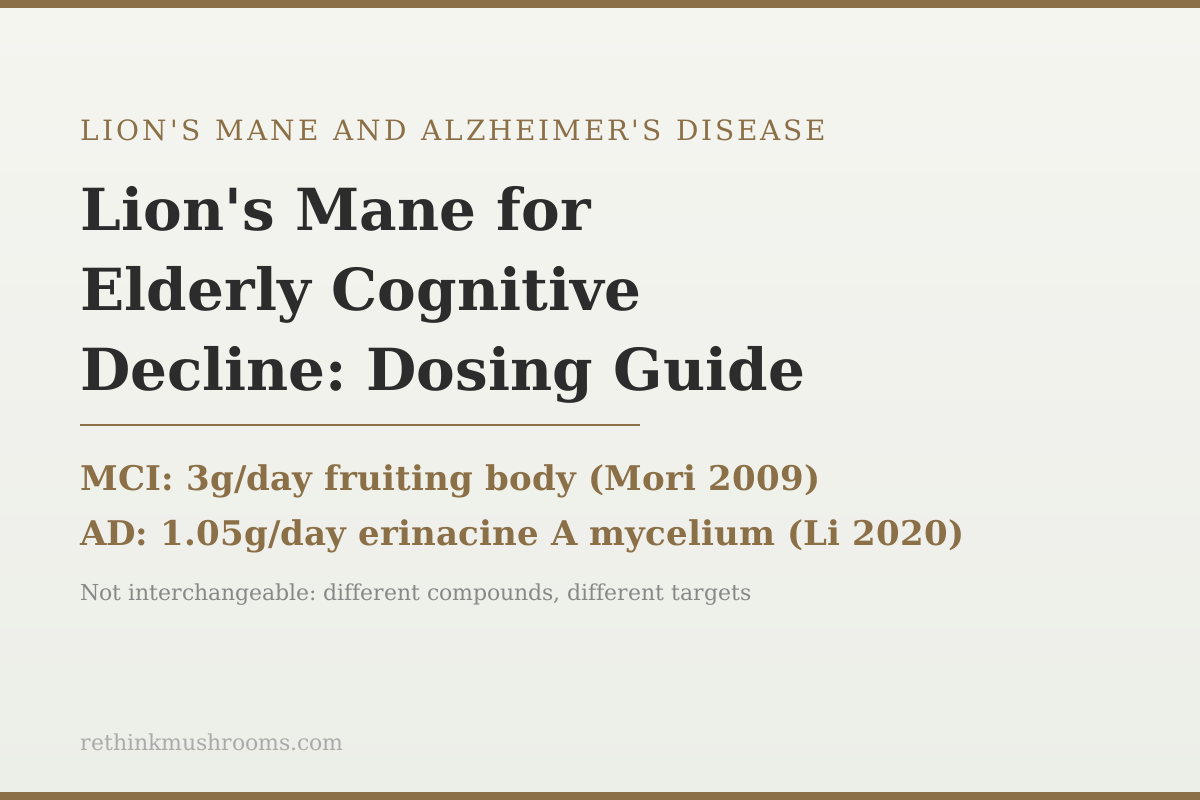
Not interchangeable: whole fruiting body (Mori 2009, 3g/day) and erinacine A-enriched mycelium (Li 2020, 1.05g/day) target different compounds
The two most-cited lion's mane cognitive decline trials used completely different preparations. Mori 2009 used whole fruiting body powder at 3g/day. Li 2020 used erinacine A-enriched mycelium at 1.05g/day. Erinacine A occurs primarily in mycelium, not fruiting body. A consumer buying fruiting body extract for Alzheimer's protection is not getting the compound tested in the Alzheimer's RCT.
Mori et al., 2009; Li et al., 2020
8 weeks
the earliest timepoint at which Mori 2009 recorded cognitive scores significantly above placebo in adults with MCI; scores continued to rise through weeks 12 and 16
Effects reverse
in Mori 2009, scores had fallen significantly by 4 weeks after intake stopped, indicating the benefit was not retained once supplementation ended
Erinacine A only
Li and colleagues' 2018 review reports erinacine A as the only H. erinaceus compound with confirmed pharmacological action in the central nervous system, and it is a mycelium compound rather than a fruiting body one
Mori et al., 2009; Li et al., 2020
 View as image ↗
Every lion's mane dosing guide for cognitive decline starts with a number: "take 1,000mg daily" or "studies used 3g per day." What almost none of them include is the preparation context that determines whether the number means anything: 3g of what? From which part of the mushroom? Processed how?
The most important fact in lion's mane cognitive dosing: the two main clinical trials used entirely different preparations containing different active compounds. Mori 2009 used whole fruiting body. Li 2020 used erinacine A-enriched mycelium. Erinacine A — the compound linked to amyloid and tau changes in Alzheimer's animal models — is found primarily in the mycelium, not the fruiting body. A supplement labeled "lion's mane fruiting body extract" does not provide the compound that was tested in the Alzheimer's trial.
For the broader lion's mane overview, see what is lion's mane mushroom: a science-based overview. For the Alzheimer's clinical evidence specifically, see lion's mane and Alzheimer's disease: what research shows.
Key Takeaways
- Mori 2009 (MCI RCT) gave four 250mg tablets of 96% dried fruiting body powder three times daily — 3g/day of tablets, about 2.88g of powder — for 16 weeks; this preparation delivers hericenones and beta-glucans rather than erinacines
- Li 2020 (mild Alzheimer's RCT) used three 350mg erinacine A-enriched mycelium capsules daily — 1.05g/day, standardized to 5mg/g erinacine A — for 49 weeks; erinacine A is a mycelium compound and is largely absent from fruiting body preparations
- Li and colleagues (2018) reviewed the erinacine literature and reported that erinacine A is the only H. erinaceus compound with confirmed pharmacological action in the central nervous system, and that this was established in rats rather than humans
- Saitsu and colleagues (2019) ran a 12-week randomized placebo-controlled trial of a fruiting body supplement; of three cognitive instruments, MMSE alone improved significantly, while the Benton visual retention test and S-PA did not. The published abstract does not state the dose used
- Effects reversed in Mori 2009: scores had fallen significantly 4 weeks after intake stopped, so the benefit observed depended on continued intake rather than persisting after a fixed course
- Safety in these trials was acceptable but not incident-free: Mori 2009 reported no adverse effect on laboratory tests, while Li 2020 lost four participants to abdominal discomfort, nausea and skin rash
The Critical Distinction: What Different Products Actually Deliver
Lion's mane contains two primary classes of neurologically active compounds:
Hericenones are found in the fruiting body (the mushroom cap and flesh). They are the compound class credited with the NGF-stimulating activity of fruiting body preparations, and they are what the Mori 2009 MCI trial and most commercially available fruiting body supplements deliver. What has not been established is how much of a hericenone dose reaches the brain in humans.
Erinacines are found in the mycelium (the root-like network). Li and colleagues (2018), reviewing the neurohealth properties of erinacine-enriched mycelia, reported that of all the compounds in H. erinaceus, only erinacine A has confirmed pharmacological action in the central nervous system — and that this was demonstrated in rats.[5] That review is the basis for treating erinacine A as the compound with the strongest mechanistic case for reaching the brain, not a head-to-head measurement of erinacine and hericenone brain penetration. No such comparison has been published in humans.
Erinacine A is the compound linked to amyloid beta and tau changes in Alzheimer's disease animal models. It is mycelium-derived; fruiting body extracts have very low or undetectable erinacine A content. This is a compositional fact about the two parts of the mushroom, and it holds regardless of how the human brain-penetration question eventually resolves.
This has a direct consumer consequence: if the reason for taking lion's mane for cognitive decline is the Alzheimer's pathway (amyloid, tau, neuroinflammation), the preparation that was actually tested in the clinical trial uses erinacine A-enriched mycelium. Buying a fruiting body supplement based on the Li 2020 trial is a mismatch between the product and the evidence.
Dosing Table: What Each Trial Used
| Trial | Population | Preparation | Dose | Duration | Primary Result |
|---|---|---|---|---|---|
| Mori 2009 | 30 randomized, MCI, ages 50–80 | Whole fruiting body tablets (96% dry powder) | 3g/day of tablets (~2.88g powder) | 16 weeks | HDS-R significantly above placebo at weeks 8, 12 and 16; scores fell significantly 4 weeks after stopping |
| Li 2020 | 49 randomized with mild AD, 41 completed | Erinacine A-enriched mycelium capsules, 5mg/g | 1.05g/day (5.25mg erinacine A) | 49 weeks | MMSE improved in the treatment group; IADL differed between groups; CASI declined in placebo; better contrast sensitivity |
| Saitsu 2019 | Adults assessed on three cognitive instruments | Fruiting body supplement | Not stated in the abstract | 12 weeks | MMSE improved significantly; Benton visual retention and S-PA did not |
These are the three human trials most often cited for lion's mane and cognitive decline. (Other human trials exist — for example in healthy young adults — but they test cognition in people without impairment, which is a different question.) The three use different preparations at different doses for different durations in different populations, and they do not report the same outcome measures. Treating them as equivalent for dosing guidance produces bad consumer advice.
Three trials, three protocols
Why the dose numbers cannot be compared to each other
These are the three published human trials of lion's mane for cognitive function in adults. They tested different parts of the mushroom, delivering different compound classes, for different durations, in different populations. There is no shared dose axis here because no source establishes one.
Mori 2009
Phytotherapy Research
Double-blind RCT · PMID 18844328
Dried whole powder, tabletted (96% dry powder)
Compound class
Hericenones
+ beta-glucans
Daily dose
3.0 g/day
four 250 mg tablets × 3 daily (~2.88 g dry powder)
Duration
16 weeks
+ 4-week washout observation
Population
30 adults with MCI, ages 50–80
What improved
HDS-R significantly above placebo at weeks 8, 12 and 16
Also reported
Scores fell significantly 4 weeks after stopping
Saitsu 2019
Biomedical Research
Double-blind RCT · PMID 31413233
Fruiting body supplement
Compound class
Hericenones
attributed by authors
Daily dose
Not stated
the abstract reports no administered amount
Duration
12 weeks
shortest of the three trials
Population
Adults assessed on three cognitive instruments
What improved
MMSE significantly improved
Also reported
Benton visual retention and S-PA did not
Li 2020
Frontiers in Aging Neuroscience
Pilot double-blind RCT · PMID 32581767
Erinacine A-enriched mycelium capsules, standardized to 5 mg/g
Compound class
Erinacine A
5.25 mg delivered daily
Daily dose
1.05 g/day
three 350 mg capsules daily
Duration
49 weeks
+ 3-week screening period
Population
49 randomized with mild AD, 41 completed
What improved
Higher CASI, MMSE and IADL scores; better contrast sensitivity
The practical consequence: a dose copied from one column does not carry the evidence from another. Taking 3 g of a mycelium product does not reproduce Mori 2009, and taking 1.05 g of a fruiting body product does not reproduce Li 2020. No trial has compared these preparations head to head.
Sources: Mori et al. (2009) Phytother Res, PMID 18844328; Saitsu et al. (2019) Biomed Res, PMID 31413233; Li et al. (2020) Front Aging Neurosci, PMID 32581767 (NCT04065061).
Mori 2009: The 3g/Day Fruiting Body Protocol
Mori and colleagues (2009) gave participants four 250mg tablets, each containing 96% Yamabushitake (Hericium erinaceus) dry powder, three times daily.[2] That is 3g of tablets per day, delivering roughly 2.88g of dried fruiting body powder. The commonly quoted "3g/day" is the tablet mass, not the mushroom mass.
This preparation delivers hericenones and beta-glucan polysaccharides rather than erinacines. The trial measured cognition with a scale based on the Revised Hasegawa Dementia Scale (HDS-R), and the treatment group scored significantly above placebo at weeks 8, 12 and 16, with scores rising as intake continued.
The population was 30 Japanese adults with diagnosed mild cognitive impairment, ages 50–80, randomized into two 15-person groups after a 2-week preliminary examination. This is a small trial, and the group sizes are the main reason its result is best described as promising rather than settled.
The dose is from dried mushroom powder, not concentrated extract. Many commercially available lion's mane supplements are concentrated extracts sold in smaller nominal doses; matching them to this protocol requires knowing the extract ratio, because a gram of concentrate is not a gram of dried mushroom.
For mild cognitive impairment without an Alzheimer's diagnosis, Mori 2009 is the closest thing to a matching protocol, simply because it is the only trial that enrolled that population and reported its dose. That is a statement about which trial fits the question, not a recommendation to take 3g/day.
Li 2020: The 1.05g/Day Erinacine A-Enriched Mycelium Protocol
Li and colleagues (2020) tested three erinacine A-enriched mycelium capsules per day in patients with mild Alzheimer's disease, following a 3-week no-drug screening period with a 49-week double-blind treatment period.[1] Sixty-eight patients were recruited, 49 were randomized, and 41 completed.
The trial report specifies capsules of 350mg each containing 5mg/g erinacine A. Three capsules is 1.05g/day, which at 5mg/g delivers 5.25mg of erinacine A daily. That second number is the one that actually characterizes the dose, and it is the number retail labels almost never provide.
Li 2020 protocol · dose derivation
How 1.05 g/day becomes 5.25 mg of erinacine A
The Alzheimer's trial dose is usually quoted as “1.05 g/day”, but the gram figure is not the active quantity. The trial capsules were standardized to a stated erinacine A concentration, and that is what makes the dose reproducible.
What a label must state to match this protocol
Erinacine A content per gram
Li 2020 standardized to 5 mg/g. Without this number the dose cannot be reconstructed.
Mycelium, not fruiting body
Erinacines occur in the mycelium. A fruiting body extract does not carry this compound.
Total daily grams
The trial delivered 1.05 g/day. Capsule counts alone do not fix the amount.
Most retail mycelium products state a total weight only. Where erinacine A content is not disclosed, the delivered amount of the compound is unknown and the Li 2020 dose cannot be verified against the product, in either direction.
Source: Li et al. (2020) Frontiers in Aging Neuroscience, PMID 32581767, NCT04065061. Arithmetic performed on the two concentrations reported in that trial.
The results were mixed in an informative way rather than uniformly positive. Cognitive Abilities Screening Instrument (CASI) scores declined significantly in the placebo group; MMSE improved significantly in the treatment group; and Instrumental Activities of Daily Living (IADL) scores differed significantly between the two groups. The treatment group also achieved significantly better contrast sensitivity. Several blood biomarkers moved unfavourably in placebo only. Note the shape of this: part of the effect is the treatment group improving, and part is the placebo group deteriorating while the treatment group held steady. Those are different claims, and a supplement label that compresses them into "clinically proven to improve cognition" is overstating the trial.
The implications for consumers: to follow this protocol, the relevant product specification is not "lion's mane mycelium" but erinacine A content per gram. A product that does not state erinacine A content cannot be matched to the trial in either direction — it may deliver more, less, or none.
At 49 weeks the Li 2020 trial is the longest lion's mane cognitive study, and that duration is its main contribution. It remains a pilot study with 41 completers, and its authors present it as such.
Saitsu 2019: 12 Weeks, and Only One Instrument Moved
Saitsu and colleagues (2019) ran a randomized, double-blind, placebo-controlled parallel-group trial of a supplement containing H. erinaceus fruiting body over 12 weeks.[3]
The trial used three cognitive instruments: the Mini Mental State Examination (MMSE), the Benton visual retention test, and the Standard verbal paired-associate learning test (S-PA). MMSE alone showed a significant improvement. The Benton and S-PA results did not.
That split is the most useful thing about this trial, and it is usually left out when the study is cited. A trial in which one of three prespecified cognitive measures moves is weaker evidence than "improved cognitive function" implies. It is compatible with a real but narrow effect; it is also compatible with a chance finding across multiple measures. Reporting only the positive instrument turns an ambiguous result into a clean one.
Two further limits matter for anyone trying to use this trial for dosing. First, the published abstract does not state how much H. erinaceus the supplement provided, so this trial cannot be used to set a dose at all. Second, at 12 weeks it is the shortest of the three trials, not the longest — it does not extend the evidence beyond Mori 2009's 16 weeks, and it says nothing about what happens after a year.
Why Duration Matters More Than Dose
The most common consumer mistake with lion's mane for cognitive decline is testing it for 2-4 weeks and concluding it does not work.
The Mori 2009 trial found the first significant difference from placebo at week 8, and scores continued rising through weeks 12 and 16. Saitsu 2019 measured at 12 weeks. Li 2020 ran for 49 weeks. None of the three trials reported a significant cognitive benefit within the first month, and none was designed to look for one.
A plausible reason is that NGF-linked neuroplasticity is a structural process rather than an acute pharmacological one: new connections form and mature over weeks, not days. That explanation is consistent with the trial timings but is not itself something these three trials tested — they measured cognition, not neural structure. It is the reasoning behind the timescale, not evidence for it.
For elderly individuals and caregivers setting expectations, the defensible statement is narrower than "give it 12–16 weeks and you will know." It is this: no trial has demonstrated a cognitive benefit before week 8, so a two- or four-week trial of a supplement is not a meaningful test. What a 12–16 week trial in one person can show is also limited — the trials measured group averages against placebo, and an individual without a comparison condition cannot distinguish a supplement effect from a good few months.
Safety at These Doses
The safety picture in these trials is reassuring but should be stated from the trials themselves rather than from summary language.
Mori 2009 reported that laboratory tests showed no adverse effect of Yamabushitake over 16 weeks.[2] Li 2020 reported no adverse events other than four subjects who dropped out of the study due to abdominal discomfort, nausea and skin rash.[1] That second detail is worth keeping rather than rounding off: four withdrawals out of 49 randomized is a real tolerability signal, and it contradicts the common claim that side effects reliably resolve without stopping. In that trial, some people stopped.
Contato and colleagues' 2025 narrative review surveys H. erinaceus bioactives and their antioxidant, anti-inflammatory and antimicrobial activity, and concludes that clinical validation remains limited and that large-scale trials and pharmacokinetic work are still needed.[4] That is the accurate summary of where this field is: an encouraging preclinical literature, a small number of modest human trials, and no large confirmatory trial yet.
For elderly patients taking multiple medications, no drug-interaction studies for lion's mane have been published. That is an absence of evidence rather than evidence of safety, and it is a reason to disclose supplement use to the prescribing clinician rather than a reason to be reassured.
This article describes what the published trials measured. It is not medical advice, and it is not a treatment recommendation for Alzheimer's disease, mild cognitive impairment, or any other condition. Decisions about supplements in a diagnosed or medicated older adult belong with that person's clinician.
The Bottom Line
Two dosing protocols anchor this topic: Mori 2009 (3g/day of tablets that were 96% dried fruiting body, 16 weeks, MCI) and Li 2020 (1.05g/day erinacine A-enriched mycelium standardized to 5mg/g, so 5.25mg erinacine A daily, 49 weeks, mild AD). They are not interchangeable, because erinacine A is a mycelium compound and fruiting body preparations deliver hericenones instead. Saitsu 2019 adds a 12-week fruiting body trial in which MMSE improved but two other cognitive measures did not, and which does not report its dose. Mori 2009's washout — scores fell significantly 4 weeks after intake stopped — indicates the benefit depended on continued intake. Safety across the trials was acceptable but not incident-free: Li 2020 lost four participants to abdominal discomfort, nausea and skin rash, and Contato 2025 concludes clinical validation of H. erinaceus remains limited.
Frequently Asked Questions
Sources & References
- 1RTHM-00631·Li, I-Chen et al. (2020). “Prevention of Early Alzheimer's Disease by Erinacine A-Enriched Hericium erinaceus Mycelia Pilot Double-Blind Placebo-Controlled Study..” Frontiers in aging neuroscience.Study breakdown →PubMed →↩
- 2RTHM-00165·Mori, Koichiro et al. (2009). “Improving effects of the mushroom Yamabushitake (Hericium erinaceus) on mild cognitive impairment: a double-blind placebo-controlled clinical trial..” Phytotherapy research : PTR.Study breakdown →PubMed →↩
- 3RTHM-00585·Saitsu, Yuusuke et al. (2019). “Improvement of cognitive functions by oral intake of Hericium erinaceus..” Biomedical research (Tokyo.Study breakdown →PubMed →↩
- 4RTHM-00921·Contato, Alex Graça et al. (2025). “Lion's Mane Mushroom (Hericium erinaceus): A Neuroprotective Fungus with Antioxidant, Anti-Inflammatory, and Antimicrobial Potential-A Narrative Review..” Nutrients.Study breakdown →PubMed →↩
- 5RTHM-00973·Li, I-Chen et al. (2018). “Neurohealth Properties of Hericium erinaceus Mycelia Enriched with Erinacines..” Behavioural neurology.Study breakdown →PubMed →↩