Lion's Mane and Alzheimer's Disease
49 weeks double-blind pilot RCT in mild Alzheimer's: the erinacine A group ended with higher MMSE, CASI, and IADL scores than placebo, but the trial enrolled only 49 patients
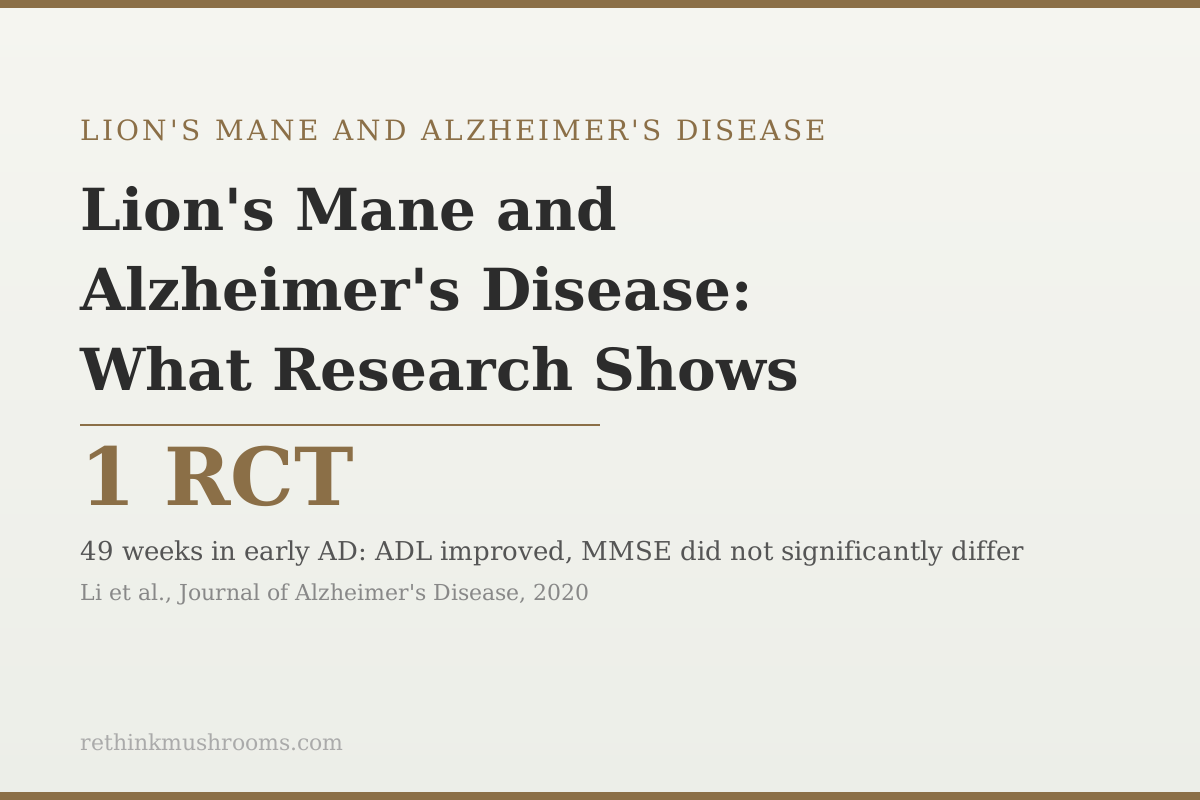
Li and colleagues (2020) conducted the only randomized controlled trial of lion's mane specifically in diagnosed Alzheimer's disease patients. The 49-week pilot reported significant improvement in Mini-Mental State Examination (MMSE) scores within the erinacine A group and a significant between-group difference in instrumental activities of daily living (IADL) favoring treatment, alongside better contrast sensitivity. It was a small pilot, so these signals need replication in larger trials before any clinical recommendation.
Li et al., Frontiers in Aging Neuroscience, 2020
Preclinical pathways
animal and review evidence links lion's mane to amyloid-beta reduction and reduced neuroinflammation; Ratan et al. (2025) and Zhang et al. (2025) synthesized the broader neuroprotective and neurotrophic picture across preclinical models
NGF mechanism
Kim et al. (2008) established NGF-inducing activity in human astrocytoma cells; NGF maintains the basal forebrain cholinergic neurons that are among the earliest to degenerate in Alzheimer's disease
Pilot study limitation
the Li 2020 trial enrolled only 49 patients and four dropped out; a sample this small cannot establish efficacy, and the positive signals require replication in adequately powered trials
Li et al., Frontiers in Aging Neuroscience, 2020
 View as image ↗
Six million Americans live with Alzheimer's disease. Families search for safe supplements that might help. Lion's mane is one of the most searched. Here is what the evidence actually shows: one small clinical trial with encouraging results, and strong mechanistic preclinical evidence that has not yet been confirmed in larger human trials.
The clinical trial is a 49-week double-blind placebo-controlled pilot study in 49 patients with mild Alzheimer's disease. After 49 weeks, the erinacine A-enriched mycelium group ended with significantly higher MMSE and CASI cognitive scores and a significant between-group advantage in instrumental activities of daily living (IADL), while the placebo group declined on several of these measures. The catch is scale: with only 49 patients enrolled and four dropouts, a single pilot cannot establish efficacy no matter how the numbers fall. The honest framing is neither "lion's mane treats Alzheimer's" nor "no evidence" — it is "one promising small trial that still needs to be replicated." For the mechanisms specifically, see lion's mane and amyloid beta: mechanisms of neuroprotection. For the broader lion's mane overview, see what is lion's mane mushroom: a science-based overview.
Not Medical Advice
ModerateThis article describes research, not a treatment plan
Concern
Alzheimer's disease is a serious progressive condition. The evidence below comes from a single small pilot trial and preclinical models. It does not establish that lion's mane treats, prevents, or slows Alzheimer's disease.
What the research says
Lion's mane was well tolerated in the Li 2020 trial, with four of 49 participants withdrawing for abdominal discomfort, nausea, or skin rash. No supplement should replace evaluation and care from a qualified clinician, and supplements can interact with prescribed medications.
Particularly relevant for: People with diagnosed Alzheimer's disease or mild cognitive impairment, and their caregivers, considering supplementation.
What to do
Discuss any supplement with the treating physician before starting, especially alongside cholinesterase inhibitors or other prescribed therapies.
Li et al., Frontiers in Aging Neuroscience, 2020
Key Takeaways
- Li and colleagues (2020) conducted a 49-week double-blind placebo-controlled pilot trial in 49 patients with mild Alzheimer's using three erinacine A-enriched mycelium capsules per day (350 mg/capsule, 5 mg/g erinacine A); the treatment group ended with significantly higher MMSE and CASI cognitive scores and a significant between-group advantage in instrumental activities of daily living (IADL)
- This is encouraging but it is a single pilot with only 49 patients and four dropouts; a trial that small cannot confirm efficacy, and the result needs replication in larger, longer studies before any clinical recommendation
- Li and colleagues (2016) demonstrated that erinacine A-enriched mycelium reduces amyloid-beta plaque burden, lowers plaque-activated microglia and astrocytes, raises the NGF-to-proNGF ratio, and promotes hippocampal neurogenesis in APPswe/PS1dE9 transgenic Alzheimer's mice
- Zhang and colleagues' 2025 PRISMA systematic review of erinacines confirmed broad neuroprotective and neurotrophic effects across cellular and rodent models, while noting that outcomes depended heavily on the chemical complexity of the preparation used
- Kim and colleagues (2008) established that H. erinaceus extract induces NGF gene expression in human astrocytoma cells via JNK signaling; NGF maintains basal forebrain cholinergic neurons that degenerate early in Alzheimer's disease, the mechanistic basis for a possible preventive role
- Kushairi and colleagues (2023) and Ratan and colleagues (2025) note that despite a large preclinical literature, only a handful of human trials exist; larger trials, longer durations, standardized preparations, and validated biomarkers are needed before clinical practice recommendations can be made
The One Clinical Trial: What Li 2020 Actually Found
The field of lion's mane and Alzheimer's disease rests on a single human clinical trial: Li and colleagues' 2020 49-week double-blind placebo-controlled pilot study.[1]
The study enrolled 49 patients with mild Alzheimer's disease, randomized to three erinacine A-enriched Hericium erinaceus mycelium capsules daily (350 mg per capsule, containing 5 mg/g erinacine A) or identical-looking placebo for 49 weeks, after a three-week no-drug screening period. This is the longest lion's mane cognitive trial published and the only one specifically in diagnosed Alzheimer's patients rather than mild cognitive impairment.
Li et al. (2020) · Frontiers in Aging Neuroscience
- Population
- 49 patients with mild Alzheimer's disease (4 withdrew for GI or skin effects)
- Intervention
- 3 erinacine A-enriched H. erinaceus mycelium capsules/day (350 mg each, 5 mg/g erinacine A) for 49 weeks
- Comparator
- Identical-appearing placebo capsules, double-blind
- Finding
- Treatment group ended with significantly higher MMSE and CASI cognitive scores and a significant between-group IADL advantage; placebo group declined on several measures. Contrast sensitivity also improved with treatment.
preliminary A genuinely positive pilot — but a pilot. With 49 patients it can generate a hypothesis worth a larger trial; it cannot establish that lion's mane is an effective Alzheimer's treatment.
Li et al., Frontiers in Aging Neuroscience, 2020 (NCT04065061)
The cognitive findings were positive. After 49 weeks, the erinacine A group showed a significant improvement in Mini-Mental State Examination (MMSE) scores, while the placebo group showed a significant decline on the Cognitive Abilities Screening Instrument (CASI). MMSE is the standard cognitive screening tool that measures orientation, attention, memory, language, and visual-spatial abilities on a 0–30 point scale; CASI is a more detailed cognitive battery.
The trial also found a significant between-group difference in instrumental activities of daily living (IADL) favoring the treatment group. IADL measures what patients can actually do in daily life: managing finances, using transportation, preparing meals, managing medications. The treatment group additionally achieved significantly better contrast sensitivity, and neuroimaging (diffusion tensor imaging) showed divergent changes between the groups in white-matter and hippocampal-region measures.
So both the cognitive scores and the functional measures moved in the same favorable direction — which is exactly why the trial is worth taking seriously, and exactly why it cannot be the last word. Some outlets cite it as proof that "lion's mane improves Alzheimer's cognition"; others wave it away. Both miss the real status: this is one small, promising pilot whose every result is provisional until a larger trial reproduces it.
Why "Promising Pilot" Is the Right Label
A positive result in a 49-patient trial is encouraging, not conclusive. Understanding why keeps the evidence in proportion.
Small trials are noisy. With only a few dozen participants per arm, a real effect and a chance fluctuation can look similar, and effects measured in small samples tend to shrink — or vanish — when the study is repeated at scale. This is why drug development does not stop at a pilot: a Phase 2 signal has to survive a larger, confirmatory Phase 3 trial. Lion's mane has not had that confirmatory trial in diagnosed Alzheimer's disease.
Four of the 49 enrolled patients dropped out for abdominal discomfort, nausea, or skin rash. That is a small number, but in a trial this size, who completes and who leaves can shift the results — another reason a single pilot cannot settle the question.
- Cell studiescompleted
Kim 2008: H. erinaceus induces NGF gene expression in human astrocytoma cells
- Animal modelscompleted
Li 2016: erinacine A mycelium reduces amyloid plaque burden and neuroinflammation in APP/PS1 Alzheimer's mice
- Small human trialcurrent
Li 2020: 49-patient pilot RCT, positive MMSE/CASI/IADL signals over 49 weeks
- Large confirmatory RCTmissing
No adequately powered trial in diagnosed Alzheimer's disease has been published
- Meta-analysismissing
Too few human AD trials exist to pool
The mechanism and animal evidence are well developed, and the single human pilot points the right way. The decisive step — a large, properly powered trial in diagnosed patients — has not been taken.
Kim et al. 2008; Li et al. 2016; Li et al. 2020; Kushairi et al. 2023
The Animal Evidence: Li 2016 and the Mechanistic Foundation
Li and colleagues (2016) established the mechanistic basis for the human trial before it was conducted.[2]
Their study used APPswe/PS1dE9 transgenic mice, the standard amyloid-based Alzheimer's disease mouse model. After 30 days of oral erinacine A-enriched mycelium, the treated mice showed reduced amyloid-beta plaque burden (notably the loosely structured, non-compact plaque), fewer plaque-activated microglia and astrocytes in the cortex and hippocampus, a higher ratio of nerve growth factor (NGF) to its precursor proNGF, and increased hippocampal neurogenesis.
These targets explain why erinacines are mechanistically relevant to Alzheimer's disease rather than only to general cognitive aging. The amyloid plaque and neuroinflammation findings address two of the disease's defining features directly, in the same erinacine A-enriched preparation later used in the human trial. That said, this is a mouse model: amyloid-overexpressing transgenic mice replicate part of Alzheimer's pathology, and many compounds that clear plaque in mice have failed to help patients. The animal data justify a human trial; they do not substitute for one.
What the 2025 Reviews Add
Three 2025 papers each synthesized the lion's mane Alzheimer's evidence from different angles. All three are reviews of preclinical work, not new human trials — they organize the mechanistic case rather than extend the clinical one.
Zhang and colleagues (2025) published a PRISMA systematic review of erinacines' neuroprotective effects across cellular and rodent models, documenting broad neuroprotective and neurotrophic activity and noting that study outcomes were strongly influenced by the chemical complexity of the preparation administered — a reminder that "lion's mane" is not a single standardized substance.[3]
Ratan and colleagues (2025) reviewed H. erinaceus as a possible future therapeutic for the prevention and delayed progression of Alzheimer's disease, weighing three human clinical trials and thirteen animal-model studies. They concluded the neurotrophic and neuroprotective preclinical foundation is compelling while clinical translation remains the critical, still-unmet next step.[4]
Chen and colleagues (2025) provided a narrative review of H. erinaceus as a neuroprotective fungus, documenting its antioxidant, anti-inflammatory, and antimicrobial properties — driven by its polysaccharides, terpenoids (hericenones and erinacines), and phenolic compounds — and placing the Alzheimer's-specific evidence in that broader context.[5]
The NGF Foundation: Why Prevention May Be the Strongest Case
Kim and colleagues (2008) established that H. erinaceus extract induces NGF gene expression in human 1321N1 astrocytoma cells through JNK signaling — the foundational in vitro evidence for lion's mane's neurotrophic activity. Notably, the isolated hericenones C, D, and E did not drive this effect, indicating the NGF induction comes from other constituents of the extract.[7]
NGF is particularly important in the Alzheimer's disease context because basal forebrain cholinergic neurons, the cells most dependent on NGF for survival, are among the earliest to degenerate in Alzheimer's disease. These neurons project to the hippocampus and cortex and are critical for memory encoding. When they degenerate, the memory problems of early Alzheimer's emerge.
Maintaining NGF levels through supplementation could theoretically protect these cholinergic neurons before significant degeneration occurs, which would make the strongest theoretical case a preventive or early-intervention one rather than treatment of established disease. This is consistent with the Li 2020 trial enrolling mild rather than advanced patients, and with the lion's mane MCI literature, where the population shows earlier changes. This remains a mechanistic hypothesis: no human prevention trial has tested it. For the MCI-specific clinical trial data, see lion's mane and mild cognitive impairment: clinical trial results.
What Would Change the Evidence Status
Kushairi and colleagues (2023) reviewed the state of H. erinaceus evidence in neurodegenerative diseases from bench to bedside, and found that despite an extensive preclinical literature only a limited number of human clinical trials exist.[6]
The gaps are concrete. The Li 2020 study is a single 49-patient pilot; a properly powered confirmatory trial would need far more participants to determine whether its cognitive and functional signals are real and how large the effect is. Longer duration would allow more time for any NGF-driven structural changes to accumulate. Standardized preparations with verified erinacine A content would allow dose-response analysis and make results comparable across studies. Biomarker tracking (amyloid burden by PET, tau in CSF) would test whether the preclinical mechanism translates to measurable pathology change in humans.
Each of these gaps is fillable with sufficiently funded and designed trials, and the Li 2020 pilot provides the justification to run them. As of 2026, no such confirmatory trial in diagnosed Alzheimer's disease has been published.
The Bottom Line
The Li 2020 49-week pilot RCT in mild Alzheimer's patients reported significantly higher MMSE and CASI cognitive scores and a significant between-group IADL advantage for erinacine A-enriched mycelium versus placebo, along with better contrast sensitivity — a genuinely positive result, but from a single trial of only 49 patients with four dropouts. The preclinical base is strong: Li 2016 (reduced amyloid plaque burden and neuroinflammation, raised NGF/proNGF, more hippocampal neurogenesis in transgenic mice), Zhang 2025 (PRISMA systematic review of erinacine neuroprotective effects), and Ratan 2025 (three human trials and thirteen animal studies synthesized). Kim 2008 established the NGF-induction foundation for cholinergic neuron protection. Kushairi 2023 and Ratan 2025 identify the gap: large, properly powered trials with standardized preparations and biomarker tracking. The honest summary: one promising small pilot atop a solid preclinical foundation, with no confirmatory trial yet — encouraging, not established.
Frequently Asked Questions
Research vs. Retail
Erinacine A-enriched mycelium: Research vs. commercial doses
What research used
~1.05 g/day mycelium
Oral (3 × 350 mg capsules)
Three capsules daily · 49 weeks
Standardized to 5 mg/g erinacine A (Li 2020)
What supplements sell
500–3000 mg/day
Oral capsules or powder
Once or twice daily
Mostly fruiting-body extracts; erinacine A usually unmeasured
The number on a retail label is not comparable to the trial. The trial used erinacine A-standardized mycelium; most products are fruiting-body extracts whose erinacine A content is unknown.
- *Erinacines (mycelium) and hericenones (fruiting body) are different compound classes with different profiles.
- *No retail product has been tested in an Alzheimer's trial.
- *This is informational only and not a dosing recommendation.
Li et al., Frontiers in Aging Neuroscience, 2020
Sources & References
- 1. Source details for this reference are not yet available.
- 2. Source details for this reference are not yet available.
- 3. Source details for this reference are not yet available.
- 4. Source details for this reference are not yet available.
- 5. Source details for this reference are not yet available.
- 6. Source details for this reference are not yet available.
- 7. Source details for this reference are not yet available.