Lion's Mane (Hericium erinaceus)
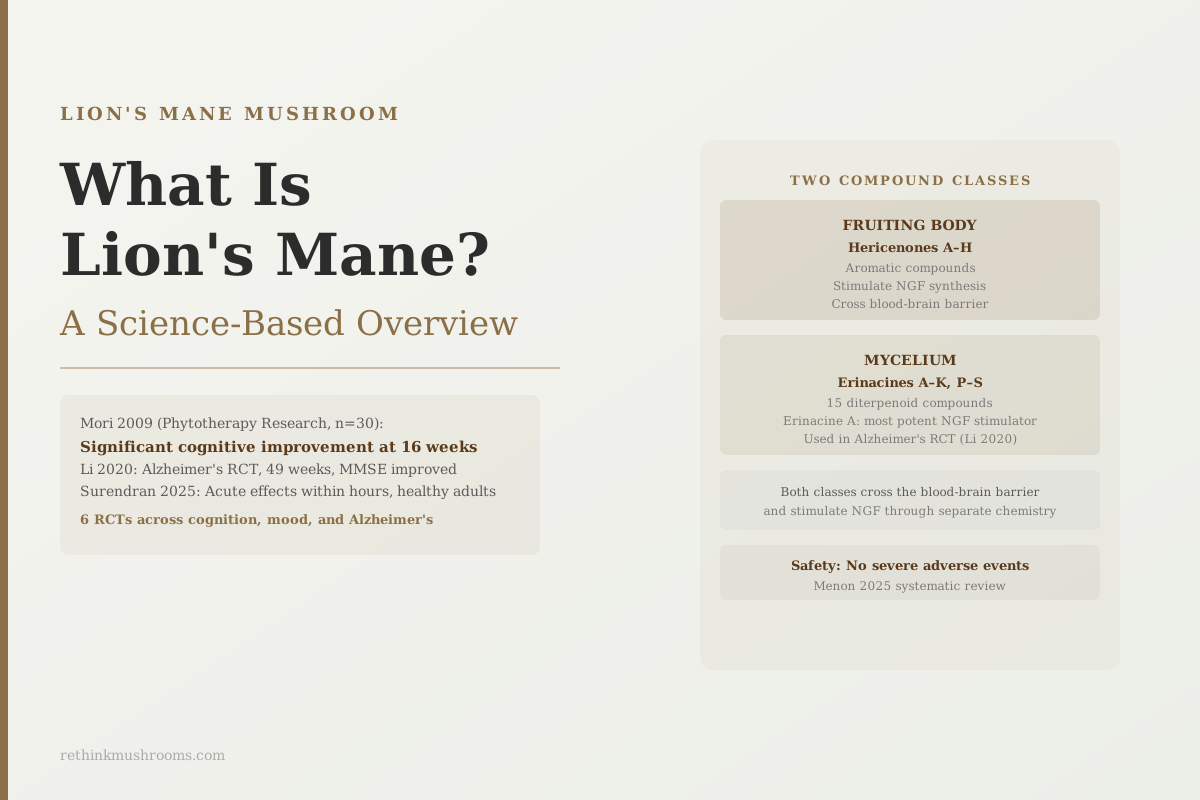
16 Weeks
In the landmark clinical trial, 30 adults with mild cognitive impairment taking Lion's Mane daily for 16 weeks showed significantly higher cognitive scores than placebo. Scores declined when supplementation stopped.
Mori et al., Phytotherapy Research, 2009
1985
Year of the first double-blind Lion's Mane RCT in humans
2 classes
Neuroactive compounds: hericenones (fruiting body) and erinacines (mycelium)
6 RCTs
Human clinical trials spanning cognitive decline, mood, and Alzheimer's
Mori et al., Phytotherapy Research, 2009
 View as image ↗
If you only read one thing
Lion's mane is a white, shaggy mushroom eaten as food and used as traditional medicine in East Asia for centuries. What sets it apart scientifically is that it contains two groups of compounds — one in the fruiting body, one in the roots — that prompt the brain to produce more nerve growth factor, a protein that keeps neurons healthy and helps them form new connections. Six clinical trials have tested it in people, mostly those with memory problems or early Alzheimer's disease, and the results have generally been positive. The honest caveat: all those trials were small, and larger confirmatory studies are still needed before this becomes a standard clinical recommendation.
Lion's mane mushroom (Hericium erinaceus) is a culinary and medicinal fungus native to Asia, Europe, and North America, identified by its cascading white spines. Two unique compound classes, hericenones in the fruiting body and erinacines in the mycelium, stimulate nerve growth factor synthesis and are the basis for its studied effects on cognition, mood, and neuroprotection.
That distinction between fruiting body and mycelium is not a minor detail. It determines which active compounds a supplement contains, and the research on one compound class does not automatically transfer to the other. A 2015 comprehensive chemistry review established that hericenones and erinacines are chemically distinct, found in different parts of the organism, and work through overlapping but separate pathways.[6]
The clinical evidence behind Lion's Mane spans from 1985 to 2025: six randomized controlled trials, six systematic reviews, and a 2024 systematic review of mushroom neurocognitive research that identified Lion's Mane as the most-studied mushroom for cognitive and mood outcomes, while noting that intervention study results have been mixed.[10] This article covers the mushroom's identity and traditional names, the two compound classes and what they do, the full clinical trial record, and the data relevant to evaluating a supplement.
Key Takeaways
- Lion's mane (Hericium erinaceus) is a culinary and medicinal mushroom native to temperate regions of North America, Europe, and Asia, with documented use in Japanese and Chinese traditional medicine for over a century
- Its two neuroactive compound classes are chemically distinct: hericenones (A-H) are found only in the fruiting body; erinacines (A-K, P-S) are found only in the mycelium, per Friedman's 2015 comprehensive chemistry review[6]
- Both compound classes cross the blood-brain barrier and stimulate nerve growth factor (NGF) production; a 2013 study found that H. erinaceus aqueous extract combined with exogenous NGF yielded the highest neurite outgrowth (60.6% increase) in laboratory nerve cells, with the extract alone also inducing NGF secretion from nerve cells[5]
- The landmark 2009 MCI trial showed significant cognitive improvement in 30 adults over 16 weeks, with scores declining after supplementation stopped, confirming a pharmacological rather than placebo effect[2]
- The strongest clinical evidence is a 49-week double-blind Alzheimer's RCT where erinacine A-enriched mycelium improved MMSE scores; the Lion's Mane group preserved key biomarker profiles (BDNF, amyloid-beta peptide 1-40) while the placebo group showed significant adverse changes vs. baseline[8]
- A 2025 systematic review found no severe adverse events across all published human trials; mild gastrointestinal upset was the primary documented side effect[14]
Fact Check
What supplement marketing claims vs. what the evidence shows
The claim
“Lion's mane is clinically proven to boost brain performance in healthy people”
Nootropics communities and supplement industry marketing
What research shows
OverstatedThe strongest clinical evidence comes from trials in people with mild cognitive impairment or early Alzheimer's disease — not healthy adults. Two trials in healthy younger adults found modest, domain-specific results: faster processing speed in one (Docherty 2023), and no significant composite cognitive improvement in another (Surendran 2025, n=18). 'Clinically proven brain booster' overstates what the data shows for healthy people.
The evidence is real and more rigorous than most botanical supplements, but it's concentrated in populations with cognitive deficits. A 2024 systematic review of 10 intervention studies found mixed results and called for larger, adequately-powered trials before conclusions can be drawn.
Cha et al. (2024), Neuroscience & Biobehavioral Reviews; Docherty et al. (2023), Nutrients; Surendran et al. (2025), Frontiers in Nutrition
What Lion's Mane Actually Is: Taxonomy, Appearance, and Why the Names Matter
Hericium erinaceus belongs to the Hericiaceae family. The fruiting body is a white, globular structure covered with long, cascading spines that hang downward in dense clusters, the visual basis for both the English name "lion's mane" and the Latin species name erinaceus, which means "hedgehog." In the wild, it grows on wounded or dying hardwood trees, particularly oaks and beeches, typically appearing in late summer through autumn.
It is simultaneously an edible culinary mushroom with a seafood-like texture and a medicinal species with documented pharmacological activity. This combination is relatively rare among fungi, and it holds across the traditional healing systems of both East Asia and Europe. A 2013 comprehensive review by Khan and colleagues catalogued its documented activities across antimicrobial, antidiabetic, hypolipidemic, antioxidant, neuroprotective, and anticancer domains. It was the broadest bioactivity profile review of the full H. erinaceus literature at the time.[4]
The traditional names tell part of the story. In Japan, the mushroom is yamabushitake, meaning "mountain monk mushroom," after the yamabushi mountain ascetics who reportedly used it. In China, it is hóutóugū (猴头菇), literally "monkey-head mushroom." The Japanese association with mental clarity and spiritual practice is consistent with the cognitive effects documented in modern trials. The Chinese use centered on what traditional pharmacopeias described as a five-organ tonic with particular relevance to the spleen and stomach. That digestive indication was the one tested in the very first clinical trial.
For a detailed look at where the traditional claims hold up against the clinical evidence and where they don't, see Lion's Mane Mushroom: Traditional Uses vs. Modern Research.
Two Compound Classes That Explain the Entire Supplement Debate
The most important structural fact about Lion's Mane is that its two major classes of neuroactive compounds are found in different parts of the organism and do not overlap.
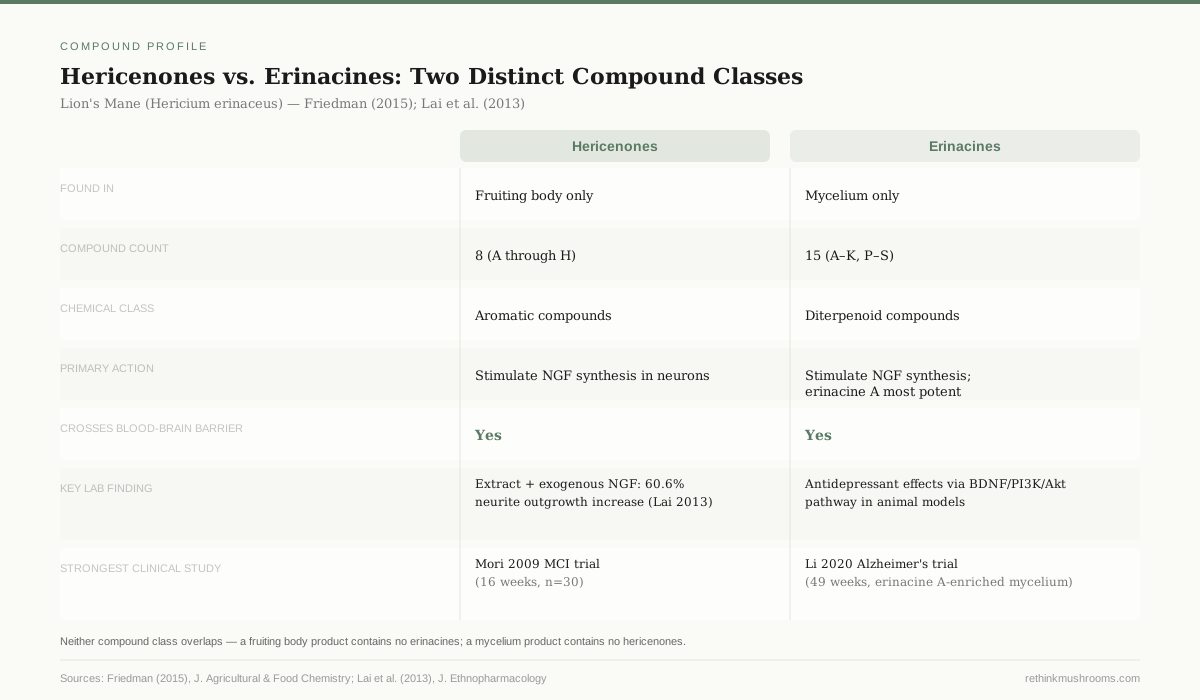
Compound Profile
Hericenones vs. Erinacines: Two Distinct Compound Classes
Hericenones
Erinacines
Found in
Fruiting body only
Mycelium only
Compound count
8 (A through H)
15 (A–K, P–S)
Chemical class
Aromatic compounds
Diterpenoid compounds
Primary action
Stimulate NGF synthesis in neurons
Stimulate NGF synthesis; erinacine A most potent
Crosses blood-brain barrier
Yes
Yes
Key lab finding
H. erinaceus aqueous extract + NGF yielded 60.6% neurite outgrowth increase
Erinacine A produces antidepressant-like effects via BDNF/PI3K/Akt pathway in animal models
Strongest clinical study
Mori 2009 MCI trial (16 weeks, n=30)
Li 2020 Alzheimer's trial (49 weeks, erinacine A-enriched mycelium)
Neither class overlaps — a fruiting body product contains no erinacines; a mycelium product contains no hericenones. The research on one doesn't automatically transfer to the other, which is why the source (fruiting body vs. mycelium) matters when interpreting clinical trial results.
Source: Friedman (2015), J. Agricultural & Food Chemistry; Lai et al. (2013), J. Ethnopharmacology
 View as image ↗
Friedman's 2015 comprehensive chemistry review in the Journal of Agricultural and Food Chemistry established the full compound profile of both the fruiting body and the mycelium.[6] The fruiting body contains hericenones A through H, eight aromatic compounds that stimulate the synthesis of NGF (nerve growth factor), a protein that helps neurons survive, grow new projections, and maintain their connections. The mycelium contains erinacines A through K and P through S, fifteen diterpenoid compounds with erinacine A as the most studied and potent NGF stimulator in the group.
Both compound classes cross the blood-brain barrier, which is central to their activity. NGF itself cannot cross the blood-brain barrier, which is why drug development targeting the NGF pathway directly has been technically difficult. The fact that hericenones and erinacines can enter the brain is what enables the cognitive effects seen in clinical trials.
A 2013 study by Lai and colleagues found that H. erinaceus aqueous extract, when combined with exogenous NGF, yielded the highest neurite outgrowth of the conditions tested, a 60.6% increase in laboratory nerve cells.[5] The extract alone also promoted neurite outgrowth and induced NGF secretion from nerve cells. The synergistic result with combined extract plus NGF suggests the mushroom's compounds activate pathways that complement rather than simply replicate exogenous NGF activity.
The practical consequence is significant. A supplement made from fruiting body extract contains hericenones and no erinacines. A supplement made from mycelium extract contains erinacines and no hericenones. A product claiming to contain both would theoretically include both compound classes, but without third-party testing of actual compound concentrations, label claims don't confirm what's present. The 2020 Alzheimer's RCT used a specifically formulated erinacine A-enriched mycelium product, not a standard fruiting body supplement, so that trial's results don't automatically generalize to all Lion's Mane products.
For the full compound profile, including the 15 individual erinacines, their specific activities, the newly characterized erinacine S (2024), and the role of ergothioneine, see Lion's Mane Bioactive Compounds: Hericenones, Erinacines, and Beyond.
This compound dichotomy is also the most concrete example in the broader debate about supplement sourcing. See Fruiting Body vs. Mycelium: The Great Mushroom Supplement Debate for the full comparison, including the grain starch contamination issue in mycelium products made on grain substrates.
How Lion's Mane Communicates with the Brain
The primary mechanism is NGF stimulation. Both erinacines and hericenones prompt neurons to produce more NGF, the protein that acts like a maintenance and growth signal across the nervous system. NGF tells neurons to survive, extend new fiber projections, maintain synaptic connections, and support the myelin sheath (the insulating layer around nerve fibers). This mechanism was identified as central to H. erinaceus's cognitive effects by Lai and colleagues in 2013 and confirmed across subsequent reviews.[5]
A 2015 systematic review by Phan and colleagues placed Lion's Mane as the strongest candidate among all medicinal mushrooms for NGF-mediated neuroprotection, with multiple validated mechanisms including anti-neuroinflammatory effects, anti-amyloid-beta activity, and direct promotion of nerve fiber growth.[7]
A separate pathway explains the mood and anxiety effects seen in human trials. Animal research has found that erinacine A-enriched mycelium produces antidepressant-like effects through the BDNF pathway (a chain of signaling molecules called BDNF/PI3K/Akt/GSK-3beta), the same cascade implicated in conventional antidepressant drug action. This is a mechanistically distinct pathway from the NGF pathway, which explains why Lion's Mane produces effects on both cognition and mood.
The 2025 review by Contato and Conte-Junior in Nutrients confirmed that hericenones and erinacines operate through complementary pathways: NGF stimulation, reactive oxygen species scavenging, and suppression of the inflammatory signaling molecule NF-kB. Together these explain the multi-domain effects across clinical trials.[11]
An open mechanistic question: the acute effect problem. NGF and BDNF upregulation require days to weeks before measurable changes accumulate. The Docherty 2023 trial found faster Stroop performance at 60 minutes post-dose, a timeframe incompatible with NGF/BDNF mechanisms. This suggests Lion's Mane may contain compounds that produce rapid, domain-specific neuromodulatory effects through other pathways that haven't been fully characterized. The Surendran 2025 acute crossover trial (n=18) did not find a significant composite cognitive benefit, but did observe improved pegboard performance at 90 minutes, suggesting that any acute effects are task-specific rather than broadly general.
For the complete pharmacological picture, including the myelination mechanism, the BDNF/PI3K/Akt pathway, and what is and isn't understood about the acute mechanism, see The Pharmacology of Hericium erinaceus: How Lion's Mane Works in the Body. For the specific NGF research trail, see Lion's Mane and Nerve Growth Factor: The Complete Research Guide.
What 40 Years of Clinical Evidence Actually Shows
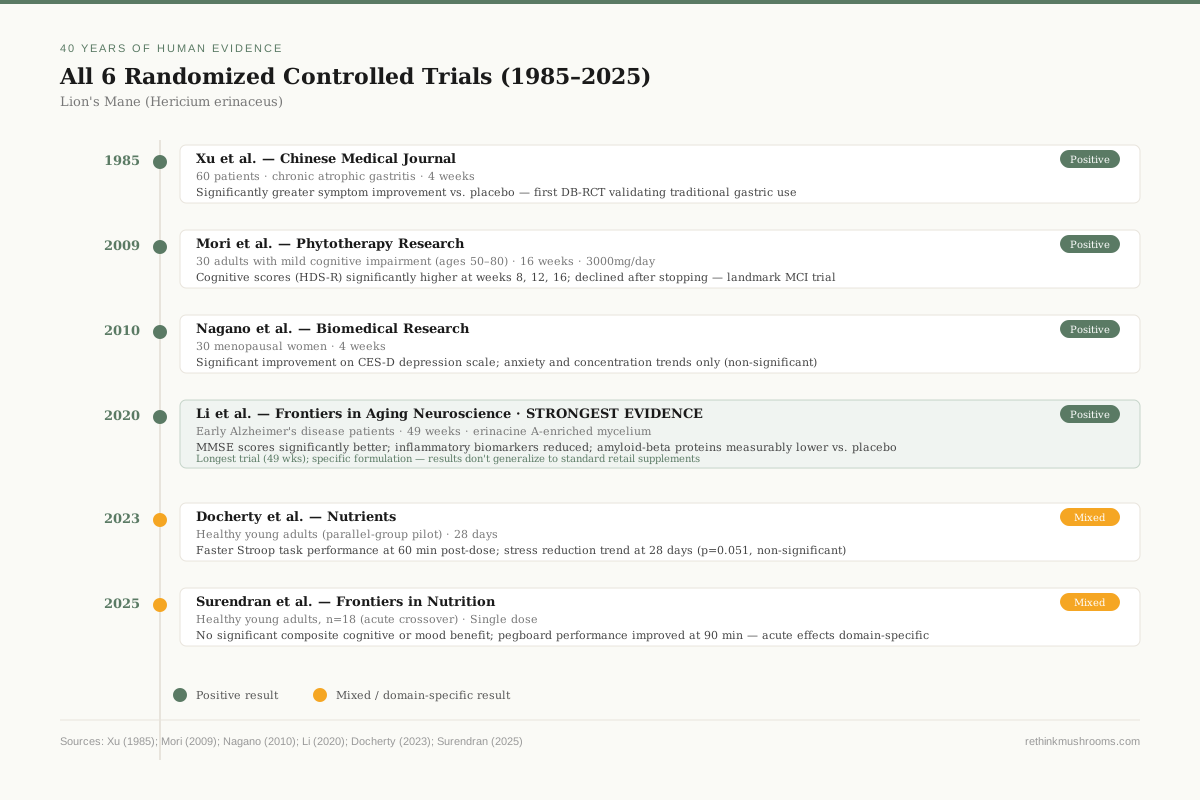
40 Years of Human Evidence
All 6 Randomized Controlled Trials (1985–2025)
Xu et al. — Chinese Medical Journal
Positive60 patients, chronic atrophic gastritis · 4 weeks
Significantly greater symptom improvement vs. placebo — validating traditional gastric use
First DB-RCT; traditional indication confirmed
Mori et al. — Phytotherapy Research
Positive30 adults with mild cognitive impairment (ages 50–80) · 16 weeks
HDS-R cognitive scores significantly higher at weeks 8, 12, 16; scores declined after stopping
Landmark MCI trial; 3000mg/day (four 250mg tabs × 3)
Nagano et al. — Biomedical Research
Positive30 menopausal women · 4 weeks
Significant improvement on CES-D depression scale; anxiety and concentration showed non-significant trends
Mood-focused trial; hormone context limits generalizability
Li et al. — Frontiers in Aging Neuroscience
PositiveEarly Alzheimer's disease patients · 49 weeks
MMSE significantly higher; inflammatory biomarkers reduced; amyloid-beta proteins measurably lower vs. placebo
Strongest evidence to date; used erinacine A-enriched mycelium
Docherty et al. — Nutrients
MixedHealthy young adults (parallel-group pilot) · 28 days
Faster Stroop task performance at 60 min post-dose; stress reduction trend at 28 days (p = 0.051, non-significant)
Acute domain-specific effect (processing speed) in healthy adults
Surendran et al. — Frontiers in Nutrition
MixedHealthy young adults, n=18 (acute crossover) · Single dose
No significant composite cognitive or mood effect; pegboard performance improved at 90 min (task-specific)
Null composite; suggests acute effects are domain-specific, not general
Sources: Xu (1985); Mori (2009); Nagano (2010); Li (2020); Docherty (2023); Surendran (2025)
 View as image ↗
The 1985 Trial That Validated a Traditional Use
The first double-blind, placebo-controlled trial of Lion's Mane in humans was published in the Chinese Medical Journal in 1985 by Xu and colleagues.[1] It did not study cognition. It studied chronic atrophic gastritis, a digestive condition involving thinning of the stomach lining.
The mushroom produced significantly greater symptom improvement than placebo.
What makes this trial notable beyond its findings is the alignment between the tested indication and traditional use. Traditional Chinese medicine had been using Lion's Mane primarily for digestive and stomach conditions for centuries. The first rigorous clinical test happened to examine that exact application, and it confirmed the effect. Whether traditional medicine was accurately observing a real pharmacological effect or whether this alignment is coincidental cannot be determined from the data. But the 1985 trial established that Lion's Mane had measurable clinical activity, tested by the standards available at the time, for the exact condition it had been used to treat.
The 2009 MCI Trial: The Result That Opened Modern Research
In 2009, Mori and colleagues published a double-blind, placebo-controlled trial in Phytotherapy Research involving 30 Japanese adults diagnosed with mild cognitive impairment (MCI).[2] MCI is the stage between normal aging and dementia where cognitive decline is measurable but daily function remains mostly intact.
Participants received 3000mg of Lion's Mane daily (four 250mg tablets taken three times a day) for 16 weeks. Cognitive function scores improved significantly in the Lion's Mane group and did not change meaningfully in the placebo group. Then, after treatment ended, participants were followed for four additional weeks without supplementation. Scores declined.
Mori et al. (2009) · Phytotherapy Research
- Population
- 30 Japanese adults (ages 50–80) with mild cognitive impairment, 15 per group
- Intervention
- 3000mg Lion's Mane daily — four 250mg tablets taken three times per day — for 16 weeks
- Comparator
- Identical placebo tablets; 4-week washout follow-up for both groups
- Finding
- Cognitive scores (HDS-R scale) significantly higher in Lion's Mane group at weeks 8, 12, and 16 vs. placebo. Scores declined significantly at the 4-week post-supplementation follow-up, confirming pharmacological rather than placebo effect.
positive Strong positive signal with reversibility confirmation — but n=30 total is small and effect sizes in larger populations remain unconfirmed
Mori et al. (2009), Phytotherapy Research, 23(3), 367–72
That reversibility is important. It confirms the cognitive improvements were driven by the intervention, not by measurement error or placebo response. It also signals that the effect requires ongoing supplementation to maintain; whatever mechanism is involved appears to need continued exposure rather than producing a lasting structural change after a single course.
The Mori 2009 trial is the anchor point for the Lion's Mane cognitive literature. For the full clinical trial record on MCI, including trials published after 2009, see Lion's Mane and Mild Cognitive Impairment: Clinical Trial Results.
The Strongest Clinical Evidence: A 49-Week Alzheimer's RCT
The most rigorous human trial to date was published in Frontiers in Aging Neuroscience in 2020 by Li and colleagues.[8] It was a pilot double-blind, placebo-controlled trial in early Alzheimer's disease patients, using a specifically formulated preparation: erinacine A-enriched Lion's Mane mycelium.
The trial ran for 49 weeks. By the end, MMSE scores (the standard cognitive assessment used in dementia research) were significantly better in the Lion's Mane group than in the placebo group. The biomarker pattern is what matters: only the placebo group showed significant declines in BDNF (a key neurotrophin) and significant elevations in amyloid-beta peptide 1-40 — the protein fragment that accumulates in Alzheimer's disease — across the 49 weeks. The Lion's Mane group preserved those biomarker profiles, with no significant change from baseline. In Alzheimer's, "preserved" is the meaningful direction; the disease's natural trajectory is decline.
Li et al. (2020) · Frontiers in Aging Neuroscience
- Population
- Early Alzheimer's disease patients — pilot double-blind placebo-controlled trial
- Intervention
- Erinacine A-enriched Lion's Mane mycelium (specific formulation) for 49 weeks
- Comparator
- Placebo for 49 weeks
- Finding
- MMSE cognitive scores significantly better in Lion's Mane group at 49 weeks vs. placebo. Biomarker-preservation pattern: only the placebo group showed significant BDNF decline and amyloid-beta peptide 1-40 elevation across the trial; the Lion's Mane group maintained stable biomarker levels from baseline.
positive Strongest clinical evidence to date; 2025 review calls for larger Phase 2/3 trials — note this used a specialized erinacine A-enriched product, not a standard retail supplement
Li et al. (2020), Frontiers in Aging Neuroscience
This trial used erinacine A-enriched mycelium, not a standard fruiting body extract or a general mycelium supplement. The specific formulation matters when interpreting the findings: the results support that particular preparation, tested in that particular population. A 2025 review by Cornford and Charnley in Nutrition Research Reviews called this the strongest available clinical evidence for Lion's Mane as an Alzheimer's intervention and concluded that the findings warrant larger Phase 2 and 3 trials.[12]
Healthy Young Adults Respond Too: Evidence from 2023 and 2025
A criticism of the earlier trials is that they studied populations with existing cognitive deficits. If Lion's Mane works primarily through neuroprotective mechanisms, it might not produce detectable effects in healthy people with normal cognitive baselines. Two recent trials addressed this directly.
Docherty and colleagues published a double-blind, parallel-group pilot study in Nutrients in 2023 testing healthy young adults.[9] Participants received Lion's Mane or placebo for 28 days. Following a single acute dose, participants performed faster on the Stroop task (a measure of processing speed and executive function) at 60 minutes post-dose. A trend toward reduced subjective stress was observed over 28 days (p = 0.051), which did not reach significance.
Surendran and colleagues then published a double-blind, randomized, placebo-controlled crossover trial in Frontiers in Nutrition in 2025, testing acute effects of a H. erinaceus fruiting body extract in healthy younger adults (n=18).[13] Composite measures of global cognitive function and mood showed no significant effect at 90 minutes post-dose. When individual tests were analyzed, participants showed improved pegboard performance at 90 minutes, indicating a domain-specific effect on psychomotor skills.
The Surendran 2025 trial is the most recent acute test in healthy younger adults. Its null composite result, alongside the Docherty 2023 Stroop finding, suggests that acute Lion's Mane effects are task-specific and may differ by cognitive domain.
Mood and Anxiety: A Separate Evidence Thread
In 2010, Nagano and colleagues published a trial in Biomedical Research specifically examining mood.[3] Thirty menopausal women received Lion's Mane cookies or placebo for four weeks. Those in the treatment group scored significantly lower on the CES-D depression scale and on specific items of the Indefinite Complaints Index. Anxiety and concentration showed trends toward improvement but did not reach statistical significance.
The population here is specific: menopausal women represent a hormonal context that affects both baseline mood and treatment response, which limits how broadly the findings generalize. But the study was methodologically sound and the effect was real.
A 2024 systematic review by Cha and colleagues in Neuroscience and Biobehavioral Reviews synthesized mushroom neurocognitive research across all species and found that Lion's Mane was the most-studied mushroom for cognitive and mood outcomes, with some enhancement in middle-aged and older adults.[10] Results from the 10 intervention studies included in the review were mixed, and the authors called for larger trials with adequate sample sizes and sensitive outcome measures.
- Cell & Lab Studiescompleted
NGF synthesis, neurite outgrowth (60.6% increase with extract + NGF), BDNF pathway characterization, anti-amyloid activity in cell models
- Animal Studiescompleted
Cognitive improvement, neuroprotection, antidepressant effects, and nerve regeneration across multiple rodent models
- Case Reportscompleted
Case reports on adverse events; clinical observations consistent with traditional gastric and cognitive applications
- Small Human RCTscurrent
6 double-blind RCTs published 1985–2025: MCI (n=30), Alzheimer's (49 weeks), mood in menopausal women (n=30), healthy adults — all with small sample sizes
- Large Confirmatory Trialmissing
- Pooled Meta-Analysismissing
Lion's mane has more human trial data than nearly any other medicinal mushroom — six RCTs across multiple populations spanning 40 years. The evidence is directionally consistent. No Phase 2 or Phase 3 confirmatory trial has been completed, and no pooled quantitative meta-analysis with effect sizes exists. Six systematic reviews have synthesized the literature but consistently call for larger trials before clinical recommendations can be made.
Mori et al. (2009); Li et al. (2020); Cha et al. (2024) systematic review; Contato & Conte-Junior (2025)
What the 2024-2025 Research Adds
Three publications in 2024-2025 expand the current picture in ways not yet reflected in most overview articles.
Cha 2024 (discussed above) is the most comprehensive neuroscience synthesis of mushroom research across the lifespan. It evaluated epidemiological and clinical studies across multiple mushroom species and found Lion's Mane to be the most-studied for cognitive and mood outcomes, particularly in middle-aged and older adults. The 10 intervention studies included showed mixed results.
Contato and Conte-Junior 2025 in Nutrients produced the most complete and current synthesis of the full Lion's Mane literature, confirming that hericenones and erinacines work through complementary but distinct pathways and providing the most up-to-date accounting of the neuroprotective, antioxidant, anti-inflammatory, and antimicrobial evidence.[11] The review identified current gaps and called for trials in broader populations.
Cornford and Charnley 2025 in Nutrition Research Reviews focused specifically on Alzheimer's disease, concluded that Lion's Mane is a credible candidate for both disease prevention and modification based on mechanistic and clinical evidence, and identified the Li 2020 erinacine A RCT as the current strongest clinical anchor while calling for larger studies to confirm effect sizes and dose-response relationships.[12]
The consistent thread across all three: the evidence is real and directionally consistent, but all existing trials are small, and larger confirmatory studies are needed to establish effect sizes in broader populations.
Safety: What the 2025 Systematic Review Found
Menon and colleagues published a systematic review in Frontiers in Nutrition in 2025 covering the full published literature on Lion's Mane as a dietary supplement, including both efficacy and adverse effects data.[14]
The safety profile across the literature is consistent: no severe adverse events reported across any published human trials. The primary documented side effect is mild gastrointestinal upset in some participants, which resolved without intervention. Rare allergic reactions have been reported in case studies but are not common in trial populations.
The caveats are standard for botanical supplements. Most trials ran 4 to 16 weeks. The Li 2020 Alzheimer's trial at 49 weeks is the longest published safety observation. Long-term data beyond one year does not exist in the published literature. Pregnancy and lactation safety data is absent. Drug interaction data from human studies is not well-characterized.
Across the six human RCTs reviewed in this article, no participant experienced a serious adverse event attributed to Lion's Mane.
Safety
LowLong-term safety data is sparse
Concern
The longest published clinical trial ran 49 weeks. No safety data exists beyond one year of daily use. Safety during pregnancy or breastfeeding has not been studied, and human drug interaction data is limited.
What the research says
Across all six published human RCTs, no participant experienced a serious adverse event attributed to Lion's Mane. Short-term use appears well-tolerated. The low severity rating reflects reassuring short-term data — not certainty about long-term use.
Particularly relevant for: Anyone considering long-term daily supplementation
What to do
If planning extended use beyond six months, be aware that the safety data has a gap. People who are pregnant, breastfeeding, or taking medications should consult a healthcare provider before use.
Menon et al. (2025), Frontiers in Nutrition; aggregate review of human trial adverse event data
How to Read a Lion's Mane Supplement Label
The fruiting body and mycelium compound distinction has direct practical consequences for supplement selection.
Fruiting body extract products contain hericenones (A-H) and no erinacines. Products made from fruiting body grown on wood-based substrates contain near-zero starch contamination from the growth medium, because wood doesn't contain meaningful amounts of digestible starch. The Mori 2009 MCI trial used a product that included fruiting body material.
Mycelium extract products contain erinacines and no hericenones. The Li 2020 Alzheimer's trial specifically used erinacine A-enriched mycelium extract. Standard mycelium products grown on grain substrates (oats, rice, corn) can contain significant starch carried over from the substrate itself. A 2016 peer-reviewed method paper in the Journal of AOAC International established a validated analytical approach for separately quantifying β-glucan (the bioactive mushroom polysaccharide) from α-glucan (starch/glycogen) in mushroom and mycelial products, and showed that enzyme-only assays systematically miss a large fraction of β-glucan compared with controlled acid hydrolysis.[15] When that validated method is applied to mycelium-on-grain commercial supplements, the consistent finding has been substantially elevated α-glucan content from the grain substrate alongside diminished β-glucan content compared with authentic fruiting body material. That residual starch is not a bioactive compound and does not contribute to the active compound content.
Erinacine A-enriched mycelium is a specific formulation designation indicating that the product was manufactured to concentrate erinacine A content. This is the preparation used in the strongest clinical trial. Standard mycelium products, even from the same species, may contain substantially different concentrations.
Dual-extract products claiming both fruiting body and mycelium content would theoretically contain both compound classes. Without third-party quantification data showing actual hericenone and erinacine content, label claims don't confirm concentrations.
One useful proxy is the beta-glucan percentage listed on a label. Beta-glucans are the biologically active polysaccharides (immune-modulating compounds) that are found in real mushroom material. Products with a high starch percentage and low beta-glucan percentage have been diluted by substrate contamination. Products with high beta-glucan content have more authentic mushroom material. For the full evidence on this, see Fruiting Body vs. Mycelium: The Great Mushroom Supplement Debate.
For how cultivation substrate (the material the mushroom is grown on) directly affects bioactive compound accumulation in the finished product, see Hericium erinaceus Cultivation and Its Impact on Bioactive Compound Potency.
Where the Evidence Currently Stands
Six human RCTs, six systematic reviews, and a comprehensive 2024 neuroscience literature review all point in the same direction: Lion's Mane produces measurable effects on cognitive function and mood across multiple populations, from patients with Alzheimer's disease to healthy young adults.
The evidence is compound-class dependent. The Alzheimer's result came from erinacine A-enriched mycelium. The MCI result came from a trial using fruiting body material. The healthy adult acute results came from a standardized extract. Which compound class is active in which preparation matters for interpreting any given trial.
The honest limitations: all trials are small. The largest RCT enrolled a relatively small number of participants. No Phase 3 trials have been conducted. Optimal dosing has not been established across populations. The mechanisms behind acute effects in healthy adults aren't fully explained. The safety data beyond 49 weeks doesn't exist.
Lion's Mane occupies an unusual position among botanical supplements: more rigorous human evidence than most, less than pharmaceutical candidates. The 2024 Cha review, which systematically compared all medicinal mushrooms across human studies, identified it as the most-studied species for cognitive and mood outcomes, though intervention results were mixed and the authors called for larger confirmatory trials. Whether that evidence base translates into clinical recommendations at scale will depend on those trials.
Research Gaps
What would it take?
What would it take to confirm Lion's Mane as a clinically recommended cognitive intervention?
Phase 2 trial with 100+ MCI participants and pre-specified primary cognitive endpoint
Called for by Cornford & Charnley (2025), Nutrition Research Reviews
Phase 3 confirmatory RCT with 500+ participants in a well-defined population
Established human dose-response relationship with biomarker outcomes
Current trials used different doses with no head-to-head comparison
Safety data beyond 12 months of daily use
Standardized erinacine A-enriched product with verified compound content
Li 2020 used a specific formulation; equivalent commercial availability is limited
Assessment based on Cornford & Charnley (2025); Contato & Conte-Junior (2025); ClinicalTrials.gov registry
The Bottom Line
Lion's mane mushroom (Hericium erinaceus) contains two distinct neuroactive compound classes, hericenones in the fruiting body and erinacines in the mycelium, that stimulate nerve growth factor synthesis and have been tested in six human randomized controlled trials spanning 1985 to 2025. The strongest evidence comes from a 49-week double-blind Alzheimer's trial showing significant MMSE improvement with erinacine A-enriched mycelium; the Lion's Mane group preserved BDNF and amyloid-beta peptide biomarkers while the placebo group showed significant adverse changes from baseline. A 2024 systematic review identified it as the most-studied medicinal mushroom for cognitive and mood outcomes, while noting that intervention study results were mixed; all existing trials are small and larger confirmatory studies are needed.
Frequently Asked Questions
Sources & References
- 1RTHM-00005·Xu, C P et al. (1985). “A double-blind study of effectiveness of hericium erinaceus pers therapy on chronic atrophic gastritis. A preliminary report..” Chinese medical journal.Study breakdown →PubMed →↩
- 2RTHM-00165·Mori, Koichiro et al. (2009). “Improving effects of the mushroom Yamabushitake (Hericium erinaceus) on mild cognitive impairment: a double-blind placebo-controlled clinical trial..” Phytotherapy research : PTR.Study breakdown →PubMed →↩
- 3RTHM-00194·Nagano, Mayumi et al. (2010). “Reduction of depression and anxiety by 4 weeks Hericium erinaceus intake..” Biomedical research (Tokyo.Study breakdown →PubMed →↩
- 4RTHM-00293·Khan, Md Asaduzzaman et al. (2013). “Hericium erinaceus: an edible mushroom with medicinal values..” Journal of complementary & integrative medicine.Study breakdown →PubMed →↩
- 5RTHM-00295·Lai, Puei-Lene et al. (2013). “Neurotrophic properties of the Lion's mane medicinal mushroom, Hericium erinaceus (Higher Basidiomycetes) from Malaysia..” International journal of medicinal mushrooms.Study breakdown →PubMed →↩
- 6RTHM-00371·Friedman, Mendel (2015). “Chemistry, Nutrition, and Health-Promoting Properties of Hericium erinaceus (Lion's Mane) Mushroom Fruiting Bodies and Mycelia and Their Bioactive Compounds..” Journal of agricultural and food chemistry.Study breakdown →PubMed →↩
- 7RTHM-00397·Phan, Chia-Wei et al. (2015). “Therapeutic potential of culinary-medicinal mushrooms for the management of neurodegenerative diseases: diversity, metabolite, and mechanism..” Critical reviews in biotechnology.Study breakdown →PubMed →↩
- 8RTHM-00631·Li, I-Chen et al. (2020). “Prevention of Early Alzheimer's Disease by Erinacine A-Enriched Hericium erinaceus Mycelia Pilot Double-Blind Placebo-Controlled Study..” Frontiers in aging neuroscience.Study breakdown →PubMed →↩
- 9RTHM-00821·Docherty, Sarah et al. (2023). “The Acute and Chronic Effects of Lion's Mane Mushroom Supplementation on Cognitive Function, Stress and Mood in Young Adults: A Double-Blind, Parallel Groups, Pilot Study..” Nutrients.Study breakdown →PubMed →↩
- 10RTHM-00868·Cha, Sara et al. (2024). “A review of the effects of mushrooms on mood and neurocognitive health across the lifespan..” Neuroscience and biobehavioral reviews.Study breakdown →PubMed →↩
- 11RTHM-00921·Contato, Alex Graça et al. (2025). “Lion's Mane Mushroom (Hericium erinaceus): A Neuroprotective Fungus with Antioxidant, Anti-Inflammatory, and Antimicrobial Potential-A Narrative Review..” Nutrients.Study breakdown →PubMed →↩
- 12RTHM-00922·Cornford, Nisha et al. (2025). “Hericium erinaceus: A possible future therapeutic treatment for the prevention and delayed progression of Alzheimer's disease? - A narrative review..” Nutrition research reviews.Study breakdown →PubMed →↩
- 13RTHM-00952·Surendran, Geyan et al. (2025). “Acute effects of a standardised extract of Hericium erinaceus (Lion's Mane mushroom) on cognition and mood in healthy younger adults: a double-blind randomised placebo-controlled study..” Frontiers in nutrition.Study breakdown →PubMed →↩
- 14RTHM-00943·Menon, Arya et al. (2025). “Benefits, side effects, and uses of Hericium erinaceus as a supplement: a systematic review..” Frontiers in nutrition.Study breakdown →PubMed →↩
- 15RTHM-00438·McCleary, Barry V et al. (2016). “Measurement of β-Glucan in Mushrooms and Mycelial Products..” Journal of AOAC International.Study breakdown →PubMed →↩