Lion's Mane (Hericium erinaceus)
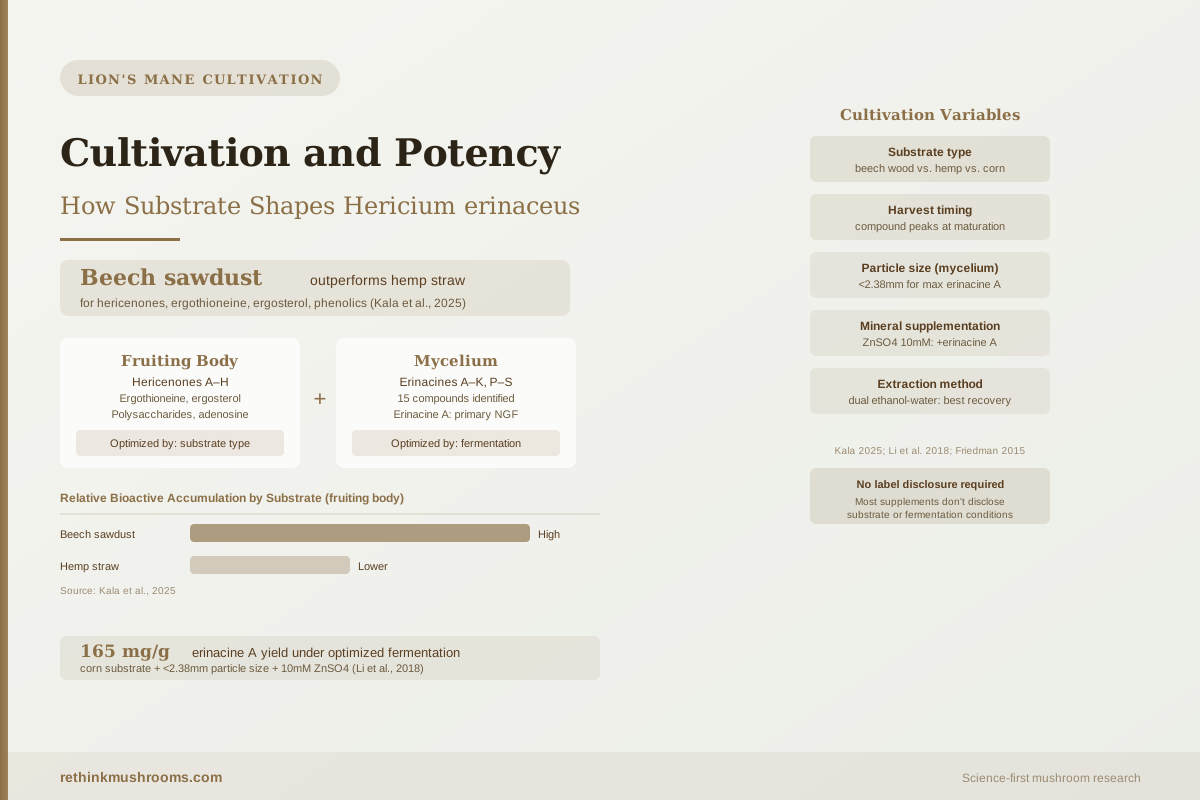
Beech sawdust
Fruiting bodies of H. erinaceus grown on beech sawdust accumulated significantly greater concentrations of most bioactive compounds compared to hemp straw substrates.
Kala et al., 2025
8 hericenones
found exclusively in fruiting bodies (A-H) — substrate-dependent (Friedman 2015)
15 erinacines
found exclusively in mycelium (A-K, P-S) — fermentation-condition-dependent (Li 2018)
165 mg/g
erinacine A yield achievable under optimized solid-state fermentation (Li 2018)
Kala et al., 2025
 View as image ↗
The potency of a lion's mane supplement is not fixed at harvest. It is determined by a series of cultivation decisions made weeks before the mushroom is processed. What substrate the fruiting body grows on, whether the mycelium is produced under controlled fermentation conditions, and when the harvest occurs all affect how many bioactive compounds end up in the finished material. Research published in 2025 made this concrete for the first time: substrate composition alone produced measurable differences in hericenone, ergothioneine, ergosterol, and phenolic concentrations in lion's mane fruiting bodies.[4]
This article is part of the Lion's Mane overview cluster and focuses specifically on how cultivation practices translate to compound content. For the broader compound chemistry and what each bioactive does, see Lion's Mane Bioactive Compounds: Hericenones, Erinacines, and Beyond.
Key Takeaways
- Substrate composition directly determines bioactive compound accumulation in lion's mane fruiting bodies — beech sawdust outperformed hemp straw for most compounds tested (Kala et al., 2025)
- Hericenones (A-H) are found exclusively in fruiting bodies; erinacines (A-K, P-S) are found exclusively in mycelium — two different parts of the fungus require two different cultivation optimizations
- Erinacine A, the most studied NGF-stimulating compound, can be maximized in mycelium through specific solid-state fermentation conditions including corn kernel substrate and mineral supplementation — yields up to 165 mg/g cell dry weight (Li et al., 2018)
- Dual ethanol-water extraction from beech-sawdust-grown fruiting bodies was the most effective method for recovering ergothioneine, lovastatin, L-phenylalanine, and ergosterol (Kala 2025)
- Wild-harvested lion's mane has not been shown to contain more bioactive compounds than well-cultivated fruiting bodies; the key variable is substrate quality and harvest timing, not wild vs. cultivated origin
- Most consumer supplement labels do not disclose substrate type or cultivation conditions, making it impossible to infer compound content from the label alone
What Cultivation Actually Determines: Two Variables, Two Compound Classes
Understanding what cultivation affects requires first understanding that lion's mane's two major bioactive classes come from different parts of the fungus.
Hericenones (compounds A through H) are found in the fruiting body — the visible mushroom that grows above the substrate. Erinacines (compounds A through K, plus P through S — fifteen total) are found in the mycelium, the root-like network of threads that colonizes the growing medium. This separation was established comprehensively by Friedman's 2015 review in the Journal of Agricultural and Food Chemistry, which catalogued the distinct chemical profiles of H. erinaceus fruiting body versus mycelium and identified the two groups as functionally distinct compound classes with different but complementary biological activities.[1]
This anatomical separation has a direct practical consequence: a supplement made from fruiting bodies contains hericenones but no erinacines. A supplement made from mycelium contains erinacines but no hericenones. A product containing both would need to combine extracts from both parts of the fungus.
Cultivation, then, is really two separate optimization problems:
- For fruiting bodies: what substrate composition maximizes hericenone and co-compound accumulation?
- For mycelium: what fermentation conditions maximize erinacine production, particularly erinacine A?
The research addresses both questions, but with different levels of evidence depth.
The Substrate Study: What Beech Sawdust vs. Hemp Straw Reveals
The 2025 study by Kala and colleagues is the most direct investigation of substrate effects on lion's mane compound accumulation available. They grew H. erinaceus fruiting bodies on two plant-based substrates — beech sawdust and hemp straw — and measured compound concentrations using validated analytical methods, testing different extraction conditions to identify the most effective recovery method for each compound class.[4]
Fruiting bodies grown on beech sawdust accumulated significantly greater concentrations of most bioactive compounds compared to hemp straw. The compounds showing the most pronounced substrate effect included ergothioneine, phenolic compounds, ergosterol, and hericenones. For extraction, dual ethanol-water extraction with moderate ethanol concentration was the most effective method for recovering ergothioneine, lovastatin, L-phenylalanine, and ergosterol from the fruiting body material.
The practical implication is specific: beech sawdust is not simply a different growing medium — it is a richer one for most of the compounds that give lion's mane its bioactive profile. A cultivator who chooses beech sawdust over hemp straw as the primary substrate is starting with a material advantage before any extraction or processing begins.
Why does substrate composition affect compound accumulation? The likely explanation is nutrient availability. Mushrooms synthesize bioactive compounds using precursor molecules derived from the substrate. Different substrates provide different ratios of lignin, cellulose, hemicellulose, and trace minerals. Beech wood, which is the natural growth substrate for wild lion's mane in temperate forests, may provide a precursor profile that more closely matches the conditions under which the fungus evolved to produce its full chemical output.
This substrate-to-compound relationship is not unique to lion's mane — similar effects have been documented for other medicinal mushrooms — but Kala 2025 is the first study to quantify it directly for H. erinaceus under controlled conditions.
Fruiting Body Cultivation: Variables Beyond Substrate
Substrate is the most measurable variable, but it is not the only one affecting fruiting body compound content.
Harvest timing also matters. Bioactive compound concentrations in mushroom fruiting bodies change as they develop and mature. Harvesting too early or too late relative to the optimal maturation stage changes compound concentrations. The general principle is that compound accumulation peaks at or near full maturation, but this varies by compound. Ergothioneine, for instance, accumulates gradually and peaks at late-stage fruiting body development.
Temperature and humidity during fruiting affect both yield and compound concentration. The specific conditions that optimize fresh weight yield do not always match those that optimize compound concentration — a trade-off that commercial cultivators face between volume and potency.
Light exposure during cultivation can influence secondary metabolite production, a phenomenon better documented in Cordyceps (where blue light specifically regulates cordycepin biosynthesis) but likely relevant in other medicinal mushrooms as well.
The 2025 comprehensive review by Contato and Conte-Junior in Nutrients confirmed that hericenones and erinacines operate through complementary pathways — NGF stimulation, reactive oxygen species scavenging, and NF-kB inflammatory suppression — with the implication that losses in either compound class represent losses in a functionally distinct activity, not just a quantitative reduction in the same effect.[3]
Mycelium Cultivation: The Specific Conditions That Maximize Erinacine A
Erinacine A is the most studied compound in the erinacine class — the one with the most direct NGF-stimulating evidence in both cell and animal models, and the specific compound used in the Li 2020 Alzheimer's pilot trial that represents the strongest clinical evidence for lion's mane in cognitive disease.[6]
The 2018 review by Li and colleagues in Behavioural Neurology, which catalogued all 15 known erinacines and their individual biological activities, also reviewed the cultivation conditions that maximize erinacine A production in H. erinaceus mycelium.[2] The findings are specific: solid-state fermentation using corn kernel as the primary substrate, with grain particle size under 2.38mm, and supplemented with zinc sulfate (ZnSO4) at 10mM concentration, achieves erinacine A yields of up to 165 mg per gram of cell dry weight. This represents the upper bound of what controlled cultivation can produce.
Three things are notable about this:
First, the substrate for optimal erinacine A production (corn kernel) is completely different from the substrate associated with optimal fruiting body compound accumulation (beech sawdust). You cannot optimize both simultaneously in a single cultivation process — fruiting bodies and mycelium are grown under different conditions.
Second, zinc supplementation specifically enhances erinacine A yield. This implies the erinacine synthesis pathway is zinc-sensitive, and that cultivation media lacking adequate mineral supplementation will produce suboptimal erinacine concentrations even if other conditions are correct.
Third, particle size matters for fermentation efficiency — smaller particles (under 2.38mm) allow more uniform mycelium colonization and nutrient extraction. A cultivation operation using coarsely ground substrate will produce less erinacine A per gram of dry mycelium, regardless of substrate type.
These specifics represent exactly what is missing from almost all supplement label disclosures. A label that says "lion's mane mycelium" gives no information about whether the fermentation was conducted under conditions that produce meaningful erinacine content.
Wild vs. Cultivated: Does Origin Affect Potency?
The assumption that wild-harvested lion's mane contains more bioactive compounds than cultivated material is not supported by the available evidence.
Wild H. erinaceus grows primarily on dead or dying hardwood trees — beech, oak, maple — in temperate forests. This happens to overlap closely with the substrate conditions (beech sawdust) that Kala 2025 identified as optimal for bioactive compound accumulation. Well-cultivated fruiting bodies on beech sawdust are likely to match or exceed wild fruiting bodies in compound content, because cultivation allows for consistent substrate composition, controlled environmental conditions, and optimal harvest timing.
Wild mushrooms also introduce variability that cultivated material eliminates: soil contamination, insect damage, over-maturation before harvest, and variation in the natural substrate's nutrient composition across different trees and forest conditions. These factors make wild-harvested material harder to standardize and potentially more variable in quality, not less.
The Friedman 2015 review's compound catalog was developed from laboratory analysis of both cultivated and wild-harvested material and did not identify wild origin as a consistent predictor of higher compound content.[1]
What This Means for Supplement Consumers
The cultivation-to-potency research has several practical implications for evaluating lion's mane supplements — though it also highlights how much information the current supplement market does not disclose.
For fruiting body products: The substrate matters. A supplement manufacturer using beech sawdust and harvesting at optimal maturity is producing more hericenone-rich material than one using lower-quality or mismatched substrates. Because labels rarely disclose substrate type, the clearest proxy is third-party testing showing hericenone content or beta-glucan content as a potency marker.
For mycelium products: The key questions are whether solid-state fermentation was used (rather than liquid fermentation, which produces less erinacine), whether erinacine A content has been measured, and whether the product specifies "erinacine A-enriched" — the specific formulation used in the Li 2020 Alzheimer's pilot trial.[6] A mycelium-on-grain product that has not had the grain substrate removed still contains the grain's starch, which dilutes the actual mushroom compound concentration.
For dual-extract or blended products: A product claiming to provide both hericenones and erinacines must have extracted from both fruiting body and mycelium. The label should make this clear. A product labeled "full-spectrum lion's mane" using only fruiting body material cannot contain erinacines.
These distinctions are lost when articles describe "lion's mane" as a single category. The cultivation variables described here mean that two products both labeled "lion's mane extract" may have dramatically different bioactive profiles.
This article describes how cultivation affects compound content; it is not medical advice and does not recommend lion's mane for any condition. The clinical trials referenced here investigated cognitive outcomes but do not establish lion's mane as a treatment. Anyone considering a supplement for a health concern should consult a qualified healthcare professional.
For a full breakdown of the fruiting body vs. mycelium debate across mushroom species, see Fruiting Body vs. Mycelium: The Great Mushroom Supplement Debate.
Where the Research Is Headed
The cultivation-to-potency research for lion's mane is notably thin compared to the clinical and mechanistic literature. The Kala 2025 study is the most direct investigation of substrate effects on H. erinaceus compound accumulation, and it is recent enough that it has not yet been replicated or extended. The erinacine A production optimization data in Li 2018 draws from a narrower literature focused on fungal biotechnology rather than consumer supplementation.
What the field currently lacks is a standardized study directly connecting cultivation conditions to clinical outcomes: do supplements made from beech-sawdust-grown fruiting bodies produce stronger cognitive effects than those from hemp straw? Does higher erinacine A concentration in a supplement produce dose-proportional effects? These questions have not been systematically answered.
The pharmacology of lion's mane operates through well-documented mechanisms investigated in multiple human trials — the Mori 2009 MCI trial,[5] the Li 2020 Alzheimer's pilot,[6] the Docherty 2023 healthy adult trial,[7] the Surendran 2025 acute effects study.[8] But the link between cultivation conditions, compound concentration, and clinical response magnitude remains an open question in the literature.
For the complete mechanism picture, see The Pharmacology of Hericium erinaceus: How Lion's Mane Works in the Body.
The Bottom Line
Substrate composition directly determines bioactive compound accumulation in Hericium erinaceus: beech sawdust produces higher concentrations of hericenones, ergothioneine, and ergosterol compared to hemp straw (Kala 2025). Separately, erinacine production in mycelium can be maximized through solid-state fermentation with corn kernel substrate, fine particle size, and zinc supplementation, reaching yields of 165 mg/g cell dry weight (Li 2018). Because hericenones (fruiting body) and erinacines (mycelium) are found in different parts of the fungus, optimizing one requires different conditions from the other. Most consumer supplement labels do not disclose cultivation substrate or fermentation conditions.
Frequently Asked Questions
Sources & References
- 1RTHM-00371·Friedman, Mendel (2015). “Chemistry, Nutrition, and Health-Promoting Properties of Hericium erinaceus (Lion's Mane) Mushroom Fruiting Bodies and Mycelia and Their Bioactive Compounds..” Journal of agricultural and food chemistry.Study breakdown →PubMed →↩
- 2RTHM-00973·Li, I-Chen et al. (2018). “Neurohealth Properties of Hericium erinaceus Mycelia Enriched with Erinacines..” Behavioural neurology.Study breakdown →PubMed →↩
- 3RTHM-00921·Contato, Alex Graça et al. (2025). “Lion's Mane Mushroom (Hericium erinaceus): A Neuroprotective Fungus with Antioxidant, Anti-Inflammatory, and Antimicrobial Potential-A Narrative Review..” Nutrients.Study breakdown →PubMed →↩
- 4RTHM-02103·Kała, Katarzyna et al. (2025). “Influence of Plant-Based Substrate Composition and Extraction Method on Accumulation of Bioactive Compounds in Hericium erinaceus (Bull.) Pers. Fruiting Bodies..” Molecules (Basel.Study breakdown →PubMed →↩
- 5RTHM-00165·Mori, Koichiro et al. (2009). “Improving effects of the mushroom Yamabushitake (Hericium erinaceus) on mild cognitive impairment: a double-blind placebo-controlled clinical trial..” Phytotherapy research : PTR.Study breakdown →PubMed →↩
- 6RTHM-00631·Li, I-Chen et al. (2020). “Prevention of Early Alzheimer's Disease by Erinacine A-Enriched Hericium erinaceus Mycelia Pilot Double-Blind Placebo-Controlled Study..” Frontiers in aging neuroscience.Study breakdown →PubMed →↩
- 7RTHM-00821·Docherty, Sarah et al. (2023). “The Acute and Chronic Effects of Lion's Mane Mushroom Supplementation on Cognitive Function, Stress and Mood in Young Adults: A Double-Blind, Parallel Groups, Pilot Study..” Nutrients.Study breakdown →PubMed →↩
- 8RTHM-00952·Surendran, Geyan et al. (2025). “Acute effects of a standardised extract of Hericium erinaceus (Lion's Mane mushroom) on cognition and mood in healthy younger adults: a double-blind randomised placebo-controlled study..” Frontiers in nutrition.Study breakdown →PubMed →↩