Lion's Mane (Hericium erinaceus)
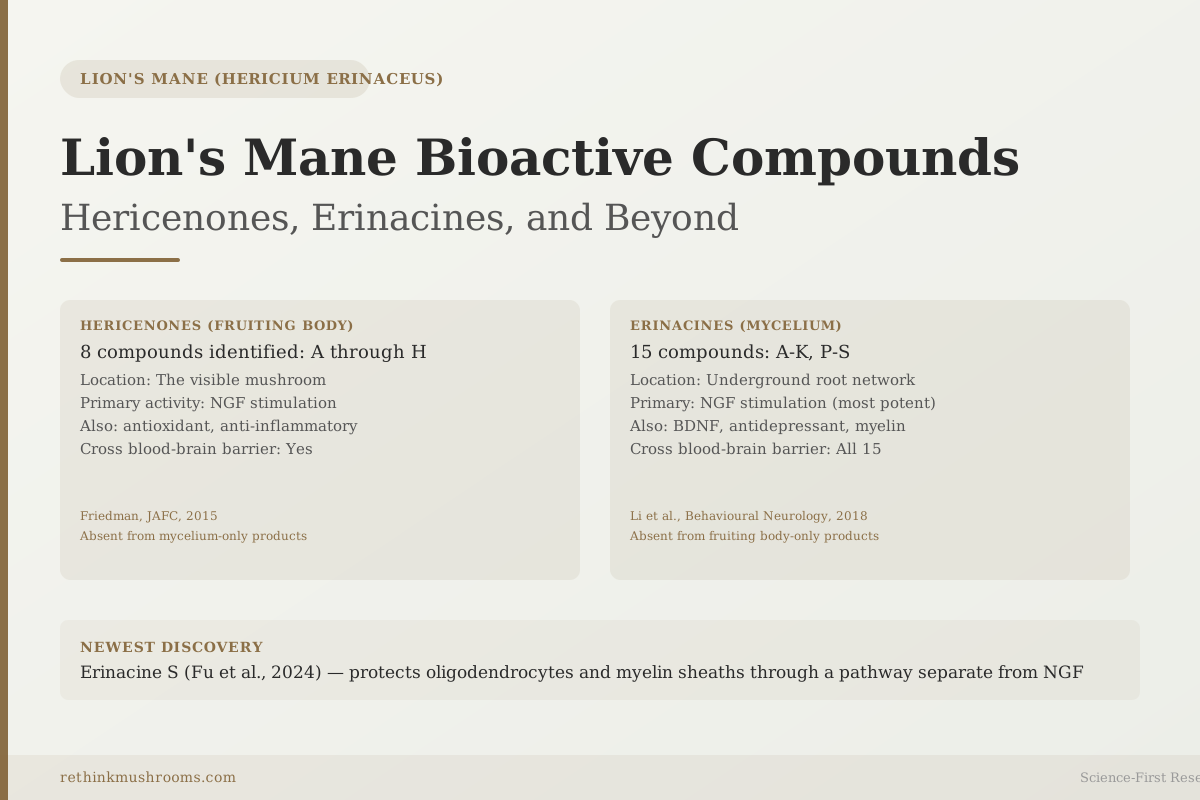
15 erinacines identified
Lion's mane mycelium contains 15 distinct erinacine compounds — all of which cross the blood-brain barrier. The fruiting body contains a separate library of 8 hericenones with overlapping but distinct effects.
Li et al., Behavioural Neurology, 2018
Hericenones A-H
in the fruiting body — the part you see
Erinacines A-K, P-S
in the mycelium — the underground network
Erinacine S (2024)
newest compound — protects myelin sheaths
Li et al., Behavioural Neurology, 2018
 View as image ↗
The white cascading mushroom you see growing on a tree is pharmacologically different from the invisible network of filaments colonizing the wood underneath it. Both parts of Hericium erinaceus — the fruiting body above and the mycelium below — contain neuroactive compounds. But they are not the same compounds, and they do not work through identical pathways.
This distinction was formally established by Friedman's 2015 chemistry review in the Journal of Agricultural and Food Chemistry, which catalogued the complete compound profiles of both parts and showed that hericenones (A through H) are found in the fruiting body, while erinacines (A through K, plus P through S) are found exclusively in the mycelium.[1]
The difference matters: a supplement made entirely from fruiting body extract contains hericenones but no erinacines. A supplement made from mycelium may contain erinacines but no hericenones. And both compound classes cross the blood-brain barrier, stimulate nerve growth, and affect the brain through different molecular mechanisms.
This article is the complete reference for both compound libraries. For the broader overview of Lion's Mane research, see What Is Lion's Mane Mushroom? A Science-Based Overview.
Key Takeaways
- Lion's mane contains two distinct neuroactive compound libraries: hericenones (A-H) in the fruiting body and erinacines (A-K, P-S) in the mycelium; both cross the blood-brain barrier
- A 2015 chemistry review (Friedman, JAFC) definitively established the fruiting body/mycelium compound dichotomy — this is the foundational reference for the entire hericenone vs. erinacine debate
- Erinacine A is the most studied compound; it stimulates nerve growth factor (NGF) production in the brain, reduces amyloid-beta plaques in Alzheimer's animal models, and produces antidepressant-like effects via the BDNF/PI3K/Akt signaling pathway
- Whole lion's mane mycelia were shown to outperform purified NGF or BDNF alone for stimulating neurite extension in vitro (Lai et al., 2013) — suggesting the compounds work synergistically
- Erinacine S (characterized 2024) has a distinct mechanism from erinacine A: it specifically protects oligodendrocytes (myelin-producing cells) from damage, with implications for multiple sclerosis and demyelinating conditions
- Substrate choice in cultivation measurably affects fruiting body bioactive compound accumulation — beech sawdust substrates produced greater concentrations of most bioactive compounds than hemp straw (Kala et al., 2025)
Hericenones: The Compounds in the Part You Can See
The visible part of Hericium erinaceus — the white, icicle-like fruiting body — contains a family of compounds called hericenones. Eight have been formally identified and named hericenones A through H.[1]
Hericenones are terpenoid compounds — meaning they are built from a repeating five-carbon unit called isoprene, the same molecular building block that produces many of the compounds in essential oils, steroids, and vitamins. Hericenones A through H share a common structural core but differ in side-chain attachments that appear to affect their potency and specific receptor interactions.
The primary documented activity is nerve growth factor (NGF) stimulation. NGF is a signaling protein that neurons require to survive, grow, and form new connections. In the healthy brain, adequate NGF production supports memory, learning, and the maintenance of neural circuits. In aging brains — and especially in Alzheimer's disease — NGF production and receptor sensitivity decline, contributing to the progressive loss of neurons.
Hericenones stimulate the production of NGF inside neurons, rather than acting like NGF directly. This distinction matters: pharmaceutical NGF cannot cross the blood-brain barrier and cannot be taken orally. Hericenones can. They cross the blood-brain barrier, enter neurons, and upregulate the internal machinery that produces NGF.
The hericenone library also includes antioxidant and anti-inflammatory properties. Hericenone compounds have been shown to scavenge reactive oxygen species — unstable molecules that cause cellular damage — and to modulate inflammatory signaling, with hericenone E in particular demonstrating neuroprotective effects against oxidative stress in cell culture studies.
Erinacines: Fifteen Compounds Found Only in the Root Network
The mycelium of Hericium erinaceus — the thread-like filaments that penetrate wood and substrate, invisible to the eye — contains a completely different and larger family of compounds called erinacines.
Fifteen erinacines have been identified and characterized: erinacines A through K (eleven compounds) and erinacines P through S (four more).[2] All fifteen have been confirmed to cross the blood-brain barrier in animal studies, making them pharmacologically accessible to the brain when consumed orally.
A 2018 review by Li and colleagues in Behavioural Neurology catalogued the individual activities of each erinacine in detail. The review established that erinacines A, B, C, E, F, H, and I are strong NGF inducers both in cell culture (in vitro) and in living organisms (in vivo). Erinacines D and G show weaker NGF-stimulating activity. Erinacines P through S are more recently characterized and include distinct activities not yet fully mapped.
Erinacine A emerged from this literature as the most extensively studied and most potent NGF inducer in the class. It has been the primary compound targeted in erinacine A-enriched mycelium preparations — the form used in the most rigorous human clinical trials.
A finding from Lai and colleagues in 2013 is worth noting because it is counterintuitive.[3] When they tested whole lion's mane mycelia against purified NGF and purified BDNF (another neurotrophic protein) for their ability to stimulate neurite extension — the growth of new nerve cell projections — the whole mycelia outperformed the purified growth factors alone. This suggests the erinacine compounds do not simply mimic NGF; they work synergistically through a mechanism that enhances or augments neural growth better than the growth factor itself.
Erinacine A: What the Most-Studied Compound Actually Does
Among the fifteen erinacines, erinacine A has accumulated the most evidence — across cell culture, animal models, and human clinical trials.
Its primary mechanism is NGF upregulation via direct action on the brain's NGF production machinery. In a 2016 animal study by Tsai-Teng and colleagues, erinacine A-enriched lion's mane mycelium was given to mice bred with Alzheimer's-like pathology — specifically mice that develop the amyloid-beta plaques and tau tangles characteristic of the disease.[5] The results showed significant reductions in amyloid-beta plaques and tau pathology, improved cognitive performance, and increased NGF and BDNF expression in the hippocampus (the brain region most critical for memory formation). This was the first study establishing that a specific lion's mane compound could modify Alzheimer's disease pathology, not just symptoms, in a validated animal model.
A second line of evidence connects erinacine A to antidepressant-like effects through a different pathway entirely. Chiu and colleagues in a 2018 study found that erinacine A-enriched mycelium produced antidepressant effects in mice via the BDNF/PI3K/Akt/GSK-3β signaling pathway — a molecular cascade that is also activated by most prescription antidepressants.[6] This provides the mechanistic basis for the mood and anxiety improvements documented in human trials: erinacine A is not only neuroprotective but engages the same anti-depressant signaling pathway as pharmaceutical agents through a distinct upstream trigger.
The two pathways — NGF stimulation for neurogenesis and BDNF/Akt for mood — are parallel and complementary. They explain why erinacine A-enriched preparations show effects across both cognitive and emotional domains, and why the compound is not simply interchangeable with the hericenones that primarily target the NGF pathway.
Erinacine S: The Newest Discovery, and Why It Changes the Picture
The erinacine family is still being characterized. The most recently identified member, erinacine S, was described in a 2024 study by Fu and colleagues published in Biomedicine and Pharmacotherapy.[4]
Erinacine S does not work through the same NGF mechanism that erinacines A and other members use. Its primary documented activity is protecting oligodendrocytes — the brain cells responsible for producing and maintaining myelin, the insulating sheath around nerve fibers that enables fast neural transmission.
The study used a cuprizone model — a well-established animal model of demyelinating disease that mimics features of multiple sclerosis. Erinacine S protected oligodendrocytes from cuprizone-induced demyelination and alleviated associated mood abnormalities. Crucially, this protection was observed at concentrations that don't significantly affect NGF levels.
The implication is that the erinacine class is more pharmacologically diverse than previously understood. Erinacine A drives neurogenesis via NGF. Erinacine S protects the insulation around existing neurons. These are complementary mechanisms targeting different aspects of brain health — and erinacine S's activity pattern has implications for multiple sclerosis research and any condition involving myelin degradation.
The discovery of erinacine S is also a reminder that characterization of the erinacine library is ongoing. Compounds P through S were only catalogued recently, and their complete pharmacological profiles remain under active investigation.
Beyond Hericenones and Erinacines: The Other Active Compounds
The hericenone and erinacine literature dominates the mechanistic research, but Hericium erinaceus contains additional biologically active compounds that contribute to its documented effects.[9]
Polysaccharides. Both the fruiting body and mycelium contain beta-glucan polysaccharides — long-chain sugar molecules with documented immune-modulating activity. These polysaccharides activate immune cells (particularly macrophages and natural killer cells) and suppress inflammatory signaling via the NF-κB pathway — the same pathway that drives chronic neuroinflammation in Alzheimer's disease and PTSD. Unlike hericenones and erinacines, polysaccharides do not cross the blood-brain barrier but exert systemic anti-inflammatory effects that indirectly benefit brain health.
Ergothioneine. Lion's mane fruiting bodies are a source of ergothioneine, an amino acid antioxidant that is unusual for two reasons: humans cannot synthesize it themselves, and the brain has dedicated transporters for it (OCTN1 transporters), suggesting it plays a specific protective role in neural tissue. Ergothioneine scavenges the most damaging reactive oxygen species and may reduce oxidative stress in aging brain cells.
Ergosterol. Both parts contain ergosterol, the fungal precursor to Vitamin D2. This does not contribute to the neurological effects but adds to the nutritional profile of the whole mushroom as a food source.
Myelination factors. A 2003 in vitro study by Kolotushkina and colleagues found that H. erinaceus extract directly promoted myelination of neurons — an effect on the physical structure of nerve insulation that predates the erinacine S discovery by two decades.[8] The specific compounds responsible were not isolated in that study, but the finding was confirmed directionally by the erinacine S research twenty years later.
How Cultivation Changes the Compounds You Get
The compound profile of lion's mane material is not fixed by the species alone. It is also determined by what the mushroom grows on.
A 2025 study by Kala and colleagues compared fruiting body material grown on two substrates — beech sawdust and hemp straw — and analyzed the resulting bioactive compound concentrations.[7] Fruiting bodies grown on beech sawdust accumulated significantly greater concentrations of most bioactive compounds, including ergothioneine, phenolic antioxidants, ergosterol, and hericenones. Hemp straw produced mushrooms with a different and generally lower bioactive compound profile.
The practical implication: the substrate choice made at the farm level has measurable consequences for the potency of the finished material before extraction even begins. Two products both labeled "lion's mane fruiting body extract" may differ substantially in hericenone content depending on how and where they were grown.
This applies only to fruiting body compounds. Erinacines are a mycelium-specific concern, and their production is optimized through different means — primarily solid-state fermentation conditions and mineral supplementation during mycelium culture. Erinacine A concentration can vary substantially depending on fermentation protocol.
For the full detail on how cultivation choices affect compound potency, see Hericium erinaceus Cultivation and Its Impact on Bioactive Compound Potency.
What the Compound Map Means for Supplement Choice
The hericenone/erinacine dichotomy has a direct practical consequence that most supplement labels don't communicate clearly.
A product labeled "lion's mane fruiting body extract" contains hericenones A-H and the other fruiting body compounds described above. It does not contain erinacines — erinacines are exclusively in the mycelium, which is not the fruiting body. A product claiming the NGF benefits associated with erinacine A should be made from mycelium, not fruiting body, and ideally labeled as "erinacine A-enriched."
A product labeled "lion's mane mycelium extract" may contain erinacines — but the concentration depends heavily on fermentation protocols that most manufacturers do not disclose. Mycelium grown on grain substrates also typically contains significant grain starch that dilutes the actual mushroom content.
A "dual extract" or "full spectrum" product theoretically provides both compound classes, but only if it contains both fruiting body material (for hericenones) and mycelium material (for erinacines) — and only if each part was extracted with appropriate methods (water extraction for polysaccharides; ethanol extraction for terpenoids including hericenones).
For a broader examination of how the fruiting body versus mycelium sourcing question affects supplement quality across all mushroom species, see Fruiting Body vs. Mycelium: The Great Mushroom Supplement Debate.
The deeper dive into each compound class continues in: Erinacines: The Compounds That Cross the Blood-Brain Barrier and Hericenones and NGF Synthesis: How Lion's Mane Stimulates Nerve Growth.
The Bottom Line
Lion's mane contains two pharmacologically distinct compound libraries: hericenones (A-H) in the fruiting body and erinacines (A-K, P-S) in the mycelium, both of which cross the blood-brain barrier. Erinacine A is the most studied, with documented effects on NGF stimulation, amyloid-beta reduction, and antidepressant-like signaling via BDNF. Erinacine S, characterized in 2024, adds a distinct oligodendrocyte-protective mechanism. The compound a supplement contains depends on which part of the mushroom was used and how it was grown — information that most product labels do not provide.
Frequently Asked Questions
Sources & References
- 1RTHM-00371·Friedman, Mendel (2015). “Chemistry, Nutrition, and Health-Promoting Properties of Hericium erinaceus (Lion's Mane) Mushroom Fruiting Bodies and Mycelia and Their Bioactive Compounds..” Journal of agricultural and food chemistry.Study breakdown →PubMed →↩
- 2RTHM-00973·Li, I-Chen et al. (2018). “Neurohealth Properties of Hericium erinaceus Mycelia Enriched with Erinacines..” Behavioural neurology.Study breakdown →PubMed →↩
- 3RTHM-00295·Lai, Puei-Lene et al. (2013). “Neurotrophic properties of the Lion's mane medicinal mushroom, Hericium erinaceus (Higher Basidiomycetes) from Malaysia..” International journal of medicinal mushrooms.Study breakdown →PubMed →↩
- 4RTHM-00878·Fu, Jing-Ting et al. (2024). “Erinacine S, a small active component derived from Hericium erinaceus, protects oligodendrocytes and alleviates mood abnormalities in cuprizone-exposed rodents..” Biomedicine & pharmacotherapy = Biomedecine & pharmacotherapie.Study breakdown →PubMed →↩
- 5RTHM-00452·Tsai-Teng, Tzeng et al. (2016). “Erinacine A-enriched Hericium erinaceus mycelium ameliorates Alzheimer's disease-related pathologies in APPswe/PS1dE9 transgenic mice..” Journal of biomedical science.Study breakdown →PubMed →↩
- 6RTHM-00505·Chiu, Chun-Hung et al. (2018). “Erinacine A-Enriched Hericium erinaceus Mycelium Produces Antidepressant-Like Effects through Modulating BDNF/PI3K/Akt/GSK-3β Signaling in Mice..” International journal of molecular sciences.Study breakdown →PubMed →↩
- 7RTHM-02103·Kała, Katarzyna et al. (2025). “Influence of Plant-Based Substrate Composition and Extraction Method on Accumulation of Bioactive Compounds in Hericium erinaceus (Bull.) Pers. Fruiting Bodies..” Molecules (Basel.Study breakdown →PubMed →↩
- 8RTHM-00058·Kolotushkina, E V et al. (2003). “The influence of Hericium erinaceus extract on myelination process in vitro..” Fiziolohichnyi zhurnal (Kiev.Study breakdown →PubMed →↩
- 9RTHM-00921·Contato, Alex Graça et al. (2025). “Lion's Mane Mushroom (Hericium erinaceus): A Neuroprotective Fungus with Antioxidant, Anti-Inflammatory, and Antimicrobial Potential-A Narrative Review..” Nutrients.Study breakdown →PubMed →↩