Lion's Mane (Hericium erinaceus)
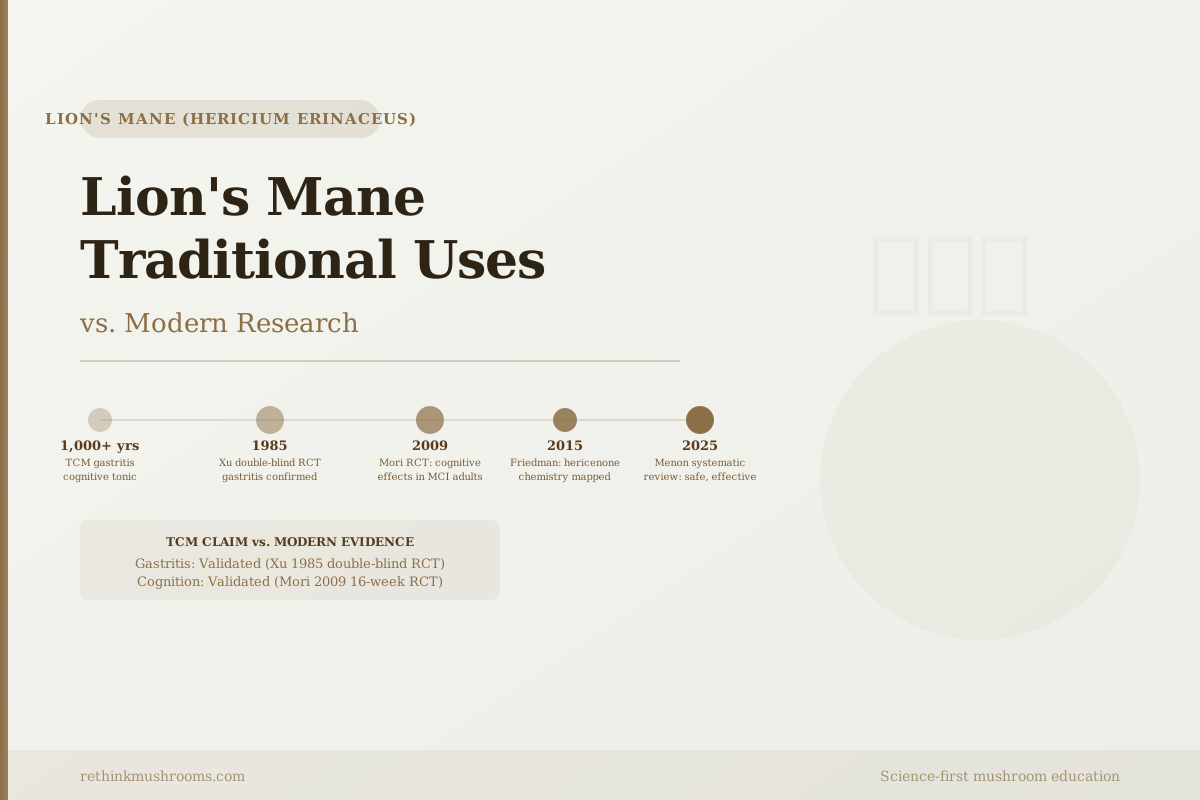
1985 — first double-blind RCT
The first controlled clinical trial of Lion's Mane tested chronic atrophic gastritis — precisely the digestive condition that Chinese medicine had used this mushroom to treat for centuries. It worked.
Xu et al., Chinese Medical Journal, 1985
1,000+ years
documented medicinal use in Chinese and Japanese traditions
3 of 4
major traditional use categories now supported by peer-reviewed human trials
Mori 2009
landmark 16-week RCT confirmed cognitive effects TCM attributed to this mushroom
Xu et al., Chinese Medical Journal, 1985
 View as image ↗
Traditional medicine rarely gets confirmed by double-blind clinical trials. The history is usually one of speculative claims that either hold up weakly or not at all under rigorous testing. Lion's Mane mushroom is an unusual exception to that pattern, and the exception starts in 1985, when researchers published the first double-blind placebo-controlled trial of this mushroom.
The condition they tested: chronic atrophic gastritis. The reason that matters: chronic atrophic gastritis is precisely the digestive condition that traditional Chinese medicine had recommended Lion's Mane for, sometimes for centuries before the 1985 paper. The trial confirmed the effect.
This is not a cherry-picked success story. This article maps the full range of traditional claims against what modern research has actually found, including where the evidence converges, where it diverges, and where traditional claims have no peer-reviewed support at all. For the full science-based overview of this mushroom, see What Is Lion's Mane Mushroom? A Science-Based Overview.
Key Takeaways
- Traditional Chinese medicine used Lion's Mane primarily for digestive conditions (Spleen/Stomach in TCM framework) and as a broad cognitive tonic — both of which have been validated by double-blind RCTs
- The 1985 Xu double-blind trial tested chronic atrophic gastritis, the exact digestive indication TCM had used Lion's Mane for, and found it effective
- Mori 2009 put 30 adults with mild cognitive impairment on 1,000mg Lion's Mane daily for 16 weeks; cognitive scores improved significantly vs. placebo and declined again after stopping
- Traditional preparations (dried fruiting body soups and powders) primarily delivered hericenones — the compounds exclusive to the fruiting body — not erinacines, which are found only in the mycelium
- The "five organ tonic" claim (Wu Zang) is partially supported by antioxidant and immune evidence but has not been tested as a unified claim in human trials
- Claims about Lion's Mane for specific organ protection (kidney, liver) beyond gastric and neural effects have not been validated in peer-reviewed human trials
Two Thousand Years of Use: What Chinese and Japanese Medicine Actually Said
Hericium erinaceus has been documented in Chinese materia medica for at least a thousand years, and the claims were remarkably specific. Khan and colleagues' 2013 review[1] established the ethnobotanical record: the mushroom was used across traditional Asian medical systems for its effects on the digestive system, the nervous system, and general vitality.
In China, it is called hóutóugū (猴头菇), meaning "monkey-head mushroom," for the visual resemblance of its white cascading spines to the face of a golden snub-nosed monkey. Chinese medicine classified it as a tonic for the five organs (Wu Zang), with particular emphasis on the Spleen and Stomach — the TCM framework for the entire digestive system. The specific application for "stomach troubles," including chronic inflammation of the gastric lining, was one of the most consistent traditional uses across texts.
In Japan, the mushroom became yamabushitake (山伏茸, "mountain monk mushroom"). Yamabushi were Buddhist ascetics who practiced extreme forms of mountain training in the Shugendo tradition. They wore white robes with straw decorations that resembled the cascading spines of the mushroom. Whether the name came first or the association is secondary, the yamabushi tradition credited the mushroom with supporting the mental clarity and endurance required for extended periods of meditation and physical practice.
Buddhist monks across East Asia reportedly powdered the dried fruiting body and prepared it as tea for use before meditation sessions. The claimed effect was mental sharpness and reduced mental fatigue. None of this was tested clinically for more than a millennium. The tests, when they came, started with the digestive system.
The 1985 Test: When Science First Checked TCM's Gastritis Claim
In 1985, Xu and colleagues published a double-blind placebo-controlled trial of Hericium erinaceus for chronic atrophic gastritis in the Chinese Medical Journal.[2] This was the first time this mushroom had been subjected to this level of scientific rigor.
Chronic atrophic gastritis is a condition where the stomach lining progressively thins and loses its acid-producing glands, often causing pain, nausea, and digestive dysfunction. It is a distinct diagnosis from simple indigestion — it involves measurable structural changes to the gastric lining that can be confirmed by endoscopy. Traditional Chinese medicine had been treating it, or the functional syndrome that corresponds to it, with Lion's Mane for a very long time.
The trial found that Lion's Mane improved symptoms compared to placebo.
The significance of this result is not just that Lion's Mane helped with gastritis. It is that the first scientific test happened to target the exact indication that centuries of traditional use had centered on. That alignment is unusual in the history of medicinal plant and fungal research. Many traditional remedies, when finally subjected to controlled trials, are tested for conditions that modern researchers find interesting, not necessarily the conditions the traditional system prioritized. In this case, the match was direct.
This 1985 result established the credibility of the broader research program that followed. If the traditional use for digestive health was valid enough to pass a double-blind test, it was reasonable to ask whether the traditional use for cognitive function would hold up too.
From Gut to Brain: How the Research Trajectory Followed Traditional Claims
The cognitive research came decades after the gastritis paper. The landmark study arrived in 2009.
Mori and colleagues enrolled 30 Japanese men and women with mild cognitive impairment (MCI) in a double-blind placebo-controlled trial and gave half of them 1,000mg of Lion's Mane powder daily for 16 weeks.[3] Cognitive function scores improved significantly in the Lion's Mane group compared to placebo. At week 16, the improvement was statistically robust.
There was a telling secondary finding: when participants stopped taking Lion's Mane, their scores declined. This suggests the effect was not a one-time intervention but required ongoing supplementation to maintain — consistent with how traditional systems thought about tonics, as daily preparations rather than acute treatments.
The dose Mori used (1,000mg per day) is relevant for a second reason: traditional preparations of Lion's Mane, which involved drying the fruiting body and either powdering it or simmering it in soup, would have delivered the compounds in the fruiting body. The fruiting body contains hericenones, the class of aromatic compounds associated with neurotrophin stimulation. The Mori trial used whole dried mushroom powder, which would primarily provide hericenones, not erinacines (which come from the mycelium).
The traditional preparation and the tested preparation are thus more comparable than they might appear at first glance. The people drinking dried Lion's Mane tea in Japanese temples were consuming the same compound class that Mori's trial later validated.
Which Traditional Claims Hold Up to Modern Evidence
This is the comparison modern research allows us to make directly.
| Traditional Use Claim | TCM/Japanese Framework | Modern Evidence | Status |
|---|---|---|---|
| Digestive health, gastritis | Spleen/Stomach tonic | Xu 1985 double-blind RCT: confirmed in chronic atrophic gastritis | Validated |
| Cognitive function, memory | Brain/Spirit tonic, yamabushi mental clarity | Mori 2009 double-blind RCT: significant improvement in MCI adults | Validated |
| Mood, anxiety, mental fatigue | Qi tonic, spiritual stability | Menon 2025 systematic review notes mood/anxiety evidence across multiple studies | Partially validated |
| General vitality, "five organ tonic" | Wu Zang (five organs) systemic support | Antioxidant and anti-inflammatory compounds identified (Khan 2013); no unified human trial testing systemic effects | Partial preclinical support |
| Immunity | Protective against pathogens | Immunomodulatory polysaccharides confirmed (Khan 2013); no dedicated human immune RCT | Preclinical support |
| Specific liver/kidney protection | Organ-specific meridian support | No peer-reviewed human trial evidence | Not yet validated |
The pattern that emerges: where traditional use pointed to the gut or the brain, modern clinical evidence has followed and confirmed. Where traditional use pointed to broader systemic effects (the five organ tonic framework), the evidence is more diffuse and has not been organized into a single human trial designed to test those specific claims.
The honest reading: three of the four most prominent traditional application categories have at least one peer-reviewed human study pointing in a supportive direction. The "five organ tonic" framework partially holds — antioxidant and anti-inflammatory effects are well-documented in the literature — but not as a unified clinical demonstration.
What the Chemistry Reveals About Traditional Preparations
Understanding which compounds traditional practitioners were actually consuming helps interpret why some claims hold up and others don't.
Friedman's comprehensive 2015 chemistry review[4] established the fundamental compound split: hericenones (A through H) are found in the fruiting body, while erinacines (A through K, plus P through S) are found exclusively in the mycelium. These two compound classes stimulate nerve growth factor through overlapping but distinct mechanisms.
Traditional preparations of Lion's Mane used the fruiting body almost exclusively. The dried fruiting body was powdered or simmered; the mycelium growing underground or through a substrate was not typically harvested separately. This means that centuries of traditional use were specifically a test of hericenone-containing preparations — not erinacines.
This distinction matters for interpreting the traditional evidence. The 1985 gastritis trial and the 2009 cognitive trial both used whole dried Lion's Mane, which would be hericenone-dominant. These results therefore validate hericenone-containing preparations. Whether traditional-style preparations would show the same effects as modern erinacine A-enriched mycelium preparations is a separate question that has not been tested directly.
The practical consumer implication: if someone is interested in replicating what traditional medicine actually used and what the earliest clinical trials tested, fruiting body preparations are the more direct parallel to that history. For a complete analysis of what each compound class offers, see Lion's Mane Bioactive Compounds: Hericenones, Erinacines, and Beyond. The quality implications of cultivation and substrate on these compounds are explored in Hericium erinaceus Cultivation and Its Impact on Bioactive Compound Potency.
Where Traditional Claims Outpace the Evidence
Honest engagement with this topic requires noting what has not been confirmed.
Traditional texts attributed Lion's Mane with effects on specific organ systems beyond the gut and brain: kidney and liver protection, blood-building effects, and broad longevity promotion in the context of Chinese tonic herb medicine. None of these has been tested in peer-reviewed human trials with adequate controls.
Traditional dosing and preparation also varied considerably, making it impossible to know what compound concentrations were actually being consumed. A mushroom simmered in soup for hours under high heat may lose or retain different compounds compared to a standardized extract tested in a clinical trial. The 1985 gastritis trial and the 2009 cognitive trial both used specific preparations; their results cannot be generalized to every traditional preparation method.
Traditional medicine also used Lion's Mane in combination with other herbs and mushrooms in many formulas. The effects observed in those combined preparations cannot be attributed to Lion's Mane alone. Modern clinical trials test Lion's Mane in isolation, which is the correct scientific approach but does not exactly replicate how it was often used.
The antimicrobial, anti-diabetic, and hypolipidemic effects mentioned in the Khan 2013 review[1] are supported primarily by in vitro and animal studies, not human clinical trials. These are plausible directions for future research, not established human health effects.
Modern Safety Research: Revisiting the "Safe Tonic" Claim
One traditional claim that has aged particularly well is safety. Lion's Mane was characterized across traditional systems as a safe long-term tonic, appropriate for daily use. The 2025 systematic review by Menon and colleagues[5] — the most comprehensive current safety synthesis — found no severe adverse events in published human clinical trials.
The most commonly documented side effect is mild gastrointestinal upset, which is self-limiting and typically resolves without intervention. Rare allergic reactions have been reported, primarily in individuals with known mushroom allergies. The safety profile across published trials is consistent with a food-grade ingredient rather than a pharmaceutical compound.
Menon 2025 also confirmed the broader efficacy picture: consistent evidence for cognitive, mood, and neuroprotective benefits across the available literature. The review notes that clinical trials have now expanded beyond older adults with cognitive impairment to include healthy younger adults, expanding the evidence base that traditional practitioners could not have anticipated.
The pharmacology of how these effects occur is examined in The Pharmacology of Hericium erinaceus: How Lion's Mane Works in the Body.
The Bottom Line
Lion's mane mushroom's traditional uses concentrated on digestive health and cognitive function, and both have been validated by double-blind placebo-controlled clinical trials. The 1985 Xu gastritis RCT confirmed the exact indication that Chinese medicine prioritized; the 2009 Mori cognitive RCT confirmed the mental clarity claims of Japanese temple use. Traditional preparations used the fruiting body, which provides hericenones — the same compound class in the studies that validated traditional use. Where traditional claims addressed specific organ protection beyond the gut and brain, peer-reviewed human trial evidence does not yet exist. The safety profile observed across modern trials is consistent with the traditional classification of Lion's Mane as a safe daily tonic.
Frequently Asked Questions
Sources & References
- 1RTHM-00293·Khan, Md Asaduzzaman et al. (2013). “Hericium erinaceus: an edible mushroom with medicinal values..” Journal of complementary & integrative medicine.Study breakdown →PubMed →↩
- 2RTHM-00005·Xu, C P et al. (1985). “A double-blind study of effectiveness of hericium erinaceus pers therapy on chronic atrophic gastritis. A preliminary report..” Chinese medical journal.Study breakdown →PubMed →↩
- 3RTHM-00165·Mori, Koichiro et al. (2009). “Improving effects of the mushroom Yamabushitake (Hericium erinaceus) on mild cognitive impairment: a double-blind placebo-controlled clinical trial..” Phytotherapy research : PTR.Study breakdown →PubMed →↩
- 4RTHM-00371·Friedman, Mendel (2015). “Chemistry, Nutrition, and Health-Promoting Properties of Hericium erinaceus (Lion's Mane) Mushroom Fruiting Bodies and Mycelia and Their Bioactive Compounds..” Journal of agricultural and food chemistry.Study breakdown →PubMed →↩
- 5RTHM-00943·Menon, Arya et al. (2025). “Benefits, side effects, and uses of Hericium erinaceus as a supplement: a systematic review..” Frontiers in nutrition.Study breakdown →PubMed →↩