Lion's Mane & Nerve Growth Factor (NGF)
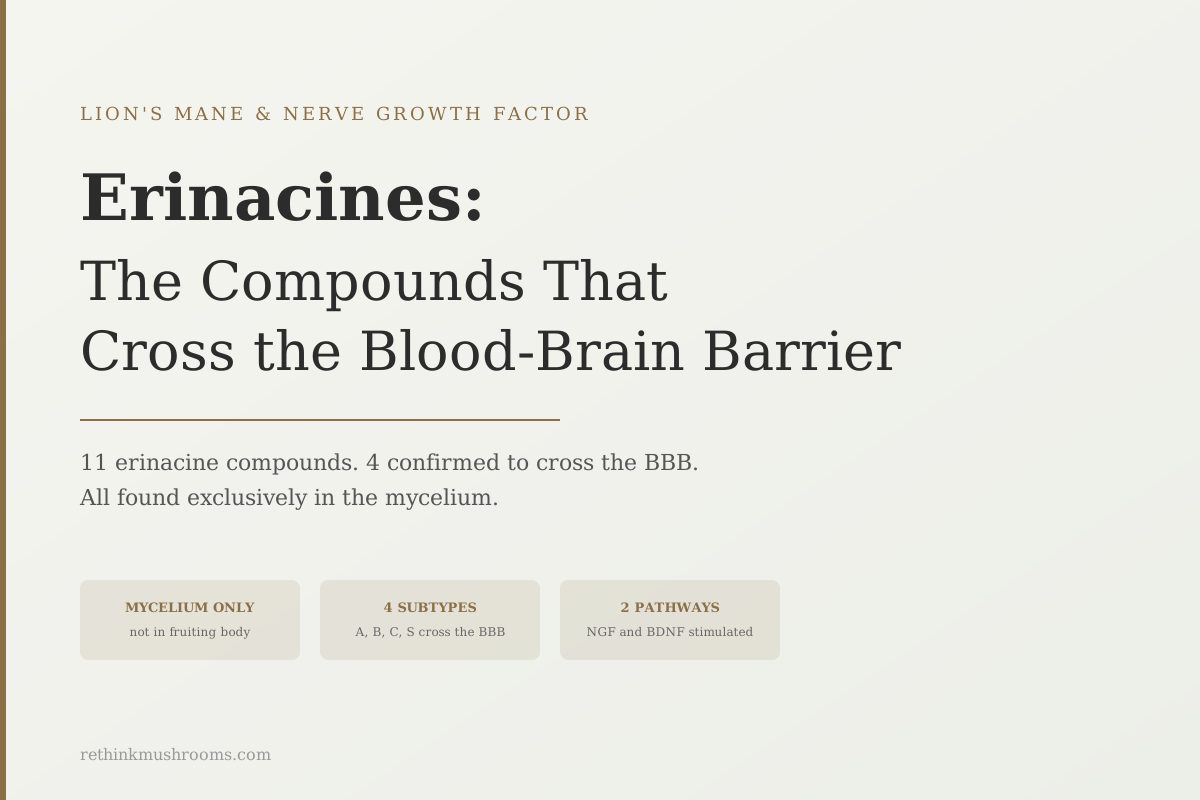
11 known erinacine compounds
Hericium erinaceus mycelium contains 11 distinct erinacine compounds, all absent from the fruiting body. A 2025 systematic review confirmed that at least four of them cross the blood-brain barrier and directly stimulate neurotrophic factors inside brain tissue.
Spangenberg et al., Frontiers in Pharmacology, 2025
Mycelium only
erinacines are absent from the fruiting body
4 subtypes
A, B, C, and S confirmed to cross the BBB
2 pathways
stimulates both NGF and BDNF in brain tissue
Spangenberg et al., Frontiers in Pharmacology, 2025
 View as image ↗
Most supplements marketed for brain health never actually reach the brain. The blood-brain barrier, a dense wall of specialized cells separating the bloodstream from brain tissue, stops the vast majority of compounds from crossing. Nerve growth factor itself, the protein that lion's mane is most famous for stimulating, cannot cross it. Swallow NGF as a capsule and it degrades in the gut. Inject it intravenously and the barrier stops it at the edge of the brain.
Erinacines are what make lion's mane different. They are a family of 11 small, fat-soluble diterpenoid compounds found exclusively in the mycelium of Hericium erinaceus. Their molecular structure lets them pass through the blood-brain barrier by passive diffusion, the same way fat-soluble vitamins like D and K move through lipid membranes. Once inside the brain, they stimulate neurons and support cells to produce NGF locally, bypassing the delivery problem entirely.
This mycelium-versus-fruiting-body distinction is the most important thing to understand about lion's mane supplements. It determines which compounds are present and which biological effects are possible. For the companion piece on hericenones, the NGF-stimulating compounds found only in the fruiting body, see Hericenones and NGF Synthesis: How Lion's Mane Stimulates Nerve Growth. For a broad introduction to lion's mane, see What Is Lion's Mane Mushroom? A Science-Based Overview.
Key Takeaways
- Erinacines (A through K) are found only in lion's mane mycelium and are absent from the fruiting body; a supplement made from fruiting body extract contains essentially none of them
- A 2025 systematic review confirmed that erinacines A, B, C, and S all cross the blood-brain barrier after oral administration and directly stimulate neurotrophic factors in brain tissue
- A 2024 pig pharmacokinetics study detected erinacine A in both cerebrospinal fluid and brain tissue after oral dosing, providing direct confirmation of central nervous system access
- Erinacine A drives two separate neurotrophic pathways inside the brain: NGF synthesis and BDNF upregulation via a PI3K/Akt/GSK-3β signaling cascade
- In a human pilot double-blind placebo-controlled trial, erinacine A-enriched mycelium produced significant cognitive benefits and reduced inflammatory markers in early-stage Alzheimer's patients
- Erinacines also promote oligodendrocyte maturation and myelin production, an angle completely absent from consumer coverage that suggests relevance for demyelinating conditions
Why Getting Supplements Into the Brain Is Harder Than It Sounds
The blood-brain barrier is one of the most selective biological filters in the human body. The capillaries that supply the brain are lined with endothelial cells packed so tightly together that they form a near-continuous wall. Unlike the leaky capillaries in most tissues, these cells allow only a narrow category of substances to pass through.
The rules for crossing are roughly two: small molecular weight, and fat-solubility. Water, oxygen, glucose, and small lipid-soluble molecules move through relatively freely. Large molecules, water-soluble compounds, and most proteins are blocked. Alcohol crosses easily because it is small and lipid-soluble. So does caffeine. So do fat-soluble vitamins.
Nerve growth factor fails on both criteria. It is a protein with a molecular weight of approximately 13,000 daltons, and it dissolves in water rather than fat. The barrier stops it completely. This is a fundamental obstacle for any therapeutic strategy built around delivering NGF to the brain from outside. Drug developers have spent decades trying to engineer around this problem, with limited success, including intranasal delivery, nanoparticle encapsulation, and gene therapy approaches, none of which have reached widespread clinical use.
The practical implication is that any oral supplement claiming to "boost NGF in the brain" faces a difficult question: how does the active compound actually get there? For hericenones, the fruiting body compounds in lion's mane, the answer is uncertain. They're larger molecules with less favorable lipid-solubility, and the evidence for their central nervous system access is limited.
For erinacines, the answer is more concrete.
Erinacines A Through K: The Compounds Found Only in Mycelium
The erinacine family was first identified in the early 1990s from the mycelium of Hericium erinaceus. Friedman's 2015 chemistry review in the Journal of Agricultural and Food Chemistry catalogued the complete family: erinacines A, B, C, D, E, F, G, H, I, J, and K: 11 compounds total, all produced by the mycelium during fungal growth.[1]
This is a point that gets lost in most lion's mane coverage: erinacines are not present in the fruiting body. The visible, edible mushroom cap produces a completely different set of neuroactive compounds called hericenones (designated C through H). Both compound families stimulate nerve growth factor, but through different mechanisms and with very different levels of access to the central nervous system.
Erinacine A is the most extensively studied member of the family and the one used in most animal and human trials. Erinacines C and S have also been characterized individually. The rest of the family (B, D through H, I through K) have been identified chemically but studied less systematically.[1]
A supplement label that reads "lion's mane fruiting body extract" is delivering hericenones. A supplement that reads "lion's mane mycelium extract" or "erinacine A-enriched mycelium" is delivering erinacines. These are not interchangeable preparations. They are different compounds with different chemistry, different locations in the mushroom, and different abilities to reach the brain.
How Researchers Know Erinacines Cross the Blood-Brain Barrier
The question of whether a compound actually reaches brain tissue after oral administration is a pharmacokinetics problem. Showing that a compound produces behavioral or neurochemical effects in animals doesn't directly prove it crossed the barrier. Direct proof requires detecting the compound (or its metabolites) in cerebrospinal fluid or brain tissue samples after dosing.
For erinacines, this evidence built up gradually. The 2018 synthesis by Li and colleagues in Behavioural Neurology reviewed the body of erinacine research and concluded that erinacine-enriched mycelium represents the CNS-active fraction of lion's mane, based on the pattern of effects observed across multiple central nervous system disease models: Alzheimer's disease, depression, and ischemic stroke.[2] These are central effects, not peripheral ones, which implies central access.
The most comprehensive current synthesis is a 2025 systematic review by Spangenberg and colleagues in Frontiers in Pharmacology, which reviewed all available preclinical erinacine research and confirmed that erinacines A, B, C, and S cross the blood-brain barrier based on pharmacokinetics data and mechanistic evidence.[3]
Why Erinacines Can Cross Where Other Compounds Cannot
The Spangenberg review, along with earlier mechanism work, identifies four properties that explain erinacine BBB crossing:
- Small molecular weight. Erinacines are diterpenoids in the range of 300 to 500 daltons, well within the range for passive membrane diffusion.
- Lipophilic structure. Their fat-soluble chemistry allows them to dissolve into and move through the lipid bilayer of the barrier's endothelial cells without requiring active transport proteins.
- Confirmed in cerebrospinal fluid and brain tissue. A 2024 pig pharmacokinetics study, covered in the Spangenberg review, detected erinacine A in both cerebrospinal fluid and brain tissue samples after oral administration, providing direct confirmation that the compound reaches the central nervous system through normal oral dosing.[3]
- Drives neurotrophic factor synthesis in the hippocampus and cortex. Once inside, erinacines stimulate NGF production specifically in the brain regions most critical to memory and learning, not just in peripheral tissues where NGF is also produced and where the barrier question is irrelevant.
The pig model finding is particularly significant. It moves the evidence from "consistent with central access" to "confirmed central access." A compound detected in cerebrospinal fluid and brain parenchyma after oral administration has, by definition, crossed the barrier. This is the kind of pharmacokinetics confirmation that consumer lion's mane coverage has almost entirely ignored.
What Erinacine A Does Once It Is Inside the Brain
Once erinacines reach brain tissue, they activate more than one pathway.
The most well-characterized mechanism is NGF stimulation. Li and colleagues' 2018 synthesis confirmed that erinacine-enriched mycelium promotes NGF synthesis in the hippocampus and cerebral cortex, and that this NGF stimulation is the primary mechanism linking erinacines to neuroprotection and cognitive support in animal models.[2] Neurons that receive adequate NGF survive longer, maintain their connections more effectively, and regenerate more readily after injury. The hippocampus, where NGF signaling is particularly critical, is the brain region most directly involved in forming new memories.
Chiu and colleagues discovered a second pathway in 2018, published in the International Journal of Molecular Sciences. Erinacine A also activates a PI3K/Akt/GSK-3β signaling cascade, a chain of molecular events that leads to upregulation of BDNF, a separate neurotrophic protein most strongly associated with learning, memory consolidation, and mood regulation.[4] In mice treated with erinacine A-enriched mycelium, BDNF levels in brain tissue were measurably elevated, and the animals showed antidepressant-like behavioral effects in standard behavioral assays.[4]
Erinacine A is not simply an NGF stimulator. It engages at least two neurotrophic pathways simultaneously, which likely explains why lion's mane research shows effects across different domains (cognitive function, mood, and neuroprotection) rather than producing a single narrow effect. For the deeper story on lion's mane and BDNF, see Lion's Mane and BDNF: What the Research Shows.
Erinacine A and Alzheimer's Disease: From Mice to a Human Trial
Most of the evidence for erinacines comes from animal models. There is one human pilot trial.
Tsai-Teng and colleagues used a genetically engineered mouse model of Alzheimer's disease to test erinacine A-enriched mycelium in 2016, published in the Journal of Biomedical Science.[5] The mice used (APPswe/PS1dE9 transgenic mice) develop amyloid beta plaques and cognitive deficits that parallel human Alzheimer's pathology. After treatment with erinacine A-enriched mycelium, the treated mice showed:
- Reduced amyloid beta plaque burden in brain tissue
- Improved spatial memory, measured by performance in the Morris water maze
- Decreased levels of neuroinflammatory markers
This was the most direct animal evidence that an erinacine-based preparation could affect Alzheimer's pathology specifically, not just general neuroprotection, but the plaques and inflammation that are central to the disease.
The human evidence comes from a 2020 pilot double-blind placebo-controlled trial by Li and colleagues in Frontiers in Aging Neuroscience.[6] Participants had early-stage Alzheimer's disease. Those who received erinacine A-enriched mycelium showed significantly greater cognitive improvement compared to the placebo group, alongside measurably reduced inflammatory markers. This is the only human RCT that has specifically used erinacine-enriched mycelium, as opposed to standard lion's mane powder, in an Alzheimer's population.
The honest framing: this was a pilot study. Pilot RCTs establish initial signals and generate effect size estimates for larger trials. They are not definitive evidence of efficacy. The sample was small. Independent replication in larger trials is required before drawing firm conclusions. What the Li 2020 study provides is a directional human signal from the most clinically relevant preparation, erinacine A-enriched mycelium, in the most relevant population, early-stage Alzheimer's patients. That makes it meaningful evidence even with those limitations.
For the broader picture of lion's mane across neurological conditions, see NGF Deficiency and Neurological Disease: Can Lion's Mane Help? and Lion's Mane and Amyloid Beta: Mechanisms of Neuroprotection.
Beyond Neurons: The Myelin Discovery That Nobody Is Talking About
Neurons get most of the attention in brain health research, and reasonably so. They generate signals, form memories, regulate mood. But the brain depends equally on a different cell type called oligodendrocytes.
Oligodendrocytes are responsible for producing myelin, the insulating sheath that wraps around nerve fibers. Without myelin, electrical signals travel slowly and unreliably. When myelin is damaged or lost, nerve function degrades progressively. This is what happens in multiple sclerosis and other demyelinating diseases: not neurons dying, but the insulation around their wires breaking down.
Erinacines appear to affect oligodendrocytes, not just neurons.
Huang and colleagues demonstrated in 2021, in Scientific Reports, that Hericium erinaceus mycelium and its isolated bioactive compounds promoted the maturation of oligodendrocyte precursor cells and increased production of myelin basic protein, a core structural component of myelin sheaths.[7] This was laboratory research using cultured cells, but it was the first study to connect erinacines to myelination biology rather than neurotrophin biology.
Fu and colleagues followed that finding in 2024, published in Biomedicine and Pharmacotherapy, by testing erinacine S specifically in a rodent model of demyelination.[8] The model they used, cuprizone exposure, causes oligodendrocyte loss and myelin damage in a way that mimics aspects of MS pathology. Erinacine S protected oligodendrocytes from cuprizone-induced damage and reduced the mood disturbances associated with demyelination. The protection was specific to oligodendrocytes, not a general anti-inflammatory effect.[8]
The Spangenberg 2025 systematic review recognized demyelination as one of the four established research areas for erinacines, alongside Alzheimer's disease, depression, and ischemic brain injury.[3]
What this body of work suggests: erinacines are not exclusively relevant to diseases of neuron loss. They may also be relevant to conditions defined by myelin loss. These are different diseases with different mechanisms, and the fact that a single compound family shows preclinical evidence in both domains makes erinacines more scientifically interesting than their current supplement category positioning suggests. This research direction is entirely absent from consumer lion's mane coverage.
Fruiting Body vs. Mycelium: Why the Source Determines What You Get
If erinacines are only in the mycelium, then the part of the mushroom used to make a supplement determines whether erinacines are present at all.
Friedman's 2015 chemistry review in the Journal of Agricultural and Food Chemistry is clear on this point: hericenones C through H are fruiting body compounds, and erinacines A through K are mycelium compounds.[1] They do not significantly overlap. The same mushroom species produces both compound families, but in different structures at different stages of the fungal life cycle.
This means the fruiting body vs. mycelium distinction is not a minor formulation preference. It is a fundamental difference in which active compounds are present. A supplement made from dried fruiting body delivers hericenones and beta-glucans. A supplement made from erinacine-enriched mycelium delivers erinacines and a different polysaccharide profile. The two products have different chemistry, different mechanisms, and different evidence bases.
This is not to say fruiting body supplements are ineffective. Hericenones have their own biology: peripheral NGF stimulation via JNK signaling, and a second mechanism identified in 2023 by Martínez-Mármol and colleagues involving ERK1/2 activation independent of the classical NGF receptor. That research is covered in full in Hericenones and NGF Synthesis: How Lion's Mane Stimulates Nerve Growth.
The evidence for central nervous system effects, however, specifically attributes those effects to erinacines. The Spangenberg 2025 systematic review is explicit on this point: the neuroprotective effects demonstrated in Alzheimer's disease, depression, ischemic injury, and demyelination models are mediated by erinacines, and the preclinical pharmacokinetics data confirms central access for at least four erinacine subtypes.[3]
For the pharmacology context on how each compound type is distributed and processed in the body, see The Pharmacology of Hericium erinaceus: How Lion's Mane Works in the Body.
The Bottom Line
Erinacines are the CNS-active fraction of lion's mane: 11 diterpenoid compounds produced exclusively by the mycelium, at least four of which have been confirmed to cross the blood-brain barrier after oral administration. A 2024 pig pharmacokinetics study detected erinacine A in cerebrospinal fluid and brain tissue directly, providing concrete pharmacokinetics confirmation that consumer coverage has largely ignored. Animal models show reduced amyloid plaque burden and improved memory in Alzheimer's mice. A human pilot RCT using erinacine A-enriched mycelium showed cognitive and inflammatory benefits in early-stage Alzheimer's patients, though the trial was small and requires independent replication. The most overlooked finding: erinacines promote myelin production and protect oligodendrocytes from demyelinating injury, opening a research direction with potential relevance to MS that no competitor has yet addressed.
Frequently Asked Questions
Sources & References
- 1RTHM-00371·Friedman, Mendel (2015). “Chemistry, Nutrition, and Health-Promoting Properties of Hericium erinaceus (Lion's Mane) Mushroom Fruiting Bodies and Mycelia and Their Bioactive Compounds..” Journal of agricultural and food chemistry.Study breakdown →PubMed →↩
- 2RTHM-00973·Li, I-Chen et al. (2018). “Neurohealth Properties of Hericium erinaceus Mycelia Enriched with Erinacines..” Behavioural neurology.Study breakdown →PubMed →↩
- 3RTHM-02184·Spangenberg, E T et al. (2025). “Unveiling the role of erinacines in the neuroprotective effects of Hericium erinaceus: a systematic review in preclinical models..” Frontiers in pharmacology.Study breakdown →PubMed →↩
- 4RTHM-00505·Chiu, Chun-Hung et al. (2018). “Erinacine A-Enriched Hericium erinaceus Mycelium Produces Antidepressant-Like Effects through Modulating BDNF/PI3K/Akt/GSK-3β Signaling in Mice..” International journal of molecular sciences.Study breakdown →PubMed →↩
- 5RTHM-00452·Tsai-Teng, Tzeng et al. (2016). “Erinacine A-enriched Hericium erinaceus mycelium ameliorates Alzheimer's disease-related pathologies in APPswe/PS1dE9 transgenic mice..” Journal of biomedical science.Study breakdown →PubMed →↩
- 6RTHM-00631·Li, I-Chen et al. (2020). “Prevention of Early Alzheimer's Disease by Erinacine A-Enriched Hericium erinaceus Mycelia Pilot Double-Blind Placebo-Controlled Study..” Frontiers in aging neuroscience.Study breakdown →PubMed →↩
- 7RTHM-00692·Huang, Hui-Ting et al. (2021). “Hericium erinaceus mycelium and its small bioactive compounds promote oligodendrocyte maturation with an increase in myelin basic protein..” Scientific reports.Study breakdown →PubMed →↩
- 8RTHM-00878·Fu, Jing-Ting et al. (2024). “Erinacine S, a small active component derived from Hericium erinaceus, protects oligodendrocytes and alleviates mood abnormalities in cuprizone-exposed rodents..” Biomedicine & pharmacotherapy = Biomedecine & pharmacotherapie.Study breakdown →PubMed →↩