Lion's Mane Neuroplasticity
2 distinct routes to BDNF-linked plasticity
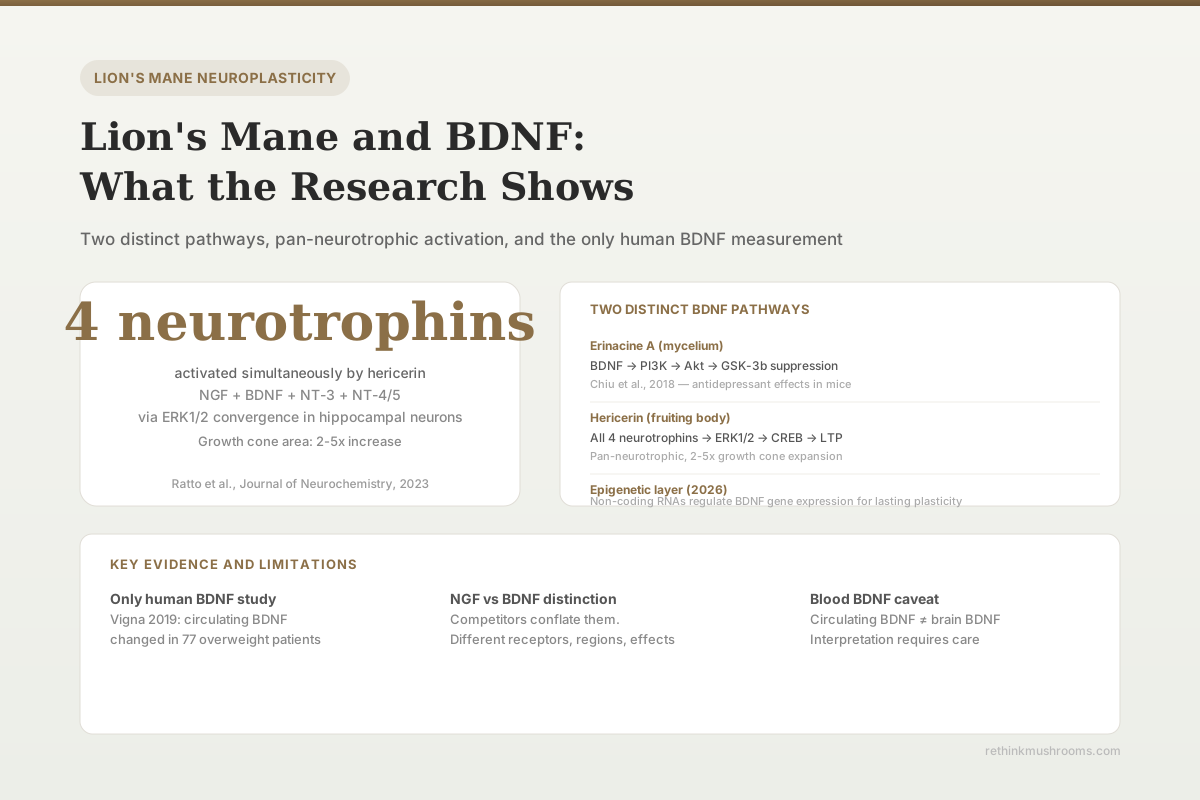
Lion's mane reaches BDNF-linked neuroplasticity through two compound routes: erinacine A (mycelium) acts through the BDNF/PI3K/Akt cascade, while hericene A and related hericerin derivatives (fruiting body) drive neurite outgrowth via a pan-neurotrophic pathway that converges on ERK1/2 and works partly independently of the BDNF receptor itself.
Journal of Neurochemistry, 2023
Erinacine A pathway
Chiu 2018: erinacine A produced antidepressant effects specifically via BDNF/PI3K/Akt/GSK-3b signaling in mice, distinct from the NGF pathway
Only human BDNF data
Vigna 2019: circulating pro-BDNF and BDNF changes in 77 overweight patients alongside 29.4% depression reduction; the only human study measuring BDNF after HE supplementation
Epigenetic layer (2026)
Cipriano et al. propose non-coding RNA networks as an additional mechanism enabling lasting gene-level neuroplasticity beyond classical BDNF signaling
Journal of Neurochemistry, 2023
 View as image ↗
Most lion's mane content describes the mushroom as boosting "NGF" (nerve growth factor) and stops there. This framing misses a significant part of the picture. BDNF (brain-derived neurotrophic factor) is a separate, distinct protein that lion's mane also affects through multiple pathways. The distinction matters because NGF and BDNF act on different receptors, serve different brain regions, and drive different aspects of brain plasticity.
In the adult hippocampus, where memory formation and mood regulation primarily occur, BDNF is the dominant neurotrophin. Understanding how lion's mane affects BDNF specifically is therefore more relevant to most people's goals than understanding its NGF effects. For the lion's mane pillar overview, see what is lion's mane mushroom: a science-based overview.
Key Takeaways
- NGF and BDNF are distinct proteins: NGF acts via TrkA receptor primarily on peripheral neurons and specific brain regions; BDNF acts via TrkB receptor and is dominant in the adult hippocampus and cortex
- Chiu et al. (2018) showed erinacine A (a mycelium compound) produces antidepressant effects specifically through the BDNF/PI3K/Akt/GSK-3b pathway, not the NGF pathway
- Martínez-Mármol et al. (2023) found hericerin derivatives (hericene A and NDPIH) from lion's mane fruiting body drive potent neurite outgrowth in hippocampal neurons through a "pan-neurotrophic" pathway that converges on ERK1/2 and works partly independently of the BDNF/TrkB receptor
- Vigna et al. (2019) is the only human study that measured circulating BDNF levels after HE supplementation: overweight patients showed changes in pro-BDNF and mature BDNF alongside 29.4% depression reduction
- Blood BDNF measurements are not equivalent to brain BDNF; circulating pro-BDNF and mature BDNF have opposing effects on neuronal survival, making the measurement interpretation complex
- Cipriano et al. (2026) propose a third mechanism beyond NGF and BDNF: non-coding RNA networks that may drive lasting epigenetic changes in neuroplasticity-related gene expression
Fact Check
What most lion's mane content claims vs. what the neurotrophin research shows
The claim
“Lion's mane works by 'boosting NGF' (nerve growth factor) — that single mechanism explains its brain benefits.”
Popular supplement content that stops at the first and most famous neurotrophin finding
What research shows
Partly TrueNGF induction is real (Mori 2008), but it is only part of the story. BDNF — a separate protein acting through a different receptor (TrkB) and dominant in the memory-forming hippocampus — is the more relevant neurotrophin for mood and cognition. Erinacine A drives antidepressant effects through BDNF/PI3K/Akt signaling (Chiu 2018), and hericerin derivatives promote hippocampal neurite outgrowth through a pan-neurotrophic pathway converging on ERK1/2 (Martínez-Mármol 2023).
The direct human evidence for BDNF specifically is thin: only one human study (Vigna 2019) has measured circulating BDNF after supplementation, and blood BDNF is an imperfect proxy for brain BDNF. The mechanism is well-characterized in cells and animals; the human biomarker data is not.
Mori et al. (2008) [ref 1]; Chiu et al. (2018) [ref 2]; Martínez-Mármol et al. (2023) [ref 8]; Vigna et al. (2019) [ref 5]
Why NGF and BDNF Are Not the Same Thing
Most editorial content treats NGF (nerve growth factor) and BDNF (brain-derived neurotrophic factor) as essentially interchangeable terms for "brain growth factor." They are not. Understanding the distinction is fundamental to understanding lion's mane's effects.
NGF was the first neurotrophin discovered (1950s) and acts primarily on peripheral neurons (sensory and sympathetic neurons outside the brain) and a specific class of cholinergic neurons in the brain's basal forebrain. Its receptor is TrkA (tropomyosin receptor kinase A). NGF is critical for peripheral nerve maintenance and is relevant to conditions like peripheral neuropathy.
BDNF is the most abundant neurotrophin in the adult brain and acts on entirely different targets through its primary receptor TrkB. BDNF is particularly concentrated in the hippocampus (memory formation), cortex (higher cognition), and cerebellum (motor learning). It drives hippocampal neurogenesis (the formation of new neurons in the adult brain), supports synaptic plasticity and long-term potentiation (the cellular basis of memory), and regulates mood through effects on serotonin and other neurotransmitter systems.
When someone asks whether lion's mane can improve memory or help with depression, BDNF is the more directly relevant neurotrophin. When someone asks whether lion's mane can protect peripheral nerves, NGF is more relevant. Most articles conflate them and provide an incomplete picture of which effects come from which pathway.
- Receptor
- TrkA
- Main targets
- Peripheral (sensory & sympathetic) neurons and basal-forebrain cholinergic neurons
- Most relevant to
- Peripheral nerve maintenance; neuropathy
- Lion's mane link
- Fruiting-body hericenones induce NGF (Mori 2008)
- Receptor
- TrkB
- Main targets
- Dominant in the adult hippocampus and cortex
- Most relevant to
- Hippocampal neurogenesis, long-term potentiation, memory and mood
- Lion's mane link
- Erinacine A acts via BDNF/PI3K/Akt (Chiu 2018); pan-neurotrophic ERK1/2 pathway (Martínez-Mármol 2023)
When the goal is memory or mood, BDNF is the more directly relevant neurotrophin — which is why the “lion's mane just boosts NGF” summary is incomplete.
How Erinacine A Activates BDNF: A Different Pathway from NGF
The first clear mechanistic evidence that lion's mane works specifically through BDNF, not just NGF, came from Chiu and colleagues in 2018.[2] Their study tested erinacine A, a compound found specifically in lion's mane mycelium (not the fruiting body), in a restraint-stressed mouse model of depression.
Erinacine A produced antidepressant effects through the BDNF/PI3K/Akt/GSK-3b signaling cascade. Breaking down that pathway in plain terms: BDNF activates TrkB, which triggers phosphoinositide 3-kinase (PI3K), which activates the enzyme Akt, which then inactivates glycogen synthase kinase-3 beta (GSK-3b, an enzyme that, when overactive, is associated with depressive states and neurodegeneration). The downstream result was restoration of depleted serotonin, norepinephrine, and dopamine: the monoamine neurotransmitters depleted by chronic stress.
This pathway runs through BDNF signaling, not NGF. The TrkB receptor rather than TrkA. The hippocampal regions rather than peripheral or cholinergic pathways. This is a meaningful mechanistic distinction: erinacine A's mood effects are BDNF-mediated, which explains their relevance to depression and anxiety rather than purely to peripheral nerve conditions.
Li and colleagues' 2018 comprehensive review of erinacine-enriched mycelium neurohealth properties confirmed that erinacines modulate BDNF alongside NGF, providing a broader synthesis of how the mycelium compounds drive neuroplasticity.[3]
The Pan-Neurotrophic Discovery: Hericerin Derivatives Converge on ERK1/2
A landmark 2023 study in the Journal of Neurochemistry by Martínez-Mármol and colleagues expanded the picture substantially.[8] They purified new active compounds from lion's mane fruiting body — N-de phenylethyl isohericerin (NDPIH), an isoindoline compound, and its hydrophobic derivative hericene A — and tested them in cultured hippocampal neurons.
The finding was striking: these hericerin derivatives were highly potent at promoting extensive axon outgrowth and neurite branching in hippocampal neurons, even in the absence of serum growth factors. Crucially, the mechanism did not run purely through the classical BDNF receptor. Pharmacological inhibition of TrkB (with the blocker ANA-12) only partly prevented the neurotrophic activity, and NDPIH still activated ERK1/2 signaling in cells lacking TrkB. The authors concluded that the compounds act through a "complementary neurotrophic pathway independent of TrkB, with converging downstream ERK1/2 activation" — what they termed a pan-neurotrophic pathway.
ERK1/2 (extracellular signal-regulated kinase 1/2) is a signaling hub downstream of the neurotrophin receptors, and its activation connects to CREB (cAMP response element-binding protein) phosphorylation, which drives long-term potentiation and memory formation. In the same study, mice fed lion's mane crude extract and hericene A showed increased neurotrophin expression and downstream signaling, alongside significantly enhanced hippocampal (spatial) memory.
This "pan-neurotrophic" framing is more accurate than the simple "lion's mane boosts NGF" summary. The NGF claim is technically true — Mori and colleagues (2008) demonstrated that lion's mane induces NGF synthesis in human 1321N1 astrocytoma cells[1] — but it is incomplete. The fruiting-body compounds engage a broader neurotrophic signaling program that converges on ERK1/2 and enhances neurite outgrowth partly independently of the BDNF/TrkB receptor. Coverage that stops at "NGF" is missing most of the picture.
For more on the NGF-specific story and the hericenone compound chemistry, see hericenones and NGF synthesis: how lion's mane stimulates nerve growth.
The Only Human Study That Measured BDNF
Animal and cell culture studies establish mechanism, but the most important question is whether lion's mane actually changes BDNF levels in humans. There is exactly one published study that directly measured circulating BDNF in humans after HE supplementation.
Vigna and colleagues (2019) enrolled 77 overweight or obese patients and measured mood, sleep, and circulating BDNF and pro-BDNF levels before and after HE supplementation.[5] Depression scores improved by 29.4%, anxiety by 33.2%, and sleep disorders by 39.1%. Alongside these clinical improvements, circulating pro-BDNF and mature BDNF levels changed.
Vigna et al. (2019) · Evidence-Based Complementary and Alternative Medicine
- Population
- 77 adults affected by overweight or obesity, on a low-calorie diet
- Intervention
- Hericium erinaceus supplementation for 8 weeks
- Comparator
- Pre- vs. post-supplementation (single-arm, no placebo control)
- Finding
- Depression scores improved 29.4%, anxiety 33.2%, and sleep disorders 39.1%, alongside measurable shifts in the serum balance between pro-BDNF and mature BDNF. This is the only human study to date that has measured circulating BDNF after lion's mane supplementation — but circulating BDNF is an imperfect proxy for brain BDNF, and the design lacked a placebo control.
The pro-BDNF to mature BDNF distinction the authors measured is biologically significant. BDNF is initially synthesized as pro-BDNF, a precursor molecule. Pro-BDNF and mature BDNF have opposing effects on neurons: mature BDNF promotes neuronal survival and plasticity through TrkB activation; pro-BDNF promotes apoptosis (neuronal death) through p75NTR activation. A shift in the pro-BDNF to mature BDNF ratio can therefore have substantial effects on brain health independent of absolute BDNF levels.
This is the most clinically relevant human BDNF data available for lion's mane, and it connects to the mechanism: if erinacine A works through BDNF pathways (Chiu 2018), and if the patient population with elevated inflammation (overweight/obese) shows the largest mood improvements (also the population in the Vigna study), then the BDNF biomarker changes provide the biological link between the animal mechanism and the human clinical outcome.
Why Blood BDNF Does Not Directly Measure Brain BDNF
The Vigna finding is important but requires careful interpretation. Circulating BDNF (measured in blood plasma or serum) does not directly reflect brain BDNF levels. BDNF is produced in the brain and in peripheral tissues, and the molecules circulating in blood are mostly from peripheral sources including platelets (which store substantial amounts of BDNF) and blood vessels.
The relationship between peripheral BDNF and brain BDNF is statistically correlated in some studies but it is not a direct measure of hippocampal or cortical BDNF concentration, which is what would most directly relevant to neuroplasticity and mood. Pro-BDNF measurements in blood add another layer of complexity.
What the Vigna BDNF data can support: HE supplementation produces measurable changes in circulating BDNF-related proteins. This is consistent with a systemic effect on BDNF biology. What it cannot directly establish: that brain BDNF in the hippocampus increased, or that the BDNF changes caused the mood improvements rather than both resulting from a common cause.
This measurement limitation is why the animal mechanistic evidence (Chiu 2018, Ryu 2018, Chong 2021) remains essential for understanding the BDNF story: those studies can directly measure brain BDNF in specific regions and test whether blocking BDNF signaling blocks the behavioral effects.
BDNF, Neurogenesis, and the Hippocampus Connection
BDNF is the primary molecular driver of adult hippocampal neurogenesis, the formation of new neurons in the dentate gyrus of the hippocampus, a process continuing throughout adult life. This connection links the BDNF story to the neurogenesis story.
Ryu and colleagues (2018) demonstrated that lion's mane specifically promotes hippocampal neurogenesis in adult mice, and that this neurogenesis is both necessary and sufficient to explain the anxiety and depression reduction observed.[4] Chong and colleagues (2021) extended this by pharmacologically blocking neurogenesis in mice receiving HE, and showed that the antidepressant effect was abolished, establishing neurogenesis as causal, not merely correlative.[6]
Since BDNF is the primary upstream driver of hippocampal neurogenesis, the neurogenesis evidence is also indirect evidence for BDNF activation in the hippocampus. The chain: erinacines/hericenones → BDNF upregulation → TrkB activation → ERK1/2 (and other MAPK pathways) → CREB phosphorylation → neurogenesis-related gene expression → new hippocampal neurons → improved memory and mood.
The comprehensive 2023 review by Szucko-Kociuba and colleagues confirms this mechanistic framework, connecting neurotrophic factor effects to neuroprotective outcomes through these shared pathways.[9]
The Epigenetic Frontier: Beyond Classical BDNF Signaling
A hypothesis-driven review published in 2026 by Cipriano and colleagues in the International Journal of Molecular Sciences proposes a third mechanism for lion's mane neuroplasticity that operates beyond the classical NGF/BDNF story.[11]
Their "neurotrophic-epigenetic axis" hypothesis proposes that HE bioactives regulate gene expression through non-coding RNA networks, specifically microRNAs (miRNAs) and long non-coding RNAs (lncRNAs). Non-coding RNAs are RNA molecules that do not encode proteins but play extensive roles in regulating which genes are transcribed and how strongly. Some non-coding RNAs regulate the expression of BDNF itself, as well as the signaling components of the TrkB pathway.
The hypothesis is that lion's mane may not only acutely stimulate BDNF release but may also alter the epigenetic regulation of BDNF-related gene expression, potentially creating more lasting changes in neuroplasticity capacity than acute neurotrophic stimulation alone would explain.
This is explicitly a hypothesis paper, not a results paper. There are no direct experimental data in humans or animals testing this specific mechanism. But it represents the current frontier of lion's mane research and suggests that the BDNF story is not finished.
For the broader context of how lion's mane supports neuroplasticity through these and related mechanisms, see lion's mane and neuroplasticity: can a mushroom rewire your brain?. For the erinacines that cross the blood-brain barrier to access these pathways, see erinacines: the compounds that cross the blood-brain barrier.
What the Human Evidence Actually Shows
Setting aside mechanism, the human clinical evidence for lion's mane's BDNF-mediated effects is limited. The Mori 2009 RCT showed cognitive improvements in MCI patients at 3g/day over 16 weeks, a functional result consistent with BDNF-mediated neuroplasticity, but did not measure BDNF.[7]
Docherty et al. (2023) found trend-level stress reduction but no significant mood effect in healthy young adults at 1.8g/day over 28 days, without measuring BDNF.[12] Surendran et al. (2025) found acute 1-hour Stroop task improvement but again without BDNF measurement.[10]
Only Vigna 2019 measured BDNF in humans, in a non-randomized cohort without a placebo control. This is a thin human evidence base for BDNF effects specifically, even though the animal and cell culture mechanistic evidence is detailed.
The honest summary: lion's mane activates BDNF-relevant pathways through well-characterized mechanisms (erinacine A via BDNF/PI3K/Akt, hericerin via pan-neurotrophic ERK1/2). The evidence suggests these mechanisms translate to cognitive and mood benefits in humans, particularly in those with existing deficits (MCI, overweight patients). BDNF is the most plausible molecular mediator. But human studies specifically measuring BDNF levels as a biomarker are scarce, and the relationship between circulating BDNF and brain BDNF adds interpretive uncertainty.
- Cell & Lab Studiescompleted
Hericerin derivatives (NDPIH, hericene A) drive hippocampal neurite outgrowth via a pan-neurotrophic pathway converging on ERK1/2, partly independent of TrkB (Martínez-Mármol 2023); NGF induction in astrocytoma cells (Mori 2008); mechanistic review of erinacine effects on BDNF and NGF (Li 2018)
- Animal Studiescompleted
Erinacine A produces antidepressant effects via BDNF/PI3K/Akt/GSK-3β in stressed mice (Chiu 2018); lion's mane promotes hippocampal neurogenesis (Ryu 2018), which is causally required for the antidepressant effect (Chong 2021)
- Small Human Trialscurrent
One single-arm study measured circulating BDNF and pro-BDNF alongside mood improvement in 77 overweight patients (Vigna 2019); an MCI RCT showed cognition gains at 3 g/day but did not measure BDNF (Mori 2009)
- Large Randomized Trials with BDNF Endpointsmissing
No large, placebo-controlled RCT has used BDNF as a primary endpoint; recent healthy-adult RCTs (Docherty 2023; Surendran 2025) did not measure BDNF at all
- Meta-Analyses of BDNF Outcomesmissing
No human meta-analysis of lion's mane effects on BDNF biomarkers
The mechanism is well-characterized in cells and animals, but human BDNF evidence stops at a single non-randomized study plus one MCI RCT that never measured BDNF. 'Lion's mane raises BDNF in humans' is biologically plausible and mechanistically supported — but not yet established by direct, controlled human measurement.
Aggregate of the studies cited in this article: Mori 2008 [ref 1], Chiu 2018 [ref 2], Li 2018 [ref 3], Ryu 2018 [ref 4], Vigna 2019 [ref 5], Chong 2021 [ref 6], Mori 2009 [ref 7], Martínez-Mármol 2023 [ref 8], Docherty 2023 [ref 12], Surendran 2025 [ref 10]
Safety — mood and medication
ModerateLion's mane is not a treatment for depression or a substitute for prescribed care
Concern
Much of the BDNF story concerns mood and depression. That framing can be misread as 'lion's mane treats depression.' The human evidence is early — one single-arm biomarker study and small RCTs — and no trial has tested lion's mane against, or alongside, prescribed antidepressants. Because several of the proposed mechanisms touch serotonin and other monoamine systems, combining supplements with prescribed psychiatric medication is not something to improvise.
What the research says
Treat lion's mane as a research-stage supplement, not a therapy. Do not start, stop, or change any prescribed antidepressant or other medication based on this research, and discuss any supplement with your clinician first — especially if you take psychiatric medication, are pregnant or breastfeeding, or have a diagnosed mood disorder. This article is educational and is not medical advice.
Particularly relevant for: Anyone with a mood disorder, on psychiatric medication, or considering lion's mane for depression or anxiety
The Bottom Line
Lion's mane engages BDNF-linked neuroplasticity through two distinct routes: erinacine A (mycelium) works specifically through BDNF/PI3K/Akt/GSK-3b signaling (Chiu 2018), while hericerin derivatives (fruiting body) drive hippocampal neurite outgrowth through a pan-neurotrophic pathway that converges on ERK1/2 and is partly independent of the BDNF/TrkB receptor (Martínez-Mármol 2023). The only human study measuring BDNF after HE supplementation (Vigna 2019) found circulating pro-BDNF and BDNF changes alongside 29.4% depression improvement in 77 overweight patients. Blood BDNF is an imperfect proxy for brain BDNF, and human studies measuring BDNF directly remain scarce. Cipriano 2026 proposes a third mechanism: non-coding RNA networks that may enable lasting epigenetic changes in BDNF gene regulation.
Frequently Asked Questions
Sources & References
- 1RTHM-00268·Mori, Koichiro et al. (2008). “Nerve growth factor-inducing activity of Hericium erinaceus in 1321N1 human astrocytoma cells..” Biological & pharmaceutical bulletin.Study breakdown →PubMed →↩
- 2RTHM-00505·Chiu, Chun-Hung et al. (2018). “Erinacine A-Enriched Hericium erinaceus Mycelium Produces Antidepressant-Like Effects through Modulating BDNF/PI3K/Akt/GSK-3β Signaling in Mice..” International journal of molecular sciences.Study breakdown →PubMed →↩
- 3RTHM-00973·Li, I-Chen et al. (2018). “Neurohealth Properties of Hericium erinaceus Mycelia Enriched with Erinacines..” Behavioural neurology.Study breakdown →PubMed →↩
- 4RTHM-01003·Ryu, Sun et al. (2018). “Hericium erinaceus Extract Reduces Anxiety and Depressive Behaviors by Promoting Hippocampal Neurogenesis in the Adult Mouse Brain..” Journal of medicinal food.Study breakdown →PubMed →↩
- 5RTHM-00590·Vigna, Luisella et al. (2019). “Hericium erinaceus Improves Mood and Sleep Disorders in Patients Affected by Overweight or Obesity: Could Circulating Pro-BDNF and BDNF Be Potential Biomarkers?.” Evidence-based complementary and alternative medicine : eCAM.Study breakdown →PubMed →↩
- 6RTHM-01338·Chong, Pit Shan et al. (2021). “Neurogenesis-dependent antidepressant-like activity of Hericium erinaceus in an animal model of depression..” Chinese medicine.Study breakdown →PubMed →↩
- 7RTHM-00165·Mori, Koichiro et al. (2009). “Improving effects of the mushroom Yamabushitake (Hericium erinaceus) on mild cognitive impairment: a double-blind placebo-controlled clinical trial..” Phytotherapy research : PTR.Study breakdown →PubMed →↩
- 8RTHM-01746·Martínez-Mármol, Ramón et al. (2023). “Hericerin derivatives activates a pan-neurotrophic pathway in central hippocampal neurons converging to ERK1/2 signaling enhancing spatial memory..” Journal of neurochemistry.Study breakdown →PubMed →↩
- 9RTHM-01798·Szućko-Kociuba, Izabela et al. (2023). “Neurotrophic and Neuroprotective Effects of Hericium erinaceus..” International journal of molecular sciences.Study breakdown →PubMed →↩
- 10RTHM-00952·Surendran, Geyan et al. (2025). “Acute effects of a standardised extract of Hericium erinaceus (Lion's Mane mushroom) on cognition and mood in healthy younger adults: a double-blind randomised placebo-controlled study..” Frontiers in nutrition.Study breakdown →PubMed →↩
- 11RTHM-02226·Cipriano, Giovanni Luca et al. (2026). “Beyond Neurotrophins: A Proposed Neurotrophic-Epigenetic Axis Mediated by Non-Coding RNA Networks for Hericium erinaceus Bioactives-A Hypothesis-Driven Review..” International journal of molecular sciences.Study breakdown →PubMed →↩
- 12RTHM-00821·Docherty, Sarah et al. (2023). “The Acute and Chronic Effects of Lion's Mane Mushroom Supplementation on Cognitive Function, Stress and Mood in Young Adults: A Double-Blind, Parallel Groups, Pilot Study..” Nutrients.Study breakdown →PubMed →↩