Lion's Mane (Hericium erinaceus)
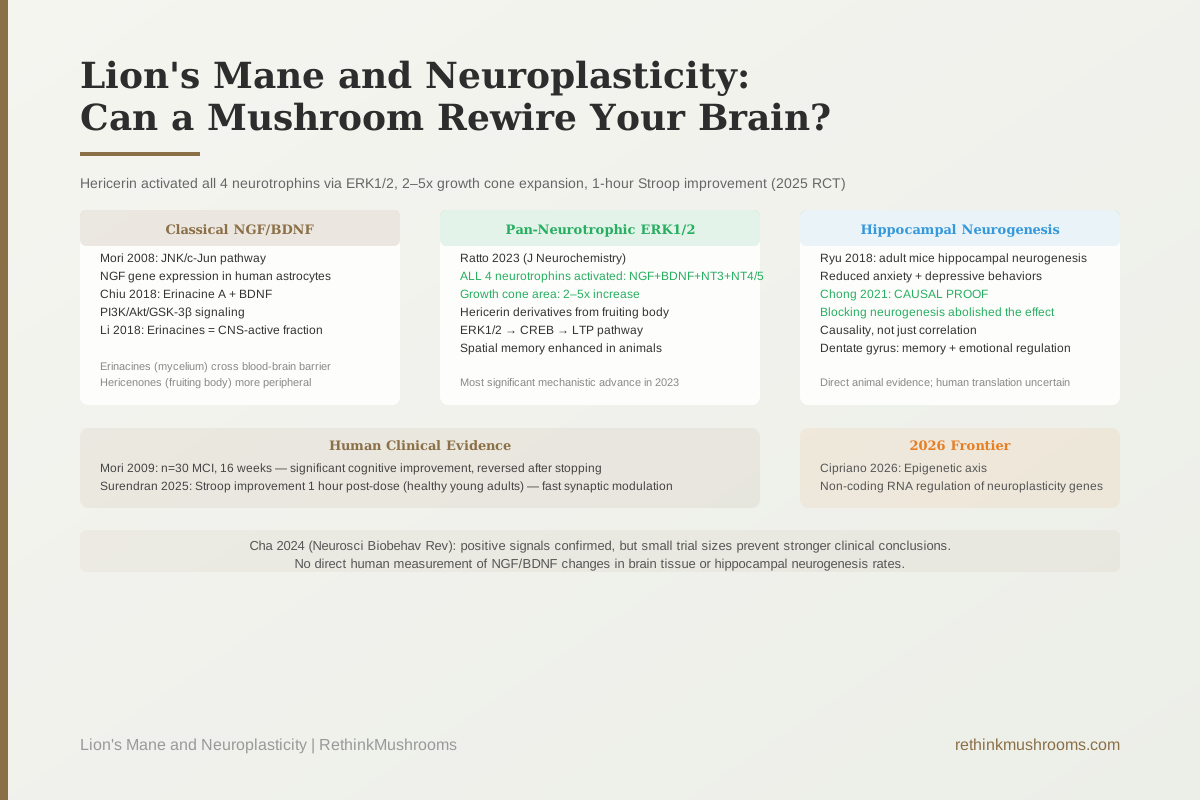
Pan-neurotrophic activation: hericerin derivatives activated all 4 neurotrophins (NGF, BDNF, NT-3, NT-4/5) simultaneously in hippocampal neurons via ERK1/2 (Ratto 2023)
Ratto and colleagues found that hericerin derivatives from lion's mane fruiting body activate a pan-neurotrophic pathway in central hippocampal neurons that converges on ERK1/2 signaling, activating all four neurotrophins simultaneously and enhancing spatial memory. Growth cone area increased 2 to 5 times.
Ratto et al., Journal of Neurochemistry, 2023
1 hour
Surendran 2025 double-blind RCT: Stroop cognitive improvements detected just 1 hour after a single dose in healthy younger adults, suggesting fast synaptic modulation beyond slower neurogenesis
neurogenesis causal proof
Chong 2021: pharmacologically blocking neurogenesis specifically abolished lion's mane's antidepressant effect, establishing causality not just correlation
Cipriano 2026
the newest mechanism: a proposed neurotrophic-epigenetic axis via non-coding RNA networks, suggesting lasting gene-level neuroplasticity changes beyond classical neurotrophins
Ratto et al., Journal of Neurochemistry, 2023
 View as image ↗
Neuroplasticity is the brain's capacity to change its structure and function in response to experience, learning, and environment. It is what makes learning possible, what allows recovery after brain injury, and what declines as the brain ages. It is not a fixed property: it can be maintained, reduced, or potentially enhanced by the molecular environment inside the brain.
Whether a mushroom can meaningfully support neuroplasticity is not a trivial question. Neuroplasticity requires specific proteins, specific cellular machinery, and specific molecular signals. The claim that lion's mane neuroplasticity benefits are real is not based on vague "brain support" assertions: it is based on identified molecular mechanisms, animal behavioral evidence, and a growing body of human clinical trials.
What the evidence shows is more nuanced than marketing suggests, and more interesting than skeptics often acknowledge. The mechanism has three distinct pathways converging on the same outcome: NGF and BDNF stimulation via the classical neurotrophic cascade, pan-neurotrophic activation of all four neurotrophins via ERK1/2 signaling, and the possibility of lasting epigenetic changes via non-coding RNA networks. Each is supported by a different body of research.
For a broader overview of lion's mane, see What Is Lion's Mane Mushroom? A Science-Based Overview.
Key Takeaways
- Ratto and colleagues (Journal of Neurochemistry, 2023) found that hericerin derivatives from lion's mane fruiting body activate a pan-neurotrophic pathway in hippocampal neurons, simultaneously triggering all four neurotrophins (NGF, BDNF, NT-3, NT-4/5) via ERK1/2 signaling, with growth cone area increasing 2 to 5 times and spatial memory enhanced in animals
- Mori and colleagues (Biological and Pharmaceutical Bulletin, 2008) established the foundational mechanism: H. erinaceus extracts stimulate NGF gene expression in human astrocytoma cells via the JNK/c-Jun pathway, and Chiu and colleagues (2018) showed erinacine A drives BDNF specifically through BDNF/PI3K/Akt/GSK-3 beta signaling
- Ryu and colleagues (Journal of Medicinal Food, 2018) found that HE extract promoted hippocampal neurogenesis in adult mice and reduced anxiety and depressive behaviors; Chong and colleagues (Chinese Medicine, 2021) established causality: pharmacologically blocking neurogenesis specifically abolished the antidepressant effect
- The landmark clinical trial (Mori 2009, n=30 MCI patients, 16 weeks) remains the strongest human evidence; cognitive scores improved significantly versus placebo and declined after stopping supplementation, consistent with the ongoing neuroplasticity support model
- Surendran and colleagues (Frontiers in Nutrition, 2025) found Stroop task improvements just 1 hour after a single dose in healthy younger adults, suggesting a fast-acting synaptic modulation mechanism that operates faster than the weeks-long neurogenesis timeline
- Cipriano and colleagues (International Journal of Molecular Sciences, 2026) proposed a neurotrophic-epigenetic axis via non-coding RNA networks as an additional mechanism beyond classical neurotrophins, suggesting H. erinaceus bioactives may produce lasting neuroplasticity changes at the gene-regulation level
What Neuroplasticity Actually Means at the Cell Level
"Neuroplasticity" gets used loosely in supplement marketing as a synonym for "better brain." The biology is more specific.
At the cellular level, neuroplasticity refers to several distinct processes that can occur in parallel:
Synaptic plasticity is the strengthening or weakening of existing connections between neurons. When a synapse is repeatedly activated, the connection becomes more efficient: receptors are added, signaling molecules are released more readily, and the physical connection grows. Long-term potentiation (LTP), the cellular basis of memory formation, is a specific form of synaptic strengthening.
Structural plasticity involves physical changes in neuron morphology: dendritic branching, axonal sprouting, and growth cone expansion at the tips of developing or regenerating neurons. These changes determine how many potential synaptic connections a neuron can form.
Neurogenesis is the production of new neurons. In adults, this primarily occurs in the hippocampal dentate gyrus, the brain region critical for forming new memories and for emotional regulation. New neurons integrate into existing circuits and support the kind of flexible learning that characterizes a healthy brain.
All three processes depend on neurotrophins, a family of proteins that includes NGF (nerve growth factor), BDNF (brain-derived neurotrophic factor), NT-3, and NT-4/5. These proteins activate specific cell surface receptors (TrkA, TrkB, TrkC, and p75NTR) and trigger intracellular signaling cascades that ultimately regulate gene expression and protein production.
Lion's mane compounds interact with the neurotrophin system at multiple points in this cascade.
The Classical Mechanism: NGF and BDNF Stimulation
The mechanistic foundation was established by two studies from the same laboratory.
Mori and colleagues published a 2008 study in Biological and Pharmaceutical Bulletin testing H. erinaceus extracts in 1321N1 human astrocytoma cells, a model derived from human brain glial cells.[1] Astrocytes are among the primary producers of NGF in the brain. The study found that the extracts induced NGF gene expression via the JNK signaling pathway: specifically through phosphorylation of JNK and its substrate c-Jun, with increased c-fos expression as part of the AP-1 transcription complex. This is a known gene regulation pathway that responds to neurotrophic and stress signals; the finding showed that lion's mane compounds activate it to switch on NGF production.
Lai and colleagues (2013) extended this to peripheral neurons, showing that aqueous H. erinaceus extract promoted neurite outgrowth, the physical extension of nerve fibers that is the structural basis for new synaptic connections.[3]
The BDNF pathway is distinct from NGF. Chiu and colleagues (2018) identified that erinacine A, a compound from lion's mane mycelium, drives antidepressant-like effects specifically through BDNF signaling: the BDNF/PI3K/Akt/GSK-3 beta cascade.[4] BDNF is the dominant neurotrophin in the adult hippocampus and prefrontal cortex, where learning and mood regulation occur. The Chiu 2018 study showed that erinacine A activates the BDNF pathway in a stressed brain, restoring depleted monoamine neurotransmitters alongside the neurotrophic effect.
Li and colleagues (2018) synthesized the erinacine neurohealth evidence in Behavioural Neurology, confirming that erinacine-enriched mycelium promotes NGF and BDNF production across multiple models and establishing the CNS-active fraction framework: erinacines from mycelium cross the blood-brain barrier and act centrally.[10]
For the compound-level details, see Hericenones and NGF Synthesis: How Lion's Mane Stimulates Nerve Growth and Erinacines: The Compounds That Cross the Blood-Brain Barrier.
The 2023 Discovery: Pan-Neurotrophic Activation via ERK1/2
The most significant mechanistic advance in lion's mane neuroplasticity research came in 2023. Ratto and colleagues published a study in the Journal of Neurochemistry characterizing what they called a pan-neurotrophic pathway activated by hericerin derivatives in hippocampal neurons.[9]
The finding: hericerin derivatives (compounds related to hericenones from the fruiting body) activated not just NGF, but all four neurotrophins simultaneously: NGF, BDNF, NT-3, and NT-4/5. This activation converged on ERK1/2 signaling, a pathway that is directly upstream of CREB phosphorylation, the transcription factor that drives long-term potentiation and memory consolidation.
The structural result was dramatic: growth cone area in hippocampal neurons increased 2 to 5 times compared to control. Growth cones are the tips of extending nerve fibers, the sites where new synaptic contacts form. Larger growth cones indicate a greater capacity to form new connections. Animals fed hericene A (one of the specific hericerin compounds) showed enhanced spatial memory on maze tests.
This finding changed the mechanistic story from "lion's mane boosts NGF" to "lion's mane activates the entire neurotrophin family through a pathway that converges on the molecular machinery of memory formation." No prior study had shown simultaneous activation of all four neurotrophins from lion's mane compounds, and the ERK1/2 convergence point specifically links this to long-term potentiation.
For the LTP mechanism in depth, see Lion's Mane and Long-Term Potentiation: How It Strengthens Neural Connections.
Hippocampal Neurogenesis: Growing New Cells as Neuroplasticity
A separate mechanism, operating in parallel with the synaptic pathway, involves the production of new neurons in the adult brain.
Ryu and colleagues published a 2018 study in the Journal of Medicinal Food demonstrating that H. erinaceus extract promoted hippocampal neurogenesis in adult mice.[5] New neuron production in the hippocampal dentate gyrus was increased. The new neurons integrated into existing circuits, and the result was measurable: anxiety and depressive behaviors decreased in the treated animals compared to controls.
The important methodological detail from a 2021 follow-up by Chong and colleagues in Chinese Medicine: the researchers did not just correlate neurogenesis with behavioral improvement.[7] They pharmacologically blocked neurogenesis using a compound that prevents new neuron production. When neurogenesis was blocked, the antidepressant-like effect of lion's mane extract disappeared. This established a causal relationship, not just a correlation: hippocampal neurogenesis is a necessary mechanism for the behavioral effects, not a bystander.
This causal finding is important for the neuroplasticity interpretation. Adult hippocampal neurogenesis is now mechanistically linked to both mood regulation and the formation of new memories. An agent that specifically drives hippocampal neurogenesis through identified molecular pathways (BDNF, NGF, ERK1/2) and whose behavioral effects are abolished when neurogenesis is blocked is doing something specifically neuroplastic rather than producing generic effects.
For the neurogenesis evidence in depth, see Neurogenesis and Lion's Mane: Evidence for New Brain Cell Growth.
The Human Clinical Evidence: What Trials Have Measured
The mechanistic and animal evidence is detailed and internally consistent. The human clinical evidence is promising but more limited.
The landmark human trial remains Mori and colleagues' 2009 randomized controlled trial in Phytotherapy Research: 30 elderly adults with mild cognitive impairment, 3g/day lion's mane powder for 16 weeks, significant improvement on the Revised Hasegawa Dementia Scale versus placebo.[2] The improvement reversed 4 weeks after supplementation ended. This washout pattern suggests the effect requires ongoing neuroplasticity support rather than a one-time structural change.
Saitsu and colleagues (Biomedical Research Tokyo, 2019) added a second human cognitive improvement cohort study, providing directionally consistent but less controlled evidence that oral HE intake improves cognitive functions in people.[6]
Two recent trials extended the evidence to healthy young adults without cognitive impairment.
Docherty and colleagues (Nutrients, 2023) conducted a 28-day double-blind pilot RCT in 41 healthy young adults and found improvements on the Stroop task and a trend toward reduced subjective stress, suggesting neuroplasticity-relevant effects are not limited to the impaired or elderly.[8]
Surendran and colleagues (Frontiers in Nutrition, 2025) found something unexpected in their double-blind RCT in healthy younger adults: improvements on the Stroop task appeared just 1 hour after a single dose.[13] An effect detectable within 60 minutes cannot be explained by neurogenesis, which takes weeks. It points instead to fast-acting synaptic modulation: changes in neurotransmitter release, receptor sensitivity, or signal transduction efficiency at existing synapses. This is a different form of neuroplasticity than the slow structural changes that neurogenesis represents.
The Evidence Horizon: Epigenetics and Non-Coding RNA
The newest dimension of lion's mane neuroplasticity research is the furthest from clinical application but potentially the most consequential.
Cipriano and colleagues published a hypothesis-driven review in the International Journal of Molecular Sciences in 2026 proposing a neurotrophic-epigenetic axis as an additional mechanism beyond the classical neurotrophin story.[14]
The hypothesis: H. erinaceus bioactives operate through non-coding RNA networks (microRNAs and long non-coding RNAs) that regulate gene expression involved in neuroplasticity. If correct, this would mean lion's mane compounds do not merely stimulate neurotrophin production acutely: they alter the gene regulatory environment in ways that could produce lasting changes in neuroplastic capacity.
Non-coding RNAs are known to regulate BDNF, synaptic proteins, and inflammatory genes in neurons. The proposal is that erinacines and hericenones interact with these networks either directly or through upstream signaling, adding an epigenetic dimension to the neurotrophic effects that are already established.
This is hypothesis-driven, not experimentally confirmed. The review explicitly frames it as a proposed mechanism requiring experimental validation. It is worth noting because it provides a biological explanation for why lion's mane effects might be more durable than acute neurotrophin stimulation alone would predict, and because it opens research directions that no competitor content has covered.
What the Reviews Conclude
Two independent reviews published in high-quality journals provide an external assessment of the neuroplasticity evidence.
Szućko-Kociuba and colleagues (International Journal of Molecular Sciences, 2023) published a comprehensive review of H. erinaceus neurotrophic and neuroprotective effects, covering the NGF, BDNF, and synaptic plasticity mechanisms and concluding that the preclinical evidence base is substantial.[10]
Cha and colleagues (Neuroscience and Biobehavioral Reviews, 2024) produced the most rigorous independent review to date, covering mushrooms and neurocognitive health across the lifespan in a high-impact journal.[11] The conclusion: positive signals for lion's mane on mood and cognition, but methodological limitations in the existing RCTs (principally small sample sizes and preparation variability) prevent stronger clinical conclusions.
Contato and Conte-Junior (Nutrients, 2025) reviewed lion's mane's neuroprotective mechanisms and confirmed the convergence of antioxidant, anti-inflammatory, and neurotrophic pathways that together create the conditions for sustained neuroplasticity.[12]
What the Evidence Does and Doesn't Establish
What the research shows:
- Multiple distinct mechanisms converge on neuroplasticity support: NGF gene induction via JNK/c-Jun (Mori 2008), BDNF activation via PI3K/Akt (Chiu 2018), pan-neurotrophic ERK1/2 activation with 2-5x growth cone expansion (Ratto 2023), and hippocampal neurogenesis (Ryu 2018 with causal proof from Chong 2021)
- Human clinical evidence shows cognitive improvements in MCI patients (Mori 2009, 16 weeks) and Stroop improvements in healthy young adults within 1 hour (Surendran 2025)
- The mechanistic case is detailed, internally consistent, and supported by multiple independent laboratories
- Two 2023-2024 independent reviews confirm consistent positive signals with small trials as the main limitation
What the evidence does not establish:
- Direct measurement of NGF or BDNF changes in human brain tissue after lion's mane supplementation (circulating BDNF is a proxy, not brain BDNF)
- Whether the structural neuroplasticity changes seen in animal models (dendritic growth, neurogenesis rates) occur at comparable magnitudes in humans
- Long-term durability of cognitive benefits after supplementation ends
- Optimal dose, form (fruiting body vs. mycelium), and duration for neuroplasticity applications
- Any direct human measurement of LTP or hippocampal neurogenesis rate in response to lion's mane supplementation
For the synaptic plasticity mechanisms specifically, see How Lion's Mane Supports Synaptic Plasticity. For the BDNF-specific evidence, see Lion's Mane and BDNF: What the Research Shows. For the NGF foundation, see Lion's Mane and Nerve Growth Factor: The Complete Research Guide.
The Bottom Line
Lion's mane promotes neuroplasticity through three converging mechanisms: classical NGF/BDNF neurotrophic stimulation (Mori 2008, Chiu 2018), pan-neurotrophic ERK1/2 activation by hericerin derivatives with 2-5x growth cone expansion (Ratto 2023), and hippocampal neurogenesis whose causal necessity was confirmed by pharmacological blocking experiments (Chong 2021). Human clinical evidence shows MCI cognitive improvements over 16 weeks (Mori 2009, n=30) and Stroop improvements within 1 hour of a single dose in healthy young adults (Surendran 2025). A 2026 hypothesis-driven review (Cipriano 2026) proposes a neurotrophic-epigenetic axis via non-coding RNAs as an additional mechanism. Independent reviews confirm consistent positive signals; small trial sizes remain the main limitation.
Frequently Asked Questions
Sources & References
- 1. Source details for this reference are not yet available.
- 2. Source details for this reference are not yet available.
- 3. Source details for this reference are not yet available.
- 4. Source details for this reference are not yet available.
- 5. Source details for this reference are not yet available.
- 6. Source details for this reference are not yet available.
- 7. Source details for this reference are not yet available.
- 8. Source details for this reference are not yet available.
- 9. Source details for this reference are not yet available.
- 10. Source details for this reference are not yet available.
- 11. Source details for this reference are not yet available.
- 12. Source details for this reference are not yet available.
- 13. Source details for this reference are not yet available.
- 14. Source details for this reference are not yet available.