Lion's Mane Neuroplasticity
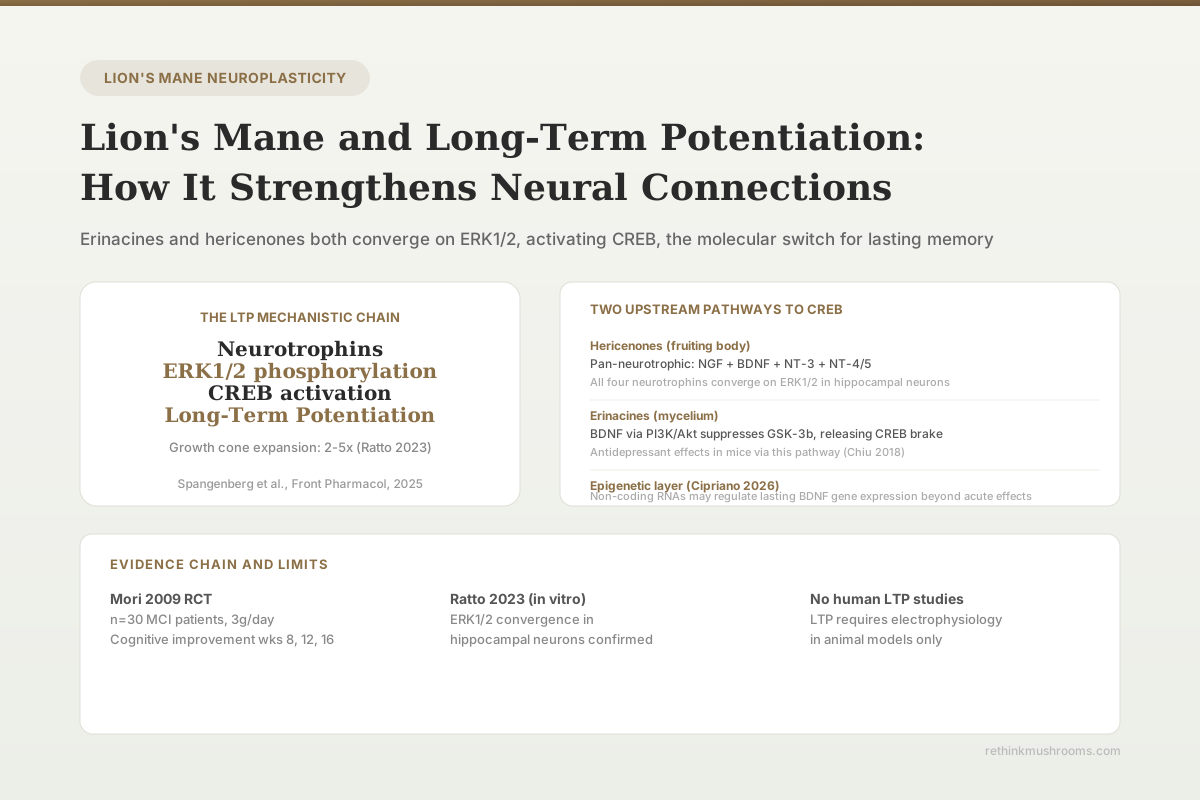
ERK1/2 → CREB
Erinacines and hericenones from lion's mane both converge on ERK1/2 signaling, which activates CREB, the transcription factor that drives long-term potentiation and memory consolidation.
Spangenberg et al., Front Pharmacol, 2025
Pan-neurotrophic
hericerin activates all 4 neurotrophins via ERK1/2 (Ratto 2023)
2-5x growth cones
growth cone expansion in hippocampal neurons (Ratto 2023)
No human LTP data
LTP is only measurable directly in animal models
Spangenberg et al., Front Pharmacol, 2025
 View as image ↗
Every time you learn something that sticks, your brain physically changed. Not metaphorically, not in some abstract sense, but literally: specific connections between specific neurons became stronger and more durable. That strengthening process has a name: long-term potentiation, or LTP. And it depends on a precise molecular sequence that lion's mane research has now mapped to within a few steps.
The lion's mane and long-term potentiation connection is the most mechanistically detailed story in the neuroplasticity evidence base for this mushroom. It runs from compounds in the fruiting body and mycelium, through receptor activation, through a molecular relay called ERK1/2, to a transcription factor called CREB that physically turns on the genes needed for lasting memory. A 2025 systematic review named this pathway explicitly, and a 2023 study showed the upstream step in hippocampal neurons.
This article builds that chain link by link and explains what the evidence actually establishes at each step. For a broader overview of the neuroplasticity evidence, see Lion's Mane and Neuroplasticity: Can a Mushroom Rewire Your Brain?, or the broader what is lion's mane mushroom overview.
Key Takeaways
- Long-term potentiation (LTP) is the cellular mechanism by which the brain strengthens connections between neurons and encodes long-term memory
- The ERK1/2 to CREB pathway is required for LTP; Spangenberg et al.'s 2025 systematic review explicitly states that erinacines activate CREB, which is "critical for increased LTP" (Spangenberg et al., 2025)
- Ratto et al. 2023 showed hericerin derivatives from lion's mane fruiting body activate all four neurotrophins simultaneously via ERK1/2 in hippocampal neurons, producing 2-5x growth cone expansion
- Chiu et al. 2018 demonstrated erinacine A acts through BDNF/PI3K/Akt/GSK-3b signaling, a pathway that converges on CREB phosphorylation
- Mori et al.'s 2009 RCT in 30 patients with mild cognitive impairment showed significant cognitive improvement at weeks 8, 12, and 16, the functional human correlate of LTP being supported
- Cipriano et al. 2026 proposed a third mechanism: non-coding RNA networks regulating BDNF gene expression, which could produce lasting LTP-associated plasticity beyond acute neurotrophic effects
- No study has directly measured LTP in humans after lion's mane; LTP measurement requires electrophysiological recording in animal models
What Long-Term Potentiation Actually Is
Long-term potentiation is the process by which repeated activation of a synapse makes that synapse stronger and more reliable over time. The rule of thumb from neuroscience is "neurons that fire together, wire together." LTP is the molecular machinery that implements that rule at the cellular level.
When two connected neurons fire at the same time repeatedly, a set of molecular changes follows. Receptor proteins on the receiving neuron become more sensitive to incoming signals. New receptor proteins are inserted into the synapse. The synapse itself can grow physically. Genes in the nucleus get switched on to produce the proteins needed to maintain these changes permanently.
The result is a stronger synaptic connection that persists for hours, days, or years. This is how a practiced skill becomes automatic, how a memory becomes permanent, how learning transfers from short-term to long-term.
LTP was first described by Bliss and Lomo in 1973. In the fifty years since, research has mapped the molecular steps in detail. Two are particularly relevant here.
The first is ERK1/2, a family of enzymes that act as molecular relays inside the neuron. When a neurotrophin (like BDNF or NGF) binds to a receptor on the neuron's surface, ERK1/2 gets activated. Once active, ERK1/2 carries the signal from the cell surface into the nucleus.
The second is CREB, a transcription factor. When ERK1/2 reaches the nucleus, it activates CREB by switching it on (technically: phosphorylating it). Activated CREB then switches on genes that produce the proteins needed for LTP: structural proteins that grow the synapse, signaling proteins that maintain receptor sensitivity, and other factors that lock the potentiated state in place.
Without CREB activation, learning can occur briefly but not persist. With CREB activation, the synapse is physically rebuilt to be stronger and that change is maintained.
The Mechanistic Chain: Where Lion's Mane Enters the Pathway
The Spangenberg 2025 systematic review of erinacine neuroprotection is the most explicit published document connecting lion's mane to LTP.[1] The review states directly: "CREB activation is critical for increased long-term potentiation (LTP), a process associated with learning and memory, and H. erinaceus and erinacine-mediated amelioration of cognitive and behavioral deficits in disease models" operates through this mechanism.
This statement places erinacines from lion's mane mycelium in the molecular sequence that leads to CREB activation and LTP. The question then is: what steps upstream of CREB do lion's mane compounds activate?
Two pathways run in parallel, one from the fruiting body and one from the mycelium. They converge on the same downstream target.
The fruiting body pathway (hericenones via ERK1/2). Ratto and colleagues in 2023 tested hericerin derivatives, compounds derived from the hericenones found in the lion's mane fruiting body, in central hippocampal neurons.[2] They found that these compounds activated all four neurotrophins simultaneously: NGF, BDNF, NT-3, and NT-4/5. This simultaneous activation of all four neurotrophins is what Ratto called a "pan-neurotrophic" effect.
The downstream convergence was ERK1/2. All four neurotrophin receptors fed their signals into the same ERK1/2 relay. And ERK1/2 sits directly upstream of CREB, the transcription factor required for LTP.
The measurable result in Ratto's hippocampal neurons was a 2 to 5 times increase in growth cone area. Growth cones are the tips of growing nerve fibers, the sites where new synaptic connections form. Bigger growth cones mean more surface area available for new connections. This is synaptic plasticity at the cellular level, exactly the structure underlying LTP.
The mycelium pathway (erinacines via BDNF/PI3K/Akt). Chiu and colleagues in 2018 tested erinacine A, a compound from lion's mane mycelium, in mice.[3] Erinacine A produced antidepressant-like effects through BDNF/PI3K/Akt/GSK-3b signaling. This pathway is parallel to ERK1/2 rather than identical to it, but both converge on the nuclear targets that drive CREB activation and gene expression changes.
PI3K (phosphoinositide 3-kinase) and Akt are enzymes downstream of the BDNF receptor (TrkB). When BDNF binds TrkB and activates PI3K and Akt, one of the downstream effects is inhibition of GSK-3b. GSK-3b is an enzyme that normally blocks CREB activity. By suppressing GSK-3b, erinacine A effectively releases the brake on CREB, allowing CREB-driven gene expression to proceed.
Both pathways, hericenone-driven ERK1/2 from the fruiting body and erinacine-driven BDNF/Akt/GSK-3b from the mycelium, converge on enabling CREB-driven transcription. CREB-driven transcription is required for LTP.
For more on the specific compounds driving these two pathways, see Erinacines: The Compounds That Cross the Blood-Brain Barrier and Hericenones and NGF Synthesis: How Lion's Mane Stimulates Nerve Growth.
Why CREB Is the Critical Link Between Neurotrophins and Memory
CREB is worth explaining in more detail because its role in memory is not obvious from the name.
Every time a neuron needs to make a lasting change, it needs to change which proteins it is producing. You cannot strengthen a synapse permanently by just temporarily increasing activity. You need to build new structural proteins, insert new receptors, and maintain those changes over time. All of that requires gene expression changes, and CREB is one of the primary transcription factors that drive those changes in neurons.
When CREB gets switched on in a neuron, it moves to specific sites on DNA and activates genes including those encoding proteins like BDNF itself (creating a self-reinforcing loop), Arc (a protein needed for AMPA receptor trafficking at synapses), and structural proteins needed to rebuild and enlarge the synapse.
This is why CREB activation is not just one step in a pathway. It is the step that separates transient neuronal activity from lasting structural change. A neuron can fire repeatedly and have temporary increased activity without LTP. LTP specifically requires CREB activation to persist.
The fact that both erinacines and hericenones converge on enabling CREB activation through different upstream routes means lion's mane compounds are targeting this critical juncture from two directions.
Human Evidence: Cognitive Improvement as the Functional Correlate of LTP
Long-term potentiation cannot be directly measured in living humans. It requires single-cell electrophysiological recording, which means measuring electrical activity at individual synapses, which is only feasible in animal models. Any human evidence for lion's mane and LTP is necessarily indirect: it measures cognitive performance, which is the functional output of LTP operating over time.
The most rigorous human evidence comes from Mori and colleagues' 2009 double-blind, placebo-controlled trial in 30 patients aged 50 to 80 with mild cognitive impairment.[4] Patients received 3 grams of lion's mane per day for 16 weeks. Cognitive scores on the Revised Hasegawa Dementia Scale were significantly higher in the lion's mane group at weeks 8, 12, and 16. After supplementation stopped, scores declined.
The pattern of results is consistent with LTP being supported during treatment: cognitive performance improved progressively over the 16-week period (consistent with accumulating synaptic strengthening), and declined when support was removed (consistent with LTP requiring continued maintenance). This interpretation is not proven, but it is consistent with what you would predict if the mechanistic story is correct.
What makes this functionally important is the MCI population: these are patients whose synaptic function is already deteriorating. If lion's mane compounds are supporting the CREB pathway that maintains LTP, the clinical payoff would be largest in patients where that pathway is already under stress.
The Epigenetic Layer: Could Lion's Mane Produce Lasting LTP Changes?
One unresolved question about LTP and neurotrophic support is duration. If you boost BDNF or activate CREB through a supplement, does the effect last beyond the period of supplementation? The Mori 2009 data suggests the answer is no, at least in the short term after stopping. But more recent mechanistic work raises the question of whether a deeper layer of change might be possible.
Cipriano and colleagues in 2026 proposed what they called a "neurotrophic-epigenetic axis" for lion's mane bioactives, in which the primary mechanism of action goes beyond acute neurotrophic stimulation.[5] Specifically, they proposed that non-coding RNA networks, small RNA molecules that regulate which genes are expressed without changing the DNA sequence itself, mediate the lasting effects of lion's mane compounds on gene expression.
This is relevant to LTP because some of the most durable forms of LTP involve epigenetic changes: stable modifications to how DNA is packaged and accessed in neurons, which change which genes are available to be expressed over long periods. If lion's mane compounds activate non-coding RNAs that drive epigenetic modifications in the BDNF or CREB gene regulatory regions, the result could be more lasting changes in LTP capacity rather than just transient boosting.
Cipriano 2026 is a hypothesis-driven review, not an experimental study. This mechanism has not been confirmed. But it provides a theoretical framework for why the cognitive effects of lion's mane might differ from what you would predict from the acute neurotrophic effects alone.
LTP Under Pathological Conditions: Tau and Lion's Mane
LTP is disrupted by several pathological conditions relevant to aging and neurodegeneration. Tau protein accumulation, the hallmark of Alzheimer's disease and chronic traumatic encephalopathy (CTE), impairs LTP specifically: tau deposits at synapses disrupt the glutamate receptor dynamics that initiate LTP.
Rodriguez and Lippi in 2022 tested lion's mane in the rTg4510 tau mouse model, which develops severe tau pathology and shows progressive behavioral deterioration.[6] Lion's mane produced anxiolytic effects in these tau-burdened animals. While the study did not directly measure LTP, anxiolytic effects in a tauopathy model suggest that the hippocampal function needed for emotional regulation, which depends on intact LTP-related plasticity, was being at least partially supported.
This matters for the LTP story because it extends the mechanistic argument beyond the healthy brain: if lion's mane compounds support CREB-driven plasticity, they may partially compensate for the LTP disruption caused by tau pathology, at least in animal models.
For more on the intersection of mushrooms and tau protein mechanisms, see Lion's Mane and Progranulin: A Second Neurotrophic Pathway Beyond NGF.
What the Research Cannot Tell You About Lion's Mane and LTP
Several important gaps remain in the current evidence.
No direct human LTP measurement exists. Every mechanistic claim about CREB and ERK1/2 in the context of lion's mane is based on animal models or cell cultures. LTP itself has only been shown to be affected by lion's mane in vitro and in animals. The cognitive improvement data from Mori 2009 is consistent with LTP support but does not prove it.
The dose used in the Mori RCT was 3 grams per day for 16 weeks. Most commercial lion's mane products provide 300 to 500 milligrams per serving. Whether these lower doses activate the same ERK1/2 to CREB pathway at the same intensity is unknown.
The pan-neurotrophic effect from Ratto 2023 was demonstrated in vitro. Whether hericerin derivatives activate all four neurotrophins in the human brain after oral supplementation depends on whether they are absorbed, reach the brain in sufficient concentration, and interact with neuronal receptors in the same way they do in cell culture. Each of those steps is uncertain.
Erinacines cross the blood-brain barrier; hericenones may not. The Ratto 2023 fruiting body pathway requires hericerin derivatives to reach hippocampal neurons. The evidence for erinacines crossing the blood-brain barrier is more established than the evidence for hericenones doing the same.
The Cipriano 2026 epigenetic axis is a hypothesis. The non-coding RNA mechanism has not been confirmed experimentally. It is a proposed explanation for how lasting changes might occur, not a demonstrated mechanism.
The Bottom Line
The mechanistic connection between lion's mane and long-term potentiation runs through a chain of molecular steps: hericenones from the fruiting body activate all four neurotrophins simultaneously via ERK1/2, which sits directly upstream of CREB; erinacines from the mycelium activate BDNF via PI3K and Akt, which releases the brake on CREB. CREB is required for LTP. A 2025 systematic review named this connection explicitly. The human functional evidence, a 2009 RCT in MCI patients showing progressive cognitive improvement at 3g/day over 16 weeks, is consistent with LTP support but does not prove it. No study has directly measured LTP in humans after lion's mane supplementation, and the precise dose, duration, and product form required to activate this pathway in the human brain are not yet established.
Frequently Asked Questions
Sources & References
- 1. Source details for this reference are not yet available.
- 2. Source details for this reference are not yet available.
- 3. Source details for this reference are not yet available.
- 4. Source details for this reference are not yet available.
- 5. Source details for this reference are not yet available.
- 6. Source details for this reference are not yet available.