Lion's Mane & Nerve Growth Factor
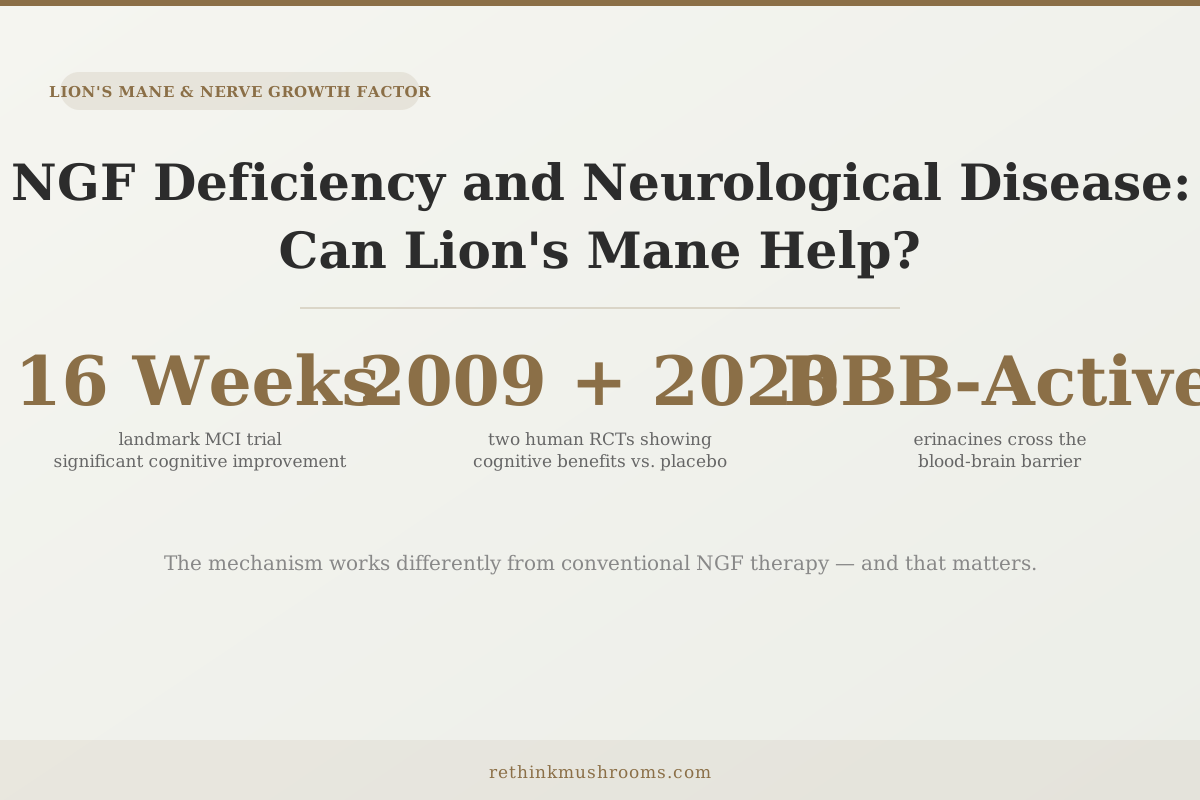
16 weeks
In the landmark double-blind trial, 16 weeks of lion's mane supplementation significantly improved cognitive function in adults with mild cognitive impairment. Scores declined when supplementation stopped.
Mori et al., Phytotherapy Research, 2009
n=30
patients in the landmark MCI randomized controlled trial
2016 + 2020
two erinacine A Alzheimer's studies showing measurable effects
Tau Mouse Model
lion's mane reduced anxiety-like behavior in rTg4510 tau mice
Mori et al., Phytotherapy Research, 2009
 View as image ↗
Nerve growth factor is the protein that keeps certain neurons alive and functioning. When NGF drops below normal levels, those neurons deteriorate. In Alzheimer's disease, the biochemical process that converts NGF from its inactive precursor form into its active, functional form becomes dysregulated, producing less usable NGF in precisely the brain regions that need it most. In Parkinson's disease, NGF deficiency affects the survival of dopaminergic neurons. In peripheral neuropathy, reduced NGF signaling contributes to nerve damage and pain.
For decades, the response to this problem was to try delivering NGF directly. It didn't work. NGF is a large protein molecule that cannot cross the blood-brain barrier, the highly selective membrane that controls what enters the brain. Injected into the bloodstream, NGF caused severe side effects, including pain, and failed to reach the relevant neurons. The approach was abandoned. The NGF deficiency problem remained.
What makes lion's mane mushroom scientifically interesting in this context is that it doesn't attempt to deliver NGF from outside. Instead, small compounds in the mushroom, particularly erinacines from the mycelium, cross the blood-brain barrier and stimulate the brain's own neurons to produce NGF themselves. This is a fundamentally different mechanism, and it's the reason lion's mane occupies a unique position in the neurological disease research landscape.
For a broad overview of what lion's mane is and how it's studied, what is lion's mane mushroom covers the foundational science. This article focuses specifically on what the research shows for NGF deficiency and neurological disease.
Key Takeaways
- NGF deficiency plays a documented role in Alzheimer's disease, Parkinson's disease, and peripheral neuropathy; direct NGF drug therapy failed because the protein cannot cross the blood-brain barrier
- The landmark human trial (Mori 2009, n=30) found that 16 weeks of lion's mane supplementation significantly improved cognitive function in adults with mild cognitive impairment; scores declined after stopping
- Erinacine A-enriched mycelium reduced amyloid plaque burden and improved spatial memory in Alzheimer's transgenic mice (Tsai-Teng 2016), and showed significant cognitive benefits over placebo in a 2020 pilot RCT in early AD patients (Li 2020)
- A 2022 study found lion's mane reduced anxiety-like behavior in the rTg4510 tau mouse model, showing effects in tau-driven neurodegeneration independent of the amyloid pathway (Rodriguez 2022)
- A 2025 narrative review concluded that erinacine A-enriched mycelium is the most clinically promising form of lion's mane for Alzheimer's prevention and delayed progression (Cornford 2025)
- The 2024 review published in Neuroscience and Biobehavioral Reviews noted positive signals for lion's mane across age groups but also identified methodological limitations in existing RCTs (Cha 2024)
What NGF Deficiency Looks Like in the Diseased Brain
Nerve growth factor is not simply "low" in neurological disease. The relationship is more specific and more mechanistically interesting than a simple deficiency.
In Alzheimer's disease, the problem is partly a breakdown in NGF metabolism. NGF is produced as a precursor called proNGF, which must be cleaved by specific enzymes (including plasmin and MMP9) into its mature, functional form. In Alzheimer's brains, this cleavage process is dysregulated: proNGF accumulates, while mature NGF decreases. At the same time, the cells responsible for transporting NGF to where it's needed, the cholinergic neurons of the basal forebrain, are among the first cell populations to die in AD. This creates a compounding problem: less NGF is produced in usable form, and fewer cells remain capable of using what is produced.
The cholinergic neuron dependence on NGF is well-established. These neurons require NGF to survive. When NGF levels drop, they atrophy and die. When they die, the cholinergic neurotransmitter system that supports memory and attention deteriorates. This is why NGF deficiency is so closely linked to the cognitive symptoms that define early Alzheimer's disease.
In Parkinson's disease, the relationship is different but related: NGF supports dopaminergic neurons in the substantia nigra, the cell population that produces dopamine and dies in PD. Reduced NGF signaling in this region contributes to the neurodegeneration that drives motor symptoms.
The breadth of conditions linked to NGF deficiency explains why a compound that stimulates endogenous NGF production, inside the brain rather than outside it, has attracted serious research attention.
Why Direct NGF Therapy Failed, and Why Lion's Mane Is Scientifically Different
The failure of direct NGF therapy is instructive. In the 1990s and 2000s, clinical trials tested whether delivering NGF protein directly could slow Alzheimer's progression. The problem was architectural: NGF is a large, hydrophilic protein. The blood-brain barrier, which is made up of tightly packed cells with strict size and chemical selectivity, blocks it. NGF injected intravenously simply didn't reach the brain in meaningful amounts.
Researchers tried neurosurgical delivery: injecting NGF directly into brain ventricles or implanting NGF-secreting cells. These approaches caused severe side effects including debilitating pain and weight loss, and did not produce consistent cognitive benefit. The gene therapy approach (delivery of NGF-expressing viral vectors) showed some promise in small trials but has not progressed to widespread clinical use.
The lion's mane approach sidesteps this entire problem. Erinacines, the cyathane diterpenoid compounds found exclusively in lion's mane mycelium, are small and lipophilic enough to cross the blood-brain barrier through passive diffusion. They don't deliver NGF; they stimulate the brain's own cells to produce it. Systematic preclinical research has confirmed that erinacines cross the blood-brain barrier and drive NGF synthesis in central brain regions, including the hippocampus and cerebral cortex, with multiple compounds in the erinacine family showing this activity.[5]
This is what makes lion's mane occupy a distinct place in the neurological research landscape. It's not a nutritional supplement with vague "brain health" claims. It's a compound delivery mechanism for a specific, documented neurotrophic pathway that conventional pharmacology hasn't been able to access through other means.
The Alzheimer's Research: From a Lion's Mane Trial to Two Follow-Up Studies
The human clinical evidence for lion's mane in neurological disease begins with a single landmark trial.
The Mori 2009 RCT. Mori and colleagues published a double-blind, placebo-controlled trial in 2009 enrolling 30 Japanese adults diagnosed with mild cognitive impairment (MCI).[1] MCI is the clinical condition that most often precedes Alzheimer's disease: cognitive performance below normal for age, but not severely enough to constitute dementia. Participants received 3 grams per day of lion's mane mushroom powder or placebo for 16 weeks.
At the end of 16 weeks, cognitive function scores on two validated assessment tools improved significantly in the lion's mane group compared to placebo. The effect was not permanent: when participants stopped supplementation, scores declined within four weeks.
This trial remains the single most-cited piece of human evidence for lion's mane and cognitive function. Its limitation is size: n=30 is too small to draw definitive conclusions, and the decline after stopping suggests the effect depends on ongoing supplementation rather than producing any lasting structural change. The Cha 2024 review in Neuroscience and Biobehavioral Reviews, which provided the most rigorous independent assessment of this literature, noted positive signals for lion's mane across age groups but specifically identified methodological limitations in existing RCTs, including the 2009 trial's small size.[8]
The Tsai-Teng 2016 animal study. Working with erinacine A-enriched lion's mane mycelium in a transgenic Alzheimer's mouse model (APPswe/PS1dE9 mice, which develop amyloid plaques similar to human AD), Tsai-Teng and colleagues found that erinacine A-enriched mycelium reduced amyloid plaque burden, improved spatial memory performance on the Morris water maze, and reduced neuroinflammatory markers.[2] This study provided direct mechanistic evidence that erinacines, not just whole lion's mane, could affect the molecular pathology of Alzheimer's in a validated animal model.
The Li 2020 pilot RCT. Li and colleagues published a pilot double-blind, placebo-controlled trial in 2020 specifically using erinacine A-enriched lion's mane mycelium in patients with early-stage Alzheimer's disease.[3] Unlike the Mori 2009 trial, which used whole mushroom powder in MCI patients, the Li 2020 trial used mycelium enriched for the specific BBB-crossing compound (erinacine A) in patients with a confirmed Alzheimer's diagnosis. The study found significant cognitive benefits compared to placebo and reduced inflammatory markers.
This is the most clinically specific human evidence available: not just lion's mane in a cognitively impaired population, but an erinacine A-enriched preparation in patients with actual Alzheimer's disease. It remains a pilot study, with the associated limitations of small sample size and preliminary design. The 2025 narrative review by Cornford and Charnley, published in Nutrition Research Reviews, concluded that the evidence warrants further clinical investigation particularly for early AD, and identified erinacine A-enriched mycelium as the most clinically promising form based on the available data.[7]
For a broader view of how lion's mane fits into the landscape of multi-species Alzheimer's research, the article on cross-species mushroom research in Alzheimer's disease covers what other mushrooms besides lion's mane show in AD models.
Beyond Amyloid: Lion's Mane in a Tau Mouse Model
Most Alzheimer's and neurodegeneration research focuses on amyloid plaques, the protein aggregates associated with the most common disease mechanism. Less attention is paid to tau pathology, the second major Alzheimer's mechanism, which involves abnormal tangles of tau protein inside neurons.
Rodriguez and Lippi published a 2022 study examining whether lion's mane produced measurable effects in the rTg4510 mouse model, a transgenic model that develops severe tau pathology rather than amyloid pathology.[4] The rTg4510 mouse overexpresses P301L mutant tau and develops progressive neuronal loss and cognitive deterioration driven by tau accumulation.
Lion's mane reduced anxiety-like behaviors in these mice. This finding is significant for two reasons. First, it shows that lion's mane effects are not restricted to amyloid-driven neurodegeneration: the same intervention produces measurable behavioral effects in a tau-driven model. Second, tau pathology is central to a broader group of neurodegenerative diseases beyond Alzheimer's, including frontotemporal dementia (FTD), progressive supranuclear palsy (PSP), and corticobasal degeneration (CBD). Evidence that lion's mane affects a tau mouse model at least opens the question of whether its effects extend to these tauopathies.
No consumer content currently covers this tau mouse model data for lion's mane. For readers interested in the mechanistic detail of how mushroom compounds interact with tau pathology, the article on mushroom compounds and tau protein covers that research stream.
What the 2023-2025 Reviews Say About the Current Evidence State
Four recent reviews provide the most current, independent assessment of where lion's mane research stands in the context of neurological disease.
Brandalise 2023. The Brandalise and colleagues review, published in the Journal of Fungi in 2023, specifically assessed lion's mane from bench to bedside, asking how far the evidence has actually moved toward clinical translation.[5] The review identified positive evidence across cognitive disorders, Alzheimer's disease, ischemic stroke, Parkinson's disease, and depression, and also identified the key evidence gaps that would need to be filled for clinical translation to be possible. It is not a promotional review; it is a structured assessment of what the evidence can and cannot support.
Li et al. 2023. A comprehensive review of mushroom bioactives in Alzheimer's disease, published in Foods in 2023, assessed multiple mushroom species and identified lion's mane erinacines as the most extensively researched fungal neuroprotective compounds for AD specifically.[6] This review positions lion's mane within a broader landscape of mushroom research and confirms its lead position for the NGF-mediated neurological disease application.
Cha et al. 2024. The most rigorous independent review is from Cha and colleagues, published in Neuroscience and Biobehavioral Reviews, a high-impact neuroscience journal, in 2024.[8] The review examined the effects of mushrooms on mood and neurocognitive health across the lifespan and found positive signals for lion's mane across age groups. It also specifically noted methodological limitations in the existing RCTs, including small sample sizes and heterogeneous preparations. Positive signals alongside legitimate limitations: that is the honest summary of the current evidence.
Cornford 2025. The most recent review, published in Nutrition Research Reviews in 2025, specifically addressed AD prevention and delayed progression.[7] Cornford and Charnley concluded the evidence warrants further clinical investigation, particularly for early AD, and identified erinacine A-enriched mycelium as the most clinically promising preparation. They called for larger RCTs, which is an honest acknowledgment that the current evidence base, while directionally positive, is not yet sufficient for clinical recommendations.
Where the Evidence Stands
The honest summary of lion's mane and NGF deficiency research is this: the mechanism is well-established, the early clinical evidence is positive, and the evidence base is small.
Erinacines cross the blood-brain barrier and stimulate NGF production in ways that conventional pharmacology has not been able to replicate safely. The landmark 2009 MCI trial showed cognitive improvement in humans. The 2020 pilot trial showed measurable effects specifically in Alzheimer's patients using an erinacine A-enriched preparation. The 2022 tau mouse data extends the potential application beyond amyloid-driven disease. Four independent reviews published between 2023 and 2025 assessed the same literature and reached similar conclusions: positive signals, limitations acknowledged, larger trials needed.
For the articles covering each specific mechanism in depth, the sibling articles in this cluster explain how hericenones stimulate NGF synthesis, how erinacines cross the blood-brain barrier, and the lion's mane progranulin research on a second neurotrophic pathway beyond NGF. The complete NGF research guide covers the full evidence landscape.
The Bottom Line
NGF deficiency plays a documented role in Alzheimer's disease, Parkinson's disease, and peripheral neuropathy. Direct NGF drug delivery failed because the protein cannot cross the blood-brain barrier. Lion's mane contains erinacines, small compounds that do cross the barrier and stimulate endogenous NGF production. The human evidence includes the landmark 2009 MCI trial (n=30, significant improvement), a 2020 pilot RCT in early AD (erinacine A-enriched mycelium, significant cognitive benefits), and a 2022 tau mouse study showing effects beyond amyloid pathology. Four independent reviews from 2023 to 2025 identified positive signals and called for larger trials.
Frequently Asked Questions
Sources & References
- 1RTHM-00165·Mori, Koichiro et al. (2009). “Improving effects of the mushroom Yamabushitake (Hericium erinaceus) on mild cognitive impairment: a double-blind placebo-controlled clinical trial..” Phytotherapy research : PTR.Study breakdown →PubMed →↩
- 2RTHM-00452·Tsai-Teng, Tzeng et al. (2016). “Erinacine A-enriched Hericium erinaceus mycelium ameliorates Alzheimer's disease-related pathologies in APPswe/PS1dE9 transgenic mice..” Journal of biomedical science.Study breakdown →PubMed →↩
- 3RTHM-00631·Li, I-Chen et al. (2020). “Prevention of Early Alzheimer's Disease by Erinacine A-Enriched Hericium erinaceus Mycelia Pilot Double-Blind Placebo-Controlled Study..” Frontiers in aging neuroscience.Study breakdown →PubMed →↩
- 4RTHM-01610·Rodriguez, Mya N et al. (2022). “Lion's Mane (Hericium erinaceus) Exerts Anxiolytic Effects in the rTg4510 Tau Mouse Model..” Behavioral sciences (Basel.Study breakdown →PubMed →↩
- 5RTHM-01662·Brandalise, Federico et al. (2023). “Hericium erinaceus in Neurodegenerative Diseases: From Bench to Bedside and Beyond, How Far from the Shoreline?.” Journal of fungi (Basel.Study breakdown →PubMed →↩
- 6RTHM-01728·Li, Na et al. (2023). “Unveiling the Therapeutic Potentials of Mushroom Bioactive Compounds in Alzheimer's Disease..” Foods (Basel.Study breakdown →PubMed →↩
- 7RTHM-00922·Cornford, Nisha et al. (2025). “Hericium erinaceus: A possible future therapeutic treatment for the prevention and delayed progression of Alzheimer's disease? - A narrative review..” Nutrition research reviews.Study breakdown →PubMed →↩
- 8RTHM-00868·Cha, Sara et al. (2024). “A review of the effects of mushrooms on mood and neurocognitive health across the lifespan..” Neuroscience and biobehavioral reviews.Study breakdown →PubMed →↩