Mycology Fundamentals
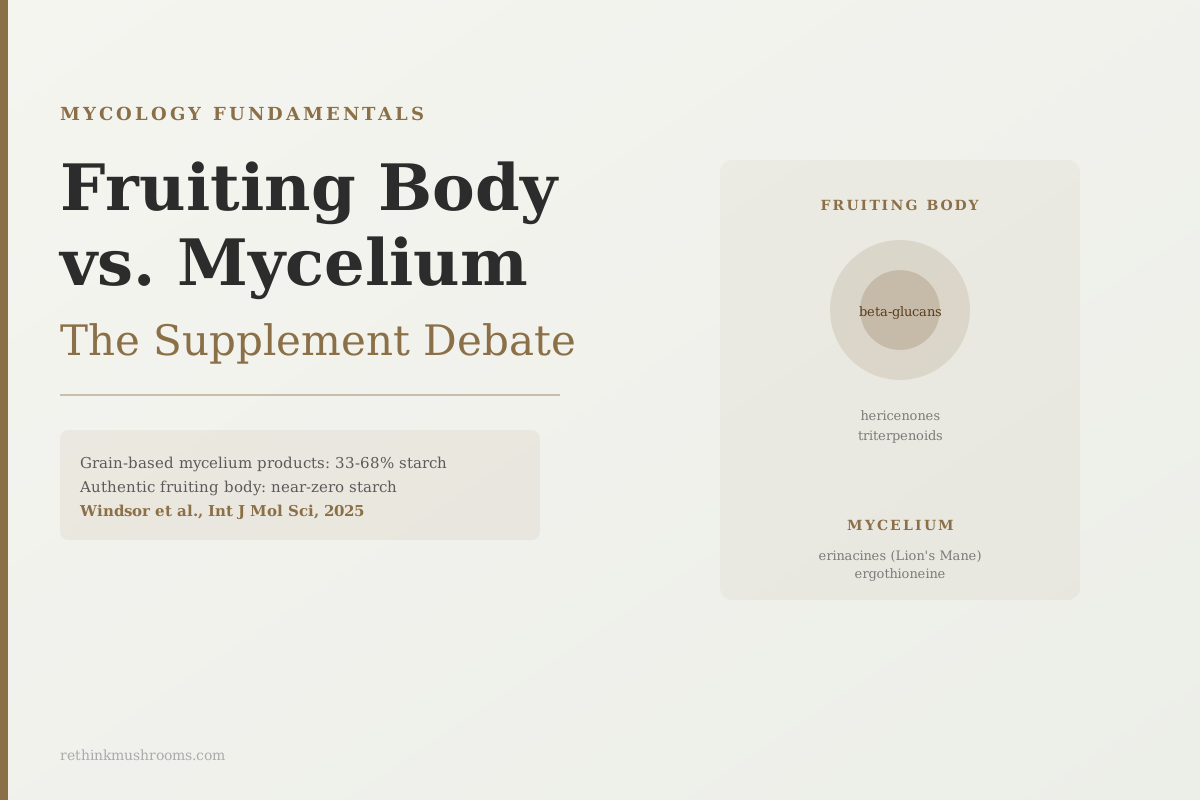
33-68% grain starch
Commercial chaga supplements made with mycelium grown on grain were found to contain 33-68% alpha-glucan (starch) by composition, compared to near-zero starch in authentic chaga fruiting body material.
Windsor et al., International Journal of Molecular Sciences, 2025
Erinacines
Lion's Mane neurological compounds found exclusively in the mycelium, not the fruiting body
~1-5%
Beta-glucan measured in grain-based mycelium chaga products, versus substantially higher levels in authentic fruiting body material (Windsor et al., 2025)
12 studies
Peer-reviewed evidence examined in this analysis
Windsor et al., International Journal of Molecular Sciences, 2025
 View as image ↗
Pick up a mushroom supplement in any health food store and the label will identify it as made from either fruiting body or mycelium. What it will not tell you is what that distinction actually means for the compounds inside the capsule, or why the gap between these two forms can be substantial.
In 2025, Windsor and colleagues published an analysis of real commercial chaga supplements in the International Journal of Molecular Sciences. Products made from mycelium grown on grain contained 33 to 68 percent alpha-glucan, the chemical name for grain starch. The same products contained approximately one to five percent beta-glucan, which is the class of compounds responsible for mushroom's studied immune effects. Authentic chaga fruiting body showed near-zero starch content.[2] That is the central issue in the fruiting body vs. mycelium debate: most mycelium supplements are predominantly grain starch, and measuring the two separately in commercial products makes that visible.
But the story has one important turn that most coverage misses. For Lion's Mane, the neurologically active compounds called erinacines exist only in the mycelium. No fruiting body produces them. This is species-specific and it matters, because erinacines pass through the brain's protective barrier more effectively than the fruiting body's neurological compounds do. A fruiting body-only Lion's Mane supplement cannot provide erinacines regardless of its quality.
The fruiting body vs. mycelium question has a different honest answer depending on which species you are asking about.
Key Takeaways
- A 2025 analysis of commercial chaga supplements found grain-grown mycelium products contain 33-68% alpha-glucan (starch) versus near-zero starch in authentic chaga fruiting body material (Windsor et al., 2025)
- Mycelium-containing reishi supplements sold in the US showed significantly lower ganoderic acid content compared to fruiting body extracts, with wide variation in quality across brands (Wu et al., 2017)
- Erinacines, the Lion's Mane compounds that reduced amyloid plaques in an Alzheimer's mouse model, are produced exclusively in the mycelium. No fruiting body contains them (Tsai-Teng et al., 2016)
- Fruiting body and mycelium of the same species are biologically distinct, not interchangeable: in Antrodia camphorata, polysaccharides from both forms reduced sepsis-driven inflammation in mice, but the fruiting body extract was more effective than the mycelium (Meng et al., 2012)
- Beta-glucan concentration directly scales with trained immunity activation in immune cells. Higher concentration produces stronger immune training, meaning starch dilution has functional consequences, not just compositional ones (Case et al., 2024)
- Clinical evidence for mushroom immune, cardiovascular, and anti-cancer effects comes primarily from fruiting body extracts or purified, standardized beta-glucans, not from whole myceliated grain biomass (Cerletti et al., 2021)
Fruiting Body vs. Mycelium on Grain: The Key Numbers
Before getting into mechanism and species-level nuance, here is the core compositional comparison that the peer-reviewed literature supports.
| Fruiting Body Extract | Mycelium on Grain | |
|---|---|---|
| Beta-glucan content | Substantially higher; varies by species (Cerletti et al., 2021) | ~1-5% (Windsor et al., 2025) |
| Starch/alpha-glucan | Near-zero in authentic material | 33-68% (Windsor et al., 2025) |
| Triterpenoids | Present and concentrated | Significantly lower (Wu et al., 2017) |
| Unique compounds | Hericenones (Lion's Mane only) | Erinacines (Lion's Mane mycelium only) |
| Primary clinical evidence | Fruiting body extracts and purified beta-glucans | Limited for grain-based biomass |
Beta-glucans are chains of glucose molecules that form the structural backbone of mushroom cell walls and activate immune cells. Alpha-glucans (starches) are a different glucose chain arrangement with no known immune benefit. The problem with most supplement labels is that they report "total polysaccharides," which counts both types together, rather than specifying beta-glucans separately.
The "unique compounds" row is why this is not a simple one-column verdict. For a compound-level comparison across specific species, see Do Fruiting Bodies Have More Bioactive Compounds Than Mycelium?.
What "Fruiting Body" and "Mycelium" Mean on a Supplement Label
The fruiting body is the visible mushroom: cap, stem, and gills. It is what you would recognize growing from a log or tree in the wild. When a supplement is made from fruiting body material, the manufacturer harvested or sourced this structure, then dried, ground, and typically extracted it to concentrate specific compound classes.
Mycelium is the underground network, the dense white thread-like mass that the mushroom grows from. Think of the fruiting body as the apple and the mycelium as the root system. Both are biologically real, both contain active compounds, and neither is simply a younger or diluted version of the other.
The practical problem is how mycelium ends up in most US supplements. Almost all of it was grown using solid-state fermentation: the mycelium was inoculated onto rice, oats, barley, or another grain, allowed to partially colonize it over days to weeks, and then dried and ground whole, grain substrate included. Because mycelium cannot be cleanly separated from solid grain once it has colonized it, the final powder contains both fungal material and grain starch in an unknown ratio.
This is different from liquid-fermented mycelium, also called submerged-culture mycelium. In that process, the fungus grows in a liquid medium with no solid grain. The mycelium can be filtered and separated from the liquid. Liquid-fermented mycelium is a genuinely distinct product from mycelium on grain, but it is far less common on supplement shelves, and most products using the label term "mycelium" do not specify which cultivation method was used.
For a full breakdown of how the grain cultivation process works and what it means for what ends up in a capsule, see Mycelium on Grain: Why It's Controversial in the Supplement Industry.
What Happens When Scientists Measure Both Forms Directly
Berger and colleagues published a direct metabolite comparison of mycelium versus fruiting bodies in Microorganisms in 2022, measuring proteins, polysaccharides, secondary metabolites, metal ions, and toxin profiles across three edible mushroom species: Agaricus bisporus (button mushroom), Pleurotus ostreatus (oyster mushroom), and Lentinus edodes (shiitake).[1]
What they found was not a clean verdict in either direction. The study documented large variation in metabolite content driven by three main factors: substrate chemistry, fungal strain, and the developmental stage of the fungus. This variation was large enough that a poorly cultivated fruiting body could theoretically contain less of a target compound than a well-cultivated mycelium. Growing conditions matter more than the form label alone.
What Berger's team concluded was that fruiting body remains the primary source of polysaccharide-rich bioactives. They also noted that controlled fungal bioprocesses (meaning carefully managed liquid-culture cultivation under defined conditions) could produce nutritious mycelial biomass with meaningful compound content. The key qualifier is "controlled." That excludes grain-based mycelium grown primarily to maximize yield volume.
Park's 2025 review on Cordyceps militaris makes the same point from a single-species perspective. Substrate type, temperature, light intensity, and humidity all profoundly alter how much cordycepin, adenosine, and polysaccharides the fungus produces during cultivation. Grain substrate conditions versus controlled fruiting body production conditions yield dramatically different bioactive profiles in the final material.[11] The cultivation method is not incidental to product quality. It determines it.
The Grain Problem: Why 33-68% of Your Supplement May Be Grain Starch
Windsor and colleagues' 2025 study in the International Journal of Molecular Sciences tested real-world commercial chaga supplements, including products made from mycelium fermented on grain (designated IoMFG in the study).[2]
The findings were specific. IoMFG products showed alpha-glucan (starch) content of 33 to 68 percent. The raw grain substrates themselves measured 46 to 74 percent alpha-glucan. Authentic chaga canker, the real fruiting body material harvested from birch trees, showed near-zero starch content. Beta-glucan content in grain-based products was approximately one to five percent, compared to substantially higher concentrations in authentic chaga.
This is not a theoretical problem. It is measurable in products currently available for purchase.
What Fills the Capsule
Active vs. Inert Material: Grain Mycelium vs. Fruiting Body
Beta-glucan is the immune-active compound class mushroom research is built on. Alpha-glucan is grain starch, with no known immune benefit. In authentic fruiting body material the proportion is inverted relative to grain-grown mycelium. Bars show the ranges measured by Windsor et al. (2025) in commercial chaga supplements.
Mycelium on grainChaga fermented on grain substrate (IoMFG)
~1-5% beta-glucan
33-68% alpha-glucan (starch)
Fruiting body extractAuthentic chaga canker (birch-harvested)
Substantially higher beta-glucan
Near-zero starch
How to read it: the two bars are not simply “more” versus “less.” The proportion of active-to-inert material is inverted. A grain-mycelium capsule can be mostly starch by composition, while an authentic fruiting body extract carries little to no starch and a far larger share of the immune-active beta-glucan fraction.
Source: Windsor et al., 2025 [2] — analytical comparison of commercial chaga supplements (grain-fermented mycelium vs. authentic canker). Bar widths reflect the reported measurement ranges and are illustrative of composition, not a single fixed value.
The reishi supplement category shows the same pattern. Wu and colleagues analyzed Ganoderma lucidum supplements sold in the United States in 2017 and found wide quality variation across products.[3] Products ranged from pure fruiting body extracts to myceliated grain material. Ganoderic acids, the triterpenoid compounds most associated with reishi's studied effects, were significantly lower in mycelium-containing products compared to fruiting body extracts.
Part of what enables these products to exist without clear consumer disclosure is a labeling gap that Timm and colleagues identified in their 2023 review of mushroom beta-glucan measurement methods. "Total polysaccharides," the figure most commonly printed on supplement labels, counts alpha-glucans (starches) and beta-glucans together.[8] A product containing 40 percent grain starch can legitimately print "40% polysaccharides" on its label, without disclosing that none of those polysaccharides are the immune-active beta-glucan type. Measuring the two separately requires a specific enzymatic assay (the Megazyme method is the most common standard), which most brands do not perform or publish.
The Lion's Mane Exception That Changes the Whole Calculation
Everything in the previous sections describes the general case: for most mushroom species, fruiting body extracts contain more of the clinically studied compounds than grain-grown mycelium products.
Lion's Mane (Hericium erinaceus) is where this general case breaks down in one specific and important direction.
Lion's Mane contains two classes of neurologically active compounds. Hericenones are produced in the fruiting body. Erinacines are produced only in the mycelium. Not predominantly in the mycelium. Exclusively. No fruiting body produces measurable erinacines regardless of species, growing conditions, or extraction method.
This matters because erinacines and hericenones reach the brain differently. Erinacines pass through the brain's protective barrier (the blood-brain barrier) more effectively than hericenones do. Tsai-Teng and colleagues published a 2016 study in the Journal of Biomedical Science testing erinacine A-enriched Lion's Mane mycelium in mice engineered to develop Alzheimer's-like brain pathology.[5] Amyloid plaques, the protein clumps associated with Alzheimer's disease, were reduced in treated animals, alongside diminished plaque-associated microglial and astrocyte activation and increased new neuron growth in the hippocampus. The mycelium was the active source, not the fruiting body. A fruiting body-only Lion's Mane supplement cannot supply erinacines at any dose.
This is the strongest peer-reviewed case for mycelium in the supplement market. It is also species-specific: it applies to Lion's Mane and does not extend to other mushrooms. For other species, the question of which form has more bioactive compounds requires a species-by-species answer. See Do Fruiting Bodies Have More Bioactive Compounds Than Mycelium? for a compound-level comparison across species, and Which Part of the Mushroom Is Most Medicinal? for the broader structural picture.
The Same Species, Different Forms: Not Just More or Less
Most people assume the relationship between fruiting body and mycelium is purely quantitative: the fruiting body has more of the same compounds, and the mycelium has less. The species-level research shows the picture is more complicated than a single dial.
Meng and colleagues' 2012 study in Nutrition extracted polysaccharides separately from the mycelia and the fruiting bodies of Antrodia camphorata and tested each in mice with polymicrobial sepsis.[12] Both forms reduced the elevated inflammatory mediators that sepsis produces, but they were not equivalent. The fruiting body extract was more effective at lowering the inflammatory response than the mycelium extract, and specific effects seen with the fruiting body, such as lower IL-6 in peritoneal fluid and a later rise in interferon-gamma, were absent in the mycelium-treated animals. Same species, same general direction, meaningfully different potency and profile.
Lin and colleagues' 2019 study in Nutrients looked at a commercial T. camphoratus product combining fruiting body extract and solid-state-cultivated mycelia.[4] In mice, it shifted the immune profile in a coordinated way, raising Th1-associated signals such as IL-2 and interferon-gamma while lowering allergic and Th2-associated markers including IL-4, IL-5, and IgE. It confirms that both forms of this species carry genuine immunomodulatory activity, without establishing that either form alone is interchangeable with the other.
The through-line, consistent with Berger's cross-species metabolite comparison, is that fruiting body and mycelium of the same species are biologically distinct materials. They differ not only in how much of a given compound they contain, but sometimes in potency, in which compounds are present at all (the Lion's Mane erinacine case is the clearest example), and in what cultivation is required to produce them. Treating them as interchangeable "forms of the same thing" is not supported by the species-level evidence.
The practical implication: combining fruiting body and mycelium in a "full-spectrum" product is not simply additive. What the combination produces depends on the species, the biological context, and which outcome is being measured.
Why Beta-Glucan Concentration Matters: The Trained Immunity Mechanism
The starch dilution in grain-based mycelium products is not just a numbers problem. Case and colleagues' 2024 study in Frontiers in Nutrition established that beta-glucan concentration directly determines how strongly it activates trained immunity in macrophages.[7]
Macrophages are the main immune cells that beta-glucans act on. When macrophages encounter beta-glucan, they undergo gene-expression changes (a process called epigenetic reprogramming) that make them more alert and responsive to future threats. This is the mechanism behind the lasting immune effects associated with medicinal mushrooms. Case's team found that enriching Agaricus bisporus products for beta-glucan content boosted the trained immunity response, while whole mushroom powder showed the strongest response overall. The higher the beta-glucan concentration, the stronger the signal.
This is why one to five percent beta-glucan in a grain-based product is not simply "less than" a fruiting body extract. If the concentration falls below the level needed to activate trained immunity reliably, the key biological mechanism may not be triggered at all.
Cerletti and colleagues' 2021 comprehensive review of mushroom beta-glucan clinical evidence confirms this from the other direction: the studies showing immunomodulatory, cardiovascular, and anti-cancer effects from medicinal mushrooms used fruiting body extracts or purified beta-glucans.[6] The clinical evidence base for mushroom supplement effects is built on fruiting body material and purified compounds, not on whole grain biomass.
Guggenheim and colleagues' 2014 review of five major medicinal mushrooms (Agaricus blazei, Cordyceps sinensis, Maitake, Reishi, and Turkey Tail) found the same pattern: the immune modulation data for each species rests on fruiting body extracts or standardized mycelium extracts, not grain-based powder.[9]
For a complete explanation of the glucan chemistry, the Megazyme testing method, and what peer-reviewed measurement research shows, see The Science Behind the Fruiting Body vs. Mycelium Argument.
When Full-Spectrum Products Actually Make Scientific Sense
"Full-spectrum" is not a regulated term in the mushroom supplement market. Products carrying the label range from genuine combinations of fruiting body and quality mycelium to grain-based mycelium products with a small fruiting body powder fraction added for label appeal. The label alone does not establish what is inside.
The scientific case for combining both forms does exist, and it is strongest for Lion's Mane. A product containing fruiting body (which provides hericenones) plus genuine quality-controlled mycelium (which provides erinacines) covers both neurological compound classes. A fruiting body-only product cannot provide erinacines. A mycelium-only product cannot provide the full hericenone profile. For Lion's Mane, the combination has a real scientific rationale.
For most other species, the case for combining both forms is weaker and depends on whether the mycelium is contributing distinct active compounds at meaningful concentrations.
Fijałkowska and colleagues' 2021 study on Fomitopsis officinalis mycelium showed that mycelium produced under controlled laboratory liquid-culture conditions, not grain-based cultivation, contained ergothioneine at concentrations up to 44.31 mg per 100g dry weight and tocopherols up to 69.00 mg per 100g dry weight. Some of these concentrations exceeded what the fruiting body contained.[10] Quality-controlled liquid-culture mycelium is genuinely different from grain biomass and can contribute compound classes the fruiting body alone does not.
The critical question for any full-spectrum product: does the manufacturer specify the mycelium source, list beta-glucan percentage separately for each component, and disclose the cultivation method? If the label says only "mycelium" without specifying liquid-fermented or controlled-culture origins, grain-based cultivation is the most common default in the US supplement market.
For a full examination of what the scientific literature supports about full-spectrum products, see Full-Spectrum Mushroom Products: Fruiting Body + Mycelium?. For the extraction chemistry, specifically why hot water and ethanol together are needed to capture both beta-glucans and triterpenoids, see Dual Extraction: Why It Matters for Full-Spectrum Mushroom Products.
How to Read a Supplement Label After Understanding All This
The terminology on mushroom supplement labels is not standardized, and several common terms carry meanings that differ from what most consumers assume.
"Mycelium" as an ingredient means mycelium-derived material was used. It does not specify whether this was grain-based solid-state cultivation or liquid-fermented culture. Without additional specification, grain-based is the more common source in the US market.
"Myceliated grain," "myceliated oats," or "myceliated rice" is explicit: the product was cultivated on grain and the substrate was not removed before processing.
"Total polysaccharides" on a label measures alpha-glucans and beta-glucans together. A product with 40 percent grain starch can accurately print "40% polysaccharides." The figure to look for is beta-glucans (%) listed separately, confirmed by a specific enzymatic assay such as the Megazyme method. Timm et al. (2023) identified this measurement conflation as a primary source of unreliable supplement claims.[8]
"Fruiting body" means the cap-and-stem structure was used. This eliminates the grain starch dilution problem, though growing conditions still affect compound content, as Berger et al. (2022) and Park (2025) both document.
"Dual-extracted" means the product was processed with both hot water (capturing water-soluble beta-glucans and polysaccharides) and ethanol or alcohol (capturing fat-soluble triterpenoids like ganoderic acids). A fruiting body product that has not been dual-extracted will not contain both compound classes at meaningful concentrations.
For a broader look at how sourcing decisions affect potency in medicinal mushroom products, see Wild-Harvested vs. Cultivated: Does Growing Method Affect Potency?.
The Bottom Line
For most mushroom species, fruiting body extracts contain substantially more of the immune-active beta-glucans that medicinal mushroom clinical research is built on. Peer-reviewed analytical testing of real commercial supplements shows that grain-grown mycelium products routinely contain 33-68% grain starch in place of fungal compounds. The important exception is Lion's Mane, where neurologically active erinacines are produced exclusively in the mycelium. The scientific case for full-spectrum products combining both forms is strongest for Lion's Mane and weakest for species where mycelium contributes no exclusive compound class. The clinical evidence base for medicinal mushroom effects is built on fruiting body extracts and purified beta-glucans, not grain biomass.
Frequently Asked Questions
Sources & References
- 1RTHM-00743·Berger, Ralf G et al. (2022). “Mycelium vs. Fruiting Bodies of Edible Fungi-A Comparison of Metabolites..” Microorganisms.Study breakdown →PubMed →↩
- 2RTHM-02209·Windsor, Coleton et al. (2025). “What This 2025 Chaga Supplement Authentication Study Actually Found.” International journal of molecular sciences.Study breakdown →PubMed →↩
- 3RTHM-00499·Wu, Ding-Tao et al. (2017). “Evaluation on quality consistency of Ganoderma lucidum dietary supplements collected in the United States..” Scientific reports.Study breakdown →PubMed →↩
- 4RTHM-00572·Lin, Liang-Hung et al. (2019). “Immunomodulatory Effects of Fruiting Body Extract and Solid-State-Cultivated Mycelia of Taiwanofungus camphoratus..” Nutrients.Study breakdown →PubMed →↩
- 5RTHM-00452·Tsai-Teng, Tzeng et al. (2016). “Erinacine A-enriched Hericium erinaceus mycelium ameliorates Alzheimer's disease-related pathologies in APPswe/PS1dE9 transgenic mice..” Journal of biomedical science.Study breakdown →PubMed →↩
- 6RTHM-00676·Cerletti, Chiara et al. (2021). “Edible Mushrooms and Beta-Glucans: Impact on Human Health..” Nutrients.Study breakdown →PubMed →↩
- 7RTHM-00867·Case, Sarah et al. (2024). “β-glucans from Agaricus bisporus mushroom products drive Trained Immunity..” Frontiers in nutrition.Study breakdown →PubMed →↩
- 8RTHM-00854·Timm, Thaynã Gonçalves et al. (2023). “Mushroom β-glucans: application and innovation for food industry and immunotherapy..” Applied microbiology and biotechnology.Study breakdown →PubMed →↩
- 9RTHM-00323·Guggenheim, Alena G et al. (2014). “Immune Modulation From Five Major Mushrooms: Application to Integrative Oncology..” Integrative medicine (Encinitas.Study breakdown →PubMed →↩
- 10RTHM-00684·Fijałkowska, Agata et al. (2021). “Fortified Mycelium of Fomitopsis officinalis (Agaricomycetes) as a Source of Biologically Active Substances Effective in the Prevention of Civilization Diseases..” International journal of medicinal mushrooms.Study breakdown →PubMed →↩
- 11RTHM-02159·Park, Hye-Jin (2025). “Influence of Culture Conditions on Bioactive Compounds in Cordyceps militaris: A Comprehensive Review..” Foods (Basel.Study breakdown →PubMed →↩
- 12RTHM-00257·Meng, Ling-Min et al. (2012). “Polysaccharides from extracts of Antrodia camphorata mycelia and fruiting bodies modulate inflammatory mediator expression in mice with polymicrobial sepsis..” Nutrition (Burbank.Study breakdown →PubMed →↩