Mycology Fundamentals
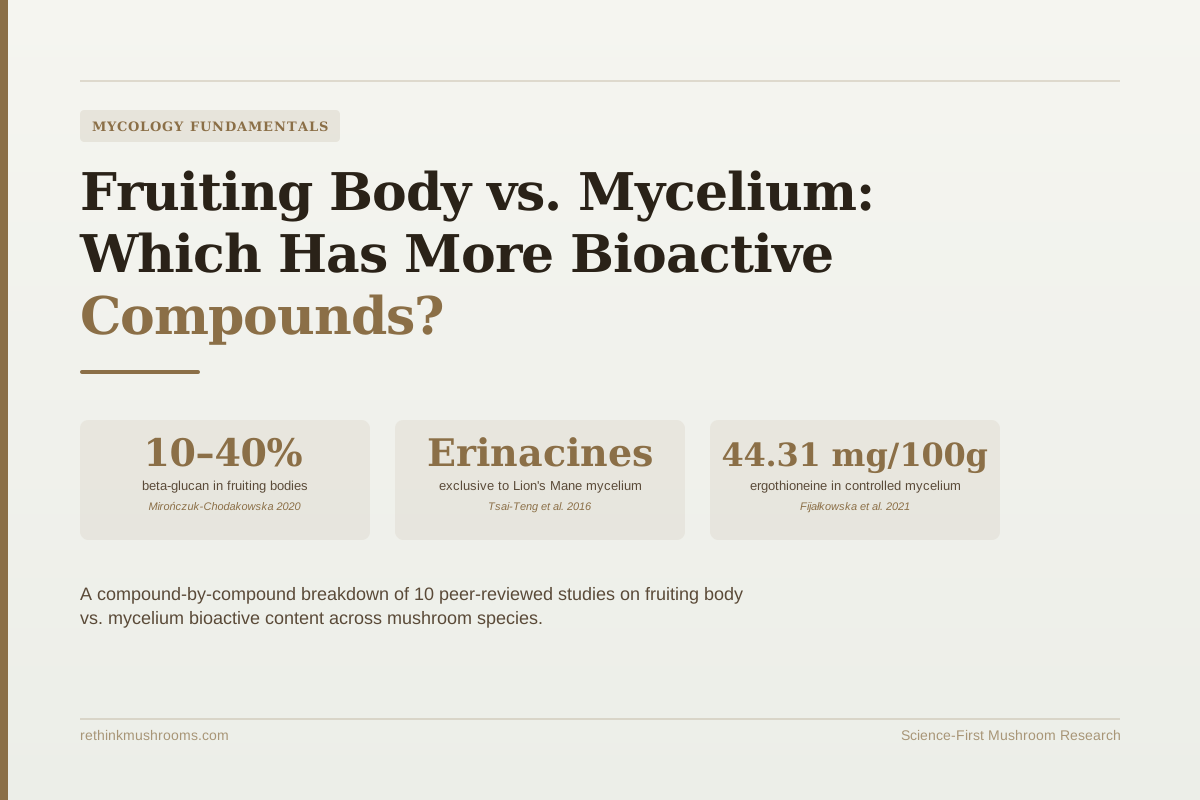
10–40% beta-glucan in real fruiting bodies
Wild mushroom fruiting bodies contain 10–40% beta-glucan by dry weight depending on species. But Lion's Mane mycelium produces erinacines the fruiting body cannot make, including compounds that reduced amyloid plaques in preclinical Alzheimer's research.
Mirończuk-Chodakowska & Witkowska, Int J Environ Res Public Health, 2020
Erinacines
exclusive to Lion's Mane mycelium; fruiting body produces none
44.31 mg/100g
ergothioneine in controlled-culture mycelium (Fijałkowska 2021)
Opposite
immune effects from same-species fruiting body vs mycelium (Lin 2019)
Mirończuk-Chodakowska & Witkowska, Int J Environ Res Public Health, 2020
 View as image ↗
The question sounds like basic biology. A mushroom has two main parts: the fruiting body (the cap and stem visible above ground) and the mycelium (the branching thread-like network that spreads through soil or wood beneath it). Which one is more packed with the compounds that make medicinal mushrooms scientifically interesting?
For most species and most compounds, the fruiting body wins by a considerable margin. Wild fruiting bodies contain 10–40% beta-glucan by dry weight depending on species, and these immune-active polysaccharides account for the bulk of the clinical research on medicinal mushrooms.[2] Grain-grown mycelium products, by contrast, contain the grain substrate mixed into the final powder. The grain contributes alpha-glucans (starches) that inflate total polysaccharide readings without providing the immune-active compounds the fruiting body delivers.[3]
But there is a layer to this answer that most of the mushroom supplement industry ignores. For Lion's Mane specifically, the mycelium produces a class of compounds the fruiting body cannot make at all. For at least one well-studied species, controlled-culture mycelium exceeds fruiting body levels for a specific antioxidant. And the fruiting body and mycelium of the same species have been shown to produce opposite effects on the same immune marker.
The correct answer depends on which mushroom you are asking about and which compound you mean. This article breaks down the evidence compound by compound. For the broader commercial and purchasing debate, see Fruiting Body vs. Mycelium: The Great Mushroom Supplement Debate.
Key Takeaways
- Wild mushroom fruiting bodies contain 10–40% beta-glucan by dry weight depending on species, providing the immune-active polysaccharides behind most clinical mushroom research (Mirończuk-Chodakowska & Witkowska 2020)
- Grain-grown mycelium products show detectable starch fragments from their substrate under mass spectrometry analysis, which artificially inflate total polysaccharide readings on supplement labels (López-García et al. 2016)
- Beta-glucan concentration scales directly with trained immunity induction in macrophages; enriching for beta-glucan content produces a stronger immune-training response (Case et al. 2024)
- Lion's Mane mycelium is the exclusive source of erinacines, neuroactive compounds that can cross into brain tissue and reduced amyloid plaques and tau tangles in an Alzheimer's mouse model (Tsai-Teng et al. 2016)
- Controlled liquid-culture mycelium of Fomitopsis officinalis contains ergothioneine up to 44.31 mg/100g DW, exceeding fruiting body levels for this specific antioxidant (Fijałkowska et al. 2021)
- Fruiting body and mycelium of the same mushroom species can produce opposite effects on the same immune marker, suggesting genuinely different biological profiles rather than just different potencies (Lin et al. 2019)
The Short Answer: Usually the Fruiting Body, With Two Important Exceptions
Fruiting bodies generally contain 3–8 times more beta-glucans than grain-grown mycelium products. However, mycelium contains exclusive compounds that fruiting bodies lack: erinacines in Lion's Mane for neurological support, and ergothioneine at higher concentrations in controlled liquid culture for certain species. The correct answer depends entirely on the mushroom species and compound in question.
This is the answer Google searchers are looking for, but it is only the starting point. The reasoning behind it matters as much as the conclusion, because the reasoning explains when each form is appropriate and why the distinction between grain-grown mycelium and controlled-culture mycelium is as significant as the distinction between mycelium and fruiting body.
Fruiting Bodies Generally Win on Beta-Glucans, With Species-Level Variation
Beta-glucans are long-chain sugars that form the structural backbone of mushroom cell walls. They have a specific molecular arrangement (beta-1,3 and beta-1,6 glucose linkages) that human immune cells recognize and respond to. The cell wall recognition triggers a cascade of immune activity that accounts for most of the documented effects of medicinal mushrooms in clinical research.[4]
Fruiting bodies accumulate high concentrations of these structural sugars because the mushroom cap and stem need them for physical support. The fruiting body is exposed to the environment and must resist pressure, moisture, and physical damage. That structural demand concentrates beta-glucans at the cell wall level. Mycelium, which spreads through soft substrate rather than standing upright in air, has less structural demand and produces correspondingly less.
Mirończuk-Chodakowska and colleagues measured actual beta-glucan concentrations in wild Polish mushroom fruiting bodies across species and found substantial variation: chanterelle was among the lowest, while oyster mushroom and boletes showed higher concentrations.[1] A follow-up analysis from the same research group found that wild-harvested fruiting bodies of common edible species typically land between 10% and 40%+ beta-glucan by dry weight, with the exact figure depending heavily on species and how the sample was processed.[2]
Those benchmarks matter when evaluating grain-grown mycelium products. When mycelium inoculates a grain substrate (rice, oats, wheat, or barley) and the whole colonized grain is dried and ground into powder, the grain starch is inseparable from the mycelial biomass. The resulting product contains both mushroom-derived beta-glucans and grain-derived alpha-glucan starches. The ratio between the two determines the supplement's actual potency for immune applications.
Cerletti and colleagues conducted a comprehensive review of beta-glucan content and clinical evidence across medicinal mushrooms and found that the immunomodulatory, cardiovascular, and anti-cancer evidence comes predominantly from studies using fruiting body extracts or purified beta-glucans, not from studies using whole myceliated grain biomass.[4] The clinical literature was built on fruiting body-derived material. Products that substitute grain mycelium are using a form that has not been validated in the studies that established the health evidence.
The Measurement Problem: Why Grain Mycelium Numbers Are Hard to Trust
Here is where supplement labels become unreliable. Most products report "polysaccharide" content rather than beta-glucan content specifically. Standard polysaccharide measurement methods cannot reliably distinguish between the mushroom's immune-active beta-glucans and the grain's immune-inactive alpha-glucan starches. A product can show a high total polysaccharide percentage while delivering very little actual beta-glucan.
López-García and colleagues used MALDI-TOF mass spectrometry, a technique that identifies molecules by measuring their molecular weight, to profile polysaccharides in commercial mushroom supplements.[3] They found detectable starch-derived fragments in grain-grown products. These fragments appear in the polysaccharide fraction of a standard assay, explaining why products can claim high polysaccharide percentages while delivering far less actual mushroom-derived beta-glucan than the label implies.
Timm and colleagues reviewed beta-glucan measurement methods and found that total polysaccharide testing conflates beta-glucans with alpha-glucans, making supplement label polysaccharide claims unreliable unless the product has been specifically tested with a beta-glucan-selective assay like the Megazyme enzymatic method.[5] Even the Megazyme method has species-specific limitations that can cause over- or underestimation in certain mushrooms.
The practical implication for consumers: a product claiming "40% polysaccharides" could mean 40% mushroom beta-glucans (a high-quality fruiting body extract) or 35% grain starch plus 5% mushroom beta-glucans (a heavily diluted grain mycelium product). The number looks identical from the outside.
This measurement problem is why the fruiting body vs. mycelium debate is not a theoretical distinction. When beta-glucan content is the active ingredient, the source and form of the product directly determine the dose the consumer receives per gram.
For a deeper look at how substrate chemistry shapes the final product, see How Growing Substrate Affects Mushroom Bioactive Content. For the full explanation of why grain-based mycelium products became so prevalent and what the controversy involves, see Mycelium on Grain: Why It's Controversial in the Supplement Industry.
Beta-Glucan Concentration Drives Trained Immunity, and the Dilution Effect Is Clinically Real
One reason the beta-glucan concentration gap between fruiting bodies and grain mycelium has practical consequences comes from how these compounds produce their immune effects.
Trained immunity is a mechanism by which a first exposure to a compound like beta-glucan reprograms immune cells to respond more vigorously to future challenges. It is a form of immune memory that does not involve the antibody-based system typically associated with vaccines. Research on this mechanism has established it as one of the key pathways by which mushroom-derived beta-glucans may support long-term immune function.
Case and colleagues studied beta-glucans from Agaricus bisporus (the common button and crimini mushroom) and their ability to drive trained immunity in macrophages, the front-line immune cells that patrol tissues and respond to threats.[6] They found that whole mushroom powder produced the strongest trained immunity response, and that enriching the preparation for higher beta-glucan content boosted the trained immunity response further.
The mechanism responds to concentration. A higher beta-glucan dose sends a stronger reprogramming signal to immune cells. A product where grain starch occupies a large portion of the total polysaccharide content delivers a weaker signal per gram consumed, even if the total polysaccharide percentage on the label appears high. The dilution is not cosmetic; it directly reduces the dose of the compound driving the biological effect.
The Lion's Mane Exception: Erinacines Come Exclusively From the Mycelium
Everything so far favors the fruiting body for beta-glucan content. Now the picture becomes more complicated.
Lion's Mane (Hericium erinaceus) produces two distinct classes of neuroactive compounds: hericenones (found in the fruiting body) and erinacines (found exclusively in the mycelium). Both have been investigated for their effects on nerve growth factor stimulation and neurological support, but they are structurally different molecules with different routes into the brain.
Erinacines can cross the blood-brain barrier, the tightly controlled boundary that separates the brain from general circulation and that most large molecules cannot cross. Hericenones have less evidence for blood-brain barrier penetration. This difference makes the mycelium form of Lion's Mane specifically relevant for neurological applications in a way that fruiting body extracts cannot replicate, regardless of beta-glucan content.
Tsai-Teng and colleagues used erinacine A-enriched Lion's Mane mycelium in an Alzheimer's disease mouse model and found that it reduced amyloid plaques and tau tangles, two of the pathological features that characterize Alzheimer's disease in the brain.[7] The study used mycelium specifically because erinacines are produced there. A fruiting body extract would have contained hericenones but no erinacines.
This is the clearest species-specific exception to the general rule. For Lion's Mane and neurological applications, the mycelium is not a weaker version of the fruiting body. It produces a different class of compounds the fruiting body cannot provide at any dose.
The counterpart to erinacines is also worth noting: hericenones, found in the fruiting body, are not produced in the mycelium. The two forms of Lion's Mane have genuinely complementary compound profiles, which is the scientific basis for full-spectrum Lion's Mane formulations. For the scientific case for combining both forms, see Full-Spectrum Mushroom Products: Fruiting Body + Mycelium?.
For a species-by-species breakdown of where bioactives are distributed across all mushroom structures, see Mycelium vs. Fruiting Body vs. Spore: Where Do the Bioactives Actually Live?.
Grain Mycelium vs. Controlled-Culture Mycelium: Not the Same Product
A common error in the fruiting body vs. mycelium debate is treating all mycelium products as equivalent. They are not. There are two fundamentally different production methods, and they produce chemically different outputs.
The first method, mycelium on grain, inoculates mushroom mycelium onto a grain substrate, allows partial colonization over several weeks, then dries and grinds the whole mass, grain and all. The grain is chemically inseparable from the mycelium in the final powder.
The second method, liquid-fermented or controlled-culture mycelium, grows mycelium in liquid broth or in controlled solid-state conditions using no grain substrate, then separates the mycelial biomass from the growth medium before drying. The final product contains only the mycelium.
Fijałkowska and colleagues produced mycelium of Fomitopsis officinalis under optimized controlled conditions and measured its bioactive compound content in detail.[8] They found ergothioneine concentrations up to 44.31 mg/100g DW and tocopherol (a form of vitamin E) concentrations up to 69.00 mg/100g DW. For ergothioneine, these levels exceeded typical fruiting body concentrations for this species.
Ergothioneine is an antioxidant amino acid that fungi synthesize and that human tissues accumulate preferentially, especially in organs with high metabolic activity. It cannot be produced by the human body and must come through diet. If controlled-culture mycelium concentrates ergothioneine at higher levels than the fruiting body for certain species, then for that specific compound in that specific application, the mycelium is the superior source.
The important qualifier is that Fijałkowska's result came from controlled-culture conditions optimized for bioactive output. The same substrate-contamination argument that makes grain mycelium inferior for beta-glucans applies here: a grain-based product cannot be optimized for ergothioneine because the grain chemistry interferes with both the measurement and the metabolic conditions the mycelium needs.
The Fijałkowska result is evidence of what high-quality mycelium can deliver. It does not support the average grain-based mycelium supplement product, which lacks both the substrate control and the optimization that produced those ergothioneine levels.
Same Species, Opposite Immune Effects: More Than Just a Concentration Difference
The most counterintuitive finding in the fruiting body vs. mycelium literature is not about concentration. It is about direction.
Lin and colleagues compared fruiting body extract and solid-state-cultivated mycelium from Taiwanofungus camphoratus (also known as Antrodia cinnamomea, a medicinal fungus used in traditional Taiwanese medicine) in cell culture, examining their effects on immune signaling molecules.[9] Under inflammatory conditions, the fruiting body extract increased IL-1β, an immune messenger that amplifies inflammation. The mycelium extract decreased IL-1β in the same conditions.
The two parts of the same mushroom had opposite effects on the same immune marker.
This finding, from a single in-vitro study with the limitations inherent to cell culture work, challenges the framing that fruiting body is simply the superior or more potent form. If the two parts produce genuinely different biological effects rather than just different intensities of the same effect, then asking which part has "more bioactives" may be the wrong question for some applications. The relevant question becomes which biological profile matches the application.
Berger and colleagues reviewed metabolites across fruiting bodies and mycelium in three edible mushroom species and found that substrate chemistry, fungal strain, and the developmental stage of the fruiting body each create large effects on the final compound content, sometimes as large as the average difference between fruiting body and mycelium as categories.[10] A high-quality fruiting body extract from an optimized substrate compared to a low-quality grain mycelium product does not tell us much about the inherent difference between fruiting body and mycelium in the abstract.
The Lin finding also provides biological support for full-spectrum products that combine both forms, not as a marketing exercise, but because the two parts of a mushroom may produce complementary rather than redundant immune activity in the same organism.
For the consumer-side implications of these distinctions, see Fruiting Body vs. Mycelium on Grain: The Debate That Defines Mushroom Supplement Quality.
The Bottom Line
Fruiting bodies contain more beta-glucans than grain-grown mycelium for most mushroom species, and the beta-glucan gap is clinically meaningful because concentration scales with trained immunity induction. However, the comparison is not straightforward: Lion's Mane mycelium contains erinacines exclusively, controlled-culture mycelium can exceed fruiting body levels for ergothioneine, and the fruiting body and mycelium of the same species can produce different rather than just different-strength immune effects. The correct answer depends on the species, the compound, and the production method.
Frequently Asked Questions
Sources & References
- 1RTHM-00484·Mirończuk-Chodakowska, Iwona et al. (2017). “Quantitative evaluation of 1,3,1,6 β-D-glucan contents in wild-growing species of edible Polish mushrooms..” Roczniki Panstwowego Zakladu Higieny.Study breakdown →PubMed →↩
- 2RTHM-00637·Mirończuk-Chodakowska, Iwona et al. (2020). “Evaluation of Polish wild Mushrooms as Beta-Glucan Sources..” International journal of environmental research and public health.Study breakdown →PubMed →↩
- 3RTHM-00437·López-García, Marta et al. (2016). “MALDI-TOF to compare polysaccharide profiles from commercial health supplements of different mushroom species..” Food chemistry.Study breakdown →PubMed →↩
- 4RTHM-00676·Cerletti, Chiara et al. (2021). “Edible Mushrooms and Beta-Glucans: Impact on Human Health..” Nutrients.Study breakdown →PubMed →↩
- 5RTHM-00854·Timm, Thaynã Gonçalves et al. (2023). “Mushroom β-glucans: application and innovation for food industry and immunotherapy..” Applied microbiology and biotechnology.Study breakdown →PubMed →↩
- 6RTHM-00867·Case, Sarah et al. (2024). “β-glucans from Agaricus bisporus mushroom products drive Trained Immunity..” Frontiers in nutrition.Study breakdown →PubMed →↩
- 7RTHM-00452·Tsai-Teng, Tzeng et al. (2016). “Erinacine A-enriched Hericium erinaceus mycelium ameliorates Alzheimer's disease-related pathologies in APPswe/PS1dE9 transgenic mice..” Journal of biomedical science.Study breakdown →PubMed →↩
- 8RTHM-00684·Fijałkowska, Agata et al. (2021). “Fortified Mycelium of Fomitopsis officinalis (Agaricomycetes) as a Source of Biologically Active Substances Effective in the Prevention of Civilization Diseases..” International journal of medicinal mushrooms.Study breakdown →PubMed →↩
- 9RTHM-00572·Lin, Liang-Hung et al. (2019). “Immunomodulatory Effects of Fruiting Body Extract and Solid-State-Cultivated Mycelia of Taiwanofungus camphoratus..” Nutrients.Study breakdown →PubMed →↩
- 10RTHM-00743·Berger, Ralf G et al. (2022). “Mycelium vs. Fruiting Bodies of Edible Fungi-A Comparison of Metabolites..” Microorganisms.Study breakdown →PubMed →↩