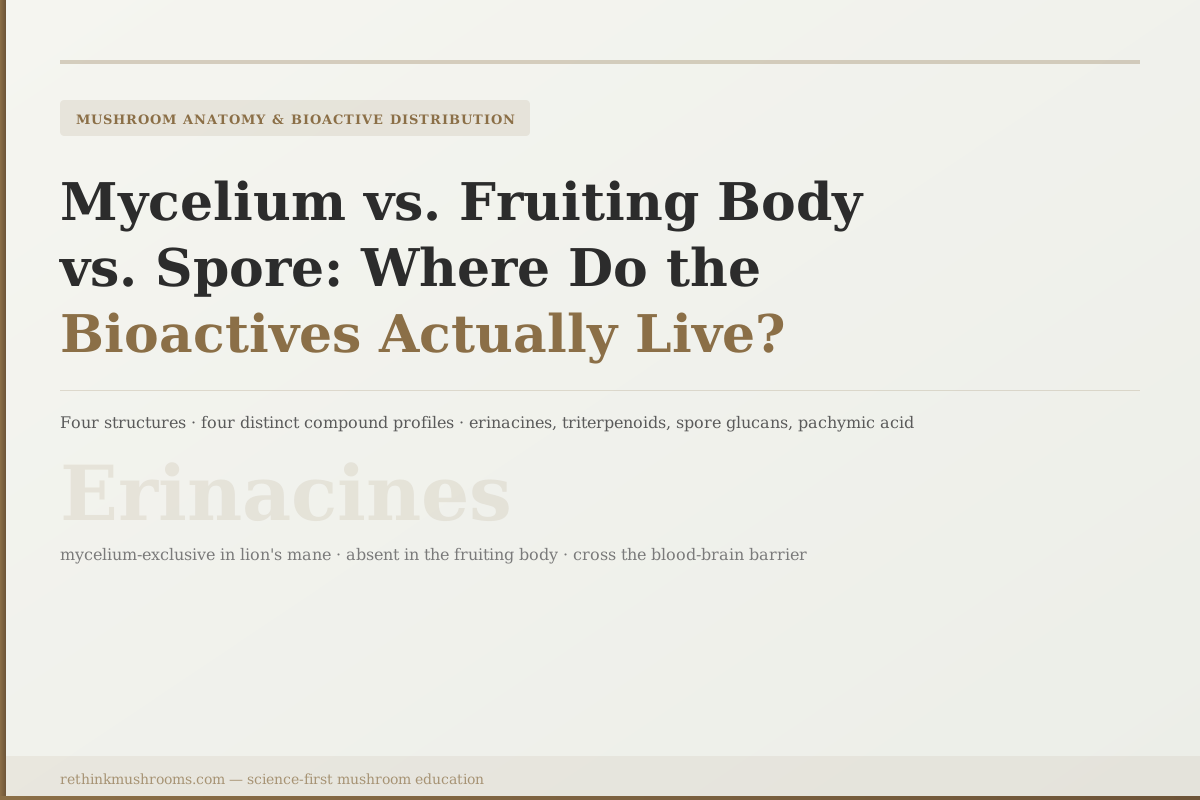
Mushroom Anatomy & Bioactive Distribution
4 distinct structures
Mushroom supplements come from four structurally different parts of the fungus, each with a distinct chemical profile. Most products only label one of them accurately.
Microorganisms, 2022 (PMID: 35889098)
Erinacines
found ONLY in lion's mane mycelium, never in the fruiting body; cross the blood-brain barrier
< 50%
the triterpenoid content of Ganoderma spore powder compared to fruiting body (Liu et al., Chinese Medicine, 2020)
Sclerotium
what Chaga, Poria cocos, and Tiger Milk Mushroom actually are: not fruiting bodies, not loose mycelium
Microorganisms, 2022 (PMID: 35889098)
 View as image ↗
The debate in mushroom supplements usually goes: fruiting body versus mycelium. Which is better? Which has more beta-glucans? Which is the real deal?
The premise of that debate is incomplete. A mushroom fungus has four distinct structures that are commercially harvested, and each has a different chemical fingerprint. The bioactives the supplement industry argues about (erinacines, triterpenoids, spore-specific glucans, pachymic acid) do not distribute uniformly across all four structures. In some cases, specific compounds are locked entirely to one structure and absent in all others.
This article maps where mushroom bioactives are actually located, structure by structure and compound by compound. For the broader debate about supplement quality, see Fruiting Body vs. Mycelium: The Great Mushroom Supplement Debate. For information on how the structures themselves differ biologically, see Mycelium, Sclerotium, and Spores: Different Parts, Different Benefits.
Key Takeaways
- Erinacines are found exclusively in lion's mane mycelium and are absent in the fruiting body; hericenones are found exclusively in the fruiting body and are absent in mycelium. Both stimulate NGF but via different mechanisms, and both are from the same mushroom species
- Ganoderma spore powder contains less than 50% of the triterpenoids found in Ganoderma lucidum fruiting body. Spore powder is a chemically distinct product, not a concentrated fruiting body extract (Liu et al., Chinese Medicine, 2020)
- Ganoderma spores contain a structurally unique beta-D-glucan not found in the fruiting body, making spore powder a different product rather than an inferior one (Dong et al., Carbohydrate Research, 2012)
- Chaga (Inonotus obliquus) is not a fruiting body and not loose mycelium. It is a sclerotium, and several of its signature bioactives (betulin, betulinic acid) come from the birch host tree, not from the fungus itself
- Poria cocos and Tiger Milk Mushroom are also sclerotia, producing a triterpenoid class (pachymic acid and related lanostanes) that is chemically distinct from the ganoderic acids in reishi fruiting body (Oncol Rep, 2022)
- A 2022 study across Agaricus bisporus, Pleurotus ostreatus, and Lentinus edodes found that substrate composition, fungal strain, and developmental stage all significantly affect compound concentrations in both fruiting body and mycelium. The fruiting body vs. mycelium comparison is an oversimplification even within a single species (Microorganisms, 2022)
The Location Problem: Fruiting Body vs. Mycelium Is Only Two of Four Structures
Most supplement debate treats mushrooms as binary: you either buy fruiting body or you buy mycelium. The "mycelium on grain" controversy in the United States dominates that conversation, with one camp arguing that grain-grown mycelium is mostly starch and barely a mushroom product at all.
That debate is real and worth understanding. But it obscures the fact that there are four commercially relevant mushroom structures, not two, and that two of the most popular medicinal species sold today, Chaga and Poria cocos, are neither fruiting body nor loose mycelium. They are sclerotia, a category the supplement debate has largely failed to name.
The four structures:
Fruiting body. The cap-and-stem structure most people recognize as a mushroom. The traditional medicinal part in most Asian herbal systems. This is where most triterpenoids (reishi's ganoderic acids, for example), PSK (in turkey tail), and hericenones (lion's mane) are concentrated.
Mycelium. The root-like network of threads that grows through substrate. In Hericium erinaceus (lion's mane), this is the only structure that contains erinacines. In cultivated Agaricus, mycelium contains more lovastatin than the fruiting body. In cordyceps fermentation, cordycepin accumulates preferentially in the liquid ferment.
Sclerotium. A hardened, compact mass of mycelium that a fungus forms as a dormant energy-storage structure. Chaga, Poria cocos, and Tiger Milk Mushroom (Lignosus rhinocerus) are commercially used sclerotia. Their bioactive chemistry differs substantially from fruiting body mushrooms because the sclerotium is a fundamentally different structure.
Spores. The reproductive units of the mushroom, produced in the gills or pores of the fruiting body. Ganoderma (reishi) spore powder is the primary spore-based supplement. Spores have a distinct chemical profile from the fruiting body they came from, not simply a diluted version.
Where Each Compound Lives
The following table maps the primary bioactive compounds in medicinal mushrooms to the structure where they concentrate, based on the published analytical literature.
| Compound | Primary Location | Species | Key Finding |
|---|---|---|---|
| Triterpenoids (ganoderic acids) | Fruiting body | Reishi (Ganoderma lucidum) | Spore powder has less than 50% of fruiting body levels |
| Beta-glucans | Both fruiting body and mycelium | Multiple | Mycelium grown on grain may have starch inflating beta-glucan readings |
| Hericenones | Fruiting body ONLY | Lion's Mane (Hericium erinaceus) | Absent in mycelium; stimulate NGF synthesis |
| Erinacines | Mycelium ONLY | Lion's Mane (Hericium erinaceus) | Absent in fruiting body; cross the blood-brain barrier; stimulate NGF synthesis |
| PSK / Krestin | Fruiting body | Turkey Tail (Trametes versicolor) | The polysaccharide K approved in Japan for cancer adjunct use |
| Cordycepin (3'-deoxyadenosine) | Primarily mycelium ferment | Cordyceps militaris | Concentrates in liquid fermentation; variable in dried fruiting body |
| Spore-specific beta-D-glucan | Spores ONLY | Reishi | Structurally distinct from fruiting body glucan (Dong 2012) |
| Pachymic acid | Sclerotium | Poria cocos (Fu Ling) | A lanostane triterpenoid specific to the sclerotium; not found in typical cap-and-stem mushrooms |
| Betulinic acid | Sclerotium (from birch host) | Chaga (Inonotus obliquus) | Absorbed from the birch tree host; not produced by the fungus itself |
| Melanin | Sclerotium exterior | Chaga | The black coloring of Chaga sclerotia |
This table is the starting point for understanding why "fruiting body vs. mycelium" is an incomplete question for many species.
Fruiting Body Chemistry: Triterpenoids, Hericenones, and the PSK Standard
The fruiting body is the part of the mushroom that accumulates secondary metabolites as it matures and prepares to sporulate. Triterpenoids in reishi (ganoderic acids), polysaccharopeptides in turkey tail (PSK), and hericenones in lion's mane all concentrate in this structure.
A 2022 comparison of metabolites in the fruiting bodies versus mycelia of three edible fungi (Agaricus bisporus, Pleurotus ostreatus, and Lentinus edodes) found that fruiting bodies contained higher levels of phenolic compounds and indole derivatives compared to mycelium.[1] These are the compound classes associated with the anti-inflammatory and antioxidant effects attributed to mushrooms in most human studies.
The qualification from that same study matters: substrate composition, fungal strain, and developmental stage all significantly affected compound concentrations in both parts. "Fruiting body has more phenolics than mycelium" is a general pattern, not a species-independent law.
For reishi specifically, the triterpenoid picture is particularly relevant. The ganoderic acids and other lanostane triterpenoids associated with reishi's immune-modulating and anti-tumor effects are concentrated in the fruiting body. When researchers compare reishi fruiting body to reishi spore powder, the triterpenoid content in spore powder consistently comes in lower, a point covered in more detail in the spore section below.
Mycelium Chemistry: Erinacines, Lovastatin, and the Grain Starch Problem
The mycelium is where the fungus spends most of its life. It is the metabolically active structure, producing enzymes and secondary metabolites to break down substrate and protect against competitors. For some species, this is where the most pharmacologically relevant compounds live.
In lion's mane, this point is sharp: erinacines are found exclusively in the mycelium and are absent in the fruiting body. Hericenones are found exclusively in the fruiting body and are absent in the mycelium. Both compound classes stimulate nerve growth factor (NGF) synthesis, but they are structurally different molecules operating through overlapping mechanisms. Erinacines are smaller, lipid-soluble molecules that more efficiently cross the blood-brain barrier. This distinction comes from established Hericium erinaceus chemistry literature and has implications for which supplement form to choose if the neurological goal is primary.
In Agaricus, the 2022 metabolites comparison found that mycelium contained higher lovastatin levels than fruiting body, demonstrating that for some species, mycelium is the preferred structure for specific bioactives.[1]
The honest caveat for mycelium supplements produced on grain (rice, oats, or other cereal grains): the substrate merges with the mycelium during fermentation, and the resulting product may contain substantial amounts of starch from the grain alongside the mycelium compounds. Lab tests measuring total polysaccharides in these products will include the grain starch in the reading, which can inflate apparent beta-glucan content. This is not a problem for mycelium produced on hardwood or liquid fermentation, but it is an unresolved quality issue for grain-grown mycelium products sold in the United States.
Spores: A Distinct Chemistry, Not Just a Weaker Fruiting Body
Ganoderma spore powder has been sold in Asia as a premium reishi product for decades, often at higher prices than fruiting body extracts. The marketing logic is that spores represent the most concentrated expression of the mushroom's bioactives.
The triterpenoid data does not support that framing. Liu and colleagues (2020, Chinese Medicine) analyzed 12 batches of Ganoderma spore powder, both broken-wall and unbroken, using HPTLC and LC-QTOF-MS, and compared them to fruiting body samples. The spore powder contained less than 50% of the triterpenoids found in the fruiting body. Triterpenoids should not be used as a quality marker for Ganoderma spore powder. Spore powder is not a concentrated fruiting body; it is a different product.[4]
But the framing of "spore powder is inferior" also misses something. A 2012 study by Dong and colleagues characterized a beta-D-glucan isolated specifically from Ganoderma spores and found it was structurally distinct from the polysaccharides in the fruiting body. It was a structurally different molecule from the fruiting body glucan, not simply a diluted version.[2]
A 2025 review (Journal of Fungi) examined the full spectrum of bioactive compounds in mushroom sexual spores and concluded that spores are a biochemically distinct structure with a unique compound profile that cannot be reduced to a subset of fruiting body chemistry.[3]
The practical read: Ganoderma spore powder is a legitimate product, but it should be evaluated and purchased for its spore-specific bioactives, not as a triterpenoid delivery system. Buying it for triterpenoid content relative to fruiting body is the wrong framing. For cross-cluster context on the sclerotia question, also see Sclerotia in Medicinal Mushrooms: The Chaga and Truffle Connection.
Sclerotia: The Structure Most Mushroom Coverage Has Never Named
Chaga is not a fruiting body. It is not loose mycelium. It is a sclerotium: a hardened, compact mass of mycelium that Inonotus obliquus forms on birch trees, incorporating host tissue as it grows. It is one of the most sold mushroom supplements in the United States and one of the most structurally mischaracterized.
True Inonotus obliquus fruiting bodies are rare and are not the commercial product. The black, conk-like growth harvested from birch trees is the sclerotium. The black exterior is melanin, a pigment produced in part by the fungus and in part reflecting the oxidation of birch compounds. The orange-brown interior is the mycelial mass.
Several of Chaga's most-cited bioactives come from the birch host tree, not from the fungus. Betulin and betulinic acid, which are lanostane triterpenes found in birch bark, are absorbed into the sclerotium from the host. They are birch compounds, not fungal compounds. Their presence in a Chaga supplement depends on whether the Chaga came from birch trees and how it was processed. Cultivated Chaga grown on media without birch typically contains none of these compounds.
Chaga sclerotia also have extremely high oxalate content, among the highest recorded in any known organism, which is a relevant safety consideration for people with kidney stones or who take Chaga in high doses regularly. This is not a reason to avoid Chaga, but it is information that should be on supplement labels and is rarely mentioned.
Poria cocos (Fu Ling) is also a sclerotium, formed on pine roots. It produces pachymic acid and related lanostane triterpenoids that are specific to its sclerotium structure and are distinct from the ganoderic acids found in reishi fruiting bodies. A 2022 review catalogued the pharmacological profiles of pachymic acid, including anti-inflammatory, anti-tumor, and metabolic effects, all derived from the sclerotium form of the fungus.[5]
Tiger Milk Mushroom (Lignosus rhinocerus) is a third sclerotium-forming medicinal species, native to Southeast Asian jungles. Its sclerotia showed antiproliferative activity against cancer cell lines in in vitro models, and a comprehensive 2015 review documented the bioactive compounds in the sclerotium (polysaccharides, proteins, ergosterol, and fatty acids), establishing that the sclerotium is the medicinal structure for this species.[6][7]
All three sclerotia (Chaga, Poria cocos, and Tiger Milk Mushroom) are categorically different from cap-and-stem mushrooms and from grain-grown mycelium products. Comparing them to fruiting body reishi or lion's mane on a beta-glucan basis ignores the distinct compound classes their sclerotium structures produce.
What the Compound Map Means When Reading Supplement Labels
Several practical points follow from the compound-location data.
For lion's mane specifically, the goal determines which form is relevant. If the interest is neurological applications (memory, nerve regeneration, post-injury support), mycelium-sourced erinacines have advantages due to BBB penetration. If the interest is general immune or digestive support, fruiting body hericenones and fruiting body beta-glucans are well-characterized. Products that combine both will contain both compound classes.
For reishi, triterpenoids come from the fruiting body, not spore powder. Buying spore powder for its triterpenoid content compared to fruiting body content is not supported by the analytical data. Buying spore powder for its unique spore-specific polysaccharides is a different and more defensible decision.
For Chaga, cultivation method matters more than for most other species. Wild-harvested Chaga from birch trees will contain betulinic acid; cultivated Chaga on non-birch media will not. The label rarely specifies the source. Oxalate content is high regardless of sourcing.
For Poria cocos and Tiger Milk Mushroom, the sclerotium is the product. There is no fruiting body alternative. Consumers evaluating these products should look for sclerotium-specific compounds (pachymic acid for Poria, specific polysaccharides for Tiger Milk) rather than applying fruiting body benchmarks.
The 2022 metabolites study found that substrate, strain, and developmental stage create substantial within-species variation that can dwarf the fruiting body vs. mycelium difference for some compounds.[1] Standardization to a specific active compound with a stated percentage is a more reliable quality signal than the structural label alone.
For the practical per-species breakdown of which part is most relevant for each therapeutic goal, see Which Part of the Mushroom Is Most Medicinal?. For further context on how the structure comparison maps to supplement quality decisions, see Fruiting Body vs. Mycelium on Grain: The Debate That Defines Mushroom Supplement Quality and How Growing Substrate Affects Mushroom Bioactive Content. For the deeper chemistry context on secondary metabolites beyond polysaccharides, see Secondary Metabolites in Mushrooms: The Compounds Beyond Polysaccharides.
The Bottom Line
Mushroom bioactives are not uniformly distributed across the four structures commercially harvested: fruiting body, mycelium, sclerotium, and spores. Erinacines are mycelium-exclusive and hericenones are fruiting-body-exclusive in lion's mane. Ganoderma spore powder contains less than 50% of fruiting body triterpenoids but has unique spore-specific glucans. Chaga, Poria cocos, and Tiger Milk Mushroom are sclerotia, not fruiting bodies, with distinct compound profiles including compounds absorbed from host trees. Substrate, strain, and developmental stage all further affect compound distribution.
Frequently Asked Questions
Sources & References
- 1. Source details for this reference are not yet available.
- 2. Source details for this reference are not yet available.
- 3. Source details for this reference are not yet available.
- 4. Source details for this reference are not yet available.
- 5. Source details for this reference are not yet available.
- 6. Source details for this reference are not yet available.
- 7. Source details for this reference are not yet available.