Mushroom Supplement Quality & Sourcing
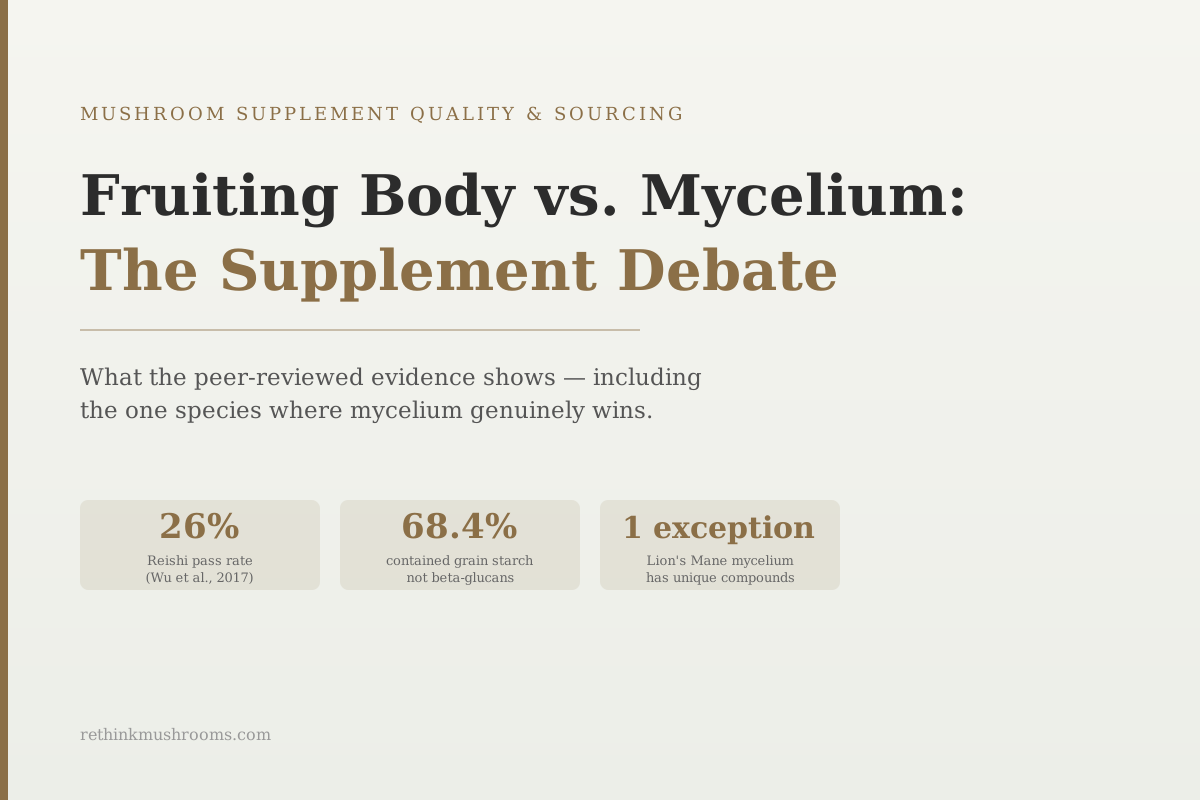
26% pass rate
Only 5 of 19 commercially available Reishi supplements passed quality testing in a 2017 independent analysis. The starch problem pointed directly to how most were made.
Wu et al., Scientific Reports, 2017
68.4%
of Reishi supplements contained starch-like polysaccharides instead of active beta-glucans (Wu 2017)
58%
of Reishi supplements lacked any detectable triterpenes, Reishi's defining secondary compounds (Wu 2017)
1 exception
Lion's Mane mycelium contains unique NGF-stimulating compounds not found in its fruiting body (Spangenberg 2025)
Wu et al., Scientific Reports, 2017
 View as image ↗
The debate over fruiting body vs. mycelium mushroom supplements is one of the most commercially contentious arguments in the dietary supplement space. Brands selling fruiting body products argue the mycelium-on-grain (MOG) category is mostly rice starch. Brands selling MOG products argue their approach captures a broader range of compounds.
The research doesn't fully vindicate either side's marketing. But it resolves the central question more clearly than most coverage suggests, including one important exception that genuinely changes the answer for one specific mushroom species. This article covers what the peer-reviewed evidence actually shows. For a broader guide to supplement quality, see how to choose a mushroom supplement.
Key Takeaways
- A 2022 peer-reviewed metabolite comparison confirmed that fruiting bodies and mycelium are chemically distinct products, with different concentrations of polysaccharides, phenolics, and triterpenoids across species
- Only 5 of 19 commercial Reishi supplements (26.3%) passed quality testing in a 2017 independent analysis; 68.4% contained starch-like polysaccharides and 58% lacked detectable triterpenes
- Lion's Mane is the critical exception: erinacines (found exclusively in the mycelium) are more potent nerve growth factor stimulators than hericenones (found in the fruiting body) in a 2025 systematic review of preclinical models
- Cordyceps fruiting bodies delivered the highest bioavailable cordycepin after simulated digestion in a 2022 study, even though one commercial supplement contained more cordycepin in raw form before digestion
- In a preclinical Antrodia model, fruiting body polysaccharides and mycelium polysaccharides produced different anti-inflammatory effects, confirming that the biochemical difference between plant parts translates to measurable functional differences
- For most species (Reishi, Chaga, Turkey Tail), fruiting body is the better-supported choice; Lion's Mane is the one species where high-quality mycelium from a clean substrate has a legitimate scientific case
What "Mycelium on Grain" Actually Is (and Why It's Not What You Picture)
When people imagine mycelium, they picture the white thread-like network that connects mushroom roots underground, a fine web of fungal tissue. What is sold as "mycelium on grain" in the supplement industry is something different.
MOG starts with grain, typically rice, oats, or sorghum, which is inoculated with fungal spores and left to grow. The mycelium threads through the grain as it colonizes the substrate. After a period of growth, the entire mass is dried and ground into powder. Because mycelium grows into the grain rather than sitting on top of it, the two cannot be meaningfully separated. The resulting product is a mixture of fungal material and grain starch.
This is not a hidden flaw or a processing error. It is inherent to the production method. The question the research addresses is whether that mixture retains enough active fungal compounds, specifically beta-glucans (the polysaccharides that drive most of mushrooms' studied health effects), to function as a genuine mushroom supplement.
The fruiting body, by contrast, is what most people recognize as the mushroom itself: the cap, the stem, the structure that forms above the growing medium. Fruiting bodies can be harvested and extracted separately from any substrate. A product made from fruiting bodies is not contaminated by grain because grain is not part of how fruiting bodies grow.
This foundational difference is what the entire quality debate turns on.
A 2022 Peer-Reviewed Comparison Found the Two Parts Are Chemically Distinct Products
Berger and colleagues published a direct metabolite comparison of mycelium versus fruiting bodies across multiple edible mushroom species in the journal Microorganisms in 2022.[1] The study was not conducted by a supplement brand. It appeared in a peer-reviewed journal and covered proteins, polysaccharides, phenolics, and mineral content.
The findings showed that fruiting bodies and mycelium are genuinely different products at the biochemical level. Fruiting bodies tended to be richer in phenolics, triterpenoids, and the structural polysaccharides that include beta-glucans. Mycelium showed different ratios of proteins and smaller metabolites, with profiles that varied substantially depending on species and growth conditions.[1]
This peer-reviewed evidence establishes something important: the fruiting body vs. mycelium difference is not marketing spin. It is a real biochemical distinction confirmed in academic literature. Neither part is universally superior for every compound, but they are not interchangeable, and a product made from one part does not replicate the compound profile of a product made from the other.
For most species, the compounds most associated with studied health effects, including immune-supporting beta-glucans and adaptogenic triterpenoids, are more concentrated in the fruiting body. The practical implication for supplements is that a product without measurable fruiting body content may not deliver what the category's research has documented.
Wu 2017: Only 5 of 19 Reishi Supplements Passed Quality Testing
The gap between what fruiting body research demonstrates and what commercial MOG products deliver is not theoretical. Wu and colleagues tested 19 commercially available Reishi supplements in a 2017 analysis published in Scientific Reports.[2]
Only 5 of the 19 products, 26.3%, passed quality standards. The failure modes were specific and consistent. Branched 1,3-beta-D-glucan, the active immune-supporting polysaccharide that gives Reishi its documented properties, was detected in only 26.3% of products. Starch-like polysaccharides were found in 13 of 19 products, 68.4% of the sample. And 58% of products lacked any detectable triterpenes, the bitter compounds that give Reishi its bitter taste and account for many of its adaptogenic effects in the research literature.[2]
A product with starch instead of beta-glucans and no detectable triterpenes is not a Reishi supplement in any meaningful sense. It is grain with a mushroom name on the label.
The Wu 2017 data comes from 2017, but subsequent market testing has consistently found similar failure rates in the North American and European mushroom supplement markets. This is not an isolated finding from a single study. It represents a systemic pattern in a product category where MOG production is common and quality testing is not required for market entry.
The starch contamination problem is not a manufacturing defect that can be fixed with better quality control. It is intrinsic to growing mycelium on grain substrate. A MOG product without starch contamination would require separating mycelium from the grain it grew in, which defeats the purpose of the substrate-based production method and is commercially impractical at scale.
The Lion's Mane Exception: Erinacines in Mycelium Are More Potent NGF Stimulators Than What's in the Fruiting Body
Reishi, Turkey Tail, Chaga, and most other medicinal mushroom species are one-sided cases: the fruiting body contains the primary active compounds, and MOG products routinely fail to deliver them. Lion's Mane is different, and the difference is substantial enough to change the entire recommendation for this species.
Friedman reviewed the chemistry of Lion's Mane fruiting bodies and mycelia in a 2015 paper published in the Journal of Agricultural and Food Chemistry.[4] The key finding: Lion's Mane contains two classes of compounds that stimulate nerve growth factor, the protein that tells neurons to grow and maintain themselves. Hericenones are found exclusively in the fruiting body. Erinacines are found exclusively in the mycelium. These compound classes do not overlap, and neither substitutes for the other.
Spangenberg and colleagues published a systematic review of erinacine research in Frontiers in Pharmacology in 2025, covering their role in the neuroprotective effects documented in preclinical models.[5] The findings elevated the erinacines above what Friedman's 2015 review had suggested. Erinacine A, one of the primary erinacine compounds found in Lion's Mane mycelium, crosses the blood-brain barrier directly. In preclinical assays, the volume of nerve growth factor stimulated by erinacines exceeded what hericenones produced in comparable models.[5]
What this means practically: for Lion's Mane specifically, a product containing only fruiting body material is missing the more potent NGF-stimulating compounds. A product containing only MOG material may be missing hericenones while also containing starch contamination. A genuine full-spectrum Lion's Mane product, containing both fruiting body and high-quality mycelium from a substrate that can be reliably separated, would be the most complete option for cognitive applications. Such products exist, but they require specific documentation of erinacine content to verify.
The caveat matters: the Lion's Mane erinacine argument applies to clean mycelium products that have been tested for erinacine content, not to standard MOG products grown on rice or oats and ground without separation. Standard MOG Lion's Mane products face the same starch contamination problem as any other species. The species-specific exception only holds if the mycelium is grown specifically for erinacine content and verified analytically.
Cordyceps: High Raw Numbers Don't Predict What the Body Actually Absorbs
Jedrejko and colleagues published an analysis of cordycepin, the primary active compound in Cordyceps militaris, across fruiting bodies, mycelium, and commercial supplements in the journal Antioxidants in 2022.[3] The study included a simulated intestinal digestion step, measuring how much cordycepin remained bioavailable after passing through conditions that approximate the digestive tract.
The finding was counterintuitive. One commercial supplement contained the highest raw cordycepin content measured, 81.4 mg per 100 grams of dry weight. But after simulated digestion, its bioavailable cordycepin was the lowest of the samples tested. Commercially obtained fruiting bodies (25.9 mg/100g) and self-cultivated fruiting bodies (25.8 mg/100g) delivered the highest bioavailable cordycepin post-digestion, despite starting with lower raw content.[3]
This result has direct implications for how to read supplement labels. A product advertising high cordycepin content in raw form is not necessarily a product that delivers more active compound to the body. The physical structure of the fruiting body versus a processed supplement form affects how much cordycepin actually becomes available after digestion.
For Cordyceps specifically, the fruiting body data supports the same conclusion as Reishi: the fruiting body form delivers more of the active compound in a bioavailable form, even when raw numbers suggest otherwise. This is the kind of nuance that raw content testing on supplement labels cannot convey.
When the Biochemistry Produces Different Biological Effects
The differences between fruiting body and mycelium polysaccharide profiles are not just analytical curiosities. Meng and colleagues demonstrated in a 2012 preclinical study published in the journal Nutrition that polysaccharide extracts from Antrodia camphorata, a medicinal mushroom used primarily for liver support, produced different effects depending on whether they came from the fruiting body or the mycelium.[6]
In a mouse model of severe bacterial infection, both fruiting body and mycelium polysaccharides from Antrodia showed anti-inflammatory effects. But the fruiting body polysaccharides showed stronger reductions in inflammatory markers. The same mushroom compound, drawn from different parts of the same species, produced measurably different outcomes in a controlled preclinical model.[6]
This is preclinical evidence from mice, not humans, and it should not be extrapolated directly to clinical outcomes. But it confirms what the biochemical analyses suggest: the different polysaccharide profiles of fruiting bodies and mycelium do not just sit inertly on an analytical report. They produce different responses in biological systems. A supplement that substitutes grain starch for fruiting body beta-glucans is not just analytically different. It is functionally different.
The Berger 2022 metabolite data, the Wu 2017 commercial failure rate, and the Meng 2012 functional outcome study together tell a consistent story: the fruiting body vs. mycelium distinction is real, measurable, and biologically relevant. The one exception, Lion's Mane erinacines, does not undermine that story. It adds a specific nuance to one species while leaving the broader conclusion intact.
For a closer look at what these failures look like in practice and how to read supplement labels, see the starch filler problem article and how to spot MOG supplement red flags. The consumer guide covers the practical decision framework by species. The broader context of why quality failures are common across the mushroom supplement market is covered in why most mushroom supplements fail quality testing. For specifics on extraction method and beta-glucan delivery, see hot water extract vs. dual extract vs. raw powder and mushroom extract vs. whole powder.
The Bottom Line
The fruiting body vs. mycelium on grain debate resolves fairly clearly for most species: peer-reviewed metabolite data confirms the biochemical difference is real, commercial testing shows MOG products routinely fail to deliver active beta-glucans and triterpenoids, and preclinical evidence shows the differences translate to functional outcomes. Lion's Mane is the genuine exception: erinacines in the mycelium are more potent NGF stimulators than hericenones in the fruiting body, and erinacine A crosses the blood-brain barrier. That exception applies to clean mycelium grown and verified for erinacine content, not to standard MOG products, which face the same starch contamination problem as other species.
Frequently Asked Questions
Sources & References
- 1RTHM-00743·Berger, Ralf G et al. (2022). “Mycelium vs. Fruiting Bodies of Edible Fungi-A Comparison of Metabolites..” Microorganisms.Study breakdown →PubMed →↩
- 2RTHM-00499·Wu, Ding-Tao et al. (2017). “Evaluation on quality consistency of Ganoderma lucidum dietary supplements collected in the United States..” Scientific reports.Study breakdown →PubMed →↩
- 3RTHM-01545·Jędrejko, Karol et al. (2022). “Cordyceps militaris-Fruiting Bodies, Mycelium, and Supplements: Valuable Component of Daily Diet..” Antioxidants (Basel.Study breakdown →PubMed →↩
- 4RTHM-00371·Friedman, Mendel (2015). “Chemistry, Nutrition, and Health-Promoting Properties of Hericium erinaceus (Lion's Mane) Mushroom Fruiting Bodies and Mycelia and Their Bioactive Compounds..” Journal of agricultural and food chemistry.Study breakdown →PubMed →↩
- 5RTHM-02184·Spangenberg, E T et al. (2025). “Unveiling the role of erinacines in the neuroprotective effects of Hericium erinaceus: a systematic review in preclinical models..” Frontiers in pharmacology.Study breakdown →PubMed →↩
- 6RTHM-00257·Meng, Ling-Min et al. (2012). “Polysaccharides from extracts of Antrodia camphorata mycelia and fruiting bodies modulate inflammatory mediator expression in mice with polymicrobial sepsis..” Nutrition (Burbank.Study breakdown →PubMed →↩