Mushroom Supplement Quality and Sourcing
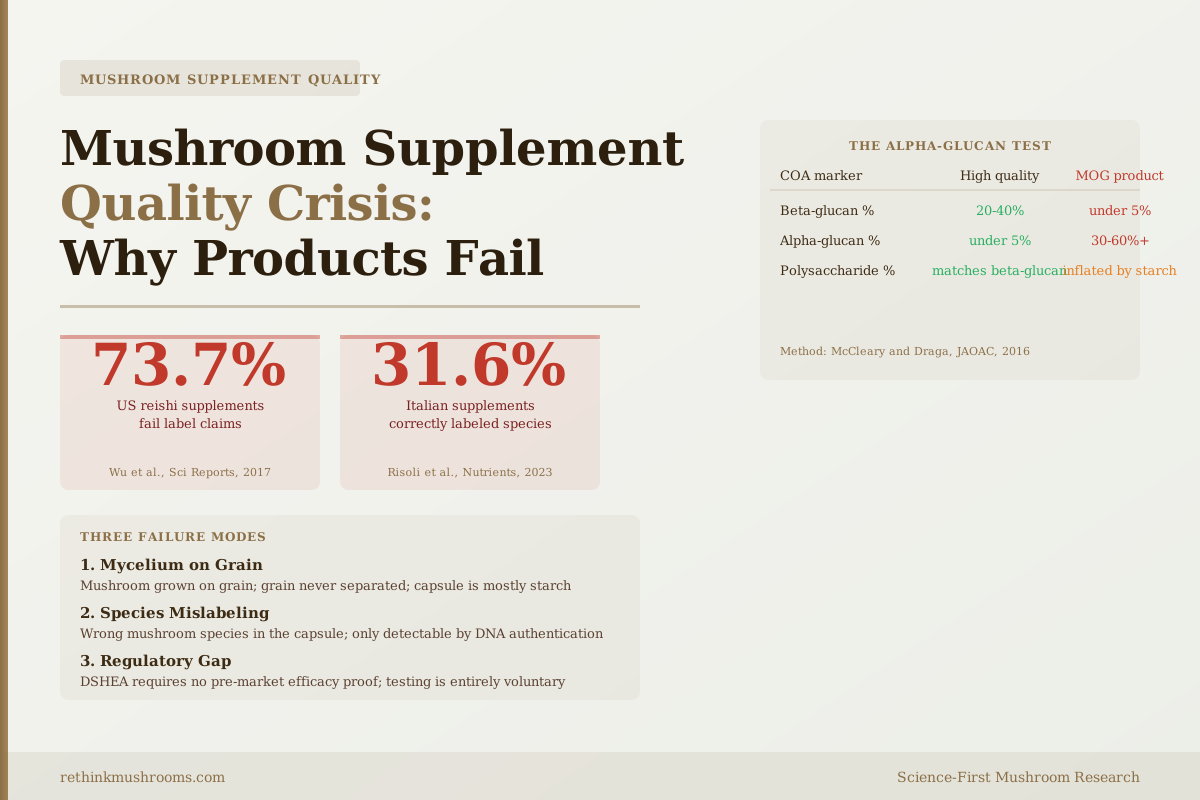
73.7% of US reishi supplements fail label claims
A 2017 market survey of US reishi supplements found nearly three in four products did not match their labels on species identity, ingredient composition, or active compound concentration.
Wu et al., Scientific Reports, 2017
31.6%
of Italian market mushroom supplements correctly matched their species label (Risoli 2023)
1
product in the Italian market survey exceeded EU aflatoxin limits (Risoli 2023)
0
pre-market safety or efficacy tests required by US law before products reach shelves (Starr 2015)
Wu et al., Scientific Reports, 2017
 View as image ↗
Nearly three in four US reishi supplements tested in a 2017 market survey did not match what was on their label. The problem was not rounding errors or minor discrepancies. It was the full range of failures: wrong species, wrong concentrations, wrong ingredient composition. And reishi is the most studied medicinal mushroom in the market, where quality incentives should be highest.
The quality problems in the mushroom supplement industry are systemic, documented across multiple countries, and driven by three distinct failures: an ingredient category that often delivers little of the claimed bioactive compound (mycelium on grain), widespread mislabeling of species identity, and a regulatory structure that places no obligation on manufacturers to verify quality before products reach consumers.
This article documents what the market survey data shows, explains the mechanisms behind each failure mode, and describes what good quality looks like. For practical steps to evaluate products before purchasing, see How to Choose a Mushroom Supplement: The Science-Based Buyer's Guide.
Key Takeaways
- A 2017 Scientific Reports market survey found that 73.7% of US reishi dietary supplements failed to match their label claims for species identity, ingredient composition, or active compound concentration (Wu et al.)
- A 2023 Italian market study of 19 mushroom supplement products found that only 6 (31.6%) correctly matched the species stated on their label; one product contained aflatoxins exceeding EU safety limits (Risoli et al.)
- The primary quality failure is mycelium-on-grain (MOG) production: mushroom mycelium grown on grain substrate and ground up with the grain intact, producing a product that is largely starch rather than mushroom bioactives
- A validated analytical method (McCleary 2016) distinguishes fungal beta-glucan from alpha-glucan (starch) by measuring both separately; a high alpha-glucan reading on a certificate of analysis is the direct indicator of a mycelium-on-grain product
- Species mislabeling is a second distinct failure mode: DNA-based authentication of commercial reishi products found that many products labeled as Ganoderma lucidum actually contained other Ganoderma species with different bioactive profiles (Loyd 2018)
- Under the US Dietary Supplement Health and Education Act (DSHEA), manufacturers are not required to prove safety or efficacy before selling supplements; quality verification falls entirely on voluntary testing and consumer due diligence (Starr 2015)
73.7% Failure: What Market Testing Actually Found
The clearest picture of how badly mushroom supplement quality has failed comes from independent market surveys that took commercial products off shelves and put them through analytical testing.
A 2017 study by Wu and colleagues, published in Scientific Reports, surveyed commercially available reishi (Ganoderma lucidum) dietary supplements in the United States and subjected them to chemical and molecular analysis.[1] The results were stark: only 26.3% of products (roughly one in four) had ingredients that matched their labels on all three criteria tested: species identity, ingredient composition, and active compound concentration. The rest failed on at least one, and most failed on multiple.
Reishi is the most commercially prominent and scientifically researched medicinal mushroom in the US market. If product quality is worst in the least-studied corners of the supplement industry, one might expect the best-studied products to fare better. The Wu 2017 data suggests that commercial success and market maturity do not drive quality improvement in the absence of regulatory pressure.
European market data shows similar patterns. A 2023 study by Risoli and colleagues analyzed 19 mushroom supplement products from six Italian companies under the title "Mushroom-Based Supplements in Italy: Let's Open Pandora's Box."[2] Only 6 of the 19 products (31.6%) correctly identified the species on the label. One product contained aflatoxins (a class of fungal toxins produced by mold contamination) at levels exceeding European Commission safety limits. The study found variation in beta-glucan content even between different capsules from the same batch, indicating quality control failures within single production runs.
A 2024 review by Liu and colleagues examined the broader landscape of counterfeiting and mislabeling in the commercial mushroom market with a focus on China, which is the world's largest mushroom-producing country and the primary source for most supplement ingredient raw materials.[3] The review documents the range of adulteration methods in commercial mushroom products, from species substitution (replacing a premium species with a cheaper lookalike) to dilution with non-mushroom materials, and evaluates detection methods including DNA barcoding and chemical fingerprinting.
Taken together, US, European, and Chinese market data describe a systemic global quality problem, not isolated incidents from individual bad actors.
The Mycelium-on-Grain Problem: When a Supplement Is Mostly Starch
The most common cause of low-quality mushroom supplements is a production method that is not immediately obvious from the label: mycelium grown on grain.
Here is what that means. Mushroom mycelium, the root-like network of fungal filaments that precedes the fruiting body (the cap-and-stem structure most people picture), can be grown in a laboratory on a grain substrate such as brown rice or oats. This is commercially convenient. But the problem is what happens during processing: in many production methods, the grain substrate is never separated from the mycelium before the material is dried and ground into powder. The capsule the consumer receives contains a mixture of fungal mycelium and the grain it grew on.
The practical consequence is that the capsule contains a large proportion of grain starch. Starch is not the bioactive compound that gives medicinal mushrooms their studied effects. The beta-glucans, triterpenes, and other fungal compounds are present at much lower concentrations in the final product.
A 2022 review by Berger and colleagues compared the metabolite profiles of mushroom fruiting bodies and mycelium across multiple species.[4] The review confirmed that fruiting bodies consistently contain higher concentrations of the bioactive compounds associated with medicinal mushroom research, including beta-glucans, triterpenes, and ergosterol. Mycelium per se is not biologically inert. Berger 2022 specifically notes that some compounds such as erinacines in lion's mane are found predominantly in mycelium rather than fruiting bodies. But the problem is not mycelium in principle: it is mycelium that has never been separated from its grain substrate, producing a product that is largely starch filler.
The bioactivity difference has been confirmed in controlled research settings. A 2012 study by Wang and colleagues compared fruiting body and mycelium extracts from Antrodia camphorata in both cell models and animal models.[5] The fruiting body extract showed superior neuroprotective activity across both testing systems. This is consistent with the broader metabolite data: if the fruiting body contains higher concentrations of bioactive compounds, products derived from it should show stronger biological effects.
The Alpha-Glucan Column: How Testing Reveals the Starch Problem
There is an analytical method that directly reveals whether a supplement contains large amounts of grain starch. A 2016 paper by McCleary and Draga, published in the Journal of AOAC International, validated what is now the standard enzymatic assay for measuring beta-glucan in mushroom products.[6]
The method works in two steps. First, acid hydrolysis breaks down all glucan polymers (chains of glucose molecules) into their component glucose units, giving a measure of total glucan content. Second, the enzyme glucoamylase specifically breaks down alpha-glucan (starch and glycogen) and not beta-glucan. By measuring both total glucan and alpha-glucan separately, the test calculates beta-glucan as the difference between the two.
The critical number this produces is the alpha-glucan percentage. In a product made from mushroom fruiting bodies, the alpha-glucan reading should be low; fruiting bodies contain very little starch. In a mycelium-on-grain product, the alpha-glucan reading will be high, because starch from the grain substrate is a major component of the powder. A certificate of analysis that shows high alpha-glucan alongside low beta-glucan is the direct chemical signature of a mycelium-on-grain product.
This is why the alpha-glucan column on a quality certificate of analysis matters as much as the beta-glucan column. Many supplement companies show total polysaccharides on their label rather than the specific beta-glucan number, because total polysaccharides includes all forms of glucan, including the alpha-glucan that is mostly starch. A product can show 40% polysaccharides while delivering less than 5% actual beta-glucan, with the remainder being grain carbohydrates.
For a full guide to reading a supplement's certificate of analysis, see Independent Lab Test Results: How to Find and Read Them.
Species Mislabeling: When the Label Gets the Mushroom Wrong Entirely
Beyond the mycelium-on-grain quality problem is a second, distinct failure: products that contain a different mushroom species than the one stated on the label. This is not a problem of low concentration. It is a problem of incorrect identity.
A 2018 study by Loyd and colleagues, published in Frontiers in Microbiology, applied DNA-based species authentication to commercial reishi supplement products in the United States.[7] Products labeled as Ganoderma lucidum, the species associated with the term "reishi," frequently contained other Ganoderma species with different bioactive compound profiles. Ganoderma is a diverse genus of bracket fungi, and while multiple species carry the reishi label commercially, they are not chemically identical. A product labeled G. lucidum that actually contains G. applanatum or another species may have genuinely different pharmacological properties from what the research literature on G. lucidum would predict.
The Loyd 2018 finding demonstrates a critical limitation of chemical testing alone. A product could show plausible beta-glucan levels on a certificate of analysis while still containing the wrong species. Beta-glucan content is a measure of one class of compounds; species identity is a separate question that requires molecular authentication.
The Liu 2024 counterfeiting review provides broader context: species substitution is not a quality control accident but an established commercial practice in parts of the supply chain.[3] Cheaper species are substituted for more expensive ones. Visual inspection cannot reliably distinguish ground mushroom powders from closely related species, which is why DNA barcoding (specifically ITS barcoding, a molecular identification method using a standardized region of fungal DNA) is the only verification approach that addresses this failure mode.
For more context on the species mislabeling problem and how DNA testing resolves it, see 7 Red Flags in Mushroom Supplements: What to Avoid.
The Regulatory Void That Allows This Market to Continue
The scale of quality failure documented in these market surveys exists within a specific regulatory context that makes it possible. Understanding that context explains why consumer due diligence is necessary rather than optional.
In the United States, dietary supplements are governed primarily by the Dietary Supplement Health and Education Act of 1994, known as DSHEA. A 2015 analysis by Starr, published in the American Journal of Public Health, describes the central structural feature of this framework: under DSHEA, manufacturers are not required to demonstrate safety or efficacy before selling a supplement.[8] The FDA's enforcement role is reactive, not proactive. It can act after a problem is identified, but it does not require pre-market proof that a product meets its label claims.
The practical consequence is that any company can formulate, label, and sell a mushroom supplement without independent verification of what is in the capsule. Quality testing, if it happens at all, is voluntary. Third-party certifications (NSF, USP, and similar) exist and carry weight, but they are not mandated. The gap between the market survey data (73.7% failure in Wu 2017, 68.4% species mislabeling in Risoli 2023) and what the regulatory framework requires is not a failure of enforcement against known violators. It is an expected outcome of a system that does not compel proof of quality at all.
This structural context does not make the regulatory framework unique to mushroom supplements. DSHEA applies to the entire US dietary supplement industry. But it explains why market quality in mushroom supplements correlates with voluntary company practices and consumer demand for transparency, rather than with any regulatory floor.
What High-Quality Looks Like: The Standards That Work
Despite the documented quality problems, high-quality mushroom supplements exist and can be identified by specific measurable criteria.
Fruiting body sourcing is the starting point. Products made exclusively from mushroom fruiting bodies (not mycelium biomass, not "full spectrum" preparations that include mycelium on grain) avoid the primary failure mode. The packaging or company website should clearly state the ingredient source.
A beta-glucan percentage from an independent third-party certificate of analysis, using the McCleary enzymatic method, is the compound-level verification. The alpha-glucan column alongside it is the starch check; any value above roughly 5-8% warrants closer scrutiny about ingredient sourcing. The lab should carry ISO 17025 accreditation, the international standard for testing laboratory competence.
Species authentication through ITS DNA barcoding is the verification that the right mushroom is in the product. This requires a separate test from compound analysis and will appear as a distinct section on an advanced COA.
Heavy metal testing (for lead, cadmium, arsenic, and mercury) addresses contamination risks, which are particularly relevant for wild-harvested species or products from unspecified geographic origins, given documented bioaccumulation of heavy metals in some mushroom species.
None of these standards is exotic. They are established laboratory procedures. The quality crisis is not a lack of available testing methods. It is a lack of consistent market demand and regulatory requirement for those methods to be applied.
For the complete framework on how to evaluate products against these standards, see What to Look for on a Mushroom Supplement Label.
The Bottom Line
Market surveys conducted across three continents document a systemic quality problem in the mushroom supplement industry. A 2017 US survey found 73.7% of reishi supplements failed label claims; a 2023 Italian study found 68.4% species mislabeling rate and one product with aflatoxins above legal limits. The primary failure mode is mycelium-on-grain production, which delivers grain starch alongside limited mushroom bioactives. A second distinct failure is species mislabeling, detectable only through DNA authentication rather than chemical analysis alone. The US regulatory framework (DSHEA) requires no pre-market quality proof, placing the burden of verification on voluntary testing and consumer evaluation.
Frequently Asked Questions
Sources & References
- 1RTHM-00499·Wu, Ding-Tao et al. (2017). “Evaluation on quality consistency of Ganoderma lucidum dietary supplements collected in the United States..” Scientific reports.Study breakdown →PubMed →↩
- 2. Source details for this reference are not yet available.
- 3. Source details for this reference are not yet available.
- 4RTHM-00743·Berger, Ralf G et al. (2022). “Mycelium vs. Fruiting Bodies of Edible Fungi-A Comparison of Metabolites..” Microorganisms.Study breakdown →PubMed →↩
- 5. Source details for this reference are not yet available.
- 6. Source details for this reference are not yet available.
- 7. Source details for this reference are not yet available.
- 8RTHM-00735·Starr, Ranjani R (2015). “Too little, too late: ineffective regulation of dietary supplements in the United States..” American journal of public health.Study breakdown →PubMed →↩