Mushroom Supplement Quality
26.3% matched their label
When researchers working with the US Pharmacopeial Convention chemically tested 19 batches of reishi supplements bought in the United States, the measured ingredients matched the printed label in only five of them.
Wu et al., Scientific Reports, 2017
≠
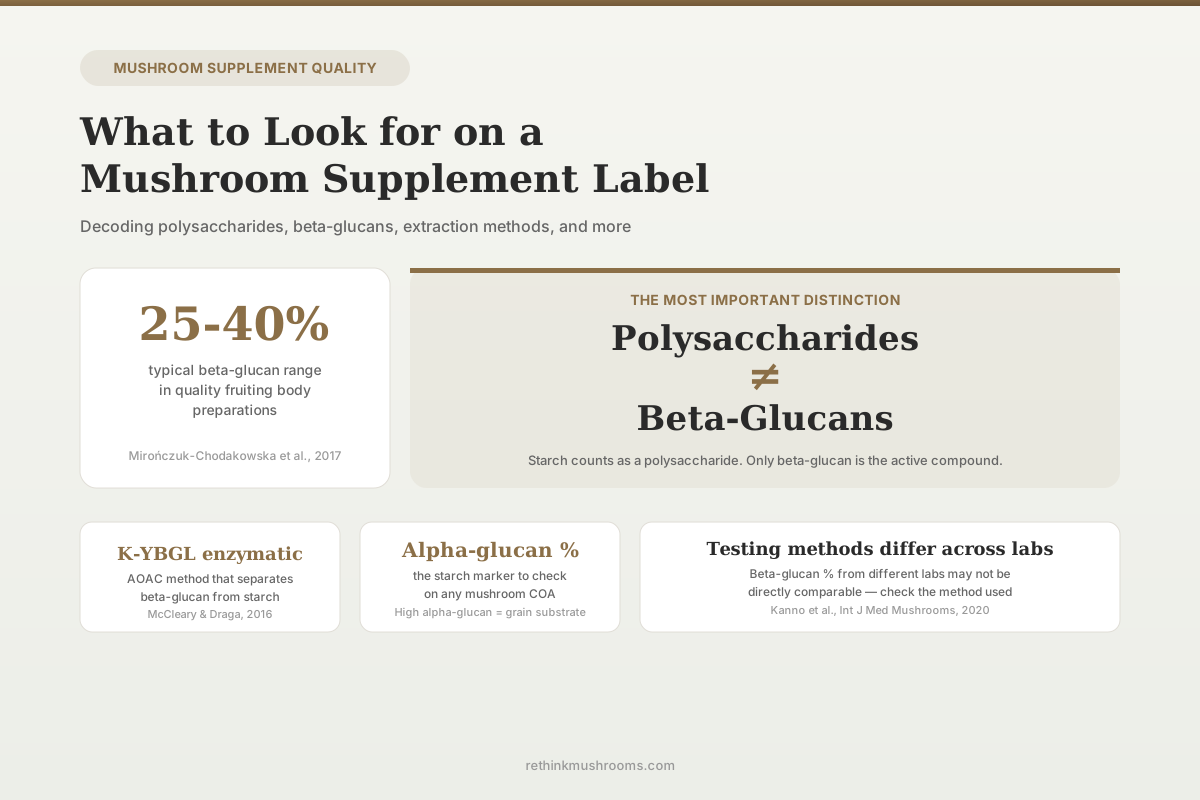
polysaccharides does not equal beta-glucan; starch is also a polysaccharide
68.4%
of those same reishi products contained starch-like polysaccharides, which authentic fruiting body does not
method
the assay used changes the beta-glucan number, so percentages from different labs are not comparable
Wu et al., Scientific Reports, 2017
 View as image ↗
Mushroom supplement labels contain a cluster of terms that appear to communicate quality but, without context, communicate almost nothing. "Polysaccharides" looks informative. "Full spectrum" sounds comprehensive. "10:1 extract" implies concentration. Each of these terms has a specific technical meaning, and in several cases that meaning is narrower than what a shopper would reasonably assume. Understanding what to look for on a mushroom supplement label means understanding what these terms actually measure, what they leave out, and what the analytical literature says when products are tested against their own claims. For the complete framework for choosing a mushroom supplement, see How to Choose a Mushroom Supplement: The Science-Based Buyer's Guide.
Key Takeaways
- When 19 batches of US reishi supplements were chemically tested against their own labels, only 5 (26.3%) matched, and starch-like polysaccharides — which authentic reishi fruiting body does not contain — turned up in 13 of 19 (Wu et al., 2017).
- "Polysaccharides" is a category that includes both beta-glucan and alpha-glucan (starch and glycogen). The standard mushroom assay exists precisely to separate them: it measures total glucan, measures alpha-glucan, and reports beta-glucan as the difference (McCleary & Draga, 2016).
- Even "beta-glucan" is not the whole story. In fruiting bodies where both were measured, the 1,3/1,6-branched fraction most associated with fungal immune activity accounted for roughly 40–54% of total beta-glucan at the top of the range (Mirończuk-Chodakowska et al., 2017).
- Measured total beta-glucan in dried fruiting bodies spans roughly 13.5–40.9 g/100 g dry mass across species, which is the realistic band for judging whether a label number is plausible (Mirończuk-Chodakowska et al., 2017).
- Beta-glucan percentages from different laboratories are not directly comparable. Two accepted methods run on the same species panel disagreed on both magnitude and which species ranked highest (Mirończuk-Chodakowska & Witkowska, 2020), and hydrolysis chemistry alone shifts the result (McCleary & Draga, 2016).
- "Fruiting body versus mycelium" is a real distinction but not a uniform hierarchy: metabolite concentrations vary widely with substrate, strain, and developmental stage (Berger et al., 2022), and some compounds, such as the erinacines in lion's mane, are associated with mycelium rather than fruiting bodies (Li et al., 2018).
Start With the Uncomfortable Baseline: Labels Are Frequently Wrong
Before parsing individual terms, it is worth knowing how often the label describes the contents at all.
Wu and colleagues, working with the United States Pharmacopeial Convention, collected 19 batches of commercial Ganoderma lucidum (reishi) dietary supplements sold in the US and analysed them for the compounds those products claimed to deliver.[1] They used chromatographic fingerprinting for triterpenes and saccharide mapping for polysaccharides. The measured ingredients were in accordance with the printed label in 5 of 19 products — 26.3%.
The breakdown is more instructive than the headline. Triterpenes characteristic of G. lucidum were detectable in 8 of 19 products (42.1%). The branched 1,3-β-D-glucan that carries most of reishi's immunological research was detected in 5 of 19 (26.3%). And starch-like polysaccharides were detected in 13 of 19 (68.4%) before enzymatic digestion.
That last number is the one that reframes the whole label-reading exercise. As the authors note, starch-like polysaccharides are absent from G. lucidum fruiting body and are frequently employed as excipients or neutral fillers in dietary supplements. So in roughly two-thirds of the products tested, something was present that contributes to a "total polysaccharide" figure while contributing nothing that the mushroom research is about.
This is a single species in a single market at a single point in time, and 19 batches is a small sample. It is not a claim that two-thirds of all mushroom supplements are adulterated. But it establishes the problem the rest of this article addresses: the words on the label and the molecules in the capsule are separate questions, and only one of them is printed on the bottle.
The Most Important Distinction: "Beta-Glucan" vs. "Polysaccharides"
The most consequential distinction on any mushroom supplement label is between "polysaccharides" and "beta-glucan." These terms look similar and measure different things.
Polysaccharides are long sugar chains. All beta-glucans are polysaccharides, but not all polysaccharides are beta-glucans. Alpha-glucans are also polysaccharides, and alpha-glucans include starch and glycogen. Starch is what grain substrates are made of, and — per the finding above — it is also used directly as a filler. A product containing meaningful amounts of either will show a higher "total polysaccharide" number without a corresponding increase in the fraction the research concerns.
McCleary and Draga developed and evaluated the reference procedure for measuring beta-glucan in mushroom and mycelial products.[2] The logic is subtractive. Total glucan is measured after controlled acid hydrolysis, with the released glucose quantified using a glucose oxidase/peroxidase reagent. Alpha-glucan — starch and glycogen — is measured separately, by hydrolysing it to glucose with glucoamylase and quantifying that glucose the same way. Beta-glucan is then reported as the difference between the two.
The existence of that second measurement is the tell. The method includes a dedicated alpha-glucan step because alpha-glucan is expected to be present in this product category and would otherwise inflate the result. A number that has not been through that separation has not excluded starch.
So when a product lists only "polysaccharides" with no separate beta-glucan figure, there is no way to know how much of that content is fungal beta-glucan and how much is starch. The polysaccharide number alone does not answer the question a buyer is asking.
The Third Layer: Not All Beta-Glucan Is the Bioactive Fraction
Getting to a beta-glucan percentage is a genuine improvement over a polysaccharide percentage. It is still not the end of the chain.
Mirończuk-Chodakowska and colleagues measured both total beta-glucan and the 1,3-1,6-β-D-glucan fraction in the same fruiting-body samples across nine species.[3] The 1,3/1,6-branched structure is the configuration most associated with the immunomodulatory activity that mushroom beta-glucans are studied for. In the four species for which the paper reported an explicit ratio — the best performers in the panel — that branched fraction accounted for between 40.6% and 54% of total beta-glucan.
In other words, even in whole fruiting bodies with no grain substrate involved, roughly half of a "total beta-glucan" figure is something other than the branched structure the health claims rest on.
The Number Behind the Number
How Much of “Total Beta-Glucan” Is Actually 1,3/1,6?
These are whole fruiting bodies — no grain, no fermentation, no substrate to blame. Mironczuk-Chodakowska and colleagues measured total beta-glucan and the 1,3/1,6-branched fungal fraction in the same samples. Even at the top of the range, roughly half the “total beta-glucan” is something other than the branched structure that fungal immune activity is attributed to.
Gyroporus cyanescensCornflower bolete
54.0%
Highest 1,3/1,6 share measured
Suillus granulatusWeeping bolete
49.8%
Roughly half the total is branched fungal glucan
Auricularia auricula-judaeWood ear
47.9%
Highest absolute 1,3/1,6 content: 16.8 g/100 g d.m.
Suillus variegatusVelvet bolete
40.6%
Nearly 60% of the label number is not 1,3/1,6
Why this reframes the debate: the mycelium-on-grain argument treats an inflated beta-glucan number as a mycelium problem. It is not. A single “total beta-glucan” figure is a weak quality signal in any form, because it does not tell you how much of that number is the branched fungal structure. Substrate carryover makes the gap worse. It is not the origin of the gap.
Source: Mironczuk-Chodakowska et al., 2017 [3] — quantitative evaluation of total and 1,3-1,6-beta-D-glucan in wild-growing and cultivated edible mushrooms. Percentages are the four species for which the paper reported an explicit 1,3/1,6-to-total ratio; these were the highest-scoring entries in the panel.
This matters for label reading in a specific way: it means a high beta-glucan percentage is a necessary signal, not a sufficient one, and that the gap between "beta-glucan" and "the active fraction" is a property of mushrooms themselves rather than an artefact of bad manufacturing. Grain substrate makes the gap worse. It does not create it.
Here is how the common label terms map onto this three-layer picture.
| Label Term | What It Means | Signal |
|---|---|---|
| Beta-glucan % | The fungal glucan fraction, measured separately from starch | Positive: this is the number to look for |
| Polysaccharides % (no beta-glucan listed) | Category total; includes starch and added fillers | Insufficient: request a beta-glucan breakdown |
| Alpha-glucan % (on a COA) | Starch and glycogen content | Useful context: a high figure points to grain or filler |
| 1,3/1,6-beta-glucan | The branched fraction most tied to immune research | Strongest signal, and rarely reported |
| Mycelium biomass / myceliated oats or rice | Mycelium grown on grain, dried and milled with the substrate | Caution: substrate travels into the powder |
| Hot water extract | Water-phase extraction; targets polysaccharides | Positive for beta-glucan-led species |
| Dual extract | Water plus ethanol extraction, run sequentially | Positive for species where both compound classes matter |
| Full spectrum | Usually a blend of parts: mycelium, fruiting body, spores | Variable: describes parts included, not compound content |
| 10:1 extract | Mass concentration ratio only | Insufficient alone: says nothing about what was concentrated |
| Fruiting body | The reproductive structure rather than mycelium | Generally positive, with species-specific exceptions |
What Counts as a Plausible Beta-Glucan Number
Knowing beta-glucan percentage matters is the first step. Knowing whether a claimed number is realistic is the second.
Across the nine-species panel above, mean total beta-glucan ranged from 13.5 g/100 g dry mass in Agaricus bisporus (portobello) to 40.9 g/100 g dry mass in Tricholomopsis rutilans.[3] The 1,3-1,6 fraction within those same samples ranged from 3.9 to 16.8 g/100 g dry mass. A broader follow-up covering 18 wild species and 3 commercial ones put the highest value measured by the Megazyme method at 34.97 g/100 g dry mass.[4]
So the realistic band for total beta-glucan in dried fruiting-body material is broadly the teens to low forties as a percentage of dry mass, depending on species and method. A supplement claiming 60% or 70% beta-glucan sits outside anything in these datasets, and the burden shifts to the manufacturer to explain the analytical method that produced it.
Two cautions apply to using this as a benchmark.
The first is that these panels are dominated by wild and cultivated culinary species, not the four or five species that dominate the supplement aisle. Published, directly comparable per-species figures for reishi, lion's mane, cordyceps and chaga measured on one panel by one method are not what these papers provide. Anyone quoting a tidy species-by-species table of supplement-species beta-glucan percentages is combining sources measured differently, and the resulting numbers should be treated as approximate.
The second is that a species does not have a single fixed value. Cortina-Escribano and colleagues cultivated Ganoderma lucidum across several wood-based substrates and multiple strains and found that beta-glucan content in the fruiting bodies depended on both.[5] The highest beta-glucan content came from a particular strain and substrate pairing, not from the species as such. A reishi beta-glucan number is a statement about one production run, not about reishi.
For more on how beta-glucan testing works and what the numbers mean, see Beta-Glucan Percentages on Labels: What the Numbers Mean.
Fruiting Body vs. Mycelium: A Real Distinction, Often Overstated
The source term on a label matters, but the popular framing — fruiting body good, mycelium bad — is more absolute than the comparative data supports.
Berger and colleagues reviewed the occurrence of proteins, polysaccharides, smaller metabolites, metal ions and toxins in mycelia versus fruiting bodies across the three most widely produced edible species: Agaricus bisporus, Pleurotus ostreatus and Lentinus edodes, plus some close relatives.[6] Their central observation is about variance rather than a clean ranking: substrate chemistry, strain, developmental stage and ecological interactions produce wide variation in the concentrations of some metabolites in both mycelial cells and fruiting bodies. Their conclusion is, if anything, favourable to mycelium as a food ingredient — they argue that fungal biomass produced under food-grade conditions could serve as a nutritious meat substitute and protein source.
That is a narrower claim than "fruiting bodies contain more of everything," and it is worth stating plainly because the stronger version is often attributed to this paper.
There is also a documented case running the other way. The erinacines — the diterpenoid compounds in lion's mane associated with nerve growth factor induction — are characteristically associated with mycelium rather than fruiting bodies, and the preclinical neurological work on lion's mane has largely been conducted using erinacine-enriched Hericium erinaceus mycelium.[7] Of those compounds, only erinacine A has confirmed pharmacological action in the central nervous system in rats, and the work remains preclinical. It is worth noting that this review was authored in part by researchers at a company that produces erinacine-enriched mycelium, which is a relevant interest to weigh even though the compound-localisation point is not in dispute.
So the honest version is: for beta-glucan-led products, fruiting body is the more defensible default. For erinacine-led lion's mane claims specifically, mycelium is what the research used. "Fruiting body" is not a universal quality guarantee, and "mycelium" is not automatically a red flag.
What does warrant caution is the narrower case of mycelium grown on grain and milled together with its substrate — the "mycelium biomass" or "myceliated oats/rice" labels. The issue there is not mycelium; it is that the grain goes into the powder, and grain is starch. That is the same starch the assay in the previous section has to subtract, and it is consistent with the starch-like polysaccharides found in most of the tested reishi products.[1]
"Full spectrum" typically signals a blend of fruiting body, mycelium, spores and sometimes fermented substrate. Without compound data it describes which parts were included, not how much active material resulted.
Extraction Method: What Water and Alcohol Each Capture
Mushroom cell walls are built largely of chitin and glucans, and much of the beta-glucan is structural rather than free. Extraction is the step intended to bring those polysaccharides into a soluble, concentrated form; milling a dried mushroom into powder does not do that.
Hot water extraction targets the water-soluble fraction, which is where polysaccharides including beta-glucans report. Ethanol extraction targets a different class: fat-soluble molecules including triterpenes — the bitter compounds in reishi — and sterols. Water does not efficiently capture those, which is the reason dual extraction exists.
The comparative work supports the split rather than a simple hierarchy. Kała and colleagues cultivated Hericium erinaceus on different plant-based substrates and then compared extraction approaches on the resulting fruiting bodies.[8] Dual extraction using moderate ethanol concentrations was the most effective approach for isolating several key bioactives, specifically ergothioneine, lovastatin, L-phenylalanine and ergosterol. But the same study found that whole fruiting bodies contained higher levels of bioelements than the extracts did — extraction concentrates some things by leaving others behind. The authors' overall conclusion is that substrate choice and extraction method both critically influence the final bioactive profile, and that fruiting bodies grown on beech sawdust carried more of most bioactive compounds than those grown on hemp straw.
A separate comparison across extraction methodologies in Laetiporus sulphureus found that aqueous and aqueous-methanolic extracts carried higher total phenolic content and better antioxidant capacity than the ethanolic extract, again indicating that solvent choice determines which compound classes come across rather than producing a uniformly "stronger" product.[9]
The practical reading: hot water extraction is the relevant standard for species whose evidence base is polysaccharide-led, such as turkey tail, shiitake and maitake. Dual extraction is the appropriate choice where a fat-soluble class also matters, principally reishi and chaga. Raw, unextracted powder is not inherently worthless — it is closer to a food than a standardised preparation — but it provides less certainty that the polysaccharide content on the label is in a form the product actually delivers. For a detailed breakdown of extraction methods and their effects on compound yield, see Hot Water Extract vs. Dual Extract vs. Raw Powder: Which Delivers More Beta-Glucans?.
The 10:1 Extract Ratio: A Manufacturing Description, Not a Quality Grade
"10:1 extract" reads like a quality claim. It is a yield statement: ten kilograms of raw material were processed down to one kilogram of finished extract.
The number has two limitations that together make it non-comparative.
First, a ratio does not specify what was concentrated. Applying a 10:1 process to low-beta-glucan starting material produces concentrated low-beta-glucan material. Concentration multiplies whatever was there; it does not upgrade it.
Second, the ratio does not survive contact with different starting materials. A smaller ratio applied to better input can finish higher than a larger ratio applied to worse input.
The Ratio Is Not a Ranking
A Bigger Extract Ratio Can Finish Lower
An extract ratio tells you how much raw mass went in per unit of finished extract. It says nothing about what was in that raw mass. Concentrating weak material produces concentrated weak material.
Illustrative arithmetic, not measured products. Starting values sit inside the beta-glucan range actually reported for fruiting bodies [3][4]; the math assumes perfect retention, which is more generous than any real extraction.
10:1Low-beta-glucan starting material
e.g. a mycelium-on-grain biomass diluted by starch
5:1Mid-range fruiting body
Inside the measured fruiting-body range
4:1High-beta-glucan fruiting body
Near the top of the measured range
Read the ordering: the 10:1 product has the largest ratio on the label and the lowest theoretical finish of the three. The 4:1 product has the smallest ratio and the highest. Nothing about the ratio predicts the outcome, because the ratio never encodes the starting compound content. A ratio becomes informative only when it is printed next to a measured beta-glucan percentage and the method used to measure it.
Input ranges anchored to Mironczuk-Chodakowska et al., 2017 [3] (total beta-glucan 13.5–40.9 g/100 g DM) and Mironczuk-Chodakowska & Witkowska, 2020 [4] (highest Megazyme value 34.97 g/100 g DM). The concentration arithmetic is illustrative and is not a finding from either paper.
The 10:1 claim is not false, and it is not meaningless — it does describe a real processing step. It is simply not rankable across products. It becomes informative only when printed alongside a measured beta-glucan percentage and the method that produced it. For the full explanation of what extract ratios mean and don't mean, see 10:1 Extract Ratios: What They Mean (and What They Don't).
Why Two Beta-Glucan Percentages Often Can't Be Compared
Suppose two products both report a beta-glucan percentage. Comparing them still requires one more piece of information: the method.
Mirończuk-Chodakowska and Witkowska determined beta-glucan content across 18 wild and 3 commercial mushroom species using two different analytical procedures — the Megazyme method and the Congo red method — on the same material.[4] The two did not merely differ in magnitude. They disagreed about which species ranked highest: Tricholoma portentosum topped the Megazyme results at 34.97 g/100 g dry mass, while Lactarius deliciosus topped the Congo red results at 17.11 g/100 g. Nor was the discrepancy a fixed offset that could be corrected: Congo red values ran generally higher than Megazyme values in wild mushrooms, while Megazyme values for wild mushrooms were comparable to commercial ones.
The chemistry inside a single method family shifts results too. McCleary and Draga compared hydrolysis approaches and found that assays based entirely on enzymatic hydrolysis generally yielded much lower values than the sulphuric acid procedure, and that for certain samples — Ganoderma lucidum and Poria cocos are named specifically — the sulphuric acid procedure returned significantly higher values.[2]
Why Two Labels Can’t Be Compared
The Beta-Glucan Number Depends on the Assay
A beta-glucan percentage is a property of the mushroom and the method used to measure it. Two accepted assays run across the same panel of mushrooms did not agree on the magnitude — or even on which species came out on top.
Same 21-species panel, two methods, two different “highest”
Megazyme method
34.97 g/100 g DMTop-ranked species: Tricholoma portentosum (Sooty head)Enzymatic / acid hydrolysis, glucose measured by GOPOD
Congo red method
17.11 g/100 g DMTop-ranked species: Lactarius deliciosus (Saffron milk cap)Dye-binding assay, different analytical procedure entirely
The two methods did not disagree by a fixed, correctable offset. Congo red values ran generally higher than Megazyme values in wild mushrooms, while Megazyme values for wild mushrooms were comparable to commercial ones — so the size and direction of the gap shift by species.
And the chemistry inside one method changes it again
H₂SO₄ hydrolysis
The procedure McCleary & Draga selected as the best option. For Ganoderma lucidum and Poria cocos specifically, it returned significantly higher values than the alternative acid.
Fully enzymatic hydrolysis
Yielded "much lower values" in general than the H₂SO₄ procedure — on the same class of material.
Trifluoroacetic acid, 120 °C
Much less effective than either of the other two acids evaluated.
What to do with this: a beta-glucan percentage is only interpretable alongside the method that produced it. A Certificate of Analysis that states a number but not the analytical method has given you a figure you cannot compare against any other product — and comparing two brands’ percentages without checking both methods is not a valid comparison.
Sources: Mironczuk-Chodakowska & Witkowska, 2020 [4] — Megazyme vs. Congo red across 18 wild and 3 commercial mushroom species. McCleary & Draga, 2016 [2] — hydrolysis chemistry comparison within the mushroom and mycelial beta-glucan procedure.
Assay specificity is a related concern. Kanno and colleagues developed a recombinant beta-glucan recognition protein assay and characterised what it does and does not bind: it did not react with barley glucan, dextran, mannan, pustulan or xylan, and was most reactive toward lentinan.[10] The reason that specificity profile matters commercially is that cereal glucans are exactly what a grain-substrate product carries. A method that cannot distinguish cereal glucan from fungal glucan will read the substrate as product.
Structural profiling reinforces how little a single percentage conveys. López-García and colleagues used MALDI-TOF mass spectrometry to compare polysaccharide profiles across five commercial mushroom supplements from different species and found the profiles qualitatively similar in showing the β-(1→3)-glucan repeating unit, while differing in molecular weight — highest for the maitake and cordyceps preparations.[11] Two products can carry the same class of molecule at different sizes, and a percentage does not capture that.
The practical rule: a Certificate of Analysis should state the analytical method, not just the result. A number without a method is not comparable to any other number. For guidance on finding and reading a Certificate of Analysis, see Independent Lab Test Results: How to Find and Read Them.
What This Adds Up To
Reading a mushroom supplement label well is mostly a matter of knowing which questions the label cannot answer, and asking for the document that can.
In descending order of informativeness: a 1,3/1,6-beta-glucan figure is the strongest signal and is rarely published. A beta-glucan percentage with a stated method and an accompanying alpha-glucan figure is the realistic target. A beta-glucan percentage without a method is weak. A total polysaccharide percentage on its own answers almost nothing. An extract ratio, a "full spectrum" claim, or a proprietary blend answers nothing at all about compound content.
Species and part should be stated in plain terms — Latin binomial, and fruiting body or mycelium — because a label that will not say what is in it has already answered the question. And given that only about a quarter of a tested US reishi sample matched its own label,[1] third-party testing from an accredited laboratory is doing more work than any phrase printed on the bottle.
This article describes what analytical terms mean and what the published testing literature reports. It is not medical advice, and none of it is a recommendation to take, avoid, or substitute any supplement. Mushroom supplements can interact with medications and are not appropriate for everyone — if you are pregnant or breastfeeding, taking prescription medication, managing an autoimmune or bleeding condition, or preparing for surgery, talk to a qualified healthcare professional before starting one.
The Bottom Line
The most important number on a mushroom supplement label is beta-glucan, measured separately from alpha-glucan (starch) by a stated analytical method — not total polysaccharides, a category that includes starch and added fillers. Beneath that sits a third layer most labels never reach: the 1,3/1,6-branched fraction most associated with immune activity accounted for only about 40–54% of total beta-glucan even in whole fruiting bodies. Measured total beta-glucan in dried fruiting bodies runs roughly 13.5–40.9 g/100 g dry mass depending on species, strain and substrate, which is the band to judge plausibility against. Percentages from different labs are not directly comparable: two accepted methods run on the same species panel disagreed on both magnitude and ranking. "Fruiting body versus mycelium" is a real but overstated distinction — metabolite content varies widely with substrate and strain, and lion's mane erinacines are associated with mycelium. Extract ratios such as 10:1 describe processing yield, not compound content. The baseline problem is substantial: in one analysis of 19 US reishi supplements, only 26.3% matched their labels and 68.4% contained starch-like polysaccharides absent from authentic fruiting body.
Frequently Asked Questions
Sources & References
- 1RTHM-00499·Wu, Ding-Tao et al. (2017). “Evaluation on quality consistency of Ganoderma lucidum dietary supplements collected in the United States..” Scientific reports.Study breakdown →PubMed →↩
- 2RTHM-00438·McCleary, Barry V et al. (2016). “Measurement of β-Glucan in Mushrooms and Mycelial Products..” Journal of AOAC International.Study breakdown →PubMed →↩
- 3RTHM-00484·Mirończuk-Chodakowska, Iwona et al. (2017). “Quantitative evaluation of 1,3,1,6 β-D-glucan contents in wild-growing species of edible Polish mushrooms..” Roczniki Panstwowego Zakladu Higieny.Study breakdown →PubMed →↩
- 4RTHM-00637·Mirończuk-Chodakowska, Iwona et al. (2020). “Evaluation of Polish wild Mushrooms as Beta-Glucan Sources..” International journal of environmental research and public health.Study breakdown →PubMed →↩
- 5RTHM-01183·Cortina-Escribano, Marta et al. (2020). “Effect of Strain, Wood Substrate and Cold Treatment on the Yield and β-Glucan Content of Ganoderma lucidum Fruiting Bodies..” Molecules (Basel.Study breakdown →PubMed →↩
- 6RTHM-00743·Berger, Ralf G et al. (2022). “Mycelium vs. Fruiting Bodies of Edible Fungi-A Comparison of Metabolites..” Microorganisms.Study breakdown →PubMed →↩
- 7RTHM-00973·Li, I-Chen et al. (2018). “Neurohealth Properties of Hericium erinaceus Mycelia Enriched with Erinacines..” Behavioural neurology.Study breakdown →PubMed →↩
- 8RTHM-02103·Kała, Katarzyna et al. (2025). “Influence of Plant-Based Substrate Composition and Extraction Method on Accumulation of Bioactive Compounds in Hericium erinaceus (Bull.) Pers. Fruiting Bodies..” Molecules (Basel.Study breakdown →PubMed →↩
- 9RTHM-00346·Petrović, Jovana et al. (2014). “Different extraction methodologies and their influence on the bioactivity of the wild edible mushroom Laetiporus sulphureus (Bull.) Murrill..” Food & function.Study breakdown →PubMed →↩
- 10RTHM-00625·Kanno, Takashi et al. (2020). “Quantification of β-Glucan from Culinary-Medicinal Mushrooms Using Novel Artificial β-Glucan Recognition Protein..” International journal of medicinal mushrooms.Study breakdown →PubMed →↩
- 11RTHM-00437·López-García, Marta et al. (2016). “MALDI-TOF to compare polysaccharide profiles from commercial health supplements of different mushroom species..” Food chemistry.Study breakdown →PubMed →↩