Mushroom Extraction Methods & Supplement Forms
20–50% beta-glucans in hot water extract
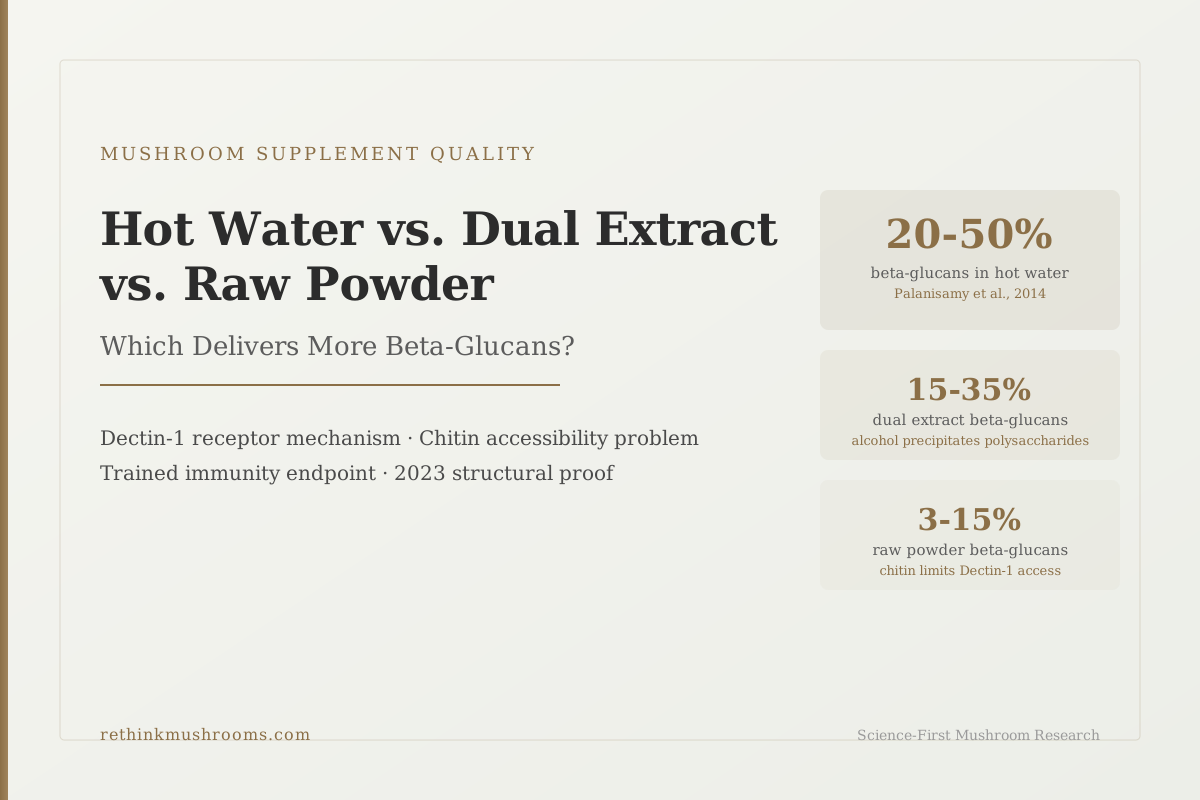
Hot water extraction yields 20-50% beta-glucan content in quality products, compared to 15-35% in dual extracts and 3-15% in raw mushroom powder, because of how each method interacts with chitin cell walls.
Palanisamy et al., Biotechnology Progress, 2014
Dectin-1 mechanism
beta-glucan's immune activity depends on structural exposure, not just concentration
Alcohol trade-off
ethanol in dual extracts precipitates some beta-glucan polysaccharides, reducing content
Trained immunity
quality beta-glucan reprograms macrophages for sustained enhanced immune responses
Palanisamy et al., Biotechnology Progress, 2014
 View as image ↗
For beta-glucan delivery, hot water extract wins. This answer contradicts how most mushroom supplement marketing frames the hierarchy, which places dual extract at the top and raw powder at the bottom without explaining the underlying chemistry. The ranking for beta-glucans specifically is: hot water extract first, dual extract second, raw powder third.
The reason matters more than the ranking. Hot water breaks down the tough cell wall material (chitin) that encases beta-glucans in raw mushrooms, concentrating and freeing them. Ethanol, the second solvent in a dual extract, captures fat-soluble compounds like triterpenes but causes some of the polysaccharide beta-glucans to precipitate out of solution, reducing their concentration in the final product. Raw powder leaves chitin largely intact, and intact chitin physically limits how accessible the beta-glucans are to the immune receptors that need to detect them.
That last point is where molecular immunology becomes directly relevant to purchasing decisions. A 2023 study in the Biophysical Journal showed that Dectin-1, the immune receptor that detects beta-glucans, requires beta-glucans to be physically exposed and structurally intact to trigger a strong response. How you process a mushroom determines whether the beta-glucans end up in a form that receptor can work with.
This article explains the chemistry and the receptor biology. For how to evaluate these claims on a supplement label, see How to Choose a Mushroom Supplement: The Science-Based Buyer's Guide.
Key Takeaways
- Hot water extraction breaks down chitin cell walls and concentrates beta-glucans, typically yielding 20-50% beta-glucan content in quality fruiting body extracts (Palanisamy et al., 2014)
- Dual extraction adds an ethanol step that captures fat-soluble triterpenes but causes some beta-glucan polysaccharides to precipitate, reducing beta-glucan content to roughly 15-35% compared to hot water extraction alone (Petrović et al., 2014)
- Raw mushroom powder retains chitin, the structural material that encases beta-glucans, limiting how accessible those beta-glucans are to the immune receptors that need to detect them (Anaya et al., 2023)
- Dectin-1, the primary immune receptor for beta-glucans, requires beta-glucans to be physically exposed at the surface of a particle to trigger strong downstream immune signaling (Anaya et al., 2023; Lee and Kim, 2014)
- Beta-glucan exposure to Dectin-1 initiates trained immunity: epigenetic reprogramming of macrophages that produces sustained, faster immune responses for weeks to months after supplementation (Stothers et al., 2021; Mata-Martínez et al., 2022)
- A 2024 study confirmed that whole Agaricus bisporus mushroom products still drive trained immunity in human monocytes, meaning well-made whole powder products retain functional beta-glucan activity, though at lower concentration than extracts
Why Beta-Glucans Are What Your Immune System Is Actually Looking For
Mushrooms contain dozens of potentially bioactive compounds. Triterpenes, ergothioneine, polyphenols, and nerve growth factors all have research behind them. But when it comes to the immune effects that form the backbone of most mushroom supplement claims, the primary active class is beta-glucans.
Beta-glucans are a type of structural fiber found in mushroom cell walls. They are built from glucose molecules linked together in a specific pattern, with a backbone of beta-1,3 linkages and side branches at the beta-1,6 positions. This precise molecular architecture is what makes beta-glucans biologically distinctive. It is recognized by the mammalian innate immune system as a signature of fungal presence.
Goodridge, Wolf and Underhill (2009) published the foundational review on beta-glucan recognition by innate immunity, explaining that the primary recognition receptor is Dectin-1, a receptor expressed on macrophages, dendritic cells, and neutrophils.[1] A secondary receptor, complement receptor 3 (CR3), also contributes. Critically, the structural form of the beta-glucan, specifically the beta-1,3-D-glucan backbone and the degree of branching, determines how strongly these receptors bind and respond. Not all beta-glucans are equal in potency.
Batbayar, Lee and Kim (2012) extended this mechanistic picture, showing that Dectin-1 binding by fungal beta-glucans triggers three downstream signaling cascades: NF-κB (the master switch for inflammatory gene expression), NFAT, and MAPK (a cascade that regulates how immune cells respond to challenges).[2] These cascades converge to produce the enhanced immune readiness that beta-glucan research centers on. The direct implication: if the beta-glucan in a supplement cannot reach Dectin-1 in an intact, exposed form, the downstream signaling does not occur.
The Form Problem: Chitin Locks Beta-Glucans Away from the Immune Receptor
Beta-glucans do not float freely inside a fresh mushroom. They are structural components, woven into cell walls alongside chitin (the same tough biopolymer that forms insect exoskeletons and crustacean shells) and other polysaccharides. In a raw, unprocessed mushroom, beta-glucans are embedded within this rigid matrix.
Lee and Kim (2014) reviewed Dectin-1 signaling and established an important constraint: beta-glucan recognition by Dectin-1 requires the beta-glucan to be exposed and accessible at the outer surface of a particle.[3] Beta-glucans buried inside a chitin-dominated particle cannot be accessed effectively.
Anaya et al. (2023) provided the most structurally precise evidence for this constraint, published in the Biophysical Journal.[8] Using biophysical imaging, they showed that Dectin-1 forms clusters on the immune cell surface when beta-glucans are properly exposed, and that this clustering is what amplifies the downstream signaling response. Beta-glucan particles that were structurally degraded or encased in other materials produced weak Dectin-1 clustering and weak downstream signaling. The quality of the immune response scales with the exposure and structural integrity of the beta-glucan.
This is the molecular rationale for why extraction method determines immunological potency. Extraction is how you either break down the chitin matrix and free the beta-glucans, or leave them trapped inside it.
For how extraction quality connects to overall supplement quality, see How Extraction Methods Determine Supplement Quality.
Hot Water Extraction: The Method That Frees Beta-Glucans From Cell Walls
Hot water extraction uses water heated under pressure or at high temperature to break apart the chitin-polysaccharide matrix of mushroom cell walls. Water dissolves the water-soluble compounds including beta-glucans, while insoluble chitin and other structural components are removed by filtration. The resulting liquid is concentrated and dried into a powder.
Palanisamy et al. (2014) specifically studied pressurized hot water extraction of beta-glucan fractions from edible mushrooms.[4] The technique yielded beta-glucan-enriched fractions that retained functional capacity, measured not just by concentration but by a functional assay. This confirmed that extraction technique determines both the yield and the functional activity of beta-glucans.
Petrović et al. (2014) directly compared hot water extraction with other solvent-based methods on the same mushroom species, measuring the resulting bioactive compound profiles.[5] Hot water, methanol, and hexane extracts each captured different compound families in different proportions, directly demonstrating that the extraction solvent is the primary variable determining what ends up in the final product.
Hot water extraction optimizes for water-soluble compounds, and the most immunologically important mushroom bioactives, primarily beta-glucans, are water-soluble. A quality hot water extract from fruiting body material typically achieves 20-50% beta-glucan content by dry weight, depending on species and production. This is the form that most directly fulfills the Dectin-1 exposure requirement: extracted beta-glucans are freed from chitin and structurally intact.
Dual Extraction: More Compounds, But Alcohol Reduces Beta-Glucan Content
Dual extraction uses both hot water and ethanol in two sequential steps, then combines the extracts. The rationale is sound: some mushroom bioactives are water-soluble (beta-glucans, most polysaccharides) and some are fat-soluble (triterpenes like ganoderic acids in reishi, betulinic acid in chaga). A single hot water extraction misses the fat-soluble fraction. Dual extraction captures both.
The trade-off is chemistry. When ethanol is added to a solution containing polysaccharides, polysaccharides precipitate. This is a predictable consequence of alcohol's effect on water-soluble polymers. In the context of dual extraction, the ethanol step that captures triterpenes partially precipitates the beta-glucan polysaccharides that the hot water step freed. The combined extract therefore contains more total compound diversity than a hot water extract alone, but fewer beta-glucans specifically.
Petrović et al. (2014) provided direct evidence of this solvent-compound specificity, showing that each extraction method captures distinct compound profiles that do not fully overlap.[5]
The species-specific implication matters here. For reishi and chaga, whose clinically studied fat-soluble compounds justify the beta-glucan trade-off, dual extraction adds real value. For lion's mane, turkey tail, cordyceps, shiitake, and maitake, whose primary studied bioactives are water-soluble, dual extraction adds processing cost without capturing additional compounds that have documented clinical relevance.
For a full cost-benefit analysis of dual extraction by species, see Dual-Extract Mushroom Products: Why They Cost More.
Raw Powder: The Chitin Matrix That Limits Accessibility
Raw mushroom powder is the simplest form: dried fruiting body or mycelium, ground into powder, encapsulated or sold in bulk. No extraction step. No solvent. The full mushroom material is delivered intact.
The advantage of raw powder is completeness. The entire fiber matrix is present, including prebiotic fibers and cell wall components that extraction removes. This preserves a full-spectrum nutritional profile.
The limitation for beta-glucan delivery is the chitin problem. Beta-glucans in raw powder are still embedded in the cell wall matrix alongside chitin. The digestive tract has some capacity to partially degrade chitin, but the extent to which this liberates beta-glucans for contact with Dectin-1 receptors in gut-associated immune tissue is variable and less controlled than extraction.
Anaya et al. (2023) showed that Dectin-1 signaling strength depends on beta-glucan surface exposure at the particle level.[8] Raw powder particles present beta-glucans embedded in chitin rather than exposed at the surface. This structurally limits the Dectin-1 activation signal. Typical beta-glucan content in raw whole mushroom powder ranges from 3-15% by dry weight, compared to 20-50% in quality hot water extracts.
Trained Immunity: Why the Form You Take Has Lasting Consequences
The stakes for beta-glucan delivery extend beyond an immediate immune response.
Stothers et al. (2021) demonstrated in the Journal of Immunology that beta-glucan exposure reprograms the epigenetics of macrophages, the long-lived immune cells that patrol tissues and coordinate immune responses.[6] Beta-glucan-trained macrophages showed enhanced responses to subsequent immune challenges, and these enhanced responses persisted beyond the supplementation period. This is trained immunity: a form of innate immune memory producing faster and stronger responses to future challenges after a prior activation event.
Mata-Martínez, Bergón-Gutiérrez and Del Fresno (2022) published an updated review of Dectin-1 signaling and trained immunity, confirming that epigenetic reprogramming occurs through histone modifications that alter gene accessibility in inflammatory and metabolic pathways.[7] The signaling cascade begins at Dectin-1 receptor clustering (which Anaya 2023 showed requires exposed beta-glucan) and propagates through the NF-κB and MAPK pathways.
The clinical significance of trained immunity is that it explains a lasting benefit from beta-glucan supplementation rather than requiring continuous dosing for effect. It also means the quality of the beta-glucan exposure event matters beyond potency. A form of beta-glucan that activates Dectin-1 weakly produces a weaker epigenetic signal and less durable trained immunity than one that activates it strongly. Extraction quality is not just a concentration question. It is a durability question.
The Whole Powder Counterpoint: Functional Activity Persists Even in Less Processed Forms
The analysis above could be read as: only hot water extracts are worth taking. A 2024 study complicates that interpretation in an instructive way.
Frontiers in Nutrition (2024) reported that beta-glucans from commercial Agaricus bisporus mushroom products, including whole mushroom preparations, drove trained immunity in human monocytes in vitro.[9] The whole mushroom products retained sufficient functional beta-glucan activity to activate the trained immunity pathway.
This finding is an important corrective to oversimplified hierarchy claims. Well-made whole mushroom products are not inactive. The difference between whole powder and hot water extract is concentration and accessibility, not presence versus absence of activity.
The practical implication: if the choice is between a high-quality whole mushroom product and a low-quality extract that claims standardization without transparent testing data, the whole mushroom product may deliver better functional beta-glucan activity. Extraction method matters, but so does source material quality, fruiting body versus mycelium on grain, and third-party testing transparency.
For how these quality factors connect to what most labels actually tell you, see The Mushroom Supplement Quality Crisis: Why Most Products Fail and How to Test for Beta-Glucans in Mushroom Supplements.
Practical Guide: Matching Form to Goal
For maximum beta-glucan delivery per dose: Hot water extract from fruiting body material. Look for a stated beta-glucan percentage from third-party Megazyme assay testing. The Megazyme method measures true beta-glucan content rather than total polysaccharides, which is how mycelium-on-grain products inflate their numbers by counting grain starch.
For reishi and chaga: Dual extract. The ganoderic acids in reishi and the betulinic acid and inotodiol in chaga are fat-soluble and require an ethanol extraction step. Accept the lower beta-glucan content as the cost of the broader compound spectrum from these particular species.
For lion's mane, turkey tail, shiitake, maitake, and cordyceps: Hot water extract is sufficient. These mushrooms' primary studied bioactives are water-soluble. Dual extraction adds processing cost without capturing additional clinically documented compounds for these species.
For culinary and whole-food incorporation: Well-made whole mushroom products, including fresh and dried mushrooms used in cooking, deliver functional beta-glucans at lower concentration. The 2024 Agaricus trained immunity study confirms this activity is real at commercial product doses.
The 10:1 and 20:1 extract ratio numbers on labels are meaningless without a stated beta-glucan percentage. Two products with identical extraction ratios can have vastly different beta-glucan content. For more on that specific issue, see 10:1 Extract Ratios: What They Mean (and What They Don't).
Also see Mushroom Extract vs. Whole Powder: Which Is More Effective? for the full trade-off analysis covering both forms.
The Bottom Line
For beta-glucan delivery, hot water extraction yields the highest content (20-50%) by concentrating water-soluble beta-glucans and freeing them from chitin cell walls. Dual extraction captures fat-soluble triterpenes but the ethanol step precipitates some polysaccharides, reducing beta-glucan content to roughly 15-35%. Raw powder delivers the least accessible beta-glucans (3-15%) because chitin encases them and limits contact with Dectin-1 immune receptors. Anaya et al. (2023) established that Dectin-1 signaling depends on physical beta-glucan surface exposure, providing the molecular basis for why extraction method determines immunological potency. Quality whole mushroom products retain functional beta-glucan activity, as confirmed in a 2024 trained immunity study with Agaricus bisporus.
Frequently Asked Questions
Sources & References
- 1. Source details for this reference are not yet available.
- 2. Source details for this reference are not yet available.
- 3. Source details for this reference are not yet available.
- 4. Source details for this reference are not yet available.
- 5. Source details for this reference are not yet available.
- 6. Source details for this reference are not yet available.
- 7. Source details for this reference are not yet available.
- 8. Source details for this reference are not yet available.
- 9. Source details for this reference are not yet available.