Bioactive Compounds in Mushrooms
K-YBGL
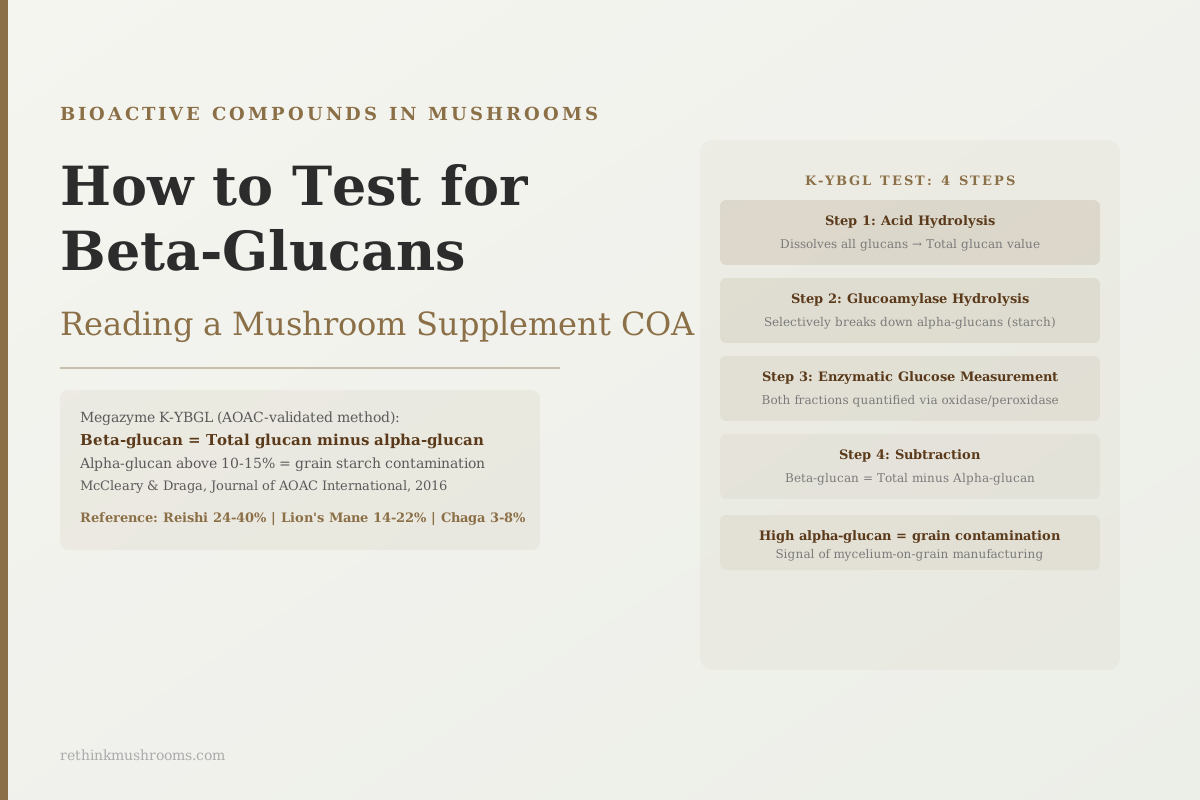
The Megazyme K-YBGL enzymatic test is the AOAC-validated gold standard for mushroom beta-glucan measurement. It simultaneously produces an alpha-glucan number that reveals grain starch contamination in mycelium-on-grain products.
McCleary & Draga, Journal of AOAC International, 2016
Total - alpha = beta
Beta-glucan is calculated by subtracting alpha-glucan (starch) from total glucan
High alpha = grain starch
Alpha-glucan above 10-15% on a COA signals substrate contamination
Reference ranges vary
Representative commercial-testing ranges differ by species: reishi roughly 24-40%, lion's mane 14-22%, chaga 3-8%
McCleary & Draga, Journal of AOAC International, 2016
 View as image ↗
When a mushroom supplement's Certificate of Analysis (COA) shows a high beta-glucan percentage, that number is only as meaningful as the method used to produce it. The gold standard test generates two numbers simultaneously: a beta-glucan percentage and an alpha-glucan percentage. The alpha-glucan number is the one most consumers ignore. It shouldn't be. A high alpha-glucan percentage on a COA is the clearest signal available that a supplement contains grain starch from a low-quality substrate, not active mushroom compounds.
Understanding what goes into that COA number, and how to evaluate it, is the subject of this article. For the broader context on what beta-glucans are, how they work in the body, and what concentrations are associated with the immunological effects studied in clinical trials, see What Are Beta-Glucans? The Most Important Compound in Medicinal Mushrooms.
Key Takeaways
- The accepted gold standard for mushroom beta-glucan measurement is the Megazyme K-YBGL enzymatic method (AOAC-validated), which calculates beta-glucan by subtracting alpha-glucan from total glucan[1]
- Alpha-glucan in the test output represents starch and glycogen; a high alpha-glucan value (above roughly 10-15%) on a COA indicates grain substrate contamination from mycelium-on-grain manufacturing
- Wild fruiting bodies carry measurable but species-variable beta-glucan: a 2017 analytical study of wild-collected edible mushrooms reported total beta-glucan from 13.5% to 40.9% by dry weight, with 1,3/1,6-beta-D-glucan from 3.9% to 16.8%[2]; representative commercial-testing ranges by species (reishi roughly 24-40%, oyster 25-35%, lion's mane 14-22%, chaga 3-8%) can be used as plausibility checks on label claims
- Different testing methods produce systematically different beta-glucan numbers for identical samples; a COA that doesn't specify its method (ideally K-YBGL or AOAC) is less interpretable[3]
- A 2025 multi-method study of Chaga supplements found that beta-glucan testing alone doesn't capture the full quality picture; DNA barcoding, melanin content, and betulinic acid measurements each reveal different quality dimensions[5]
- Labels stating "polysaccharides" rather than "beta-glucans" are not equivalent: polysaccharides is a broader category that includes starch, and a high polysaccharide percentage can be padded with non-bioactive components
Why Beta-Glucan Testing Matters: The Quality Problem It Solves
Mushroom supplement quality varies dramatically. A 2021 review of beta-1,3/1,6-glucans and immunity documented that these structurally defined glucans act as immunomodulators, with the strength of the immune response depending on structural features rather than on total polysaccharide content alone.[4] That structure-dependence is what drives demand for measurement methods precise enough to distinguish active beta-glucan from inert fillers.
The main source of variation in the market is manufacturing method. Supplements made from mushroom fruiting bodies grown on wood substrates produce near-zero starch contamination, because wood doesn't contain digestible starch and the only glucans present are mushroom-derived. Supplements made from mycelium grown on grain substrates (oats, corn, rice) contain substantial starch from the grain, which cannot be fully separated from the mushroom-derived compounds during processing. A COA without a test that separates starch from active beta-glucan cannot distinguish between these two scenarios.
The beta-glucan test solves this by using enzymes that selectively target different glucan types. The same test that measures beta-glucan content also reveals the starch contamination level. This is why knowing how to read a COA is not an academic exercise. It is a practical tool for identifying which products contain what they claim.
How the Gold Standard Test Works: The Megazyme K-YBGL Method
The Megazyme K-YBGL assay is the AOAC-validated enzymatic method for measuring beta-glucan in mushrooms and mushroom-derived products. McCleary and Draga validated the protocol in a 2016 paper in the Journal of AOAC International, providing the methodological foundation that the supplement industry standard now rests on.[1]
How the test works in four steps:
Step 1: Acid hydrolysis dissolves all glucans. The sample is treated with acid, which breaks down both alpha-glucans (starch, glycogen) and beta-glucans (the immunologically active compounds) into glucose units. This gives the "total glucan" value.
Step 2: Glucoamylase selectively hydrolyzes alpha-glucans. An enzyme called glucoamylase specifically breaks down alpha-glucan chains (but not beta-glucan chains) into glucose. This measures the alpha-glucan content separately.
Step 3: Both fractions are measured enzymatically. Glucose from both fractions is measured using a glucose oxidase/peroxidase reaction that produces a color signal proportional to the glucose concentration.
Step 4: Subtraction gives the beta-glucan result. Beta-glucan = Total glucan minus alpha-glucan.
Why this matters: A supplement with 15% total glucan and 12% alpha-glucan contains only 3% beta-glucan. The 12% alpha-glucan is starch. A COA that only reports "30% polysaccharides" or "20% glucans" without the alpha-glucan breakdown gives you no way to determine how much of that number is active beta-glucan versus inert starch.
How to Read a COA
The K-YBGL Subtraction, and What the Alpha-Glucan Column Reveals
Reading the alpha-glucan value
Fruiting body or cleanly processed mycelium
Wood substrates contain no digestible starch; endogenous mushroom glycogen is low.
Meaningful grain starch present
Indicates a mycelium-on-grain product where substrate was not fully separated.
Substantial substrate contamination
Most of the reported "glucan" is starch regardless of the beta-glucan figure shown alongside it.
A COA that reports only "polysaccharides %" or a single "beta-glucan %" without the alpha-glucan breakdown cannot tell you how much of that number is active compound versus grain starch.
Method: McCleary & Draga (2016), J. AOAC International — Megazyme K-YBGL assay
View as image ↗Reading a COA: What the Alpha-Glucan Column Actually Tells You
A COA from a lab using the Megazyme K-YBGL method will include three columns: total glucan, alpha-glucan, and beta-glucan. Most consumers focus on the beta-glucan number and ignore alpha-glucan. The alpha-glucan column is where the quality information lives.
Alpha-glucan as a starch indicator:
Alpha-glucans in a mushroom supplement originate from two sources: a small amount of endogenous mushroom glycogen (present in fruiting body material) and starch from grain substrates (present in mycelium-on-grain products).
In a fruiting body product, alpha-glucan content is typically low, generally under 5%, because wood substrates contain no digestible starch and mushroom glycogen is not abundant in dried fruiting body material.
In a mycelium-on-grain product, alpha-glucan content can be high because the mycelium grows into and through the grain substrate and cannot be fully separated. Analytical work on commercial chaga products confirms this directly: a 2025 multi-method study found that mycelia-fermented-grain supplements were starch-rich, while authentic wild chaga canker showed an absence of starch on iodine-starch and beta-glucan assays.[5] When alpha-glucan (starch) content is high, the beta-glucan percentage of the same product is correspondingly low, because most of the total glucan content is starch rather than mushroom-derived compound.
Practical reading guidance:
If a COA shows the Megazyme K-YBGL breakdown and the alpha-glucan percentage is under 5%, the product is likely made from fruiting body or from mycelium processed to separate grain substrate. If alpha-glucan is 10-15% or higher, the product contains meaningful starch content. If alpha-glucan is above 20%, grain substrate contamination is substantial regardless of the beta-glucan percentage reported alongside it.
If a COA shows only a "beta-glucan %" or "polysaccharides %" without specifying the method or without showing the alpha-glucan value, the number is less interpretable. It may or may not reflect the actual active compound content.
Are All Beta-Glucan Test Methods Equivalent?
No. This is an important nuance that doesn't appear in most consumer-facing content.
Kanno and colleagues published a study in 2020 introducing a novel protein-based beta-glucan quantification method (using a recombinant beta-glucan-recognition protein) and comparing its specificity against existing antibody- and enzyme-based assays.[3] The recognition protein reacted to different beta-glucans with markedly different affinities (most reactive to lentinan, only slightly to curdlan, and not at all to several other polysaccharides), demonstrating that the apparent beta-glucan content of a sample depends on which assay chemistry is used. This means that a beta-glucan percentage from one testing methodology is not directly comparable to a percentage from another methodology, even if both claim to measure "beta-glucan."
The key practical implication: if two supplement brands report "30% beta-glucan" on their labels, those numbers are only comparable if both used the same testing method. If one used the Megazyme K-YBGL enzymatic assay and the other used a colorimetric or protein-binding method, the numbers may reflect different fractions of the total beta-glucan pool.
When evaluating a COA, look for:
- Explicit identification of the testing method: "Megazyme K-YBGL" or "AOAC Method" is most interpretable
- The lab name and whether it is ISO-accredited or third-party independent
- All three values from the Megazyme method (total glucan, alpha-glucan, beta-glucan) rather than a single "beta-glucan %" without methodology context
A COA that doesn't state its method, or that only reports one number without showing the breakdown, provides incomplete information for quality evaluation.
Species-Specific Reference Ranges: Is the Claimed Percentage Plausible?
One useful calibration tool is species-specific reference beta-glucan ranges. Wild fruiting bodies represent roughly the upper limit of what's biologically achievable without concentrated extraction.
That wild fruiting bodies carry substantial but species-variable beta-glucan is documented in primary literature. Mirończuk-Chodakowska and colleagues, in a 2017 analytical study of wild-collected edible Polish mushrooms, measured total beta-glucan ranging from 13.5% (cultivated Agaricus bisporus) to 40.9% by dry mass, with the 1,3/1,6-beta-D-glucan fraction ranging from 3.9% to 16.8% across the species they sampled.[2] That study did not test reishi, lion's mane, or chaga specifically, but it establishes the order of magnitude: whole fruiting bodies typically fall in the low-tens-of-percent for total beta-glucan.
For the species consumers most often buy, the table below gives representative ranges as reported across commercial supplement testing rather than from a single primary study. Treat them as plausibility checks, not exact published constants:
| Species | Representative Beta-Glucan Range (whole fruiting body) |
|---|---|
| Oyster mushroom (Pleurotus ostreatus) | 25-35% |
| Reishi (Ganoderma lucidum) | 24-40% |
| Lion's Mane (Hericium erinaceus) | 14-22% |
| Chaga (Inonotus obliquus) | 3-8% |
How to use these numbers:
If a reishi supplement claims 50% beta-glucan, that figure is above the range typically found in wild reishi fruiting bodies. This could indicate: a concentrated extract (where mushroom material has been concentrated and dried), or a testing methodology that produces inflated numbers compared to the enzymatic gold standard.
If a Lion's Mane product claims 40% beta-glucan, the claim either reflects concentration through extraction or should be evaluated carefully for methodology. Wild Lion's Mane fruiting body typically contains 14-22% beta-glucan by dry weight.
If a Chaga product claims 30% beta-glucan, that is substantially above what wild Chaga fruiting body contains (3-8%). Chaga's primary bioactive compounds are melanins and betulinic acid, not beta-glucans; a very high beta-glucan claim for Chaga in particular warrants method verification.
These reference ranges serve as plausibility checks, not hard ceilings. Extracted and concentrated products can legitimately exceed whole-mushroom ranges. But claims that far exceed the biological baseline without method documentation deserve scrutiny.
Why One Test Isn't Enough: Lessons from Multi-Method Chaga Analysis
A 2025 study by Windsor and colleagues illustrates why beta-glucan alone does not tell the complete quality story.[5] The researchers tested multiple commercial Chaga supplements using four complementary analytical methods: beta-glucan quantification, betulinic acid measurement, melanin content analysis, and DNA barcoding for species authentication.
The findings showed that each method revealed a distinct quality dimension. A product scoring well on beta-glucan content might perform poorly on betulinic acid (a compound specific to Chaga with anti-tumor activity in preclinical research). A product with accurate DNA barcoding (confirming the species was actually Inonotus obliquus) might still have variable bioactive compound concentrations. No single marker captured the full picture.
This has direct implications for reading supplement marketing. A brand that leads with "30% beta-glucan certified" may genuinely have that beta-glucan content while containing low amounts of every other bioactive compound that characterizes that species. Beta-glucan percentage, while the most standardized and interpretable marker available to consumers, is not a complete quality indicator.
For Chaga specifically, because its primary bioactive compounds are melanins and betulinic acid rather than beta-glucans, a high beta-glucan percentage may be less meaningful than for species like reishi or turkey tail where beta-glucans are the central bioactive class. The Windsor 2025 study is the most rigorous demonstration to date that species-appropriate marker selection matters for quality evaluation.
The "Polysaccharides" Label Problem
Many mushroom supplement labels report "polysaccharides" rather than "beta-glucans." These are not the same measurement.
Polysaccharides is a broad category that includes all large carbohydrate polymers: beta-glucans (the immunologically active compounds in mushrooms), alpha-glucans (starch, glycogen), chitin (the structural polymer of mushroom cell walls), and other complex carbohydrates. A polysaccharide percentage can include substantial amounts of compounds with no documented immunological activity alongside the beta-glucans that drive the studied effects.
A product reporting "40% polysaccharides" may contain 30% beta-glucan and 10% other polysaccharides, or it may contain 10% beta-glucan and 30% alpha-glucan (starch). Without the Megazyme K-YBGL breakdown showing alpha-glucan separately, the polysaccharides number is not interpretable as a beta-glucan proxy.
The practical reading: when a COA shows "polysaccharides" without a separate beta-glucan and alpha-glucan breakdown, ask the manufacturer for the method-specific data. If they cannot provide a Megazyme K-YBGL result with all three values (total glucan, alpha-glucan, beta-glucan), the polysaccharides figure cannot be used to evaluate beta-glucan content.
This connects directly to the broader sourcing question. See Fruiting Body vs. Mycelium: The Great Mushroom Supplement Debate for the evidence on how product formulation affects what compounds are present. For guidance on what to look for across all quality dimensions when choosing a supplement, see How to Choose a Mushroom Supplement: The Science-Based Buyer's Guide.
For a practical walkthrough of how to find and interpret third-party lab results across supplement brands, see Independent Lab Test Results: How to Find and Read Them.
What the Beta-Glucan Structure Research Adds to This
The reason beta-glucan testing matters, beyond the marketing quality issue, is that the immunological activity of a beta-glucan depends on its structure, not just on how much is present by weight. A 2021 state-of-the-art review of beta-1,3/1,6-glucans and immunity emphasized that these glucans act as immunomodulators through structurally specific interactions, and that much uncertainty remains about how individual structural variants translate to human immune outcomes.[4]
Standard Megazyme K-YBGL testing measures total beta-glucan content by weight but does not distinguish between structural variants. A product with 20% beta-glucan composed of highly branched 1,3/1,6-linked chains may be more immunologically active than a product with 25% beta-glucan composed of less branched or partially degraded chains. This structural dimension cannot be assessed from a standard COA.
The current state of the art for consumer-available testing can verify that beta-glucan is present (and at what concentration) and that grain starch is or is not contaminating the product. Structural characterization of the beta-glucan, including branching frequency, molecular weight, and conformation, requires additional analytical techniques not routinely included in commercial supplement testing.
For the structural biology that underlies why these distinctions matter for immune effects, see 1,3/1,6 Beta-D-Glucan: Structure, Function, and Health Effects and Beta-Glucan 1,3/1,6 Branching: Why Mushroom Beta-Glucans Outperform Oat and Yeast.
The Bottom Line
The Megazyme K-YBGL enzymatic assay is the AOAC-validated gold standard for measuring beta-glucans in mushroom supplements. It produces three values: total glucan, alpha-glucan (starch), and beta-glucan (calculated by subtraction). The alpha-glucan value is the key quality indicator: high alpha-glucan reveals grain starch contamination from mycelium-on-grain manufacturing. Different testing methods produce non-equivalent results for the same samples. Wild mushroom reference ranges (reishi 24-40%, lion's mane 14-22%, chaga 3-8%) provide a plausibility benchmark for label claims, but beta-glucan alone does not capture the complete quality picture for all species.
Frequently Asked Questions
Sources & References
- 1. Source details for this reference are not yet available.
- 2. Source details for this reference are not yet available.
- 3. Source details for this reference are not yet available.
- 4. Source details for this reference are not yet available.
- 5. Source details for this reference are not yet available.