Beta-Glucans
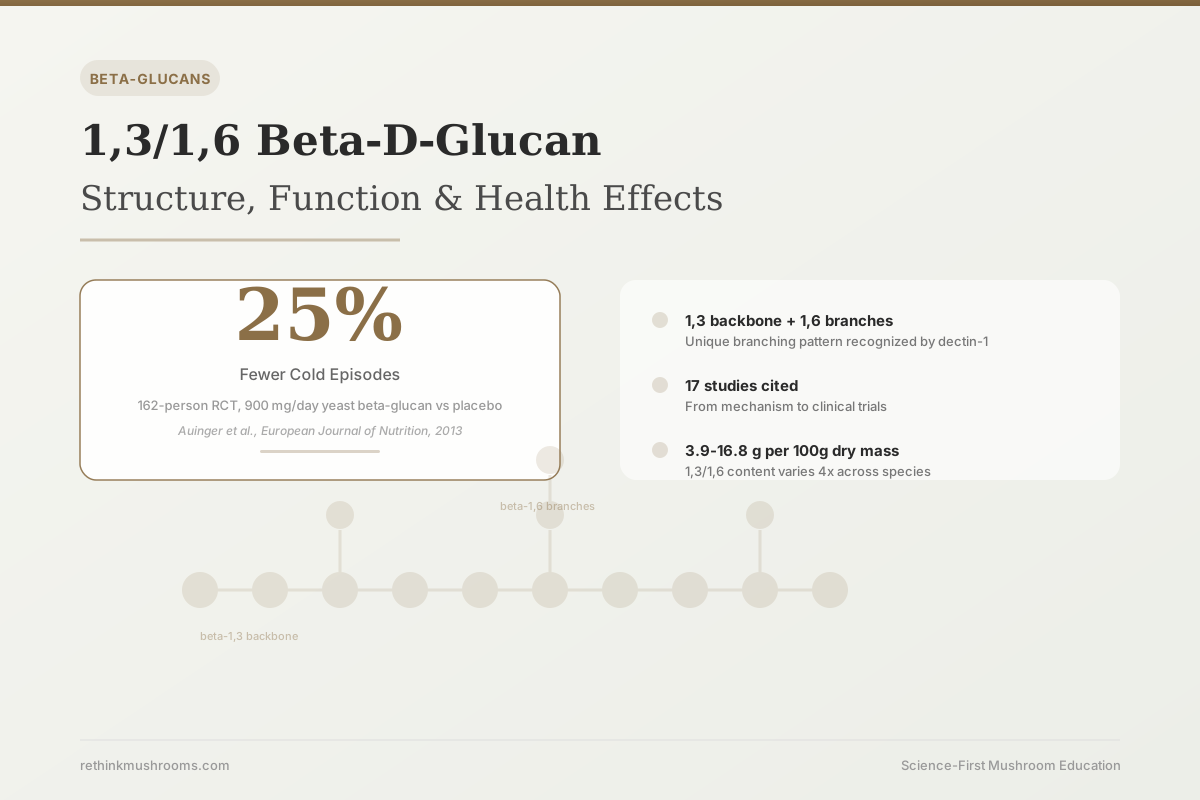
25% Fewer Cold Episodes
In a 162-person placebo-controlled randomized trial, 900 mg/day of yeast (1,3)-(1,6)-beta-D-glucan reduced symptomatic common cold episodes by 25% versus placebo over 16 weeks (p = 0.041).
Auinger et al., European Journal of Nutrition, 2013
1,3 Backbone
with 1,6 side-chain branches
Dectin-1
primary fungal beta-glucan receptor
Triple Helix
native conformation in solution
Auinger et al., European Journal of Nutrition, 2013
 View as image ↗
Beta-glucans are glucose polymers found in the cell walls of fungi, yeast, bacteria, and cereal grains. Not all beta-glucans are the same. The specific branching pattern, a backbone of beta-1,3-linked glucose with side chains attached through beta-1,6 linkages, defines what researchers call 1,3/1,6 beta-D-glucan. This branching pattern is the molecular signature that human immune cells recognize. For a broader overview of what beta-glucans are and why they matter in medicinal mushrooms, the pillar article covers the full landscape.
A 2012 review by Batbayar and colleagues in Biomolecules & Therapeutics mapped how this recognition works: immune cells express a surface receptor called dectin-1 that binds specifically to beta-1,3 glucan chains with 1,6 branching.[1] That binding event triggers a cascade of immune responses. The structural detail matters because beta-glucans from oats (which use 1,3/1,4 linkages instead of 1,3/1,6) do not activate this same pathway.
Key Takeaways
- Fungal 1,3/1,6 beta-D-glucans activate immune cells through the dectin-1 receptor, a pathway that 1,3/1,4 cereal beta-glucans do not trigger (Batbayar et al., Biomolecules & Therapeutics, 2012)
- TNF-alpha release from macrophages correlates with beta-glucan molecular weight; fractions above 45 kDa showed the strongest cytokine induction (Okazaki et al., Biological & Pharmaceutical Bulletin, 1995)
- A 162-person randomized controlled trial found 900 mg/day of yeast 1,3/1,6 beta-glucan reduced common cold episodes by 25% versus placebo over 16 weeks (Auinger et al., European Journal of Nutrition, 2013)
- Lentinan, a 1,3/1,6 beta-glucan from shiitake, selectively attenuates AIM2 and non-canonical inflammasome activation while inducing pro-inflammatory cytokines (Ahn et al., Scientific Reports, 2017)
- Wild mushroom species contain 3.9 to 16.8 g of 1,3/1,6 beta-D-glucan per 100 g dry mass depending on species (Mironczuk-Chodakowska et al., Roczniki PZH, 2017)
- A systematic review of 7 clinical trials found fungal beta-glucans improved quality of life and immune markers in cancer patients receiving chemotherapy (Steimbach et al., Clinical Nutrition, 2021)
The 1,3/1,6 Branching Pattern
All beta-glucans share the same basic building block: glucose molecules linked by beta-glycosidic bonds. What separates them is which carbon positions those bonds connect and how the chains branch.
In 1,3/1,6 beta-D-glucan, the primary chain (backbone) consists of glucose units connected at their first and third carbon positions. Side chains branch off from the backbone at the sixth carbon position. These branches can be short (a single glucose unit) or long (multiple glucose units extending further), and the length and frequency of branching varies between species.[2]
Okazaki and colleagues at Tokyo University of Pharmacy and Life Sciences published one of the earliest systematic structure-activity studies in 1995.[3] They isolated grifolan, a (1→3)-beta-D-glucan from maitake (Grifola frondosa), and tested how structural features affected cytokine production in mouse macrophages. Two findings stood out. First, the triple-helix versus single-helix conformation did not significantly change cytokine-inducing activity. Second, molecular weight mattered: the highest molecular weight fraction of grifolan (Mr ≥ 45,000) exhibited the strongest TNF-alpha release. The paper's other key conclusion ran the opposite of common intuition: TNF-alpha release was induced "only by beta-glucans with high molecular weights and lower branching ratios," and chemically de-branching a previously inactive (1→3)-beta-D-glucan (SSG) actually restored cytokine-inducing activity. In this in vitro mouse-macrophage system, then, very heavy 1,6 branching was not what drove the signal — molecular weight and a moderate branching pattern were.
This triple-helix structure deserves a closer look. In aqueous solution, three beta-1,3-glucan chains wind around each other to form a helical rope. This is the native conformation for most fungal beta-glucans. Alkaline treatment unfolds the helix. Some extraction methods destroy it. Whether the helix survives processing has implications for bioactivity, though the Okazaki data suggests the branching pattern carries more weight than helical state alone. For a deeper dive into how molecular weight affects biological activity, the dedicated article in this cluster covers the full evidence.
How 1,3/1,6 Differs from 1,3/1,4
Cereal grains (oats, barley) produce beta-glucans with a 1,3/1,4 linkage pattern. The backbone alternates between 1,3 and 1,4 bonds, creating a linear, unbranched chain. This structure is water-soluble, forms viscous gels in the gut, and affects cholesterol metabolism. The European Food Safety Authority has authorized a health claim that oat beta-glucan at 3 g/day lowers LDL cholesterol.
Fungal 1,3/1,6 beta-glucans are structurally different. The 1,6 branching creates a three-dimensional architecture that the immune system interprets as a pathogen-associated molecular pattern (PAMP).[1] Dectin-1, the receptor on macrophages and dendritic cells that detects fungal invasion, binds to the 1,3 backbone but requires the 1,6 branches for full activation. Cereal beta-glucans, lacking these branches, do not engage dectin-1 in the same way. A 2021 review by Cerletti and colleagues in Nutrients confirmed that mushroom beta-glucans, at variance with those from oats and barley, do not appear to beneficially affect lipid levels, while their immune-modulating effects are distinct.[4] The article comparing mushroom beta-glucans to oat and yeast sources explores these differences further.
How 1,3/1,6 Beta-Glucans Activate Immune Cells
The Dectin-1 Pathway
Lee and Kim published a detailed mechanistic review in the International Journal of Medicinal Mushrooms in 2014.[5] The sequence works like this: beta-1,3/1,6 glucan binds to the C-type lectin-like domain of dectin-1 on the surface of macrophages, neutrophils, dendritic cells, and natural killer cells. This binding activates an intracellular enzyme called spleen tyrosine kinase (Syk). From Syk, three downstream pathways branch out.
The first pathway activates NF-kB, a master transcription factor that turns on genes for inflammatory cytokines (TNF-alpha, IL-1beta, IL-6) and chemokines that recruit more immune cells to the site. The second pathway goes through phospholipase C gamma (PLCgamma) to activate calcineurin and the transcription factor NFAT, which is involved in T cell activation. The third pathway triggers NADPH oxidase to produce reactive oxygen species (ROS), which activate the NLRP3 inflammasome and drive IL-1beta processing.
Batbayar and colleagues emphasized that dectin-1 is the best-characterized pattern recognition receptor for fungal beta-glucans, though complement receptor 3 (CR3) and toll-like receptors (TLR2, TLR6) also participate.[1] The multi-receptor engagement is part of why fungal beta-glucans produce such a broad immune response.
From Receptor Binding to Functional Immunity
Motta, Gershwin, and Selmi reviewed the full chain from receptor binding to functional outcomes in a 2021 paper in the Journal of Autoimmunity.[6] After dectin-1 activation, macrophages increase phagocytosis (engulfing and destroying pathogens), produce an oxidative burst (releasing reactive oxygen species to kill microbes), and secrete cytokines that coordinate the broader immune response. Dendritic cells mature and present antigens more effectively to T cells. Natural killer cells increase their cytotoxic activity.
This is innate immunity, the fast, non-specific arm of the immune system. The evidence for adaptive immune effects (antibody production, T cell memory) is less established in humans, though animal studies show beta-glucans can enhance vaccine responses.
Lentinan: A Specific 1,3/1,6 Beta-Glucan from Shiitake
Lentinan is one of the most studied individual beta-glucans. It is extracted from the fruiting body of Lentinus edodes (shiitake mushroom) and has a defined 1,3/1,6 branching structure with a branching ratio of approximately 2:5 (two 1,6 branches for every five 1,3 backbone units).
Ahn and colleagues at Kangwon National University published a mechanistic study in Scientific Reports in 2017.[7] They found that lentinan selectively attenuates two types of inflammasome activation (AIM2 and non-canonical) while simultaneously inducing pro-inflammatory cytokines through the canonical pathway. This selective action is unusual. Most immune stimulants are broadly activating or broadly suppressing. Lentinan appears to fine-tune the inflammatory response.
Xu and colleagues demonstrated in the Journal of Biological Chemistry that lentinan from shiitake inhibited nitric oxide and TNF-alpha production in lipopolysaccharide-stimulated macrophages.[8] This anti-inflammatory action in the context of bacterial endotoxin, combined with Ahn's finding of selective inflammasome modulation, suggests lentinan's effects depend on the inflammatory context. In the presence of fungal patterns, it activates. In the presence of bacterial endotoxin, it dampens. The reishi beta-glucan research covers another species-specific variant of this mechanism.
What Clinical Trials Show
Upper Respiratory Infections
Auinger and colleagues conducted a placebo-controlled, double-blind, randomized, multicentric clinical trial published in the European Journal of Nutrition in 2013.[9] They enrolled 162 healthy adults with a history of recurring infections. Participants received either 900 mg/day of insoluble yeast (1,3)-(1,6)-beta-D-glucan or placebo for 16 weeks during cold season. In the per-protocol population, the beta-glucan group had 25% fewer symptomatic common cold episodes than the placebo group (p = 0.041). Mean symptom scores were 15% lower in the beta-glucan group, though this difference did not reach statistical significance (p = 0.125).
Dharsono and colleagues followed up with a larger trial of 299 healthy adults, published in the Journal of the American College of Nutrition in 2019.[10] Participants received 900 mg/day of yeast beta-glucan or placebo for 16 weeks. The beta-glucan group showed reduced severity of upper respiratory tract infection symptoms measured by the WURSS-21 questionnaire. Both the Auinger and Dharsono trials used yeast-derived (not mushroom-derived) 1,3/1,6 beta-glucan. The branching pattern is structurally similar to mushroom beta-glucans, but the source organism and extraction method differ. Direct clinical trials using purified mushroom-derived 1,3/1,6 beta-glucan for respiratory infections are limited.
Shiitake Mushroom Consumption and Immunity
Dai and colleagues at the University of Florida conducted a dietary intervention trial published in the Journal of the American College of Nutrition in 2015.[11] Fifty-two healthy adults aged 21-41 consumed 5 or 10 g of dried shiitake mushrooms daily for 4 weeks. The researchers measured immune markers before and after the intervention. Participants showed increased proliferation of gamma-delta T cells and natural killer T cells, increased secretory IgA production, and decreased C-reactive protein (a marker of systemic inflammation). These changes suggest both innate and adaptive immune activation from whole mushroom consumption, though the study did not isolate beta-glucans as the active component.
Cancer Adjuvant Therapy
Steimbach and colleagues published a systematic review of clinical trials in Clinical Nutrition in 2021.[12] They identified 7 clinical trials using fungal beta-glucans as adjuvants alongside conventional cancer treatment. The most studied was lentinan, administered intravenously alongside chemotherapy in gastric and lung cancer patients. Zhang and colleagues reviewed 12 years of clinical studies using lentinan for lung cancer in China and found evidence for improved quality of life and immune markers in patients receiving lentinan plus chemotherapy versus chemotherapy alone.[13] Steimbach noted that while the results are promising for quality of life and immune parameters, the trials were generally small, and overall survival benefits remain unconfirmed.
It is worth noting that intravenous lentinan, as used in the cancer trials, bypasses the gut entirely. Oral beta-glucan supplements follow a different absorption pathway and produce different blood concentrations. Extrapolating from IV lentinan data to oral mushroom supplements requires caution.
Beta-Glucan Content Across Mushroom Species
Not all mushrooms contain the same amount of 1,3/1,6 beta-D-glucan. Mironczuk-Chodakowska and colleagues measured beta-glucan content in wild-growing Polish mushroom species in 2017, using a colorimetric method to separately quantify the (1,3)-(1,6)-beta-D-glucan fraction.[14] The endpoints of the species range:
| Species | Total Beta-Glucan (g/100g dry) | 1,3/1,6 Fraction (g/100g dry) |
|---|---|---|
| Tricholomopsis rutilans | 40.9 | — |
| Auricularia auricula-judae (wood ear) | — | 16.8 |
| Agaricus bisporus (button) | 13.5 | — |
| Agaricus bisporus (cremini) | — | 3.9 |
A 2020 follow-up paper by the same group expanded the dataset to 18 wild Polish species and 3 commercial reference mushrooms and showed that switching between Megazyme and Congo red assays meaningfully shifted the species ranking — Tricholoma portentosum topped the Megazyme list at 34.97 g/100 g, whereas Lactarius deliciosus topped the Congo red list at 17.11 g/100 g.[15] Species with higher (1,3)-(1,6)-beta-D-glucan fractions are not necessarily "better" supplements. Extraction efficiency, bioavailability, and the presence of other bioactive compounds (triterpenes in reishi, erinacines in lion's mane) all matter. The numbers show that beta-glucan content varies several-fold across common species — and that the assay used to measure it is part of the answer.
McCleary and Draga developed a validated analytical method for measuring beta-glucan in mushroom and mycelial products, published in the Journal of AOAC International in 2016.[16] Their method separately quantifies total glucan, alpha-glucan (starch and glycogen), and beta-glucan (by difference). When this kind of split assay is applied to grain-based mycelial supplements, the alpha-glucan signal can flag starch from the substrate. Independent market testing shows why this matters: Wu and colleagues evaluated 19 batches of commercial Ganoderma lucidum (reishi) supplements sold in the United States using chromatographic methods and saccharide mapping, and found that the measured triterpene and polysaccharide content of only 5 of the 19 products (26.3%) was consistent with their labels — evidence that quality consistency in the retail reishi market is poor.[18] The testing methods for beta-glucans in supplements article details how these assays work in practice.
Limitations of the Current Evidence
The evidence for 1,3/1,6 beta-glucan immune effects is mechanistically strong but clinically uneven. Dectin-1 binding, downstream signaling, and in vitro immune activation are well-documented across dozens of studies. The gap is in human clinical trials, particularly for mushroom-derived (not yeast-derived) beta-glucans taken orally.
Most human trials use yeast (Saccharomyces cerevisiae) beta-glucan, which has the same 1,3/1,6 linkage pattern but different molecular weight, branching frequency, and purity compared to mushroom beta-glucans. Whether results from yeast beta-glucan trials apply directly to mushroom supplements is an open question.
The cancer adjuvant data, while encouraging for quality of life, comes primarily from intravenous lentinan administered in hospital settings. Oral supplements deliver different doses through a different route. Volman and colleagues tested beta-glucan-rich polysaccharide extracts from multiple mushroom species in 2010 and found significant differences in nitric oxide production and NF-kB activation between species, even among those with similar total beta-glucan content.[17] This suggests that beta-glucan content alone does not predict biological activity. Other structural features, co-extracted compounds, and processing methods all influence what happens after ingestion.
The Bottom Line
The 1,3/1,6 beta-D-glucan structure in mushroom and yeast cell walls activates innate immune cells through the dectin-1 receptor, triggering phagocytosis, cytokine production, and natural killer cell activity. Clinical trials with yeast-derived 1,3/1,6 beta-glucan show a 25% reduction in cold episodes. Lentinan from shiitake has shown immune benefits in cancer adjuvant trials, though primarily via intravenous delivery. The gap between mechanistic clarity and clinical proof remains significant for orally consumed mushroom-derived beta-glucans specifically.
Frequently Asked Questions
Sources & References
- 1RTHM-00244·Batbayar, Sainkhuu et al. (2012). “Immunomodulation of Fungal β-Glucan in Host Defense Signaling by Dectin-1..” Biomolecules & therapeutics.Study breakdown →PubMed →↩
- 2RTHM-00854·Timm, Thaynã Gonçalves et al. (2023). “Mushroom β-glucans: application and innovation for food industry and immunotherapy..” Applied microbiology and biotechnology.Study breakdown →PubMed →↩
- 3RTHM-00017·Okazaki, M et al. (1995). “Structure-activity relationship of (1-->3)-beta-D-glucans in the induction of cytokine production from macrophages, in vitro..” Biological & pharmaceutical bulletin.Study breakdown →PubMed →↩
- 4RTHM-00676·Cerletti, Chiara et al. (2021). “Edible Mushrooms and Beta-Glucans: Impact on Human Health..” Nutrients.Study breakdown →PubMed →↩
- 5RTHM-00333·Lee, Dong Hee et al. (2014). “Innate immunity induced by fungal β-glucans via dectin-1 signaling pathway..” International journal of medicinal mushrooms.Study breakdown →PubMed →↩
- 6RTHM-00709·Motta, Francesca et al. (2021). “Mushrooms and immunity..” Journal of autoimmunity.Study breakdown →PubMed →↩
- 7RTHM-00459·Ahn, Huijeong et al. (2017). “Lentinan from shiitake selectively attenuates AIM2 and non-canonical inflammasome activation while inducing pro-inflammatory cytokine production..” Scientific reports.Study breakdown →PubMed →↩
- 8RTHM-00272·Xu, Xiaojuan et al. (2012). “β-Glucan from Lentinus edodes inhibits nitric oxide and tumor necrosis factor-α production and phosphorylation of mitogen-activated protein kinases in lipopolysaccharide-stimulated murine RAW 264.7 macrophages..” The Journal of biological chemistry.Study breakdown →PubMed →↩
- 9RTHM-00278·Auinger, Annegret et al. (2013). “Yeast (1,3)-(1,6)-beta-glucan helps to maintain the body's defence against pathogens: a double-blind, randomized, placebo-controlled, multicentric study in healthy subjects..” European journal of nutrition.Study breakdown →PubMed →↩
- 10RTHM-00550·Dharsono, Tanita et al. (2019). “Effects of Yeast (1,3)-(1,6)-Beta-Glucan on Severity of Upper Respiratory Tract Infections: A Double-Blind, Randomized, Placebo-Controlled Study in Healthy Subjects..” Journal of the American College of Nutrition.Study breakdown →PubMed →↩
- 11RTHM-00368·Dai, Xiaoshuang et al. (2015). “Consuming Lentinula edodes (Shiitake) Mushrooms Daily Improves Human Immunity: A Randomized Dietary Intervention in Healthy Young Adults..” Journal of the American College of Nutrition.Study breakdown →PubMed →↩
- 12RTHM-00719·Steimbach, Laiza et al. (2021). “Fungal beta-glucans as adjuvants for treating cancer patients - A systematic review of clinical trials..” Clinical nutrition (Edinburgh.Study breakdown →PubMed →↩
- 13RTHM-00538·Zhang, Yiran et al. (2018). “Lentinan as an immunotherapeutic for treating lung cancer: a review of 12 years clinical studies in China..” Journal of cancer research and clinical oncology.Study breakdown →PubMed →↩
- 14RTHM-00484·Mirończuk-Chodakowska, Iwona et al. (2017). “Quantitative evaluation of 1,3,1,6 β-D-glucan contents in wild-growing species of edible Polish mushrooms..” Roczniki Panstwowego Zakladu Higieny.Study breakdown →PubMed →↩
- 15RTHM-00637·Mirończuk-Chodakowska, Iwona et al. (2020). “Evaluation of Polish wild Mushrooms as Beta-Glucan Sources..” International journal of environmental research and public health.Study breakdown →PubMed →↩
- 16RTHM-00438·McCleary, Barry V et al. (2016). “Measurement of β-Glucan in Mushrooms and Mycelial Products..” Journal of AOAC International.Study breakdown →PubMed →↩
- 17RTHM-00200·Volman, Julia J et al. (2010). “Effects of mushroom-derived beta-glucan-rich polysaccharide extracts on nitric oxide production by bone marrow-derived macrophages and nuclear factor-kappaB transactivation in Caco-2 reporter cells: can effects be explained by structure?.” Molecular nutrition & food research.Study breakdown →PubMed →↩
- 18RTHM-00499·Wu, Ding-Tao et al. (2017). “Evaluation on quality consistency of Ganoderma lucidum dietary supplements collected in the United States..” Scientific reports.Study breakdown →PubMed →↩