Beta-Glucan Science
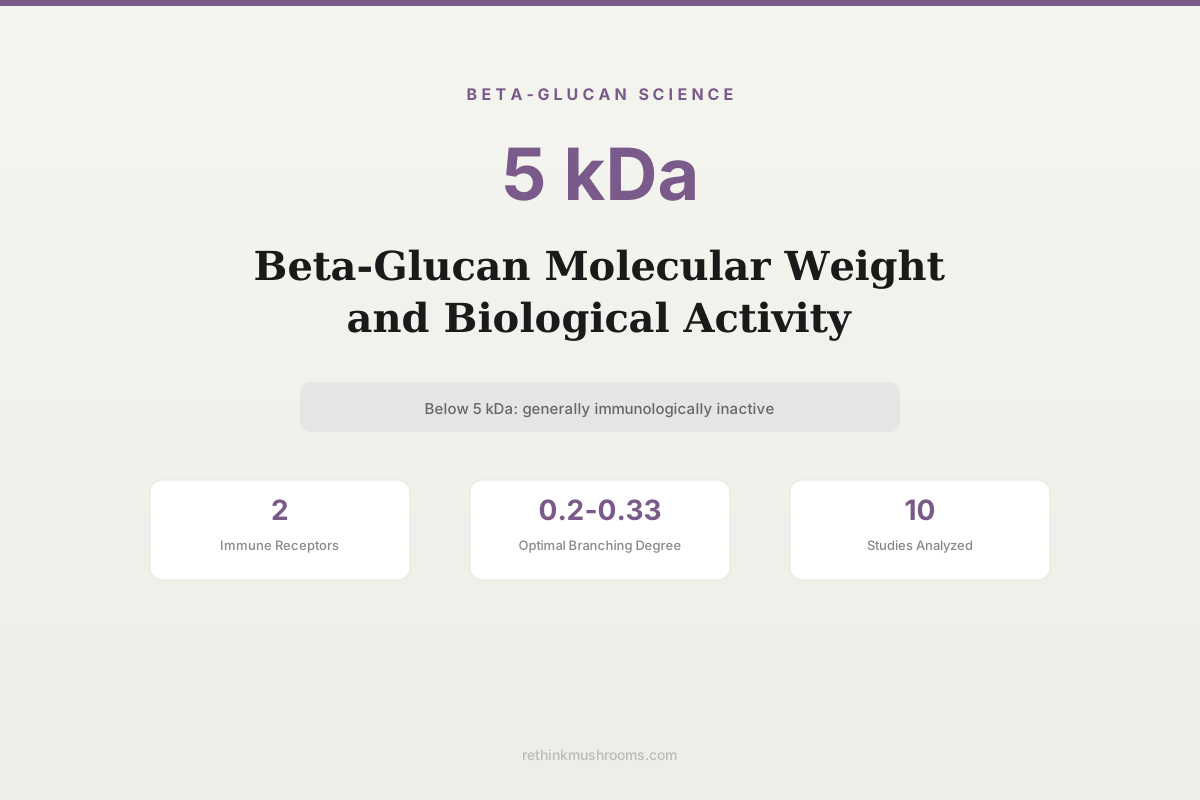
5 kDa minimum
Beta-glucans below 5,000 Daltons of molecular weight are generally immunologically inactive. Above that threshold, triple-helix conformation, branching ratio, and receptor specificity determine biological potency.
Murphy et al., J Fungi, 2020; Okazaki et al., Biol Pharm Bull, 1995
2 Receptors
Dectin-1 and CR3 bind different sizes
0.2-0.33
optimal branching degree for immune activation
10 Studies
on structure-activity relationships
Murphy et al., J Fungi, 2020; Okazaki et al., Biol Pharm Bull, 1995
 View as image ↗
Not all beta-glucans produce the same biological effects. Two beta-glucan preparations can have identical chemical compositions (same glucose subunits, same linkage types) and produce dramatically different immune responses based solely on molecular weight, branching pattern, and three-dimensional conformation. This distinction matters because the supplement and functional food industry often treats "beta-glucan content" as the only relevant metric, when the research shows that structural parameters determine whether a given beta-glucan activates immune pathways, lowers cholesterol, or passes through the body with minimal effect. For the foundational overview of 1,3/1,6 beta-D-glucan structure and function, see the companion article.
Key Takeaways
- Beta-glucans below 5,000 Daltons molecular weight are generally immunologically inactive, while those above 5 kDa activate different immune pathways depending on size (Murphy et al., 2020)
- TNF-alpha release by macrophages is induced only by beta-glucans with high molecular weights (Mr greater than 45,000) and lower branching ratios (Okazaki et al., 1995)
- Triple-helix conformation is required for full cytokine-stimulating activity; denaturation by NaOH irreversibly reduces potency even after attempted renaturation (Falch et al., 2000)
- Dectin-1 recognizes large particulate beta-glucans on macrophages and dendritic cells, while CR3 on NK cells binds smaller soluble fragments, creating two distinct immune activation pathways (Goodridge et al., 2009)
- Beta-glucans with branching degrees between 0.20 and 0.33 are the most effective immune modulators; higher branching (0.67) and lower branching (0.16) both reduce activity (Batbayar et al., 2012)
- High and low molecular weight oat beta-glucans produced different therapeutic effects in colitis, with high MW reversing lymphocyte changes and low MW better reducing inflammatory markers (Zyla et al., 2019)
What Molecular Weight Means for Beta-Glucans
Beta-glucans are polymers of glucose subunits linked by beta-glycosidic bonds. Their molecular weight reflects the total mass of the polymer chain, which ranges from a few thousand Daltons (short fragments) to several million Daltons (long, intact chains). A single glucose unit weighs approximately 180 Daltons. A beta-glucan of 5,000 Da contains roughly 28 glucose units. A beta-glucan of 500,000 Da contains roughly 2,778 glucose units.
Murphy et al. (2020) reviewed the clinical and preclinical evidence and identified molecular weight as one of the primary determinants of beta-glucan biological activity. The review noted that beta-glucans below approximately 5,000 to 10,000 Da are generally inactive in immunological assays, while those above this threshold activate immune cells through receptor-dependent mechanisms. Two licensed beta-glucan drugs in Japan (lentinan and schizophyllan) are both high-molecular-weight preparations from mushroom sources, with molecular weights in the hundreds of thousands of Daltons.[1]
The molecular weight of a beta-glucan preparation depends on the source organism, extraction method, and processing conditions. Hot water extraction, the method most commonly used for mushroom beta-glucans, tends to produce intermediate to high molecular weight fractions. Alkaline extraction can cleave chains, reducing molecular weight. Ultrasonic processing fragments chains further. This means two supplements derived from the same mushroom species can contain beta-glucans of vastly different molecular weights depending on how they were manufactured.
Why Larger Beta-Glucans Tend to Be More Immunoactive
Okazaki et al. (1995) provided some of the earliest direct evidence linking molecular weight to immune activation. The study tested fractions of grifolan (a 1,3-beta-D-glucan from Grifola frondosa, maitake) and found that the highest molecular weight fraction (Mr greater than or equal to 45,000) produced the strongest TNF-alpha release from macrophages. Lower molecular weight fractions were progressively less active.[2]
The explanation involves receptor accessibility. Larger beta-glucan molecules present more binding epitopes to immune cell surface receptors. A long polymer chain can simultaneously engage multiple receptor molecules on a single cell, creating a clustering effect that amplifies intracellular signaling. Short fragments can bind individual receptors but cannot create this multi-receptor crosslinking, which limits the strength of the downstream immune signal.
Okazaki et al. also found that the branching ratio interacted with molecular weight. Native SSG (a beta-glucan with high branching, Mr greater than 2,000,000) did not induce cytokine production despite its enormous size. But when the side-chain glucose residues were chemically removed (debranching), the modified SSG gained TNF-alpha-inducing activity. This demonstrated that molecular weight alone is not sufficient; the branching pattern must also permit receptor access to the backbone chain.[2]
The Triple Helix: How Shape Determines Potency
Many mushroom beta-glucans adopt a triple-helix conformation in solution: three polymer chains wind around each other like a three-stranded rope. This three-dimensional structure is not a minor detail. It is a primary determinant of biological activity.
Falch et al. (2000) tested the relationship between triple-helix conformation and cytokine-stimulating activity using scleroglucan (a 1,3-beta-glucan structurally similar to lentinan and schizophyllan). The study found a complex molecular weight dependency: samples with triple-helical structure and molecular weight below 500,000 g/mol or above 1,100,000 g/mol stimulated human monocytes more efficiently than samples in the 670,000 to 1,100,000 g/mol range.[3]
The critical finding was about denaturation. When scleroglucan triple helices were disrupted by NaOH treatment (above 0.25 M), the cytokine-inducing activity decreased irreversibly. Even when the denatured samples were neutralized and annealed to reform structures that looked similar to the original under electron microscopy, the biological activity did not recover. This means the triple-helix conformation carries structural information that cannot be fully restored once lost.[3]
For mushroom supplement consumers, this has practical implications. Processing methods that use strong alkali (NaOH extraction), extreme pH, or aggressive chemical treatments may irreversibly damage the triple-helix conformation and reduce the biological potency of the beta-glucan, even if the total beta-glucan content measured by chemical assay remains unchanged. A supplement can test high for beta-glucan content while containing structurally damaged, less bioactive molecules. For guidance on testing beta-glucans in supplements, see the dedicated article.
Dectin-1 and CR3: Two Receptors, Two Size Preferences
The immune system does not have a single beta-glucan receptor. At least two major receptors recognize beta-glucans, and they have different size preferences.
Goodridge et al. (2009) reviewed the receptor biology and established that Dectin-1 is the primary receptor for particulate (large, insoluble) beta-glucans on macrophages, dendritic cells, and neutrophils. Dectin-1 has a single carbohydrate recognition domain that specifically binds 1,3-beta-glucans. When Dectin-1 engages a large beta-glucan particle, it triggers phagocytosis, reactive oxygen species production, and cytokine secretion (TNF-alpha, IL-6, IL-12). Dectin-1 also activates NF-kB signaling and can prime adaptive immune responses.[4]
Complement Receptor 3 (CR3) on NK cells and neutrophils, by contrast, binds smaller, soluble beta-glucan fragments. CR3 binding primes these cells to kill complement-opsonized target cells, including tumor cells. This represents a fundamentally different immune mechanism: Dectin-1 activation drives inflammation and pathogen clearance, while CR3 priming enhances targeted cytotoxicity.
Batbayar et al. (2012) elaborated on the Dectin-1 signaling cascade specifically for fungal beta-glucans. The review detailed how Dectin-1 recognition of mushroom-derived beta-1,3/1,6-glucans triggers Syk kinase activation, CARD9 signaling, and downstream NF-kB and NFAT transcription factor activation. These pathways link innate beta-glucan recognition to adaptive immune responses, including T helper cell differentiation.[5]
The dual-receptor system means that both large and small beta-glucans have biological functions, but through different mechanisms and in different immune cell populations. A diverse molecular weight distribution in a mushroom extract may activate both pathways simultaneously, which could explain why whole mushroom preparations sometimes outperform purified, uniform-molecular-weight beta-glucan fractions.
The Branching Ratio Problem
Mushroom beta-glucans have a 1,3-linked backbone with 1,6-linked side branches. The ratio of branching (how many backbone glucose units carry a side chain) profoundly affects receptor recognition.
Batbayar et al. (2012) compiled data showing that beta-glucans with branching degrees between 0.20 and 0.33 (one branch per three to five backbone glucose units) function as the most effective immune modulators. Shiitake lentinan, with a branching degree of approximately 0.29, consistently outperformed beta-glucans with higher branching (0.67) or lower branching (0.16) in immunological assays.[5]
The mechanism relates to receptor access. The 1,3-linked backbone is the primary recognition epitope for Dectin-1. Side branches at the 1,6 position protrude outward from the triple helix. Too few branches (low branching ratio) may reduce water solubility and prevent the beta-glucan from reaching immune cells in the gut lumen. Too many branches (high branching ratio) physically obstruct Dectin-1 access to the backbone, reducing binding affinity.
This creates a Goldilocks zone: enough branching for solubility and structural stability, but not so much that the backbone epitopes are buried. Mushroom beta-glucans naturally fall within or near this optimal range, which may explain their consistent immunomodulatory activity across multiple species. Oat and barley beta-glucans, which have 1,3 and 1,4 linkages but no 1,6 branching at all, activate different receptors and have different biological effects (primarily cholesterol reduction rather than immunomodulation). For a comparison of mushroom vs oat and yeast beta-glucans, see the dedicated analysis.
Molecular Weight and Gut Health: Different Sizes, Different Effects
Zyla et al. (2019) provided direct experimental evidence that molecular weight determines which anti-inflammatory pathways a beta-glucan activates in the gut. The study compared low and high molecular weight oat beta-glucan fractions in a rat colitis model.[6]
Both fractions reduced inflammation, but through different mechanisms. High molecular weight beta-glucan more effectively reversed the changes in lymphocyte populations caused by colitis. Low molecular weight beta-glucan more effectively reduced levels of inflammatory markers and improved cytokine and chemokine signaling pathways. The authors concluded that "the therapeutic effect of dietary oat beta-glucan supplementation in the colitis is in evident relation to the molecular weight of polymer."
For mushroom beta-glucans specifically, Wang et al. (2022) demonstrated that a purified beta-1,6-glucan from Pleurotus eryngii increased splenic lymphocyte proliferation, NK cell activity, and CD4+/CD8+ T cell proportions in the lamina propria. The glucan also modulated gut microbiota, increasing Lachnospiraceae and Rikenellaceae while raising acetic and butyric acid concentrations.[7]
Cerletti et al. (2021) reviewed the broader evidence and noted that mushroom beta-glucans have both immunomodulatory and anti-inflammatory effects, but emphasized that "important differences appear to exist in the effects of apparently similar beta-glucan preparations, which may be due to differences in sources and extraction procedures."[8]
Soluble vs Particulate: Another Size Dimension
Beyond molecular weight of individual chains, the physical form of a beta-glucan preparation matters. Particulate beta-glucans (insoluble particles containing many entangled polymer chains) and soluble beta-glucans (individual chains or small aggregates dissolved in water) activate different immune pathways.
Dong et al. (2012) isolated a novel water-soluble beta-D-glucan (GLSA50-1B) from the spores of Ganoderma lucidum with a unique 1,6-linked backbone and 1,4-linked branches. This soluble glucan had a distinct structure from the insoluble cell wall glucans of the same organism, demonstrating that a single mushroom species can produce beta-glucans of different sizes, structures, and solubilities.[9]
Petraglia et al. (2023) showed that an enriched polysaccharide fraction from P. eryngii containing 1,3/1,6-beta-D-glucans had antioxidant activity across multiple radical-scavenging assays and protected neural cells from oxidative damage at concentrations of 0.05 to 0.2 mg/mL. This demonstrates that beta-glucan biological activity extends beyond immune modulation to antioxidant defense, and that the polysaccharide fraction as a whole (containing a distribution of molecular weights) can be functionally active.[10]
Practical Implications for Mushroom Selection
The molecular weight research has several practical takeaways:
Hot water extraction preserves more high-molecular-weight beta-glucans than aggressive chemical extraction methods. Supplements made from hot water extracts of fruiting bodies are more likely to contain intact, triple-helical beta-glucans than those made with alkali extraction or extensive ultrasonic processing.
Whole mushroom preparations contain a molecular weight distribution that may activate both Dectin-1 (large particulate) and CR3 (small soluble) pathways simultaneously. Highly purified, uniform-molecular-weight preparations may miss one pathway.
Beta-glucan content alone is an incomplete quality metric. Two products with identical beta-glucan percentages can have different molecular weight profiles, branching ratios, and triple-helix integrity, leading to different biological effects. Until molecular weight characterization becomes standard in supplement testing, beta-glucan content remains a necessary but insufficient measure of quality. For a broader understanding of what beta-glucans are and why they matter, see the overview article. For related Agaricus blazei beta-glucan research, see the species-specific review.
Species-specific beta-glucan structures vary. Reishi, maitake, shiitake, turkey tail, and king trumpet each produce beta-glucans with different molecular weights, branching patterns, and biological activities. The optimal mushroom choice depends on the target health outcome, not just the beta-glucan content on the label.
The Bottom Line
Beta-glucan biological activity depends on molecular weight, triple-helix conformation, branching ratio, and solubility rather than chemical composition alone. Molecules below 5 kDa are generally inactive. Triple-helix conformation is required for full cytokine-stimulating potency and cannot be fully restored after denaturation. Two immune receptors (Dectin-1 and CR3) respond to different molecular sizes through different signaling pathways. Branching degrees between 0.20 and 0.33 occupy the optimal range for immunomodulation. These structural parameters explain why beta-glucan content is a necessary but insufficient measure of supplement quality.
Frequently Asked Questions
Sources & References
- 1RTHM-00639·Murphy, Emma J et al. (2020). “β-Glucan Metabolic and Immunomodulatory Properties and Potential for Clinical Application..” Journal of fungi (Basel.Study breakdown →PubMed →↩
- 2RTHM-00017·Okazaki, M et al. (1995). “Structure-activity relationship of (1-->3)-beta-D-glucans in the induction of cytokine production from macrophages, in vitro..” Biological & pharmaceutical bulletin.Study breakdown →PubMed →↩
- 3RTHM-00032·Falch, B H et al. (2000). “The cytokine stimulating activity of (1-->3)-beta-D-glucans is dependent on the triple helix conformation..” Carbohydrate research.Study breakdown →PubMed →↩
- 4RTHM-00154·Goodridge, Helen S et al. (2009). “Beta-glucan recognition by the innate immune system..” Immunological reviews.Study breakdown →PubMed →↩
- 5RTHM-00244·Batbayar, Sainkhuu et al. (2012). “Immunomodulation of Fungal β-Glucan in Host Defense Signaling by Dectin-1..” Biomolecules & therapeutics.Study breakdown →PubMed →↩
- 6RTHM-00603·Żyła, Ewa et al. (2019). “Beneficial Effects of Oat Beta-Glucan Dietary Supplementation in Colitis Depend on its Molecular Weight..” Molecules (Basel.Study breakdown →PubMed →↩
- 7RTHM-00801·Wang, Xue et al. (2022). “β-1,6-Glucan From Pleurotus eryngii Modulates the Immunity and Gut Microbiota..” Frontiers in immunology.Study breakdown →PubMed →↩
- 8RTHM-00676·Cerletti, Chiara et al. (2021). “Edible Mushrooms and Beta-Glucans: Impact on Human Health..” Nutrients.Study breakdown →PubMed →↩
- 9RTHM-00248·Dong, Qun et al. (2012). “A novel water-soluble β-D-glucan isolated from the spores of Ganoderma lucidum..” Carbohydrate research.Study breakdown →PubMed →↩
- 10RTHM-00847·Petraglia, Tania et al. (2023). “Antioxidant Activity of Polysaccharides from the Edible Mushroom Pleurotus eryngii..” Molecules (Basel.Study breakdown →PubMed →↩