Beta-Glucans
3 Source Types
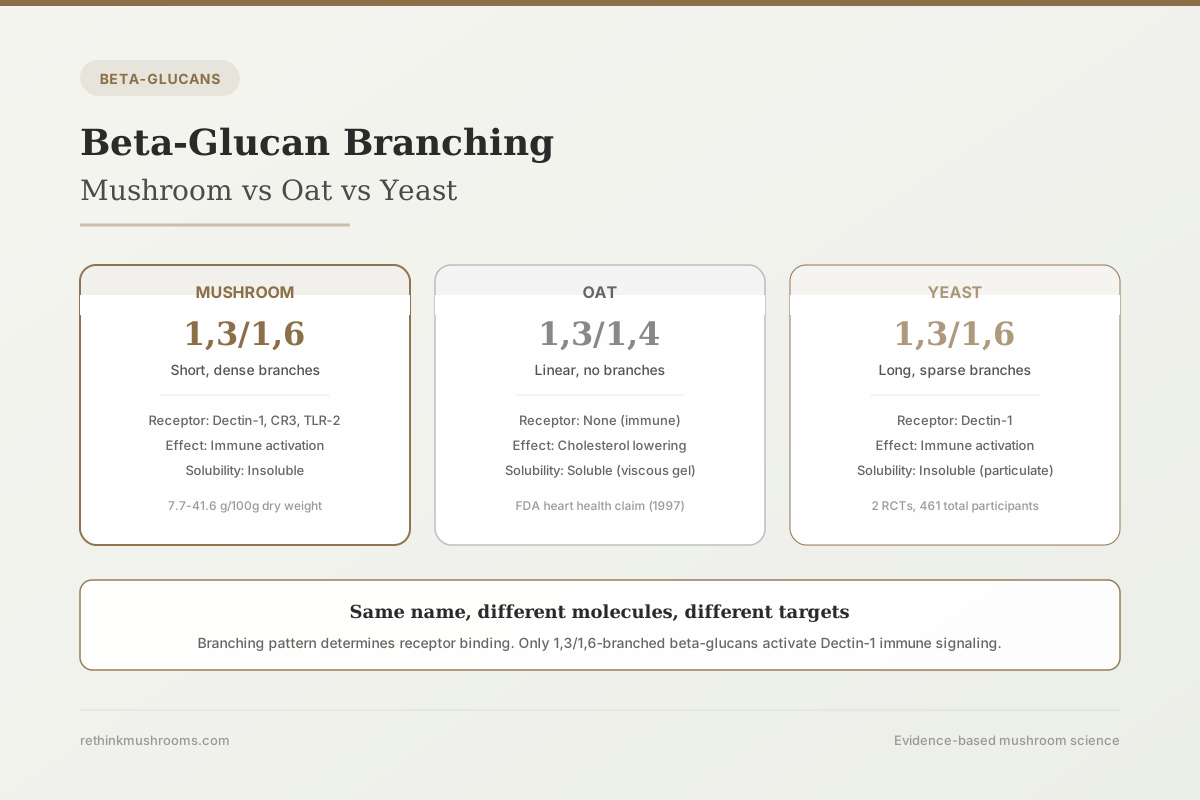
Beta-glucans from oats, yeast, and mushrooms share a name but differ in branching structure, receptor binding, and biological effects. Only fungal 1,3/1,6-branched forms activate Dectin-1 immune signaling.
Goodridge et al., Immunological Reviews, 2009
1,3/1,6
branching pattern in fungal beta-glucans
Dectin-1
primary immune receptor for fungal glucans
1,3/1,4
linear linkage pattern in oat beta-glucans
Goodridge et al., Immunological Reviews, 2009
 View as image ↗
Not all beta-glucans are the same molecule. Oat beta-glucans lower cholesterol. Mushroom and yeast beta-glucans activate immune cells. These are fundamentally different compounds that happen to share a category name, and the difference comes down to how glucose chains branch. Understanding what beta-glucans are at the structural level explains why a bowl of oatmeal and a reishi extract do completely different things in your body.
The branching pattern determines which receptors the molecule can bind, which cells respond, and what biological cascade follows. For the foundational chemistry of how 1,3/1,6 beta-D-glucan structure relates to function, the companion article covers the basics. This article focuses specifically on why branching makes mushroom beta-glucans immunologically distinct from oat and yeast sources.
Key Takeaways
- Mushroom and yeast beta-glucans have a 1,3-backbone with 1,6-branches that bind the immune receptor Dectin-1; oat beta-glucans have a 1,3/1,4-linear structure that cannot activate this receptor (Goodridge et al., Immunological Reviews, 2009)
- Beta-glucan source shapes the immune response: in animal models comparing glucans from different sources, a yeast-derived beta-glucan significantly stimulated phagocytic activity and cytokine release, illustrating that source and structure — not just total beta-glucan content — determine the immunological effect (Vetvicka et al., Journal of Medicinal Food, 2008)
- Dectin-1 multimerization (clustering on the cell surface) depends on beta-glucan chain length and branching density; short or poorly branched chains fail to trigger full immune signaling (Anaya et al., Biophysical Journal, 2023)
- A 162-person RCT found 900 mg/day of yeast 1,3/1,6-beta-glucan reduced common cold episodes by 25% over 16 weeks compared to placebo (Auinger et al., European Journal of Nutrition, 2013)
- Across wild-growing edible Polish mushroom species, 1,3/1,6 beta-D-glucan content ranged from 3.9 to 16.8 g per 100g dry weight, with wood ear (Auricularia auricula-judae) the highest of the species tested (Mironczuk-Chodakowska et al., 2017)
- Yeast 1,3/1,6-beta-glucan at 900 mg/day significantly reduced the severity of physical URTI symptoms during the first days of infection in 299 healthy adults over 16 weeks, though infection incidence and global severity did not differ from placebo (Dharsono et al., J American College of Nutrition, 2019)
The Three Beta-Glucan Families
Beta-glucans are polysaccharides made of glucose units linked together. The name "beta" refers to the orientation of the bond between glucose molecules. Beyond that shared feature, beta-glucans from different sources diverge in structure and function.[1][2]
Cereal beta-glucans (oats, barley): These have a backbone of glucose units connected by alternating beta-1,3 and beta-1,4 linkages. The chain is linear with no branches. This creates a flexible, soluble fiber that forms viscous gels in the digestive tract. The gel-forming property is what drives cholesterol reduction: the viscous mass traps bile acids in the intestine, forcing the liver to pull cholesterol from blood to make more bile acids. The FDA approved a health claim for oat beta-glucan and heart disease risk in 1997 based on this mechanism.
Yeast beta-glucans (Saccharomyces cerevisiae): The backbone is beta-1,3-linked glucose with beta-1,6 branches. The branches in yeast beta-glucan tend to be relatively long and less frequent along the backbone. This creates a large, particulate structure that is insoluble in water. The branching pattern allows yeast beta-glucan to bind immune receptors, particularly Dectin-1.
Fungal/mushroom beta-glucans: Like yeast, the backbone is beta-1,3-linked glucose with beta-1,6 branches. The key structural difference is that mushroom beta-glucan branches tend to be shorter (often 1-3 glucose units) and more frequent along the backbone.[2] This shorter, denser branching pattern creates a different three-dimensional shape that interacts with immune receptors differently than yeast beta-glucan. Different mushroom species produce beta-glucans with distinct branching frequencies and chain lengths, which partly explains why some species show stronger immunological activity than others.
Structural Contrast
Three Beta-Glucan Families: Same Name, Different Molecules
Oat
Yeast
Mushroom
Backbone linkage
beta-1,3 / beta-1,4 (alternating)
beta-1,3 with beta-1,6 branches
beta-1,3 with beta-1,6 branches
Branching
None — linear chain
Long, infrequent branches
Short, frequent branches
Solubility
Soluble, gel-forming
Insoluble, particulate
Largely insoluble
Immune receptor
None
Dectin-1
Dectin-1
Primary effect
Lowers LDL cholesterol (bile-acid trapping)
Innate immune activation
Innate immune activation
Oat beta-glucan has no 1,6 linkages and no branches, so it cannot bind Dectin-1; its benefit is cholesterol-lowering fiber. Yeast and mushroom beta-glucans share the 1,3/1,6-branched architecture that activates Dectin-1, differing mainly in branch length and density.
Sources: Goodridge et al. (2009) [ref 1]; Cerletti et al. (2021) [ref 2]; Brown et al. (2007) [ref 3].
Why Branching Determines Immune Activity
The immune system does not respond to "beta-glucan" as a generic category. It responds to specific three-dimensional shapes. The receptor that mediates most of the immune recognition of fungal beta-glucans is Dectin-1, a C-type lectin receptor expressed on macrophages, dendritic cells, neutrophils, and some T cells.[1]
Brown and colleagues published the crystal structure of Dectin-1 in Protein Science in 2007.[3] The receptor has an extracellular C-type lectin domain that recognizes beta-1,3-glucan chains. It does not bind beta-1,4 linkages. This is the structural reason oat beta-glucan cannot activate Dectin-1: the alternating 1,3/1,4 backbone presents a different shape to the receptor's binding groove.
Goodridge and colleagues reviewed the full landscape of beta-glucan recognition in Immunological Reviews in 2009.[1] They established that Dectin-1 recognizes beta-1,3-linked glucans and beta-1,6-branched glucans, but not glucans containing solely beta-1,6 linkages. The receptor requires a minimum chain length of the 1,3-backbone to bind, and the 1,6-branches influence the overall conformation that determines binding affinity.
Beyond Dectin-1, fungal beta-glucans also interact with complement receptor 3 (CR3) and certain toll-like receptors (TLRs), creating multiple parallel pathways for immune activation.[4] Oat beta-glucan interacts with none of these immune receptors. Its biological activity works entirely through the gastrointestinal tract as a soluble fiber.
Dectin-1 Signaling: How Shape Triggers Immunity
When a beta-1,3/1,6-glucan binds Dectin-1, the receptor clusters on the cell surface in a process called multimerization. This clustering is not passive; it is the structural trigger for downstream immune signaling.
Anaya and colleagues published a detailed study of this process in Biophysical Journal in 2023.[6] They demonstrated that Dectin-1 multimerization depends directly on beta-glucan structure and exposure. Larger, more branched beta-glucan particles drove stronger receptor clustering. Short chains or poorly exposed glucan surfaces failed to trigger the full signaling cascade. This means the biological activity of a mushroom beta-glucan extract is not just about total beta-glucan content; it depends on the molecular architecture of the beta-glucan polymers present.
Once Dectin-1 clusters, it activates an intracellular signaling domain called hemITAM. This triggers a cascade through Syk kinase, NF-kB, and MAPK pathways that leads to phagocytosis (the immune cell engulfing a target), production of reactive oxygen species, and secretion of pro-inflammatory cytokines including TNF-alpha, IL-6, and IL-1beta.[5]
Batbayar and colleagues reviewed this pathway comprehensively in 2012, establishing that fungal beta-glucan-Dectin-1 signaling plays a central role in antifungal immunity and has broader implications for tumor surveillance and infection resistance.[5]
Lee and colleagues (2014) detailed how this signaling pathway extends beyond Dectin-1 alone: fungal beta-glucans activate innate immunity through collaborative signaling between Dectin-1 and TLR-2, producing a synergistic immune response stronger than either receptor alone.[4]
Mushroom vs Yeast Beta-Glucan: The Branching Difference
Both mushroom and yeast beta-glucans have 1,3/1,6 architecture and both activate Dectin-1. The difference is in the branching pattern.
Vetvicka and colleagues published a comparison of glucans from different sources in the Journal of Medicinal Food in 2008.[7] Using two routes of administration and two animal models, they measured phagocytic activity, cytokine release, and anti-tumor effects. A yeast-derived beta-glucan significantly stimulated phagocytic activity and the release of multiple cytokines (including IL-1, IL-2, IL-6, and TNF-alpha) and inhibited tumor growth in vivo. The broader finding was that different beta-glucan sources produce distinct immunological profiles — the source and structure of the glucan, not merely the "beta-glucan" label, determine the immune response — rather than establishing a simple "better or worse" hierarchy between mushroom and yeast.
This finding aligns with the structural biology. Shorter, more densely spaced branches (typical of mushroom beta-glucans) create a different surface topology than longer, less frequent branches (typical of yeast). Different surface shapes engage Dectin-1 at different binding angles and with different clustering kinetics.[6] The result is that both activate immunity but through subtly different signaling intensities and cytokine profiles.
It is also worth noting that "mushroom beta-glucan" is not a single compound. Mironczuk-Chodakowska and colleagues (2017) quantified 1,3/1,6 beta-D-glucan content across wild-growing edible Polish mushroom species and found substantial variation: from 3.9 g per 100 g dry weight in cultivated button mushroom (Agaricus bisporus) up to 16.8 g per 100 g in wood ear (Auricularia auricula-judae), the highest of the species tested.[8] Different species also produce beta-glucans with different branching densities and chain lengths. A shiitake beta-glucan extract and a reishi beta-glucan extract are related but structurally distinct molecules.
For more on how beta-glucan molecular weight affects biological activity, the companion article examines the size question.
Clinical Evidence: Yeast 1,3/1,6-Beta-Glucan and Immune Function
The most rigorous clinical trials on purified 1,3/1,6-beta-glucan for immune function have used yeast-derived sources, because yeast beta-glucan is easier to standardize and purify at scale.
Auinger and colleagues (2013) conducted a double-blind, randomized, placebo-controlled, multicentric clinical trial with 162 healthy participants who had recurring infections.[9] Participants received 900 mg of brewers' yeast 1,3/1,6-beta-glucan or placebo daily for 16 weeks. The beta-glucan group experienced 25% fewer common cold episodes than placebo. The number of symptomatic days also decreased, though the study noted the effect was modest in absolute terms.
Dharsono and colleagues (2019) ran a larger trial: 299 healthy adults received 900 mg/day of yeast 1,3/1,6-beta-glucan or placebo for 16 weeks during cold and flu season.[10] The incidence of upper respiratory tract infections did not differ between groups, and global symptom severity was also similar overall. However, among participants who developed infections, the beta-glucan group had significantly less severe physical symptoms during the first days of illness. The mixed results suggest a ceiling effect: in generally healthy adults with robust immune function, additional immune stimulation may not prevent infections but could blunt the severity of symptoms once an infection begins.
These trials tested yeast beta-glucan, not mushroom beta-glucan. Direct human clinical trials comparing mushroom and yeast beta-glucan head-to-head do not exist. The mechanistic data from Vetvicka (2008) and the receptor biology from Anaya (2023) support the idea that mushroom beta-glucans activate similar pathways, but the clinical proof specifically for purified mushroom beta-glucan extracts is still developing.
Why Oat Beta-Glucan Cannot Do What Mushroom Beta-Glucan Does
The structural differences are not subtle. Oat beta-glucan has beta-1,3 and beta-1,4 linkages in an alternating pattern with zero branches. Mushroom beta-glucan has a beta-1,3 backbone with beta-1,6 branches. These are chemically distinct molecules with different three-dimensional shapes, different solubility properties, and different receptor targets.
Oat beta-glucan binds no known immune receptor. It does not activate Dectin-1, CR3, or TLR-2.[1] Its health benefits operate entirely as a soluble viscous fiber: it slows glucose absorption (reducing blood sugar spikes), traps bile acids (lowering LDL cholesterol), and feeds beneficial gut bacteria. These are well-established effects supported by decades of clinical trials.
The reverse is also true: mushroom beta-glucan has not been shown to lower cholesterol through the bile acid mechanism. The 1,3/1,6 branched structure is largely insoluble and does not form the viscous gels that drive oat beta-glucan's cardiovascular effects.
Cerletti and colleagues reviewed this distinction in Nutrients in 2021, noting that mushroom-originated beta-glucan shows very different biological activities from oat and barley beta-glucan: mushroom beta-glucan has shown effectiveness in anti-tumor defense and immune system modulation, while cereal beta-glucan helps in lowering cholesterol and blood sugar.[2]
This means "beta-glucan" on a supplement label tells you almost nothing without knowing the source. A product containing oat beta-glucan and marketing immune benefits is fundamentally misleading, regardless of the beta-glucan dose. Similarly, a mushroom extract marketed for cholesterol reduction based on "beta-glucan content" is making claims that the structural chemistry does not support.
For guidance on verifying beta-glucan content in supplements, see how to test for beta-glucans in mushroom supplements.
What the Evidence Supports and What It Does Not
The structural biology is clear: 1,3/1,6-branched beta-glucans from mushrooms and yeast activate Dectin-1-mediated immune signaling; 1,3/1,4-linear beta-glucans from oats do not. This is not a debate in the scientific literature; it is established receptor biochemistry.
What remains less certain:
Optimal branching density. Different mushroom species produce beta-glucans with different branching patterns. Which pattern is optimal for human immune activation is not established. The Vetvicka (2008) comparison indicates the immune response is source- and structure-dependent, so the optimal pattern likely depends on the specific outcome being targeted.
Clinical translation. Most of the mechanistic evidence comes from cell studies and animal models. The clinical trials (Auinger 2013, Dharsono 2019) used yeast beta-glucan, not mushroom beta-glucan. Randomized controlled trials testing purified mushroom beta-glucan for specific immune outcomes in humans are limited.
Dose equivalence. Whether a given dose of yeast beta-glucan and the same dose of mushroom beta-glucan produce equivalent immune activation is unknown. The structural differences suggest they would not, but the direction and magnitude of any difference has not been measured in humans.
Whole mushroom vs. extract. Whole mushroom preparations contain beta-glucans alongside other bioactive compounds (terpenoids, proteins, sterols). The interaction between these compounds may modify beta-glucan's immune effects. Studying purified beta-glucan isolates does not capture this complexity.
The Bottom Line
Beta-glucans from oats, yeast, and mushrooms are structurally distinct molecules with different biological targets. Oat beta-glucan (1,3/1,4 linear) acts as a viscous fiber that lowers cholesterol but does not activate immune receptors. Mushroom and yeast beta-glucan (1,3/1,6 branched) bind Dectin-1 and activate innate immune signaling, with mushroom beta-glucans showing shorter, denser branching than yeast. The clinical evidence for yeast 1,3/1,6 beta-glucan reducing infection severity is supported by randomized trials; equivalent clinical data for purified mushroom beta-glucan is still limited.
Frequently Asked Questions
Sources & References
- 1RTHM-00154·Goodridge, Helen S et al. (2009). “Beta-glucan recognition by the innate immune system..” Immunological reviews.Study breakdown →PubMed →↩
- 2RTHM-00676·Cerletti, Chiara et al. (2021). “Edible Mushrooms and Beta-Glucans: Impact on Human Health..” Nutrients.Study breakdown →PubMed →↩
- 3RTHM-00111·Brown, James et al. (2007). “Structure of the fungal beta-glucan-binding immune receptor dectin-1: implications for function..” Protein science : a publication of the Protein Society.Study breakdown →PubMed →↩
- 4RTHM-00333·Lee, Dong Hee et al. (2014). “Innate immunity induced by fungal β-glucans via dectin-1 signaling pathway..” International journal of medicinal mushrooms.Study breakdown →PubMed →↩
- 5RTHM-00244·Batbayar, Sainkhuu et al. (2012). “Immunomodulation of Fungal β-Glucan in Host Defense Signaling by Dectin-1..” Biomolecules & therapeutics.Study breakdown →PubMed →↩
- 6RTHM-00814·Anaya, Eduardo U et al. (2023). “Dectin-1 multimerization and signaling depends on fungal β-glucan structure and exposure..” Biophysical journal.Study breakdown →PubMed →↩
- 7RTHM-00148·Vetvicka, Vaclav et al. (2008). “Immunological effects of yeast- and mushroom-derived beta-glucans..” Journal of medicinal food.Study breakdown →PubMed →↩
- 8RTHM-00484·Mirończuk-Chodakowska, Iwona et al. (2017). “Quantitative evaluation of 1,3,1,6 β-D-glucan contents in wild-growing species of edible Polish mushrooms..” Roczniki Panstwowego Zakladu Higieny.Study breakdown →PubMed →↩
- 9RTHM-00278·Auinger, Annegret et al. (2013). “Yeast (1,3)-(1,6)-beta-glucan helps to maintain the body's defence against pathogens: a double-blind, randomized, placebo-controlled, multicentric study in healthy subjects..” European journal of nutrition.Study breakdown →PubMed →↩
- 10RTHM-00550·Dharsono, Tanita et al. (2019). “Effects of Yeast (1,3)-(1,6)-Beta-Glucan on Severity of Upper Respiratory Tract Infections: A Double-Blind, Randomized, Placebo-Controlled Study in Healthy Subjects..” Journal of the American College of Nutrition.Study breakdown →PubMed →↩