Reishi (Ganoderma lucidum)
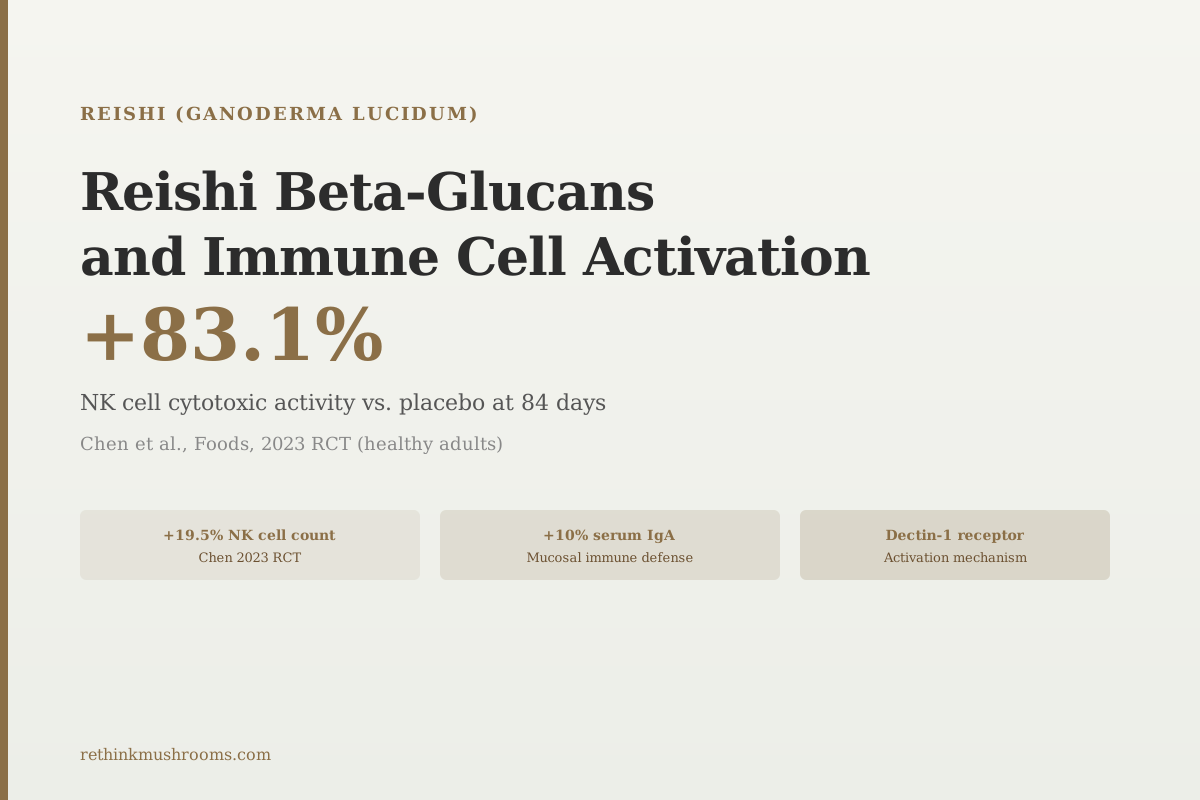
83.1% higher NK cell cytotoxic activity
In a 2023 randomized controlled trial of healthy adults, 84 days of reishi beta-glucan supplementation raised NK cell cytotoxic activity by 83.1% versus placebo, with a 19.5% rise in NK cell count and a 10% increase in serum IgA.
Chen et al., Foods, 2023
+19.5%
NK cell count increase at 84 days vs. placebo in healthy adults (Chen et al., Foods, 2023)
+10%
serum IgA increase in the same RCT, reflecting stronger mucosal immune defense
Dectin-1
the primary receptor on immune cells that recognizes and responds to reishi beta-glucans
Chen et al., Foods, 2023
 View as image ↗
Reishi beta-glucans are the specific carbohydrate structures that make reishi mushroom immunologically active. In a 2023 randomized controlled trial published in Foods, healthy adults who took reishi beta-glucan for 84 days showed NK cell cytotoxic activity 83.1% higher than the placebo group. That is not a mechanistic hypothesis. It is a measured outcome in a controlled study. Understanding what reishi beta-glucans immune cells means in practice requires understanding what these molecules are and how they trigger a response.
For the science behind reishi as a whole, see What Is Reishi Mushroom? The Science Behind the Mushroom of Immortality.
Key Takeaways
- Reishi's beta-glucans are β-1,3;β-1,6-D-glucans, a branched molecular structure that binds Dectin-1, CR3, and TLR2 receptors on immune cells, triggering NK cell and macrophage activation (Lin, J Pharmacol Sci, 2005)
- A 2023 RCT of healthy adult volunteers showed +83.1% NK cell cytotoxic activity, +19.5% NK cell count, and +10% serum IgA after 84 days of reishi beta-glucan supplementation; CD3+, CD4+, and CD8+ T-lymphocyte counts also increased (Chen et al., Foods, 2023)
- Reishi beta-glucans differ structurally from oat beta-glucans (β-1,3;β-1,4): the different branching pattern explains why reishi activates immune cell receptors while oat beta-glucans primarily lower cholesterol
- Beta-glucans from reishi also work through the gut: oral consumption enriches Bifidobacterium and Lactobacillus populations, increasing short-chain fatty acid production, which regulates immune cells throughout the body (Guo et al., Carbohydrate Polymers, 2021)
- A systematic review of RCTs found consistent NK cell and immune count improvements from fungal beta-glucans, with strongest effects in immunocompromised and elderly populations (Vlassopoulou et al., Food & Function, 2021)
- Beta-glucan immune effects work even from a food matrix: children consuming reishi beta-glucan-enriched yogurt for 12 weeks showed significantly higher CD8+ T-cell and NK cell counts vs. placebo (Henao et al., Int J Med Mushrooms, 2018)
What Makes Reishi Beta-Glucans Different from Oat Beta-Glucans
Every supplement label with "beta-glucan" listed as an ingredient is not talking about the same molecule. The beta-glucan category covers a family of carbohydrates with the same basic building block, glucose, arranged in very different configurations. That configuration determines what the molecule does in the body.
Oat beta-glucan, the kind found in oatmeal and oat fiber supplements, is a β-1,3;β-1,4-D-glucan. It forms a chain where glucose molecules are linked in two alternating patterns, creating a linear or slightly curved structure. This shape makes oat beta-glucan useful for cholesterol lowering: it forms a gel in the digestive tract that slows cholesterol absorption. The FDA has approved a health claim for oat beta-glucans and heart disease based on this mechanism.
Reishi beta-glucan is a β-1,3;β-1,6-D-glucan. The chain is primarily linked in one direction (β-1,3), with branches shooting off at regular intervals in a second direction (β-1,6). This creates a triple-helix structure in solution, with branches that project outward like a molecular bristle brush.
That branched structure is what matters for immune activation. The immune system's pattern recognition receptors for fungi are designed to detect exactly this kind of branched glucan structure. The branching signals "fungal cell wall" to immune cells, triggering a response. A linear glucan like oat beta-glucan fits those receptors poorly, because the branching pattern that the receptor is keyed to is absent.
This distinction has a practical consequence for supplement purchasing. A product labeled "high in beta-glucan" may be high in oat-derived beta-glucan, yeast beta-glucan, or mushroom beta-glucan. The immune effects documented in reishi research are specific to the β-1,3;β-1,6 structure. Listing beta-glucan content on a label without specifying the source and structural type does not indicate immune activity.[2]
How Dectin-1 Triggers the Immune Activation Cascade
When a macrophage or NK cell encounters a fungal pathogen, it identifies the threat using surface detectors called pattern recognition receptors. Dectin-1 is one of these receptors, specifically designed to recognize the branched beta-glucan structure on fungal cell walls.
Reishi's beta-glucans present that same structure. When Dectin-1 on a macrophage binds to a reishi beta-glucan, it triggers a chain of internal signals inside the cell.[2] The key signaling proteins involved are called Syk and CARD9. They relay the Dectin-1 signal to a master immune regulator called NF-kB. NF-kB activation switches on genes for cytokine production. Cytokines are the chemical signals immune cells use to communicate, coordinate, and escalate the response.
The result of this cascade: the macrophage becomes more aggressive at engulfing pathogens, releases cytokines that recruit other immune cells, and activates neighboring NK cells.
Reishi beta-glucans also bind two other receptors: CR3 (complement receptor 3) and TLR2 (toll-like receptor 2). Each receptor activates overlapping but distinct signaling pathways. TLR2 binding, for example, is particularly important for the dendritic cell activation that bridges the innate and adaptive immune responses.[3]
Dendritic cells are the messengers between the immune system's two branches. The innate branch responds immediately and non-specifically to anything that looks foreign. The adaptive branch responds more slowly but with precision, creating targeted antibodies and T-cells against specific pathogens. Ganoderma polysaccharides activated human dendritic cells in cell culture research, upregulating the surface molecules that dendritic cells use to present information to T-cells and triggering cytokine patterns consistent with adaptive immune activation.[7] For the full picture of how reishi connects innate and adaptive immunity, see How Reishi Modulates Innate and Adaptive Immunity.
The 2023 RCT: NK Cells, T-Cells, and IgA at 84 Days
Chen and colleagues ran a randomized controlled trial in healthy adult volunteers testing reishi beta-glucan supplementation against placebo over 84 days.[1]
NK cells (natural killer cells) are the immune system's rapid-response assassins. They identify and destroy infected cells and abnormal cells without needing prior exposure to the specific threat. NK cell cytotoxic activity measures how effectively each NK cell kills its target when it encounters one.
The reishi beta-glucan group showed NK cell cytotoxic activity 83.1% higher than placebo at 84 days. The NK cell count itself was 19.5% higher. These are large improvements for a healthy population where immune function is not impaired at baseline.
The trial also measured T-lymphocyte subpopulations. T-lymphocytes are the adaptive immune system's specialized soldiers. CD3+ cells are all T-lymphocytes; CD4+ cells are helper T-cells that coordinate the immune response; CD8+ cells are cytotoxic T-cells that directly kill infected or abnormal cells. All three counts increased significantly in the reishi beta-glucan group.
The CD4/CD8 ratio reflects the balance between coordinating T-cells and killing T-cells. This ratio is used clinically as a marker of immune health. The ratio improved in the reishi group.
Finally, serum IgA rose by 10%. IgA is an antibody concentrated in the mucous membranes of the respiratory and digestive tracts, the main entry points for pathogens. Higher IgA levels reflect stronger mucosal immunity, the kind that matters most for preventing respiratory infections.
This is the most complete human immune activation dataset available for reishi beta-glucans, and it comes from healthy adults, not a diseased or immunocompromised population. The effects were consistent across multiple immune readouts simultaneously.
The Gut Route: How Beta-Glucans Also Work Through the Microbiome
Not all of the immune effects from orally consumed reishi beta-glucans come from direct receptor binding. Some work through a longer path.
Guo and colleagues gave Ganoderma polysaccharides to animals and tracked what happened in the gut and to the immune system.[6] The beta-glucans changed the composition of the gut microbial community. Specifically, the populations of Bifidobacterium and Lactobacillus, two genera of bacteria associated with beneficial immune and metabolic effects, increased significantly.
Those bacteria then produced higher levels of short-chain fatty acids, small molecules made when gut bacteria ferment fiber. Short-chain fatty acids travel from the gut into the bloodstream. They interact with immune cells in the colon wall and in circulation, shifting those cells toward less inflammatory, more regulated behavior.
The result in the animal model was reduced colonic inflammation and reduced tumor formation, both outcomes driven by the immune cell changes that the short-chain fatty acids produced.
This gut-immune pathway means that reishi beta-glucans have at least two distinct routes to immune effect. One is direct: beta-glucan binds Dectin-1 on immune cells and activates them. The second is indirect: beta-glucan changes the gut microbial community, and the altered microbial community changes immune cell behavior throughout the body.
The gut pathway is entirely absent from consumer content about reishi immune effects. Most explanations focus solely on direct receptor binding. The indirect gut route helps explain why consistent daily supplementation over weeks (rather than a single dose) produces cumulative immune effects.
From Yogurt to Lab: Beta-Glucans Work in a Food Matrix Too
Consumer products increasingly incorporate reishi beta-glucans in food formats: functional beverages, enriched yogurts, and fortified foods. A question that follows is whether the beta-glucan retains its immune activity when embedded in a food matrix alongside other ingredients.
Henao and colleagues addressed this directly.[5] They conducted a randomized controlled trial in children in Medellin, Colombia, using yogurt enriched with reishi beta-glucans. Children who consumed the enriched yogurt for 12 weeks showed significantly higher CD8+ cytotoxic T-cell counts and NK cell counts compared to the placebo group.
The yogurt matrix did not prevent the immune effects. The beta-glucan molecule survives the food context and retains its biological activity.
This is relevant for understanding what drives immune effects from mushroom consumption. The active molecule is the beta-glucan structure itself, not some property of the raw mushroom or a specific supplement formulation. Whether it arrives via a capsule, a food product, or potentially via cooking with reishi mushrooms, the Dectin-1 binding activity of the glucan chain is the key variable.
For a comparison of extraction methods and their effect on beta-glucan content, see Hot Water Extract vs. Dual Extract vs. Raw Powder: Which Delivers More Beta-Glucans?.
What the Systematic Review of Fungal Beta-Glucan Trials Concluded
Individual trials show effects in specific populations. A 2021 systematic review by Vlassopoulou and colleagues synthesized the evidence across RCTs of fungal beta-glucans more broadly, covering multiple mushroom species including Ganoderma.[4]
The review found consistent improvements in immune cell counts and NK cell activity across the included trials. The effects were present in diverse populations. The strongest results appeared in immunocompromised subjects (cancer patients, people undergoing chemotherapy) and in the elderly, where immune function is reduced from the baseline level of healthy younger adults.
This pattern makes mechanistic sense. If beta-glucans work by bringing immune cell activity closer to an optimal state, the gains will be larger where there is more room for improvement. A healthy 25-year-old with vigorous NK cell activity may show smaller improvements than an elderly person whose NK cell function has declined with age.
The Chen 2023 RCT, which showed the 83.1% NK cytotoxic activity improvement in healthy adults, is an important counterpoint: even in people without immune compromise, the improvements were substantial. The baseline does not need to be low for the effect to be meaningful.
For what beta-glucans do beyond immune activation, including the emerging evidence on epigenetic reprogramming of immune cells, see How Beta-Glucans Epigenetically Reprogram Immune Cells. For reishi's immune effects during cancer treatment specifically, see Reishi for Immune Support During Chemotherapy. For the role of reishi triterpenes as the complement to beta-glucans, see How Reishi Triterpenes Differ from Polysaccharides in Mechanism.
The Bottom Line
Reishi beta-glucans are β-1,3;β-1,6-D-glucans that activate immune cells by binding Dectin-1, CR3, and TLR2 receptors. The structural distinction from oat beta-glucans explains why the immune effects are specific to mushroom-type beta-glucans. A 2023 RCT in healthy adults showed 83.1% higher NK cell cytotoxic activity, 19.5% higher NK cell count, and 10% higher IgA at 84 days. Beta-glucans also work through the gut microbiome as a second, indirect immune pathway.
Frequently Asked Questions
Sources & References
- 1. Source details for this reference are not yet available.
- 2. Source details for this reference are not yet available.
- 3. Source details for this reference are not yet available.
- 4. Source details for this reference are not yet available.
- 5. Source details for this reference are not yet available.
- 6. Source details for this reference are not yet available.
- 7. Source details for this reference are not yet available.