Reishi (Ganoderma lucidum)
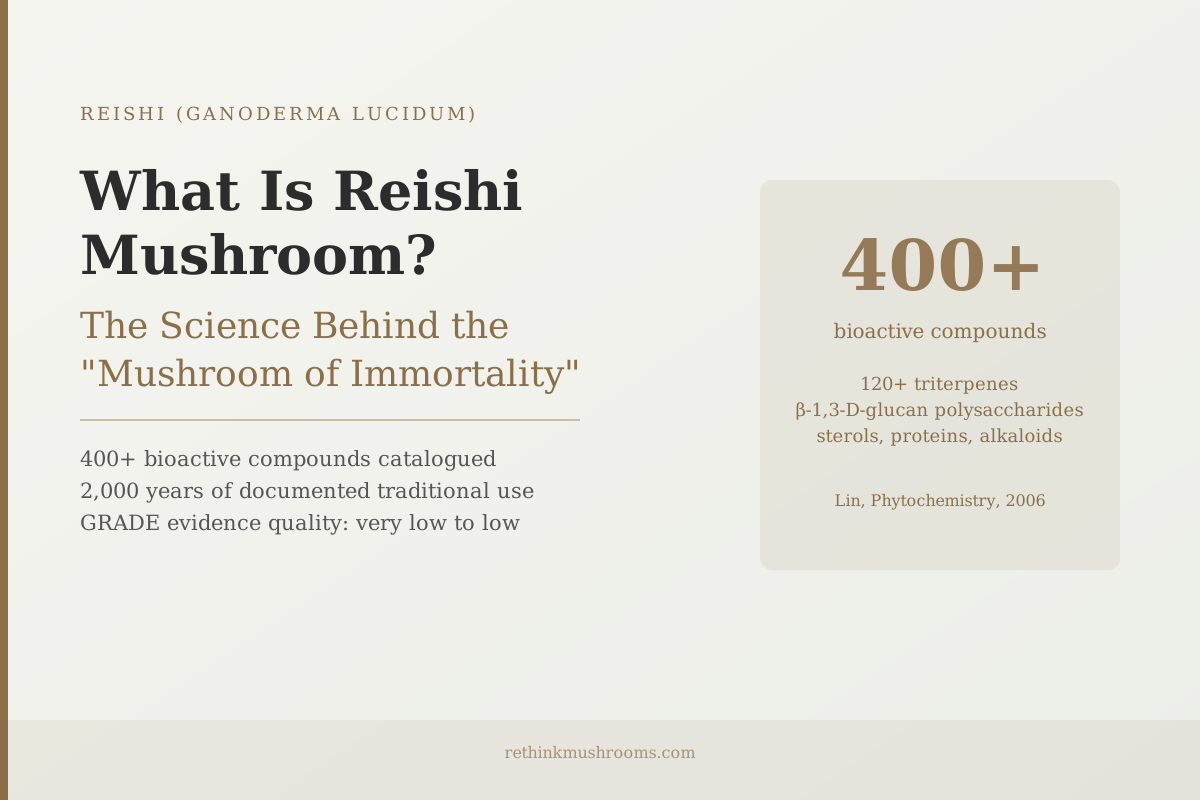
400+ bioactive compounds
Ganoderma lucidum contains over 400 distinct bioactive compounds across triterpenes, polysaccharides, proteins, alkaloids, and sterols — more chemical diversity than nearly any other medicinal fungus studied.
Paterson, Phytochemistry, 2006
2,000 years
of documented use in traditional Chinese medicine as lingzhi
120+ triterpenes
unique to Ganoderma — the compound class responsible for its bitter taste and anti-inflammatory effects
GRADE: very low
evidence quality rating across all outcomes in the 2025 clinical trial meta-analysis (Jafari et al.)
Paterson, Phytochemistry, 2006
 View as image ↗
Reishi mushroom — known as lingzhi in Chinese and reishi or mannentake in Japanese — is a polypore bracket fungus in the genus Ganoderma. It grows on the base of decaying hardwood trees, particularly oak, plum, and maple. The fruiting body is characterized by a kidney-shaped cap with a distinctive glossy, lacquered red-to-reddish-brown surface and white pore surface underneath.
It is one of the most studied medicinal mushrooms in the world, with documented use in Chinese pharmacopeia dating back more than 2,000 years. Research has catalogued over 400 distinct bioactive compounds across multiple chemical classes, including more than 120 triterpenes unique to Ganoderma.[1]
There is a complication that most guides skip over: the mushroom sold as reishi or Ganoderma lucidum in Western supplements is almost certainly a different species than the G. lucidum described in European mycological literature. The taxonomy of Ganoderma is genuinely complex — more than 180 species have been described — and the Asian medicinal mushroom most studied is now classified as G. lingzhi or G. sichuanense, not G. lucidum sensu stricto. This naming problem affects most commercial products and is covered in depth in Ganoderma lucidum Taxonomy: How to Identify Authentic Reishi Species.
This article covers what reishi is biologically, what its major compound classes are, what the mechanism evidence shows, what human clinical trials demonstrate, and what the safety picture looks like — including the cases the supplement industry rarely mentions.
Key Takeaways
- Reishi (Ganoderma lucidum/G. lingzhi) is a polypore bracket fungus with over 400 catalogued bioactive compounds, including 120+ species-specific triterpenes (ganoderic acids) and beta-1,3-D-glucan polysaccharides
- The two primary compound classes act through distinct mechanisms: polysaccharides activate immune cells via TLR-4 and NK cell signaling; triterpenes suppress inflammation via NF-κB and MAPK pathway downregulation
- A 2025 GRADE-assessed meta-analysis of clinical trials (Jafari et al.) rated the overall quality of human evidence as very low across all outcomes, finding significant effects only in specific subgroups (younger patients, lower doses)
- A 2005 double-blind RCT of 132 participants found reishi polysaccharide extract significantly improved fatigue and well-being compared to placebo over 8 weeks — the most-cited human RCT for reishi
- Safety profile is generally favorable in controlled trials (Wicks 2007), but rare but serious hepatotoxicity cases exist: a fatal fulminant hepatitis case in 2007 and a 2023 acute liver injury case report are in the literature and should not be dismissed
- Reishi inhibits platelet aggregation and may interact with anticoagulants and immunosuppressive drugs — disclosure to a prescribing physician is essential for anyone taking these medications
Two Thousand Years of Use: What Lingzhi Refers To
Lingzhi (灵芝) is a Chinese term combining characters meaning "spirit/divine" and "fungus/plant" — roughly translatable as "divine fungus" or "mushroom of spiritual potency." It appears in the Shennong Bencao Jing, a Chinese pharmacopeia believed to date to around 200 CE, classified as a superior herb suitable for long-term use.
The Japanese term reishi (霊芝) is the Japanese reading of the same characters. Mannentake (万年茸, "10,000-year mushroom") is the poetic Japanese name that connects to the Western marketing phrase "mushroom of immortality." The immortality framing is a traditional cultural attribution, not a pharmacological claim.
Traditional use spanned immune support, liver function, longevity, and "spirit calming" — what modern Chinese medicine terms shen tonification, associated with anxiety reduction and improved sleep. These traditional uses inform which biological targets researchers have focused on.
The formal taxonomy matters because the research literature is not unified. Studies conducted in China and Japan use G. lingzhi and the broader term Ganoderma interchangeably with G. lucidum. A 2023 comparative review by Łysakowska and colleagues places reishi within the broader medicinal mushroom landscape as distinct from turkey tail, lion's mane, chaga, and cordyceps by virtue of its unique triterpene profile — the 120+ ganoderic acids that are characteristic of Ganoderma genus and are essentially absent from other medicinal mushrooms.[13]
What Makes Reishi Chemically Unusual: The 400-Compound Inventory
A 2006 review by Paterson catalogued the full range of known bioactive compounds in G. lucidum — over 400 distinct molecules across five major chemical classes.[1]
The three classes with the strongest evidence:
Triterpenes (ganoderic acids and relatives): More than 120 distinct triterpene compounds unique to Ganoderma have been identified. They are alcohol-soluble and are responsible for reishi's characteristic bitter taste. Ganoderic acid A, B, C, and D are the most studied. A 2025 updated review by Ren and colleagues characterizes these as the primary anti-inflammatory, hepatoprotective, and cholesterol-modulating agents in reishi.[5]
Polysaccharides (beta-D-glucans and heteropolysaccharides): Water-soluble long-chain sugars built on a beta-1,3-D-glucan backbone with various branching patterns. These are the immune-activating fraction — they bind pattern recognition receptors on immune cells. Polysaccharides from both the fruiting body and spores have been characterized, with structural differences between the two sources.[12]
Sterols (ergosterol and others): Ergosterol is the primary fungal sterol and the precursor to vitamin D2 on UV exposure. Reishi also contains additional steroidal compounds with proposed anti-inflammatory and lipid-modulating activities.
The practical implication: these compound classes require different extraction solvents. Hot water extracts polysaccharides; ethanol or alcohol extracts triterpenes. A reishi supplement extracted only with hot water captures the immune-active polysaccharides but loses the anti-inflammatory triterpenes. A supplement extracted only with ethanol captures triterpenes but loses polysaccharides. Dual-extraction products capture both. For a full breakdown of compound classes and extraction methodology, see Reishi Bioactive Compounds: Triterpenes, Polysaccharides, and Sterols.
How Reishi Works: The Two Primary Mechanisms
The immune modulation and anti-inflammatory effects operate through distinct molecular pathways corresponding to the two major compound classes.
Polysaccharides and immune activation: Beta-glucan polysaccharides bind to Toll-Like Receptor 4 (TLR-4) and other pattern recognition receptors on macrophages, dendritic cells, and NK cells. TLR-4 activation triggers the NF-kappa-B transcription factor, which drives production of pro-inflammatory cytokines including IL-1-beta, IL-2, IL-6, interferon-gamma, and TNF-alpha. A 2005 review by Lin mapped this mechanism in detail and established the foundational framework: reishi polysaccharides act as immunomodulators, amplifying immune cell activity through cytokine-driven signaling.[2]
A 2019 comprehensive review by Wang and Lin — 37 pages covering the entire immunomodulation literature through 2019 — confirmed that TLR-4 signaling is the primary pathway for polysaccharide-mediated immune activation, and showed how this extends to modulation of T cell subsets (Th1/Th2 balance), B cell antibody production, and NK cell cytotoxic activity.[3]
Triterpenes and inflammation suppression: Ganoderic acids suppress NF-kappa-B and MAPK (mitogen-activated protein kinase) signaling, reducing downstream production of inflammatory mediators including COX-2, TNF-alpha, IL-1-beta, and IL-6. A 2026 systematic review and meta-analysis by Pozzobon and colleagues, synthesizing 23 preclinical studies, confirmed this pathway with the most rigorous statistical analysis of triterpene anti-inflammatory mechanisms available — finding significant reductions in TNF-alpha, IL-1-beta, and IL-6 through MAPK and TLR-4/NF-kappa-B downregulation.[14]
This dual mechanism — polysaccharides activating immune response when needed, triterpenes dampening excessive inflammation — is why researchers characterize reishi as an immunomodulator rather than a simple immune booster. The same compound source can activate immune surveillance and suppress chronic inflammatory signaling, depending on context.
For detailed mechanistic pathways including the gut microbiome angle and lipid metabolism evidence, see The Pharmacology of Ganoderma lucidum: How Reishi Works.
The Human Clinical Evidence: What Trials Actually Show
Human trials are where reishi's evidence base becomes more constrained.
The most-cited controlled trial remains Tang and colleagues' 2005 double-blind, placebo-controlled RCT enrolling 132 participants with neurasthenia (characterized by fatigue and weakness).[8] Over 8 weeks, the reishi polysaccharide extract group showed significantly improved fatigue scores and sense of well-being compared to placebo. This is a well-designed study with a clear outcome — but it addresses a fatigue-specific population, not general wellness or any specific disease.
Tang et al. (2005) · Journal of Medicinal Food
- Population
- 132 adults with neurasthenia (chronic fatigue and weakness)
- Intervention
- Reishi polysaccharide extract, 8 weeks
- Comparator
- Matched placebo (double-blind)
- Finding
- Significantly improved fatigue scores and sense of well-being versus placebo
narrow-scope A well-designed trial, but in a fatigue-specific population — it does not establish general-wellness or disease-specific benefit.
Tang W, et al. Journal of Medicinal Food, 2005.
A 2025 GRADE-assessed systematic review and meta-analysis by Jafari and colleagues represents the most rigorous current synthesis of the human clinical literature.[6] Covering clinical trials using doses from 200 to 11,200 mg per day for 1 to 24 weeks, the meta-analysis found:
- Significant improvements in BMI in subgroups receiving low doses (under 1,400 mg/day) or in younger patients (under 50 years)
- Significant reduction in MDA (a marker of oxidative stress) in subgroups
- No significant effect on blood pressure, fasting glucose, or lipid profile in the overall analysis
- Evidence quality rated very low across all outcomes under GRADE criteria
That final rating is worth understanding. GRADE (Grading of Recommendations Assessment, Development and Evaluation) is the evidence evaluation standard used by major medical organizations. A "very low" rating means the effect estimates are uncertain and future studies could substantially change the conclusions. It does not mean reishi does not work. It means the trials conducted so far are too small, too heterogeneous in their protocols, or have too high a risk of bias to produce confident conclusions.
This is the honest state of the evidence: mechanistically strong, clinically suggestive, not yet conclusive in the way that would satisfy evidence-based medicine standards.
Reishi for Specific Conditions: What the Evidence Supports
The most consistent human evidence clusters around three outcome areas:
Fatigue and well-being: The Tang 2005 RCT provides the strongest data here, specifically for fatigue-affected populations. The earlier Lin 2005 review places this in the context of NK cell activation — reishi-mediated immune enhancement may contribute to reduced fatigue perception in the setting of chronic low-grade inflammation.[2]
Cancer adjunct use: A 2014 review by Guggenheim and colleagues, the most-cited integrative oncology mushroom reference, positions reishi within a five-mushroom panel for cancer support based on its anti-angiogenic and apoptosis-inducing preclinical evidence and the immune activation mechanisms.[7] The cancer adjunct evidence for reishi is primarily from quality-of-life studies (fatigue reduction in cancer patients) rather than survival trials — the latter is where turkey tail's PSK has much stronger data.
Immune function: The mechanistic evidence for NK cell and macrophage activation is consistent across reviews. Whether this translates to measurable real-world immune outcomes (infection rates, recovery times) in healthy populations has not been rigorously studied.
A 2025 pharmacology review by Sarkar and colleagues integrating the full evidence base acknowledges that while the mechanistic science is well-characterized, the translation to human clinical outcomes remains constrained by small trial sizes and variable product quality across studies.[4]
Spores vs. Fruiting Body: A Brief on Forms
Reishi is sold in multiple forms: dried whole mushroom, powdered fruiting body, powdered spores, hot water extract, ethanol extract, and dual extracts. Each has a different bioactive profile.
Spores are the reproductive particles released from the pore surface of the fruiting body. They are reported to be highly concentrated in certain triterpenes and contain a distinct oil fraction (reishi spore oil) rich in ergosterol and fatty acids. A 2023 systematic review by Thuy and colleagues covering spore-specific pharmacology found antitumor, hepatoprotective, and immunomodulatory activities with generally favorable safety — but noted that intact spores have very low bioavailability because the spore wall (sporoderm) is biologically indigestible.[12] "Cracked spore" or "broken sporoderm" processing exists to address this.
Whole mushroom powder captures most compound classes but at lower concentrations than extracts. Hot water extract captures polysaccharides. Alcohol/ethanol extract captures triterpenes. A properly made dual extract captures both.
For a detailed examination of fruiting body versus mycelium compound profiles, see Do Fruiting Bodies Have More Bioactive Compounds Than Mycelium?. For why dual extraction matters, see Double-Extraction Mushroom Tinctures: Why Alcohol + Water Captures More Compounds.
The Safety Picture: Mostly Favorable, with Real Exceptions
A 2007 double-blind, placebo-controlled trial by Wicks and colleagues in healthy subjects found no significant adverse events with reishi supplementation, establishing a baseline safety profile for short-term use in healthy adults.[9]
That baseline needs qualification.
In 2007, Wanmuang and colleagues published a case report of fatal fulminant hepatitis in a woman who consumed powdered Lingzhi for 2 months.[10] The causality was attributed to the reishi powder. In 2023, a second acute liver injury case associated with reishi consumption was reported in the literature.[11]
Two case reports over 18 years — against millions of users worldwide — does not indicate a high-frequency risk. But hepatotoxicity, even when rare, is serious, and these cases should not be omitted from any honest guide. People with pre-existing liver disease or those taking hepatotoxic medications face elevated risk. People on anticoagulants (reishi inhibits platelet aggregation[15]), blood pressure medications, or immunosuppressants should discuss reishi with their prescribing physician before use, given the potential for pharmacokinetic interactions.
Safety
ModerateRare hepatotoxicity and bleeding-risk interactions
Concern
Reishi is well-tolerated in controlled trials, but the literature includes a fatal fulminant hepatitis case (2007) and a 2023 acute liver injury case associated with reishi powder. Reishi also inhibits platelet aggregation, which can compound the bleeding risk of anticoagulants.
What the research says
Two hepatotoxicity case reports across 18 years against millions of users is a low absolute frequency, but the events are serious. Controlled trials (Wicks 2007) and the Jafari 2025 meta-analysis found no major safety signals, though trial durations rarely exceeded 6 months.
Particularly relevant for: People with liver disease; those on anticoagulants (warfarin, heparin, blood-thinning aspirin), blood pressure medication, or immunosuppressants; and pregnant or breastfeeding women (no safety data).
What to do
Disclose reishi use to your prescribing physician before starting if you take any of these medications or have liver disease. This is general information, not medical advice.
Wanmuang 2007; Guedikian 2023; Tao 1990 (platelet aggregation); Wicks 2007; Jafari 2025.
The Jafari 2025 meta-analysis noted no major safety signals across reviewed clinical trials, consistent with the Wicks 2007 finding — but also noted that trial durations rarely exceeded 6 months, meaning long-term safety data is limited.[6]
How Reishi Compares to Other Medicinal Mushrooms
Within the medicinal mushroom landscape, reishi occupies a distinctive position defined by its triterpene profile. No other commonly used medicinal mushroom has a comparable diversity of triterpene compounds. Turkey tail has strong clinical evidence for cancer adjuvancy, with multiple randomized controlled trials of PSK spanning thousands of patients. Lion's mane has unique neurotrophin-stimulating compounds (hericenones and erinacines). Chaga has high antioxidant capacity from melanins.
The 2014 Guggenheim review — which covers reishi, turkey tail, shiitake, maitake, and chaga — places reishi as the strongest candidate for anti-angiogenic and apoptosis-related mechanisms in cancer context, based on its triterpene pharmacology.[7] But for the cancer adjuvant clinical evidence, turkey tail's PSK data outperforms reishi's clinical trial base substantially.
Reishi's strongest comparative advantage is its unique bitter-compound chemistry — the ganoderic acid family — combined with its long traditional safety record. Its clinical evidence is less mature than its mechanistic science, which is a common pattern across medicinal mushrooms generally.
For a species-by-species comparison of Ganoderma, see Red Reishi vs. Other Ganoderma Species: Key Differences.
The Bottom Line
Reishi mushroom (Ganoderma lucidum/G. lingzhi) contains over 400 bioactive compounds, with beta-glucan polysaccharides activating immune cells via TLR-4 signaling and triterpenes suppressing inflammation via NF-κB/MAPK downregulation. The human clinical evidence is suggestive but limited: a 2025 GRADE meta-analysis rated evidence as very low quality across all outcomes, while a 2005 RCT of 132 participants showed significant fatigue improvement. Safety is generally favorable in controlled trials, but rare hepatotoxicity cases require disclosure to prescribing physicians for patients with liver disease or those on anticoagulants.
Frequently Asked Questions
Sources & References
- 1RTHM-00107·Paterson, R Russell M (2006). “Ganoderma - a therapeutic fungal biofactory..” Phytochemistry.Study breakdown →PubMed →↩
- 2RTHM-00084·Lin, Zhi-Bin (2005). “Cellular and molecular mechanisms of immuno-modulation by Ganoderma lucidum..” Journal of pharmacological sciences.Study breakdown →PubMed →↩
- 3RTHM-00594·Wang, Xin et al. (2019). “Immunomodulating Effect of Ganoderma (Lingzhi) and Possible Mechanism..” Advances in experimental medicine and biology.Study breakdown →PubMed →↩
- 4RTHM-02175·Sarkar, Tumpa et al. (2025). “Reishi Mushroom (Ganoderma lucidum): pharmacology of a potent healer in traditional Chinese medicine..” Natural product research.Study breakdown →PubMed →↩
- 5RTHM-02166·Ren, Sizhu et al. (2025). “A Review of Bioactive Components and Pharmacological Effects of Ganoderma lucidum..” Food science & nutrition.Study breakdown →PubMed →↩
- 6RTHM-02098·Jafari, Ali et al. (2025). “The Nutritional Significance of Ganoderma lucidum on Human Health: A GRADE-Assessed Systematic Review and Meta-Analysis of Clinical Trials..” Food science & nutrition.Study breakdown →PubMed →↩
- 7RTHM-00323·Guggenheim, Alena G et al. (2014). “Immune Modulation From Five Major Mushrooms: Application to Integrative Oncology..” Integrative medicine (Encinitas.Study breakdown →PubMed →↩
- 8RTHM-00088·Tang, Wenbo et al. (2005). “A randomized, double-blind and placebo-controlled study of a Ganoderma lucidum polysaccharide extract in neurasthenia..” Journal of medicinal food.Study breakdown →PubMed →↩
- 9RTHM-00123·Wicks, Sheila M et al. (2007). “Safety and tolerability of Ganoderma lucidum in healthy subjects: a double-blind randomized placebo-controlled trial..” The American journal of Chinese medicine.Study breakdown →PubMed →↩
- 10RTHM-00122·Wanmuang, Harirak et al. (2007). “Fatal fulminant hepatitis associated with Ganoderma lucidum (Lingzhi) mushroom powder..” Journal of the Medical Association of Thailand = Chotmaihet thangphaet.Study breakdown →PubMed →↩
- 11RTHM-00826·Guedikian, Roupen et al. (2023). “Ganoderma lingzhi (Reishi Mushroom)-Induced Acute Liver Injury in the Setting of Alcohol Use: A Case Report and Review of the Literature..” Cureus.Study breakdown →PubMed →↩
- 12RTHM-01802·Thuy, Nguyen Huu Lac et al. (2023). “Pharmacological Activities and Safety of Ganoderma lucidum Spores: A Systematic Review..” Cureus.Study breakdown →PubMed →↩
- 13RTHM-00843·Łysakowska, Paulina et al. (2023). “Medicinal Mushrooms: Their Bioactive Components, Nutritional Value and Application in Functional Food Production-A Review..” Molecules (Basel.Study breakdown →PubMed →↩
- 14RTHM-02241·Pozzobon, Rafaela Guedes et al. (2026). “Anti-Inflammatory Potential of Ganoderma lucidum Triterpenes: A Systematic Review and Meta-Analysis of Preclinical Evidence..” Pharmaceuticals (Basel.Study breakdown →PubMed →↩
- 15RTHM-00011·Tao, J et al. (1990). “Experimental and clinical studies on inhibitory effect of ganoderma lucidum on platelet aggregation..” Journal of Tongji Medical University = Tong ji yi ke da xue xue bao.Study breakdown →PubMed →↩