Mushroom Tinctures & Extraction Methods
2 compound classes, 2 opposite solubility profiles
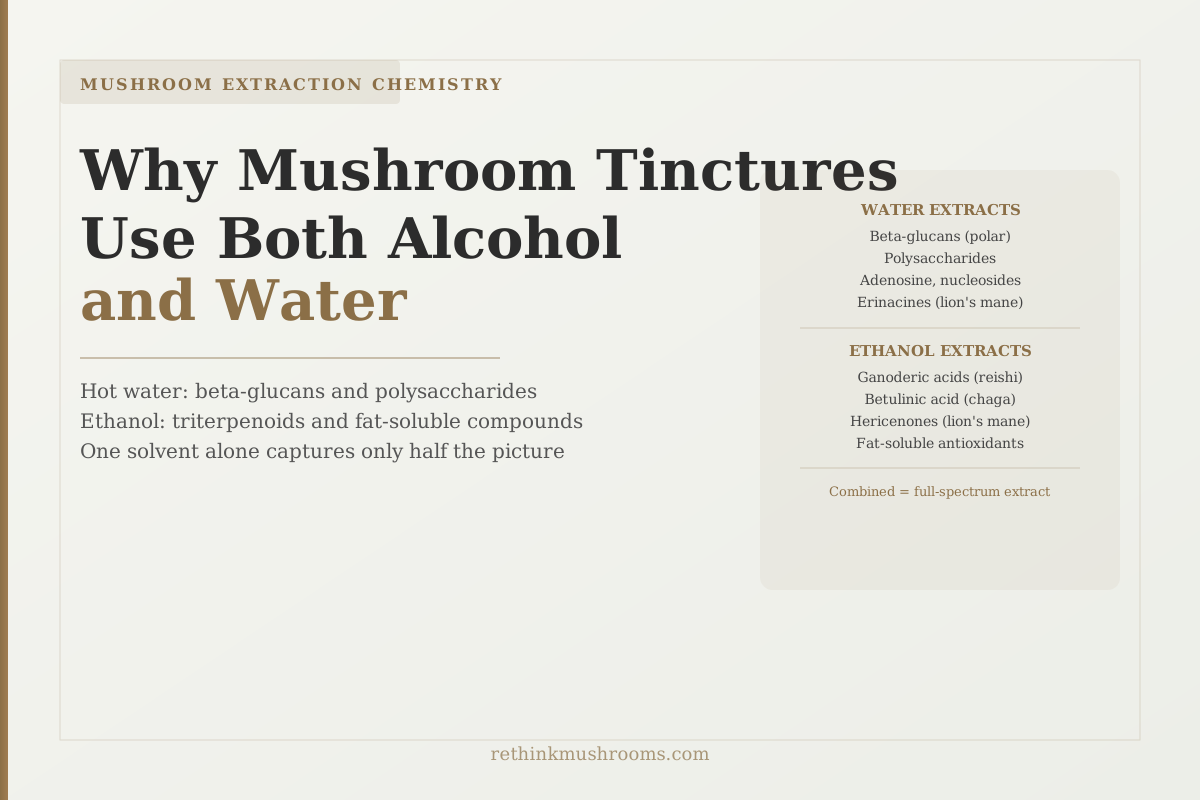
Mushroom bioactives divide into water-soluble compounds (beta-glucans) and alcohol-soluble compounds (triterpenoids). Hot water extracts one; ethanol extracts the other. A single-solvent tincture captures only half the picture.
Optimization study, 2020 (PMID:33382761)
Water
extracts beta-glucans but leaves triterpenoids behind
Ethanol
extracts triterpenoids but not beta-glucans
Both solvents
needed for reishi and chaga full-spectrum extracts
Optimization study, 2020 (PMID:33382761)
 View as image ↗
A mushroom tincture is only as complete as its extraction method. Most of the research attention on medicinal mushrooms focuses on beta-glucans, the complex sugars in mushroom cell walls that activate immune receptors. Beta-glucans dissolve in hot water. They do not dissolve in alcohol. But mushrooms like reishi and chaga contain a second major class of bioactive compounds, the triterpenoids, that are virtually insoluble in water and require alcohol to come out. Single-solvent tinctures, whether alcohol-only or water-only, leave one of these compound classes behind. Double extraction, which uses hot water followed by an ethanol soak and combines both extracts, is designed to capture both classes in one bottle. This article explains why the two solvents are necessary, what the chemistry actually is, and which mushrooms benefit most from the double-extraction process. The companion article Double-Extraction Tinctures: What Makes Them Superior covers the value question; this one goes deeper into the molecular mechanism. For a broader look at mushroom product formats, see Mushroom Coffee: What Is It and Does It Actually Work?.
Key Takeaways
- Mushroom bioactives divide into two groups by solubility: polysaccharides (including beta-glucans) are polar and water-soluble; triterpenoids are non-polar and alcohol-soluble
- Hot water extraction efficiently releases polysaccharides from mushroom cell walls, but leaves triterpenoids untouched. This is confirmed by Leong et al.'s 2021 review of polysaccharide extraction methods
- Ethanol extraction captures triterpenoids that hot water cannot dissolve; Petrović et al. (2014) found ethanol and water extracts had significantly different compound profiles and different biological activities
- The hot water decoction step also softens and ruptures chitin cell walls, making the subsequent alcohol extraction more efficient than alcohol alone would be on whole dried mushroom
- Reishi and chaga require double extraction because their two most-studied compound classes, polysaccharides and triterpenoids, have opposite solubility profiles
- Lion's mane is an exception: its primary neuroactive compounds (erinacines) are water-soluble, making hot water extraction sufficient for the main NGF-stimulating effects
Two Compound Classes With Opposite Chemistry
Understanding why double extraction works requires one piece of basic chemistry: polarity.
Polarity describes how well a molecule mixes with water versus how well it mixes with oils and fats. Water is a polar solvent; it dissolves other polar molecules. Ethanol is partially polar, which is why it mixes with water, but it is far better than water at dissolving non-polar molecules. The rule of chemistry is "like dissolves like": polar compounds dissolve in polar solvents (water), and non-polar compounds dissolve in non-polar solvents (oils, alcohols).
Mushroom bioactive compounds split neatly along this polarity line.
Beta-glucans and other polysaccharides are large, polar molecules built from repeating sugar units. They mix readily with water and are routinely extracted using hot water in both research and commercial production. Leong et al.'s 2021 comprehensive review of polysaccharide extraction methods from edible mushrooms confirmed hot water as the standard and most effective solvent for mushroom polysaccharides, noting that temperature, time, and water-to-mushroom ratio are the key variables for maximizing yield.[2]
Triterpenoids are a different structural class entirely. These are compounds built from isoprene units into multi-ring structures with a strongly non-polar character. In reishi, the best-studied triterpenoids are the ganoderic acids, a family of compounds that give reishi its characteristic bitter taste. In chaga, the prominent triterpenoids include betulinic acid and inotodiol. These compounds are fat-soluble. Hot water cannot dissolve them in meaningful quantities. Ethanol can.
A 2020 laboratory study on optimizing extraction conditions systematically tested how well different solvents extracted each compound class and confirmed that polysaccharides and triterpenoids have fundamentally different optimal solvents and extraction conditions, establishing that optimizing for one class under-extracts the other.[1] You cannot extract both compound classes with one solvent pass.
| Compound class | Polarity | Best solvent | Mushroom examples |
|---|---|---|---|
| Beta-glucans (polysaccharides) | Polar | Hot water (90-95°C) | All mushrooms; primary class in turkey tail, lion's mane |
| Triterpenoids | Non-polar | 40-60% ethanol | Reishi (ganoderic acids), chaga (betulinic acid) |
| Hericenones | Moderately non-polar | Ethanol | Lion's mane fruiting body |
| Erinacines | Polar | Water | Lion's mane mycelium |
| Melanin complexes | Mixed | Water | Chaga |
What Hot Water Actually Does to Mushroom Material
Hot water does two things simultaneously in the first extraction step.
First, it dissolves water-soluble compounds into the liquid. Beta-glucans, water-soluble polysaccharides, nucleosides like adenosine, and water-soluble antioxidants all pass into the hot water extract during this step.
Second, heat breaks down the mushroom's structural material. Mushroom cell walls are made primarily of chitin, the same tough structural material found in insect exoskeletons and crab shells. Chitin does not dissolve in water, but sustained heat at near-boiling temperatures softens it, causing cell walls to rupture and release their intracellular contents into the water. Without heat, many beta-glucans that are tightly bound within the cell wall structure remain trapped and unavailable.
Palanisamy et al. (2014) demonstrated the importance of temperature in polysaccharide extraction efficiency, using pressurized water to achieve beta-glucan-enriched fractions and showing that elevated temperature is critical for maximizing yield from the cell wall matrix.[3] A longer, hotter decoction achieves better beta-glucan extraction than a brief low-temperature soak.
The practical implication for double extraction: the hot water step is not just about dissolving water-soluble compounds. It is also physically breaking down the mushroom's structural barriers. This has a direct consequence for the second extraction step.
What Ethanol Extraction Captures That Hot Water Missed
After the hot water decoction, the spent mushroom material still contains the full triterpenoid load. Water never touched those compounds.
When the spent mushroom material is then soaked in ethanol (typically 40-60% ethanol, which is roughly the alcohol content of vodka to a mild spirit), the triterpenoids dissolve into the alcohol. The ethanol passes through the cell walls, now softened and partially ruptured by the hot water step, and draws out the fat-soluble compounds.
Petrović et al. (2014) directly compared water, ethanol, and methanol extracts from wild mushrooms and found significantly different bioactivity profiles depending on solvent choice.[4] The ethanol extracts showed superior antimicrobial activity and a different antioxidant profile than the water extracts. Importantly, the difference was not just quantitative (more antioxidants) but qualitative (different types of antioxidants), confirming that ethanol and water are capturing different compound classes with different biological effects.
Fogarasi et al. (2021) arrived at similar conclusions in a systematic solvent comparison on edible mushrooms, finding that extraction solvent is the primary determinant of which antioxidant compounds end up in the final extract and in what amounts.[5] The choice of solvent is not a minor technical variable. It determines the compound profile of the product.
This is why glycerin, which is sometimes used as an alcohol-free alternative in tinctures, produces a different result from ethanol. Glycerin is a polar solvent, similar in polarity to water. It extracts polysaccharides reasonably well but cannot dissolve non-polar triterpenoids effectively. For mushrooms where the triterpenoid fraction is biologically significant, glycerin-based tinctures are not equivalent to ethanol-based ones. For more on that comparison, see Mushroom Tinctures: Alcohol vs. Glycerin Extraction.
The Cell Wall Advantage: Why Doing Both Steps in Sequence Works Better
Here is a mechanism that no competitor explains and that the research supports: the hot water step in double extraction makes the subsequent alcohol step more effective than it would be on untreated dry mushroom material.
Chitin cell walls act as a barrier. When mushroom material is dried and stored, those walls are intact and tough. Alcohol will penetrate them and extract triterpenoids, but slowly and incompletely. When the mushroom has first been simmered in hot water, the cell walls are partially broken down. The cell structure is more porous. The spent decocted material is more accessible to a solvent than whole dried mushroom powder would be.
The optimization study from 2020 that examined extraction conditions for both compound classes noted that sequential extraction processes, where each step builds on the physical changes made by the previous step, produce higher yields than treating each solvent as independent.[1] Double extraction is not just two separate single-extraction procedures run back to back. The steps are biochemically linked.
This is one reason why some DIY double-extraction protocols recommend using the spent mushroom material from the hot water decoction directly for the alcohol maceration, rather than starting with fresh dried mushroom for each step.
Which Mushrooms Need Both Steps, and Which Can Get Away With One
Not all mushrooms have equal triterpenoid content. Double extraction matters most where both compound classes are biologically significant.
Reishi is the species that most clearly requires double extraction. Reishi's polysaccharides (beta-glucans) and its triterpenoids (ganoderic acid family) are both extensively studied, and they have different biological effects. A water-only reishi extract captures the immune-modulating polysaccharide fraction but completely misses the bitter triterpenoid fraction. An alcohol-only extract does the reverse. Full-spectrum reishi extraction requires both.
Chaga similarly contains both polar and non-polar compounds of interest. Its polysaccharide fraction (including beta-glucans) is water-soluble. Its triterpenoid compounds, including betulinic acid and inotodiol, require alcohol for meaningful extraction. Single-solvent chaga products are leaving part of the compound profile behind.
Lion's mane presents a more nuanced picture. The compounds most commonly associated with lion's mane's neuroactive effects divide between two structural types: erinacines (found in the mycelium) are water-soluble and come out in hot water extraction. Hericenones (found primarily in the fruiting body) are more lipophilic and require ethanol. For fruiting body lion's mane products, double extraction captures both classes. For mycelium-based products, the relevant erinacines are water-accessible, making hot water extraction sufficient for the main neuroactive compounds.
Turkey tail is primarily a polysaccharide-centric mushroom with a relatively minor triterpenoid fraction. Its best-documented compounds, PSK (polysaccharide K, also called krestin) and PSP, are water-soluble. Turkey tail tinctures built on hot water extraction are capturing the most-studied compound class. Double extraction adds minor non-polar components, but the benefit is less dramatic than with reishi or chaga.
What the Research Shows About Compound Yield Differences
The research studies available on extraction methods consistently show that solvent choice is not a subtle variable. It produces dramatically different compound profiles in the final extract.
Petrović et al. (2014) measured the bioactivity of water and ethanol extracts from the same mushroom and found the ethanol extract showed superior antimicrobial activity while the water extract had higher polysaccharide content.[4] These are not two versions of the same extract with slightly different potencies. They are extracts with different compound compositions and, as a result, different biological activities.
Fogarasi et al. (2021) quantified this directly for antioxidant compounds, showing that the total antioxidant capacity and the specific antioxidant compound profile both varied substantially with solvent choice.[5] The same mushroom material extracted with different solvents produces different products.
The implication for consumers reading product labels: "mushroom tincture" is not a single standardized product. A hot-water-only tincture of reishi and a double-extracted tincture of reishi are different products with different compound profiles. The chemistry tells you which is capturing more of what the research has actually studied. For a practical look at making this kind of tincture yourself, see How to Make Your Own Mushroom Tincture at Home. For a comparison of how the delivery format (tincture vs. capsule) affects what you get, see Are Mushroom Tinctures More Effective Than Capsules?.
The Bottom Line
Mushroom bioactive compounds split into two classes by solubility: polysaccharides (including beta-glucans) are polar and water-soluble; triterpenoids are non-polar and require ethanol. Each solvent captures its respective class; neither captures both. Double extraction solves this by running a hot water decoction and an ethanol maceration sequentially and combining the extracts. The hot water step also ruptures chitin cell walls, making the subsequent alcohol step more efficient. Reishi and chaga require double extraction most critically; lion's mane's main neuroactive compounds are predominantly water-soluble.
Frequently Asked Questions
Sources & References
- 1RTHM-00668·Zheng, Shizhong et al. (2020). “Optimization of ultrasonic-assisted extraction of polysaccharides and triterpenoids from the medicinal mushroom Ganoderma lucidum and evaluation of their in vitro antioxidant capacities..” PloS one.Study breakdown →PubMed →↩
- 2RTHM-01383·Leong, Yoong Kit et al. (2021). “Extraction of polysaccharides from edible mushrooms: Emerging technologies and recent advances..” Carbohydrate polymers.Study breakdown →PubMed →↩
- 3RTHM-00342·Palanisamy, Marimuthu et al. (2014). “Pressurized water extraction of β-glucan enriched fractions with bile acids-binding capacities obtained from edible mushrooms..” Biotechnology progress.Study breakdown →PubMed →↩
- 4RTHM-00346·Petrović, Jovana et al. (2014). “Different extraction methodologies and their influence on the bioactivity of the wild edible mushroom Laetiporus sulphureus (Bull.) Murrill..” Food & function.Study breakdown →PubMed →↩
- 5RTHM-00686·Fogarasi, Melinda et al. (2021). “Comparison of Different Extraction Solvents for Characterization of Antioxidant Potential and Polyphenolic Composition in Boletus edulis and Cantharellus cibarius Mushrooms from Romania..” Molecules (Basel.Study breakdown →PubMed →↩