Mushroom Tinctures & Extraction
2 solvents, one tincture
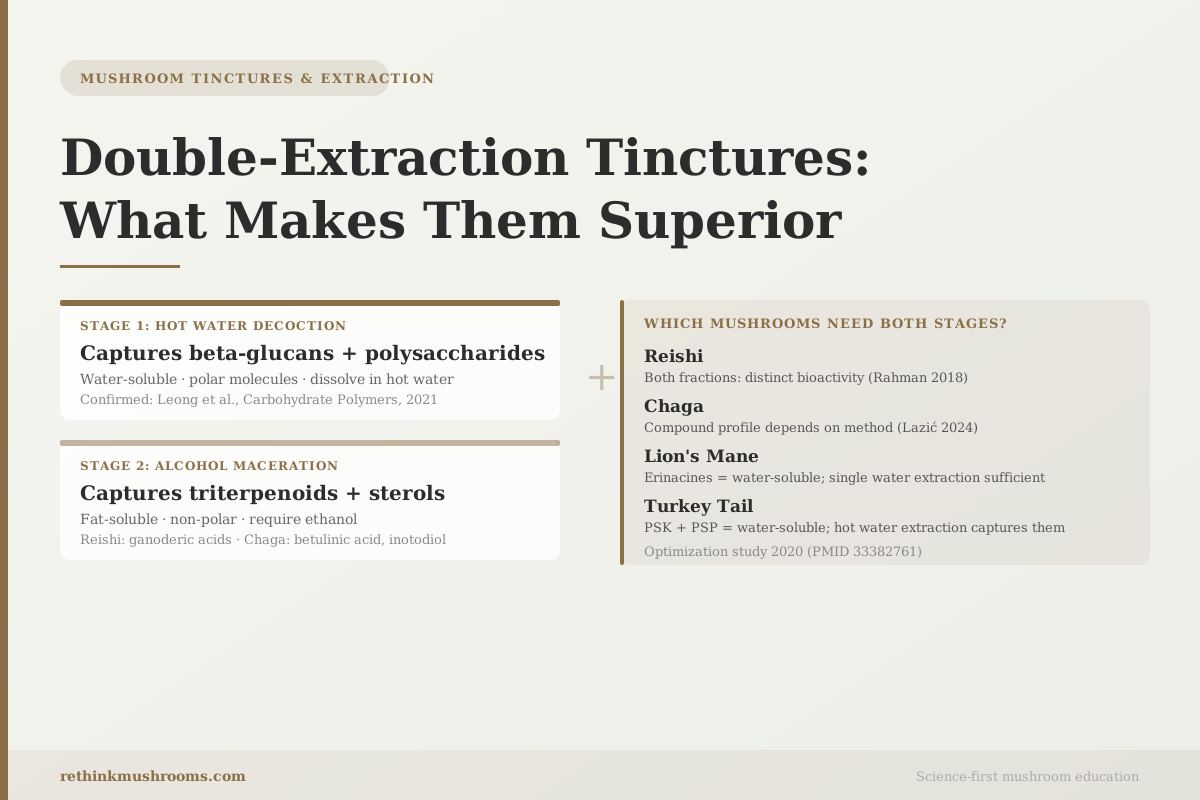
Mushroom compounds divide into two solubility classes: water-soluble beta-glucans and alcohol-soluble triterpenoids. A single solvent captures one class and misses the other. Double extraction uses both sequentially and combines them into one product.
2020 extraction optimization study / Leong et al., Carbohydrate Polymers, 2021
Reishi + Chaga
require double extraction to capture both polysaccharides and triterpenoids
Lion's Mane
erinacines are water-soluble; single hot water extraction is sufficient for NGF compounds
ethanol-only
extracts triterpenoids but leaves most beta-glucans behind (they need water)
2020 extraction optimization study / Leong et al., Carbohydrate Polymers, 2021
 View as image ↗
"Double-extracted" has become one of the most common quality claims on mushroom tincture labels. Most explanations stop at "uses both water and alcohol." That answer is technically correct and practically useless without knowing which mushroom compounds each solvent captures, why they're different, and which mushrooms actually require both steps to deliver their documented bioactives.
The chemistry is straightforward, and it has real consequences for what ends up in a tincture.
For context on how tinctures compare to other mushroom product formats, see Mushroom Coffee: What Is It and Does It Actually Work?.
Key Takeaways
- Mushroom bioactives split into two solubility classes: beta-glucans (polysaccharides) dissolve in water but not alcohol; triterpenoids dissolve in alcohol but not water; each class requires a different solvent to extract effectively
- Systematic extraction research confirmed that optimizing for polysaccharides and triterpenoids requires fundamentally different conditions because their solubilities are incompatible with a single solvent (2020 extraction optimization study)
- Reishi (Ganoderma lucidum) specifically requires double extraction: its cardiovascular and antioxidant bioactivity comes from BOTH its polysaccharide fraction AND its triterpenoid fraction, and each has distinct biological effects (Rahman et al., 2018)
- Chaga's compound profile shifts significantly based on extraction method; different solvents yield dramatically different polyphenol and polysaccharide content (Lazić et al., 2024)
- Lion's Mane erinacines are water-soluble, meaning a single hot water extraction is sufficient for the NGF-stimulating compounds; double extraction for Lion's Mane captures additional hericenones but isn't required for the primary mechanism
- A product labeled "double-extracted" should describe two distinct processing stages; "total polysaccharides" alone on a label does not confirm triterpenoid extraction occurred
The Problem One Solvent Cannot Solve
Mushroom bioactive compounds are not a single category. They are a diverse set of chemical structures with fundamentally different physical properties, and the most important difference for extraction is polarity: the degree to which a molecule interacts with water versus with fats and oils.
Polysaccharides and beta-glucans are polar molecules. They have multiple hydroxyl groups that form hydrogen bonds with water molecules, making them highly water-soluble. Put dried mushroom in hot water and these compounds dissolve readily into the liquid. Put the same mushroom in alcohol and most of the polysaccharides stay behind.
Triterpenoids, sterols, and many phenolic compounds are non-polar or weakly polar. They dissolve in alcohol (ethanol) and in oils, but have very low solubility in water. A hot water extraction leaves them largely intact in the spent mushroom material.
Researchers who systematically optimized extraction conditions for both polysaccharide and triterpenoid fractions from mushrooms found that the two compound classes have fundamentally incompatible optimal solvents; what maximizes one fraction consistently underperforms for the other.[1] The conclusion from this optimization work: extracting both compound classes from a single mushroom species requires two separate extraction steps with two different solvents.
This is the chemical basis for double extraction. It isn't a marketing distinction. It reflects real incompatibility between the target compounds' solubilities.
What Hot Water Extracts, and What It Leaves Behind
Hot water is the established solvent for mushroom polysaccharides. Leong and colleagues, reviewing polysaccharide extraction methods across edible mushroom species, confirmed that hot water is both the standard and the most effective approach for capturing beta-glucans from mushroom fruiting bodies.[3] Temperature matters: high-temperature water both dissolves the polysaccharides and helps break through the chitinous cell walls that contain them. The review established that water temperature, extraction time, and solvent-to-material ratio all affect how much beta-glucan is captured.
Hot water is specifically suited to the beta-glucan extraction because of polarity matching: the strongly polar water molecules interact effectively with the polar hydroxyl groups on the beta-glucan chains. The same polarity that makes water excellent for polysaccharides makes it poor for triterpenoids, which have the opposite molecular character.
A tincture made with only hot water decoction will contain a meaningful beta-glucan fraction. It will contain very little of the triterpenoid compounds that have been studied for anti-inflammatory, hepatoprotective, and antitumor activity in reishi and other species. For mushroom species where the triterpenoid fraction carries distinct bioactivity, particularly reishi and chaga, a water-only extract is a partial product.
What Alcohol Extracts, and What It Misses
Ethanol extracts the non-polar compounds that water leaves behind. Petrović and colleagues directly compared water, ethanol, and methanol extracts of the same mushroom species and found that each solvent produced significantly different bioactivity profiles; ethanol extracts showed superior antimicrobial and antioxidant activity, while aqueous extracts differed in polysaccharide content and the bioactivities associated with those compounds.[4]
This isn't just about different chemical lists; it is about different biological outcomes. Ethanol and water extracts of the same mushroom produce different measurable effects in bioassays because they contain fundamentally different active compounds.
The flip side of alcohol's strength is its weakness: pure ethanol doesn't effectively dissolve polysaccharides. A single-solvent alcohol-only tincture captures the fat-soluble compound fraction and misses most of the water-soluble beta-glucan fraction. For species where both fractions carry documented bioactivity, this is a meaningful gap.
This is why the double-extraction process uses both solvents sequentially. The typical approach: hot water decoction first (extracts polysaccharides), followed by alcohol maceration of the same spent mushroom material (extracts triterpenoids and other fat-soluble compounds), then combination of both extracts in a defined ratio. The combined product contains both compound classes in one tincture.
For a technical look at how the alcohol and water stages work together and why combining them matters, see Double-Extraction Mushroom Tinctures: Why Alcohol + Water Captures More Compounds.
Which Mushrooms Actually Need Double Extraction
This is the species-specific guidance absent from nearly every "double extraction is better" article. The answer depends on which compound classes carry the primary bioactivity for that mushroom.
Reishi (Ganoderma lucidum): Double extraction is necessary. Reishi's documented bioactivity comes from two distinct compound classes that do not overlap. Rahman and colleagues found that reishi's cardiovascular and antioxidant effects are tied to both the polysaccharide fraction AND the triterpenoid fraction, with each class showing distinct biological activity.[2] The water-soluble polysaccharides (Ganoderma polysaccharides, GLP) have been studied for immune modulation and tumor inhibition. The alcohol-soluble triterpenoids (ganoderic acids) have documented hepatoprotective, anti-inflammatory, and antitumor activity through different mechanisms. A reishi product that hasn't been alcohol-extracted is missing the compound class responsible for a substantial portion of the documented reishi effects in the literature. Double extraction for reishi is not optional for a full-spectrum product.
Chaga (Inonotus obliquus): Double extraction is necessary. Chaga contains both water-soluble polysaccharides and alcohol-soluble triterpenoids including betulinic acid and inotodiol. Lazić and colleagues found that different extraction methods applied to Chaga produce significantly different chemical profiles, with extraction method being a primary determinant of what ends up in the final product.[5] Specifically, the polyphenol and polysaccharide content varied substantially based on how the Chaga was processed. For Chaga, which is often marketed specifically for its antioxidant triterpenoid content, a water-only extraction captures polysaccharides but leaves the betulinic acid and lanostane triterpenoids behind.
Lion's Mane (Hericium erinaceus): Double extraction helps but isn't as critical. The primary bioactive compounds associated with Lion's Mane's most-studied effect (NGF, or nerve growth factor, stimulation) are erinacines, found in the mycelium. Erinacines are water-soluble. A hot water extraction from Lion's Mane mycelium captures the erinacines that support NGF production. The fruiting body contains hericenones, which are more fat-soluble and better captured with alcohol. A double-extracted Lion's Mane tincture from fruiting body provides both. But for the specific NGF-stimulating mechanism from mycelium-derived erinacines, water extraction is sufficient. This species nuance is why treating all mushrooms as equivalent for double extraction guidance is an oversimplification.
Turkey Tail (Trametes versicolor): Single hot water extraction is generally sufficient. Turkey Tail's most studied bioactives are the polysaccharides PSK (polysaccharide-K, krestin) and PSP (polysaccharide peptide), which are water-soluble. A hot water extraction from Turkey Tail captures the compounds that have been studied in clinical trials for immune support.
For a detailed comparison of how glycerin compares to alcohol for these extractions, see Mushroom Tinctures: Alcohol vs. Glycerin Extraction.
The Evidence for Why Compound Completeness Matters for Reishi
The reishi case is the best-documented example of why double extraction changes the product in a clinically meaningful way rather than just chemically.
Rahman and colleagues studied reishi's antioxidant and lipid-lowering effects and found that these activities are distributed across both compound classes, not concentrated in one.[2] The polysaccharide fraction contributes to certain bioactivities. The triterpenoid fraction contributes to others. A product missing one of these fractions isn't delivering "most" of what reishi offers; it delivers a subset of compound classes that have been studied as a set.
This isn't unique to reishi. The broader extraction literature establishes that for mushroom species containing both polar and non-polar bioactive fractions, extraction solvent determines compound profile, and compound profile determines biological activity. Petrović and colleagues specifically showed that ethanol and water extracts of the same mushroom species had different antimicrobial and antioxidant activity in direct bioassays, not just different chemical compositions.[4] The difference between solvents isn't just a list of compounds; it translates to different measurable outcomes.
What a Legitimate Double-Extract Label Should Describe
The phrase "dual extracted" or "double extracted" on a tincture label carries no regulated definition. A product can claim double extraction without specifying what each stage was, what ratio of water to alcohol extract it contains, or how long each extraction step ran.
Meaningful product information for a double-extracted tincture includes:
- Confirmation that a hot water decoction stage occurred and a separate alcohol maceration stage occurred
- The ratio of water extract to alcohol extract in the final product (typically 2:1 water:alcohol or 1:1, though ratios vary)
- The alcohol percentage in the final product (which affects triterpenoid concentration and shelf stability)
- Whether the source material was fruiting body or mycelium (this affects which compound classes are available to extract)
What does not confirm double extraction:
- "Total polysaccharides" percentage alone: this measures the water-soluble fraction and says nothing about triterpenoid extraction
- "Full spectrum" labeling without process description
- A general "extract" claim without specifying both solvent stages
For context on how adulteration and mislabeling affect the mushroom supplement market more broadly, see Mushroom Supplement Adulteration: How Widespread Is the Problem?.
Is Double Extraction Worth the Price Premium?
The honest answer is species-dependent.
For reishi and chaga, where the triterpenoid and polysaccharide fractions both carry documented and distinct bioactivity, a double-extracted product is more complete than a water-only or alcohol-only extract. The premium for double extraction in these species reflects a real difference in compound profile.
For lion's mane, whether double extraction is "worth it" depends on which compounds you're prioritizing. If the goal is NGF-stimulating erinacines from mycelium, a quality water extract from lion's mane mycelium is sufficient. If the goal is a full fruiting-body spectrum including both erinacines and hericenones, double extraction adds value.
For turkey tail, the evidence base is built primarily on the water-soluble PSK and PSP fractions. Double extraction adds alcohol-soluble compounds with less documented clinical relevance for turkey tail specifically.
The question of whether tinctures as a format are superior to capsules is a separate issue from extraction completeness. A double-extracted capsule product contains the same compound profile as a double-extracted tincture. The format doesn't determine the extraction quality. For a direct comparison of formats, see Are Mushroom Tinctures More Effective Than Capsules? and Mushroom Capsules vs. Powder vs. Tincture: Which Is Best?.
The Bottom Line
Double extraction addresses a fundamental chemical incompatibility: mushroom beta-glucans (polysaccharides) are water-soluble, and mushroom triterpenoids are alcohol-soluble. A single-solvent extraction captures one class well and the other poorly. For reishi and chaga, where both compound classes carry distinct documented bioactivity, double extraction is necessary for a complete product. For lion's mane, hot water extraction is sufficient for the primary NGF-stimulating erinacine compounds; double extraction adds hericenones. For turkey tail, water extraction captures the clinically studied PSK and PSP fractions. The label claim "double extracted" has no regulated definition, so meaningful product descriptions should specify both extraction stages, their sequence, and the ratio of extracts combined.
Frequently Asked Questions
Sources & References
- 1RTHM-00668·Zheng, Shizhong et al. (2020). “Optimization of ultrasonic-assisted extraction of polysaccharides and triterpenoids from the medicinal mushroom Ganoderma lucidum and evaluation of their in vitro antioxidant capacities..” PloS one.Study breakdown →PubMed →↩
- 2RTHM-00997·Rahman, Mohammad Azizur et al. (2018). “Evaluation of the Antioxidative and Hypo-cholesterolemic Effects of Lingzhi or Reishi Medicinal Mushroom, Ganoderma lucidum (Agaricomycetes), in Ameliorating Cardiovascular Disease..” International journal of medicinal mushrooms.Study breakdown →PubMed →↩
- 3RTHM-01383·Leong, Yoong Kit et al. (2021). “Extraction of polysaccharides from edible mushrooms: Emerging technologies and recent advances..” Carbohydrate polymers.Study breakdown →PubMed →↩
- 4RTHM-00346·Petrović, Jovana et al. (2014). “Different extraction methodologies and their influence on the bioactivity of the wild edible mushroom Laetiporus sulphureus (Bull.) Murrill..” Food & function.Study breakdown →PubMed →↩
- 5RTHM-00888·Lazić, Vesna et al. (2024). “The Effect of Green Extraction Technologies on the Chemical Composition of Medicinal Chaga Mushroom Extracts..” Journal of fungi (Basel.Study breakdown →PubMed →↩