Mushroom Tinctures & Extraction
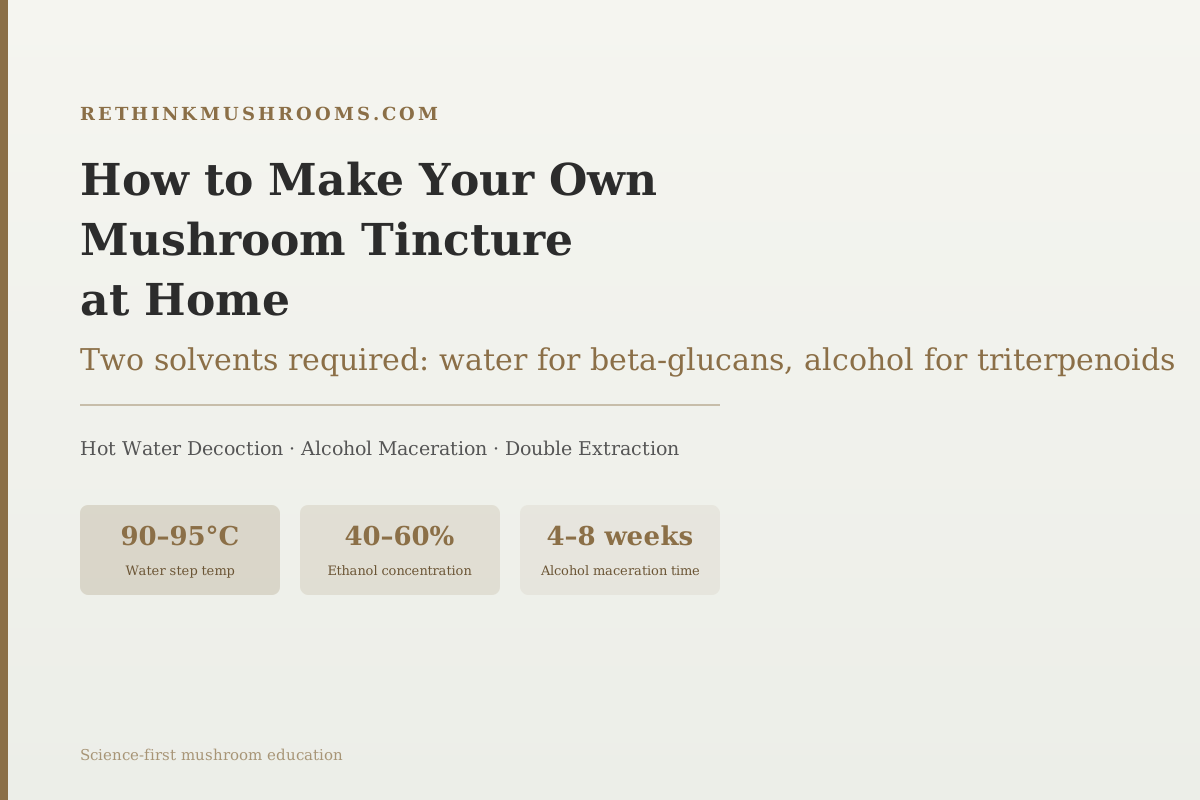
2 solvents required
Mushroom bioactive compounds divide into two solubility classes: water-soluble polysaccharides (beta-glucans) and fat-soluble triterpenoids (ganoderic acids, betulinic acid). A single-solvent extraction captures one class and misses the other.
Optimization study (PMID:33382761), 2020; Leong et al., Carbohydr Polym, 2021
90-95°C water
the optimal temperature for hot water extraction of beta-glucan polysaccharides from mushroom material (Leong et al., 2021)
40-60% ethanol
the optimal alcohol concentration for triterpenoid extraction; above 65% can precipitate polysaccharides
Extraction method
directly determines the chemical profile of the final product; different methods yield significantly different compound ratios (Lazić et al., 2024)
Optimization study (PMID:33382761), 2020; Leong et al., Carbohydr Polym, 2021
 View as image ↗
Most DIY mushroom tincture guides give you steps: soak mushrooms in alcohol for four weeks, strain, done. What they don't explain is why those steps produce different extracts than hot water alone, why the alcohol percentage matters, or why steeping reishi the same way as lion's mane is a chemical mistake. The science of extraction is what distinguishes a tincture that captures the full compound profile from one that gets only half of it.
This guide provides the protocol with the rationale for each step. For the chemistry behind why double extraction is necessary, see double-extraction mushroom tinctures: why alcohol + water captures more compounds. For a comparison of alcohol vs. glycerin extraction, see mushroom tinctures: alcohol vs. glycerin extraction.
Key Takeaways
- Mushroom bioactive compounds fall into two solubility classes: water-soluble polysaccharides (beta-glucans) and fat-soluble triterpenoids; optimizing extraction for both requires different solvents, temperatures, and conditions (2020 optimization study; Leong et al., 2021)
- Hot water at 90-95°C is the standard and most effective solvent for mushroom polysaccharide extraction; temperature drives cell wall disruption and polysaccharide dissolution (Leong et al., 2021; Palanisamy et al., 2014)
- 40-60% ethanol is the optimal concentration range for triterpenoid extraction; below 40% is too polar, reducing non-polar compound yield; above 65% can precipitate polysaccharides (2020 optimization study)
- Extraction method directly determines the chemical profile of the final product in medicinal mushrooms; different extraction approaches applied to the same Chaga material yielded significantly different polyphenol and polysaccharide profiles (Lazić et al., 2024)
- Reishi and Chaga require double extraction to capture both compound classes; lion's mane and turkey tail are primarily water-soluble and can be captured with hot water alone, though dual extraction provides broader coverage
- A standard home double-extraction ratio is 1:5 mushroom to solvent by weight:volume; the two extracts are typically combined 2 parts water extract to 1 part alcohol extract to maintain adequate alcohol concentration as a preservative
Why One Solvent Is Not Enough: The Chemistry of Mushroom Extraction
The key to understanding mushroom tinctures is molecular polarity. Water is a highly polar solvent: it dissolves compounds that carry electrical charges or form hydrogen bonds, including the long-chain sugar structures of beta-glucans and other polysaccharides. Alcohol (ethanol) is a less polar solvent that sits between water and oils: it dissolves compounds that are relatively non-polar, including the steroid-like triterpenoid compounds found in reishi, chaga, and other medicinal species.
A 2020 study optimizing extraction conditions for both polysaccharides and triterpenoids from medicinal mushrooms established that these two compound classes have fundamentally different optimal solvents and extraction conditions.[1] The polysaccharide fraction extracted at maximum yield in hot water; the triterpenoid fraction required alcohol. No single solvent achieved optimum for both.
Leong and colleagues' comprehensive review of polysaccharide extraction from edible mushrooms confirmed hot water as the standard and most effective solvent for beta-glucans across species, with temperature and contact time being the primary variables affecting yield.[2]
The implication for home tincture making: a tincture made by soaking dried mushroom in alcohol alone captures the triterpenoid fraction but leaves most of the beta-glucans behind. A hot water decoction captures beta-glucans but leaves the fat-soluble compounds undissolved. Double extraction, done sequentially, captures both.
Which Mushrooms Need Double Extraction (and Which Don't)
Not all medicinal mushrooms have equal amounts of both compound classes. The decision about whether to double-extract depends on the target mushroom's compound profile.
Reishi (Ganoderma lucidum): Double extraction essential. Reishi's therapeutic profile is built on both fractions: the polysaccharides (immunomodulatory beta-glucans) and the triterpenoids (ganoderic acids with adaptogenic, cardiovascular, and anti-inflammatory properties). Using only hot water captures the immune-supporting fraction but misses the triterpenoid fraction that characterizes reishi's adaptogenic effects.
Chaga (Inonotus obliquus): Double extraction essential. Chaga contains betulinic acid, inotodiol, and other triterpenoids that are fat-soluble and require alcohol extraction. A 2024 study on Chaga extraction demonstrated that different extraction approaches applied to the same Chaga material yielded significantly different polyphenol and polysaccharide profiles, confirming that extraction method selection directly determines what you get in the final product.[4]
Turkey tail (Trametes versicolor): Hot water extraction is sufficient for the primary bioactives. Turkey tail's most studied compounds are PSK (polysaccharide-K) and PSP (polysaccharide peptide), both water-soluble. A hot water decoction captures these effectively. Double extraction is optional and provides broader coverage but is not required for the primary active compounds.
Lion's mane (Hericium erinaceus): Hot water extraction is sufficient for the NGF-stimulating erinacines, which are water-soluble. Hericenones, found in the fruiting body, are more fat-soluble and may benefit from alcohol extraction. A dual extraction captures both compound classes; a single hot water extract covers the primary neurotropic compounds.
Step-by-Step: The Double-Extracted Mushroom Tincture Protocol
This protocol produces approximately 300 ml of finished double-extracted tincture from 30g of dried mushroom material.
What you need:
- 30g dried mushroom (fruiting body; whole or coarsely ground)
- 300 ml water
- 150 ml food-grade ethanol at 95% concentration, diluted to 60% with water (or use 40-60% alcohol spirit like vodka as a shortcut)
- Two glass jars with lids (at least 500 ml capacity each)
- Fine mesh strainer and cheesecloth
- A pot for simmering
- Dark glass bottles for storage
Step 1: Hot water decoction (captures water-soluble beta-glucans)
Place 30g of dried mushroom in 600 ml of cold water. Bring to a slow simmer at 90-95°C. Maintain this temperature for 2-4 hours, adding water to replace evaporation and keep the mushroom material submerged. The specific temperature matters: studies on beta-glucan extraction confirm that temperatures in this range are effective for cell wall disruption and polysaccharide dissolution, while temperatures below 70°C leave significant polysaccharide content unextracted.[3]
After simmering, strain the liquid through a fine mesh strainer lined with cheesecloth, pressing to recover as much liquid as possible from the spent mushroom material. Reserve the spent material. You should have approximately 300 ml of dark water extract. Allow to cool to room temperature.
Do not discard the spent material. It still contains residual triterpenoids and some cell wall material that will be extracted in the next step.
Step 2: Alcohol maceration (captures fat-soluble triterpenoids)
Place the spent mushroom material from Step 1 into a clean glass jar. Cover with 150 ml of 40-60% ethanol. Seal the jar and store in a cool, dark location.
Macerate for 4-8 weeks. The extended maceration time allows triterpenoid extraction to proceed to completion; unlike hot water extraction which proceeds quickly with heat, alcohol extraction of fat-soluble compounds is a slower kinetic process. Shake the jar once daily.
The optimal alcohol concentration is 40-60% ethanol. The 2020 optimization study found that concentrations in this range achieved maximum triterpenoid yield; above 65% alcohol, some polysaccharide precipitation can occur, and very high concentrations (above 80%) begin to reduce triterpenoid solubility as well.[1] Spirits at 40% ABV (vodka, brandy) are acceptable and convenient for home production.
After 4-8 weeks, strain through cheesecloth, pressing firmly. You should have approximately 100-120 ml of alcohol extract.
Step 3: Combine the extracts
Combine the water extract and alcohol extract at a ratio of approximately 2 parts water extract to 1 part alcohol extract. This 2:1 ratio maintains a final alcohol concentration of approximately 20-25%, which serves as an adequate preservative for shelf stability.
Final volume: approximately 350-400 ml of double-extracted tincture.
Storage, Labeling, and Shelf Life
Store the finished tincture in dark glass bottles (amber or cobalt) away from direct light and heat. Properly made double-extracted tinctures with a final alcohol concentration of 20-25% or higher are stable for 2-4 years at room temperature. Lower final alcohol concentrations reduce shelf life.
Label each bottle with: the mushroom species, the date of production, and the approximate alcohol concentration. Label the two components separately during production to avoid confusion.
Do not use methanol, isopropyl alcohol, or other industrial solvents. Food-grade ethanol or potable spirits are the only appropriate solvents for personal use.
The Species-Specific Extraction Guide
| Species | Dual Extraction Needed? | Primary Target Compounds | Notes |
|---|---|---|---|
| Reishi (G. lucidum) | Yes | Ganoderic acids (alcohol) + beta-glucans (water) | The classic double-extraction mushroom |
| Chaga (I. obliquus) | Yes | Betulinic acid, inotodiol (alcohol) + polyphenols, polysaccharides (water) | Extraction conditions significantly affect compound profile (Lazić 2024) |
| Turkey tail (T. versicolor) | Optional | PSK, PSP (water-soluble) | Hot water decoction captures primary bioactives |
| Lion's mane (H. erinaceus) | Optional | Erinacines (water) + hericenones (alcohol) | Water sufficient for primary NGF compounds |
| Shiitake (L. edodes) | Optional | Beta-glucans, AHCC compounds (primarily water) | Some lentinan is lost to boiling water, so consume the broth |
What You're Actually Making: Managing Expectations
A home tincture is a genuine double extraction if both solvent steps are performed correctly. What it is not is a standardized pharmaceutical extract. Commercial dual-extracted products are typically produced under controlled temperatures, standardized mushroom material with verified beta-glucan content, and quality-tested at finished product stage.
A home tincture will contain both compound classes in unknown concentrations. The compound ratios depend on the quality of the starting material, the grind size, the precise temperatures, and the duration of each step. This does not make home tinctures ineffective, but it does mean that dose consistency is harder to establish compared to a product with a certificate of analysis.
For a direct comparison of tinctures vs. capsules, see are mushroom tinctures more effective than capsules?. For a comparison of all delivery formats, see mushroom capsules vs. powder vs. tincture: which is best?.
The Bottom Line
Double-extracted mushroom tinctures require two sequential solvent steps: a hot water decoction at 90-95°C to capture water-soluble beta-glucans, and a 40-60% ethanol maceration of the spent material to capture fat-soluble triterpenoids. The two extracts are combined at approximately 2:1 water-to-alcohol by volume. Reishi and Chaga require double extraction to access their full therapeutic compound profile; turkey tail and lion's mane are primarily water-soluble and can be adequately extracted with hot water alone, though dual extraction provides broader coverage. Extraction method selection is the primary determinant of compound profile in the finished product.
Frequently Asked Questions
Sources & References
- 1. Source details for this reference are not yet available.
- 2RTHM-01383·Leong, Yoong Kit et al. (2021). “Extraction of polysaccharides from edible mushrooms: Emerging technologies and recent advances..” Carbohydrate polymers.Study breakdown →PubMed →↩
- 3RTHM-00342·Palanisamy, Marimuthu et al. (2014). “Pressurized water extraction of β-glucan enriched fractions with bile acids-binding capacities obtained from edible mushrooms..” Biotechnology progress.Study breakdown →PubMed →↩
- 4RTHM-00888·Lazić, Vesna et al. (2024). “The Effect of Green Extraction Technologies on the Chemical Composition of Medicinal Chaga Mushroom Extracts..” Journal of fungi (Basel.Study breakdown →PubMed →↩