Mushroom Tinctures and Extraction
2 solvents needed
Hot water extracts polysaccharides (beta-glucans), while ethanol extracts triterpenoids. No single solvent captures the full bioactive profile of any medicinal mushroom.
Zheng et al., J Fungi, 2020
Water-Soluble
beta-glucans, polysaccharides
Alcohol-Soluble
triterpenoids, sterols
No Head-to-Head
tincture vs capsule trials
Zheng et al., J Fungi, 2020
 View as image ↗
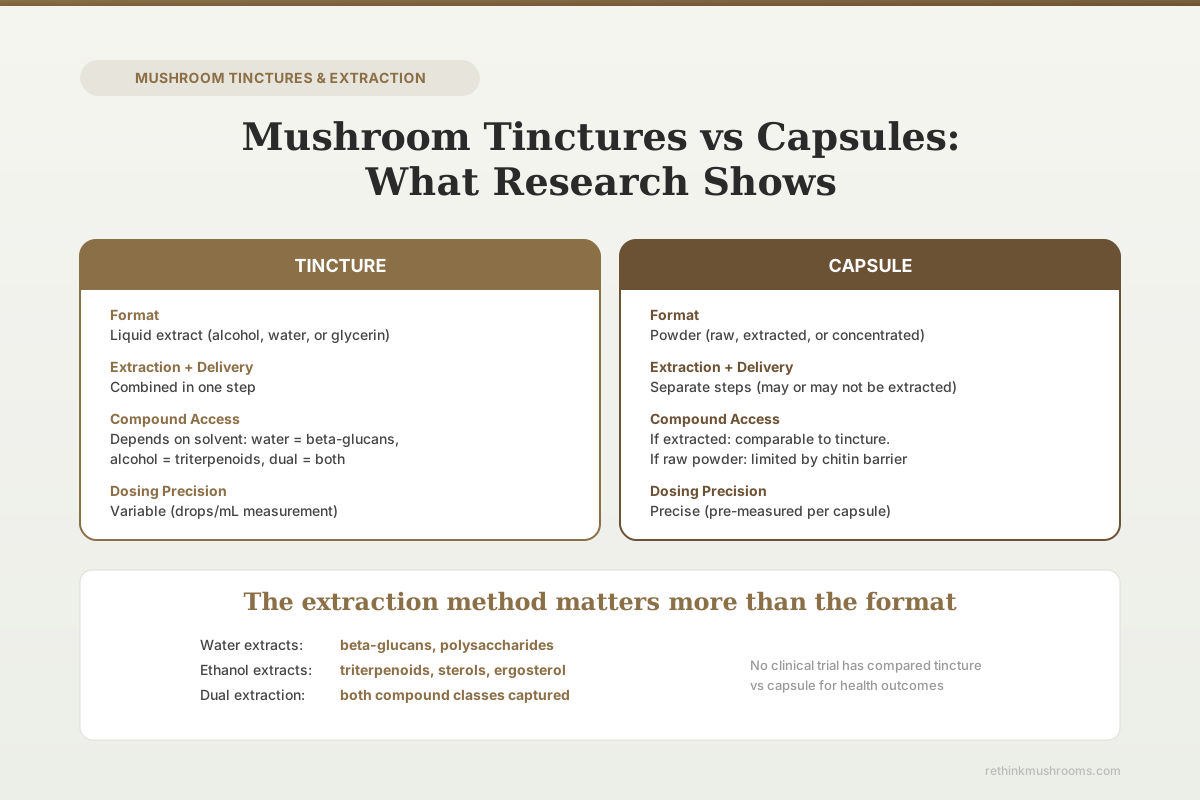
No clinical trial has ever compared a mushroom tincture head-to-head against a capsule containing the same species at the same dose and measured health outcomes. That single fact frames this entire discussion. The tincture-versus-capsule debate plays out in marketing copy, not in controlled research. What the science does address is extraction chemistry: which solvents pull which compounds from mushroom cell walls, and how the format of a supplement affects what bioactive molecules reach your bloodstream.
The answer depends less on "tincture or capsule" and more on what extraction happened before the product reached either format. A dual-extracted capsule can contain more bioactive compounds than a single-solvent tincture, and a properly made tincture can deliver compounds that an unextracted powder capsule cannot access at all.
Key Takeaways
- Hot water extraction releases water-soluble polysaccharides (beta-glucans), while ethanol extraction targets alcohol-soluble triterpenoids, sterols, and terpenoids; neither solvent alone captures both (Zheng et al., 2020)
- Mushroom cell walls are made of chitin, which humans cannot digest; without extraction, raw mushroom powder passes through the gut with limited bioactive compound release (Cerletti et al., 2021)
- Beta-glucan structural features (branching ratio, molecular weight) determine immune-stimulating activity more than raw quantity; extraction method affects these structural features (Volman et al., 2010)
- Pressurized water extraction at 200 degrees C yielded beta-glucan fractions with bile acid-binding capacity from three mushroom species, demonstrating that extraction conditions alter functional properties (Palanisamy et al., 2014)
- Different extraction methods applied to chaga produced extracts with markedly different chemical compositions, confirming that the solvent matters more than the delivery format (Lazic et al., 2024)
- Ethanol extracts of Antrodia camphorata grown on germinated brown rice contained anti-inflammatory compounds not present in water extracts (Park et al., 2013)
The Extraction Problem: Why Format Matters Less Than Process
The tincture-versus-capsule question misses the more fundamental issue: what happened to the mushroom before it became a supplement.
Mushroom cell walls are composed of chitin, a structural polymer that human digestive enzymes cannot break down efficiently. Cerletti et al. (2021) reviewed the evidence on edible mushrooms and beta-glucans and noted that the bioactive compounds locked within chitin-walled cells require extraction or processing to become accessible for absorption.[3]
This means an unextracted mushroom powder in a capsule is fundamentally different from an extracted mushroom product in either a capsule or tincture. The capsule itself is just a delivery vehicle. A tincture is both an extraction method and a delivery vehicle, which is why tinctures and capsules are not equivalent comparisons unless the capsule contents have also been extracted.
Three common scenarios exist in the supplement market:
Raw powder capsules: Dried, ground mushroom material in capsules. Minimal extraction. Most bioactive compounds remain trapped in chitin matrices. This is the least effective format regardless of species. Marketing may describe these as "whole mushroom" or "full spectrum," but without extraction the spectrum is inaccessible to human digestion.
Extracted powder capsules: Mushroom material that has been hot water extracted, ethanol extracted, or dual-extracted, then spray-dried or freeze-dried into a powder and encapsulated. Contains concentrated bioactive compounds in a form the body can access. Extract ratios (e.g., 10:1, 20:1) indicate how much raw material produced one unit of extract powder.
Tinctures: Mushroom material soaked in a solvent (alcohol, glycerin, or water) for weeks to months, then strained. The liquid contains whatever the solvent dissolved. Dual-extraction tinctures use both hot water and alcohol sequentially to capture both compound classes. Glycerin-based tinctures are alcohol-free but less effective at extracting triterpenoids.
Water vs. Ethanol: What Each Solvent Extracts
The core chemistry is straightforward: different mushroom compounds dissolve in different solvents.
Water-Soluble Compounds
Hot water extraction targets polysaccharides, particularly beta-glucans, which are the most extensively studied bioactive compounds in medicinal mushrooms. Palanisamy et al. (2014) developed pressurized water extraction methods for beta-glucans from Agaricus bisporus, Lentinula edodes, and Pleurotus ostreatus, finding that optimal extraction at 200 degrees C and 10.3 MPa produced fractions with bile acid-binding capacity, a functional property relevant to cholesterol metabolism.[2]
The extraction conditions alter the structural properties of the resulting beta-glucans. Volman et al. (2010) tested beta-glucan-rich polysaccharide extracts from multiple mushroom species and found that the structure of the extracted beta-glucans (branching ratio, molecular weight, linkage type) determined their immune-stimulating activity in macrophages and NF-kappaB reporter cells. The same starting material extracted under different conditions produced extracts with different biological activity.[4]
This is a crucial point: two beta-glucan supplements with identical milligram quantities on their labels can have completely different immune-stimulating potential if the extraction methods produced beta-glucans with different branching structures. A high-temperature, high-pressure extraction may fragment the polysaccharide chains, producing lower-molecular-weight glucans with different receptor binding properties than gentle hot water extraction.
This means that "contains beta-glucans" on a label tells you little about efficacy. The extraction method determines whether those beta-glucans have the structural features required for biological activity.
Ethanol-Soluble Compounds
Ethanol extraction targets triterpenoids, sterols (including ergosterol), terpenoids, and other lipophilic compounds that are insoluble in water.
Park et al. (2013) specifically demonstrated this with Antrodia camphorata: ethanol extract of Antrodia grown on germinated brown rice suppressed inflammatory markers through beta-catenin signaling inhibition, an activity mediated by alcohol-soluble compounds not accessible through water extraction alone.[6]
Correa et al. (2018) optimized ethanol-based extraction of ergosterol from Agaricus bisporus, demonstrating that extraction temperature, time, and solvent concentration all affected yield. Ergosterol is a precursor to vitamin D2 when exposed to UV light and has documented anti-inflammatory and antitumor properties, but it is essentially absent from water-only extracts.[7] This illustrates a broader point: some of the most pharmacologically interesting mushroom compounds are invisible to water extraction.
The Case for Dual Extraction
Zheng et al. (2020) optimized ultrasonic-assisted co-extraction of polysaccharides AND triterpenoids from Ganoderma lucidum, finding that aqueous ethanol (50% v/v) at 80 degrees C achieved meaningful yields of both compound classes: 0.63% polysaccharides and 0.38% triterpenoids. The antioxidant capacities of polysaccharides obtained through this co-extraction were higher than those from traditional hot water extraction alone.[1]
This finding undermines the idea that water and ethanol extractions must happen separately. Optimized co-extraction can produce a single extract containing both compound classes. Whether this happens in a tincture or a capsule is irrelevant to the chemistry.
The practical significance of the Zheng findings: a dual-extraction tincture maker who uses sequential hot water and ethanol steps, then combines the results, is performing essentially the same operation that pharmaceutical-grade extraction facilities do. The difference lies in precision, standardization, and quality control. A home tincture maker cannot easily verify the beta-glucan content or triterpenoid concentration of their final product. A commercial facility can test and standardize these values before encapsulating or bottling.
Species-Specific Extraction Differences
Not all mushrooms respond identically to the same extraction method.
Lazic et al. (2024) tested green extraction technologies on chaga (Inonotus obliquus) and found that different methods produced extracts with markedly different chemical compositions. The choice of extraction method altered the ratio of polyphenols to polysaccharides to triterpenoids in the final product.[8]
Geethangili and Tzeng (2011) catalogued over 78 bioactive compounds in Antrodia camphorata spanning multiple solubility classes. The unique antcin triterpenoids in Antrodia are ethanol-soluble, while its polysaccharides are water-soluble, making dual extraction particularly relevant for this species.[10]
Lysakowska et al. (2023) reviewed bioactive components across multiple medicinal mushroom species and found that the relative importance of water-soluble versus ethanol-soluble compounds varies by species. Reishi is rich in both triterpenes (ethanol-soluble) and beta-glucan polysaccharides (water-soluble). Lion's mane contains hericenones (ethanol-soluble) and erinacines (also found in mycelium). Chaga is dominated by water-extractable polyphenolic compounds but also contains ethanol-soluble triterpenoids.[9]
This species variation means that the "best" extraction method differs by mushroom. A water-only tincture may capture most of chaga's polyphenols but miss reishi's triterpenes. An ethanol-only tincture captures Antrodia's antcins but misses its polysaccharides. For a deeper look at what dual extraction captures, see Double-Extraction Mushroom Tinctures: Why Alcohol + Water Captures More Compounds.
For Antrodia camphorata specifically, the triterpenoid content that makes it valuable for liver and antioxidant research is predominantly alcohol-soluble. A water-only Antrodia tincture would miss the antcins and antroquinonol that drive most of its studied biological activity. Conversely, an ethanol-only Antrodia tincture would miss its polysaccharides, which have shown independent anti-inflammatory and immunomodulatory effects. For more on Antrodia's compound classes, see Antrodia Bioactive Compounds: Antcins, Triterpenoids, and Polysaccharides.
The Bioavailability Question: Liquid vs. Solid
A common claim is that liquid tinctures are "more bioavailable" than capsules because liquids are absorbed faster through sublingual (under-the-tongue) or mucosal routes. The pharmacokinetic literature on this is mixed.
For pharmaceutical drugs, liquid formulations sometimes reach peak blood levels faster than tablet or capsule forms, but total absorption (area under the curve) is often comparable. However, this pharmaceutical data cannot be directly applied to mushroom supplements for several reasons:
Molecular size: Beta-glucans are large polysaccharide molecules (molecular weights from 10,000 to over 1,000,000 daltons). They are too large for sublingual absorption and must be absorbed through the intestinal epithelium regardless of whether they arrive as a liquid or a dissolved capsule.
Gastric breakdown: Triterpenoids and smaller phenolic compounds could theoretically benefit from faster delivery to the small intestine via a liquid format, but no study has measured this difference specifically for mushroom compounds. Gastric pH and enzyme activity would affect both tincture and capsule contents similarly once the capsule shell dissolves.
Capsule dissolution: Modern vegetable cellulose capsules dissolve within 15 to 30 minutes in the stomach. The time difference between a pre-dissolved tincture and a capsule-delivered extract is small relative to total gut transit time of 24 to 72 hours.
Alcohol content: Tinctures typically contain 25 to 60% ethanol. When taken sublingually or orally, this alcohol may enhance absorption of certain lipophilic compounds by acting as a co-solvent. However, the volume of alcohol per dose (usually 1 to 2 mL) is minimal, and whether this produces a measurable pharmacokinetic advantage over a capsule is unknown for mushroom compounds.
The honest answer: no clinical trial has measured the bioavailability of any specific mushroom compound from a tincture versus the same compound from a capsule. The claim that tinctures are "more bioavailable" lacks direct evidence for mushroom-specific bioactives. Until someone conducts a crossover pharmacokinetic study comparing plasma levels of a mushroom compound delivered via tincture versus capsule, this question remains unanswered by science. For related discussion of Antrodia compound pharmacokinetics, see Antrodia Dosage: Tested Doses in Human Trials.
What Actually Determines Supplement Effectiveness
Based on the extraction chemistry evidence, these factors matter more than whether a product is a tincture or capsule:
1. Was extraction performed? An extracted product in either format outperforms raw powder in a capsule because extraction breaks chitin barriers and concentrates bioactive compounds.
2. What solvents were used? Single-solvent extraction (water only or ethanol only) captures only part of the bioactive profile. Dual extraction captures both water-soluble and alcohol-soluble compounds.
3. What species is it? Different species have different ratios of water-soluble to ethanol-soluble compounds. The optimal extraction method varies by species.
4. Is the product standardized? Knowing the beta-glucan percentage, triterpenoid content, or specific compound concentrations tells you more than knowing whether it is a tincture or capsule.
5. Fruiting body or mycelium? Fruiting bodies and mycelium contain different compound profiles, and this distinction matters more than delivery format. Fruiting bodies typically have higher concentrations of certain triterpenoids and beta-glucans, while mycelium grown on grain may contain substantial amounts of starch from the growing substrate that dilutes the bioactive compound concentration. For how this applies to tincture-making, see Mushroom Tinctures: Alcohol vs. Glycerin Extraction.
6. Concentration and dosing accuracy? Capsules offer precise, repeatable dosing. Each capsule contains a measured amount of extract powder. Tinctures require measuring drops or milliliters, which introduces more variability between doses. For people tracking specific compound intake, capsules provide more consistent dosing.
Faccin et al. (2007) illustrated the solvent issue directly by comparing aqueous and ethanol extracts from the same mushroom species and finding that the two extracts had different antiviral activities, confirming that solvent choice determines which bioactive compounds end up in the final product.[5]
The practical implication: when evaluating any mushroom supplement, whether tincture or capsule, the questions to ask are what extraction method was used, whether both water-soluble and alcohol-soluble compounds are represented, and whether the product provides standardized concentrations of key compounds like beta-glucans or triterpenoids. A product that answers these questions gives you more useful information than one that simply promotes its delivery format. For guidance on evaluating supplement quality claims, see How to Make Your Own Mushroom Tincture at Home.
The Bottom Line
No clinical trial has compared mushroom tinctures to capsules for health outcomes. The extraction method (hot water, ethanol, or dual) determines which bioactive compounds are present in the final product, regardless of delivery format. An extracted capsule can be equivalent to or superior to a single-solvent tincture. The "tincture vs. capsule" question is less important than whether the product underwent proper extraction for the target species.
Frequently Asked Questions
Sources & References
- 1RTHM-00668·Zheng, Shizhong et al. (2020). “Optimization of ultrasonic-assisted extraction of polysaccharides and triterpenoids from the medicinal mushroom Ganoderma lucidum and evaluation of their in vitro antioxidant capacities..” PloS one.Study breakdown →PubMed →↩
- 2RTHM-00342·Palanisamy, Marimuthu et al. (2014). “Pressurized water extraction of β-glucan enriched fractions with bile acids-binding capacities obtained from edible mushrooms..” Biotechnology progress.Study breakdown →PubMed →↩
- 3RTHM-00676·Cerletti, Chiara et al. (2021). “Edible Mushrooms and Beta-Glucans: Impact on Human Health..” Nutrients.Study breakdown →PubMed →↩
- 4RTHM-00200·Volman, Julia J et al. (2010). “Effects of mushroom-derived beta-glucan-rich polysaccharide extracts on nitric oxide production by bone marrow-derived macrophages and nuclear factor-kappaB transactivation in Caco-2 reporter cells: can effects be explained by structure?.” Molecular nutrition & food research.Study breakdown →PubMed →↩
- 5RTHM-00112·Faccin, L C et al. (2007). “Antiviral activity of aqueous and ethanol extracts and of an isolated polysaccharide from Agaricus brasiliensis against poliovirus type 1..” Letters in applied microbiology.Study breakdown →PubMed →↩
- 6RTHM-00302·Park, Dong Ki et al. (2013). “Ethanol Extract of Antrodia camphorata Grown on Germinated Brown Rice Suppresses Inflammatory Responses in Mice with Acute DSS-Induced Colitis..” Evidence-based complementary and alternative medicine : eCAM.Study breakdown →PubMed →↩
- 7RTHM-00506·Corrêa, Rúbia C G et al. (2018). “A natural food ingredient based on ergosterol: optimization of the extraction from Agaricus blazei, evaluation of bioactive properties and incorporation in yogurts..” Food & function.Study breakdown →PubMed →↩
- 8RTHM-00888·Lazić, Vesna et al. (2024). “The Effect of Green Extraction Technologies on the Chemical Composition of Medicinal Chaga Mushroom Extracts..” Journal of fungi (Basel.Study breakdown →PubMed →↩
- 9RTHM-00843·Łysakowska, Paulina et al. (2023). “Medicinal Mushrooms: Their Bioactive Components, Nutritional Value and Application in Functional Food Production-A Review..” Molecules (Basel.Study breakdown →PubMed →↩
- 10RTHM-00214·Geethangili, Madamanchi et al. (2011). “Review of Pharmacological Effects of Antrodia camphorata and Its Bioactive Compounds..” Evidence-based complementary and alternative medicine : eCAM.Study breakdown →PubMed →↩