Antrodia Safety and Dosage
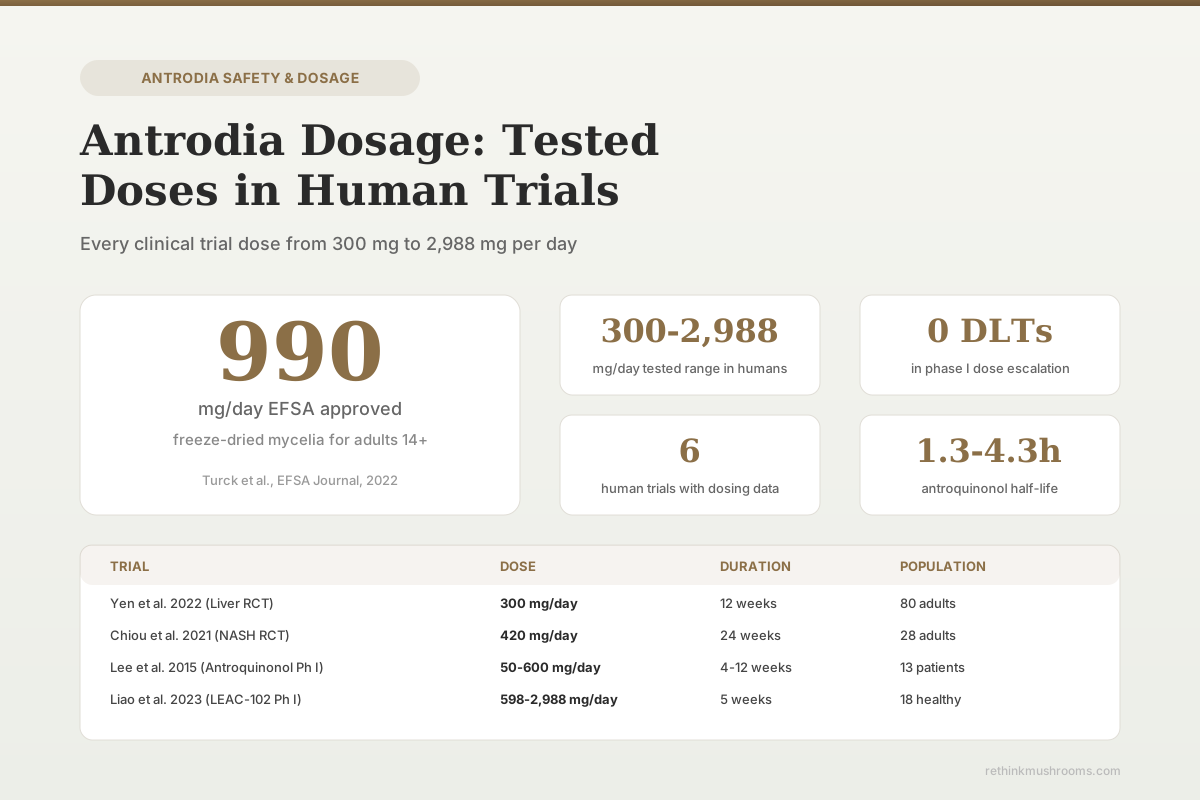
990 mg/day
The maximum daily intake of freeze-dried Antrodia camphorata mycelia that the European Food Safety Authority assessed as safe for people aged 14 and older.
Turck et al., EFSA Journal, 2022
6 Human Trials
in the published record
300-2,988 mg
whole-preparation range
No DLTs
in the antroquinonol phase I
Turck et al., EFSA Journal, 2022
 View as image ↗
Antrodia camphorata is one of the most studied medicinal mushrooms in Taiwan, yet the question of how much to take has no single answer. Human clinical trials have tested daily doses ranging from 300 mg of whole extract to nearly 3,000 mg of a standardized botanical drug, and even pure antroquinonol has been escalated to 600 mg per day without dose-limiting toxicities.[2] That range reflects a basic reality: "Antrodia dosage" depends on what preparation you are taking, what compound is being isolated, and what health context the research addresses. For context on the safety profile that accompanies these doses, see Antrodia and Drug Interactions: What to Know.
This article reports every published human dose, what each trial measured, and how the European Food Safety Authority arrived at its 990 mg/day safety assessment. It does not provide recommendations, and it is educational content rather than medical advice. Readers get the data; they decide what to do with it in consultation with their own clinician.
Key Takeaways
- The EFSA assessed freeze-dried Antrodia camphorata mycelia as safe at the applicant's proposed maximum use level of 990 mg/day for people aged 14 and older, deriving a safe level of 16.5 mg/kg body weight per day (Turck et al., 2022)
- A randomized controlled trial of 300 mg/day of Golden-Antrodia camphorata tablets in 80 participants with elevated GGT produced statistically significant reductions in AST, ALT, and triglycerides over 12 weeks, but the authors concluded the changes were not clinically significant (Yen et al., 2022)
- A first-in-human phase I study escalated LEAC-102 (an Antrodia cinnamomea botanical drug) from 597.6 mg to 2,988 mg per day in 18 healthy volunteers with no serious adverse events; 2,988 mg/day was designated the maximum tolerated dose after one participant developed urticaria (Liao et al., 2023)
- Pure antroquinonol was escalated from 50 mg to 600 mg daily in cancer patients with no dose-limiting toxicities and a half-life of 1.3 to 4.3 hours (Lee et al., 2015)
- A 6-month NASH trial used 420 mg/day of Antrodia cinnamomea mycelium capsules in a double-blind, placebo-controlled design, though it enrolled only 28 participants and tracked liver status with serum panels rather than biopsy (Chiou et al., 2021)
- The one trial pairing Antrodia with chemotherapy found no survival benefit and significantly lower platelet counts in the treatment arm, the clearest dose-relevant safety signal in the human record (Tsai et al., 2016)
- Doses vary substantially by preparation type: whole mycelium, fruiting body extract, and purified compounds like antroquinonol each carry different concentration profiles
What Human Clinical Trials Report About Antrodia Doses
The clinical evidence for Antrodia camphorata dosing in humans comes from a small but growing set of trials. Each used a different preparation, dose, and target population, making direct comparisons difficult. What follows is a study-by-study breakdown.
300 mg/day: Liver Protection After Alcohol-Related Hepatitis
Yen et al. (2022) conducted a randomized controlled trial with 80 participants who had elevated gamma-glutamyl transferase (GGT) levels between 60 and 180 U/L, an indicator of alcohol-related liver stress. The treatment group received 300 mg per day of Golden-Antrodia camphorata tablets containing antroquinonol for 12 weeks, with blood chemistry measured at 6 and 12 weeks. At 12 weeks, serum aspartate aminotransferase (AST), alanine aminotransferase (ALT), and triglycerides were significantly lower in the treatment group than in the placebo group.[1]
The important qualifier is one the trial's own authors supplied: although the differences reached statistical significance, they concluded that no clinical significance was observed in the serum parameters they measured. A statistically detectable shift in a liver enzyme is not the same as a meaningful change in liver health, and this trial is a clean illustration of that gap. It is also worth noting the trial reported no clinically significant differences between groups on general safety parameters.
This is the lowest daily dose of a whole Antrodia preparation reported in a published human randomized trial, and it used a standardized product with quantified antroquinonol content. The trial was published in Frontiers in Pharmacology.
420 mg/day: Nonalcoholic Steatohepatitis (NASH)
Chiou et al. (2021) ran a 6-month randomized, double-blind, placebo-controlled trial in patients with nonalcoholic steatohepatitis. Twenty-eight participants received three capsules per day containing 420 mg total of Antrodia cinnamomea mycelium, or 420 mg of starch as matching placebo, returning for assessment every three months.[4]
The supplemented group showed improvement in steatosis and a decrease in the inflammatory marker TNF-alpha at three and six months, with the mean SteatoTest value falling from 0.66 at baseline to 0.49 at six months. No participants experienced adverse events.
Two caveats shape how much weight this trial can carry. It enrolled 28 people, which is small enough that the findings should be treated as preliminary rather than established. And liver status was tracked using the FibroMax and SteatoTest serum panels rather than liver biopsy, which remains the reference standard for confirming and staging steatohepatitis; serum panels estimate liver condition indirectly from blood chemistry.
The trial's six-month duration is longer than most Antrodia studies. The preparation was mycelium rather than fruiting body, a distinction that matters for bioactive compound profiles because cultivated mycelium produces a different ratio of triterpenoids to polysaccharides than wild fruiting bodies. The results were published in the Journal of the American College of Nutrition.
597 to 2,988 mg/day: First-in-Human Dose Escalation
Liao et al. (2023) conducted the first-in-human phase I study of LEAC-102, a botanical drug extracted from Antrodia cinnamomea. Using a standard 3+3 dose-escalation design, 18 healthy volunteers received doses of 597.6, 1,195.2, 1,792.8, 2,390.4, or 2,988 mg per day for one month, plus seven days of safety follow-up.[3]
All clinical biochemistry profiles stayed within normal range and no serious adverse effects were observed. One detail the headline number obscures: the maximum tolerated dose was formally designated as 2,988 mg/day because a participant at that level developed urticaria (hives). The trial reached the top of its planned escalation rather than being stopped by toxicity, but a tolerability event did occur at the ceiling dose.
The study's exploratory arm also reported that LEAC-102 elevated natural killer cells, natural killer T cells, and dendritic cells in a dose-dependent manner, and activated effector T cells. These are mechanistic immune-marker readouts in healthy volunteers, not clinical outcomes.
This study established the widest dose range tested in healthy humans and was published in the Journal of the American Nutrition Association. The upper dose of nearly 3 grams per day represents the highest published human dose of any Antrodia preparation.
Liao et al. (2023) · Journal of the American Nutrition Association
- Population
- 18 healthy adult volunteers (standard 3+3 dose-escalation cohorts)
- Intervention
- LEAC-102, a standardized botanical drug extracted from Antrodia cinnamomea, at 597.6, 1,195.2, 1,792.8, 2,390.4, or 2,988 mg/day for one month plus 7 days of safety follow-up
- Comparator
- None — open dose-escalation design with no placebo arm
- Finding
- All clinical biochemistry profiles remained in the normal range and no serious adverse effects occurred. The maximum tolerated dose was set at 2,988 mg/day, the top of the planned escalation, after one participant experienced urticaria.
preliminary This is a safety and tolerability study in healthy people, not an efficacy trial. It establishes that a standardized extract was tolerated across this range; it says nothing about whether any dose treats any condition.
Liao et al., Journal of the American Nutrition Association, 2023
50 to 600 mg/day: Antroquinonol in Cancer Patients
Lee et al. (2015) conducted a phase I multicenter study of pure antroquinonol in 13 patients with metastatic non-small-cell lung cancer, all of whom had already received at least two prior systemic treatment regimens including platinum-based chemotherapy. Doses were escalated from 50 mg to 600 mg daily in 4-week cycles (up to 3 cycles). No dose-limiting toxicities occurred at any dose level. The most common treatment-related adverse events were diarrhea, vomiting, and nausea.[2]
Pharmacokinetic data showed peak blood levels (Tmax) between 1.0 and 3.7 hours after a single dose, and 1.9 to 4.1 hours under multiple-dose conditions. The mean elimination half-life ranged from 1.3 to 4.3 hours regardless of dose. The recommended dose for phase II study was 600 mg or higher daily. These results appeared in Molecular and Clinical Oncology.
EFSA Safety Assessment: The 990 mg/day Threshold
In 2022, the European Food Safety Authority (EFSA) Panel on Nutrition, Novel Foods and Food Allergens published a formal safety evaluation of freeze-dried Antrodia camphorata mycelia as a novel food.[5]
The Panel reviewed the composition of the novel food, which is produced by solid-state cultivation from tissue cultures and consists primarily of carbohydrates, proteins, and fats, along with bioactive constituents including beta-glucans, antroquinonol, and triterpenoids. Based on a 90-day repeated-dose toxicity study and a prenatal developmental toxicity study, the Panel derived a safe intake level of 16.5 mg/kg body weight per day, and found no concerns regarding genotoxicity.[5]
The direction of that reasoning is worth getting right, because it is commonly reported backwards. The 990 mg/day figure did not originate with EFSA. It was the maximum use level the applicant proposed for marketing the ingredient in food supplements. EFSA's task was to evaluate whether that proposed level was safe, and the Panel concluded that the novel food is safe at the proposed use level for individuals aged 14 years and above. The derived safe level of 16.5 mg/kg body weight per day corresponds to 990 mg for a 60 kg adult, which is how the proposed level and the toxicological ceiling line up.
This remains the most substantive formal safety evaluation of Antrodia camphorata by a major food-safety body. We are not aware of an equivalent published assessment from the U.S. FDA or another national agency as of 2026, though absence of a published assessment is not the same as a finding of concern. For a broader look at how Antrodia interacts with the liver, see Antrodia and Alcohol-Related Liver Damage: Research Review.
How Dose Varies by Extract Type
One of the central challenges with "Antrodia dosage" is that the term covers wildly different preparations. Geethangili and Tzeng (2011) catalogued more than 78 identified compounds across the major bioactive classes in Antrodia camphorata: terpenoids (including antcins), polysaccharides (including beta-glucans), maleic and succinic acid derivatives, benzenoids, lignans, and benzoquinone derivatives such as antroquinonol.[8]
Each preparation method yields different concentrations of these compounds:
Whole mycelium (solid-state cultivated): Used in the EFSA assessment and the NASH trial. Contains the full spectrum of compounds but at lower concentrations per milligram than purified extracts. Study and assessment doses here run from 420 to 990 mg/day. Animal work has dosed mycelium powder at 50 to 200 mg/kg/day.[9]
Fruiting body extract: Wild-harvested or wood-cultivated Antrodia is reported to produce higher concentrations of certain triterpenoids. No human dosing trial in this article's reference set used a fruiting body preparation, which is itself an important gap: the human dose record is built almost entirely on cultivated mycelium and purified or standardized extracts.
Purified antroquinonol: A tetrahydro ubiquinone derivative found predominantly in the mycelium and isolated as a single compound.[10] The phase I cancer trial used 50 to 600 mg/day of this isolated compound, which represents far higher antroquinonol exposure than any whole-mushroom product would deliver.[2]
Standardized botanical drugs: LEAC-102, tested up to 2,988 mg/day, is a standardized extract with defined chemical fingerprints. This is not the same as taking 3 grams of generic Antrodia powder.
This means a "500 mg Antrodia supplement" can contain vastly different amounts of the compounds that drive biological activity, depending on whether it is mycelium powder, a fruiting body extract, or a standardized product. For more on the bioactive compounds themselves, see Antrodia Bioactive Compounds: Antcins, Triterpenoids, and Polysaccharides.
Dose Comparison
Antrodia camphorata / cinnamomea (whole preparations): Research vs. commercial doses
What research used
300–2,988 mg/day
Oral
Daily · 1 month to 6 months, depending on trial
Yen 2022 used 300 mg/day of a standardized tablet for 12 weeks; Chiou 2021 used 420 mg/day of mycelium for 6 months; Liao 2023 escalated a standardized botanical drug from 597.6 to 2,988 mg/day for one month in healthy volunteers.
What supplements sell
Not characterized in the peer-reviewed record
Oral
Daily
No study in this article's reference set surveys what retail Antrodia products actually contain, so this guide does not assert a typical commercial dose. What the literature does establish is the reason the comparison is hard: EFSA's assessment applies specifically to freeze-dried mycelia produced by solid-state cultivation, and the trials each used a defined preparation, while a supplement label stating a milligram figure need not disclose whether the contents are cultivated mycelium, fruiting body, or an extract, nor state antroquinonol or triterpenoid content.
The meaningful gap here is compositional rather than quantitative. The trials tested defined, standardized preparations, so a product matching a trial's milligram number does not thereby match the material that produced the result. Matching the dose is not the same as matching the intervention — which is why the preparation type on the label carries more information than the number beside it.
- *The 300–2,988 mg range covers whole and standardized preparations only. Purified antroquinonol was dosed separately at 50–600 mg/day and is not interchangeable with whole-mushroom milligrams.
- *No human trial in this record used a fruiting body preparation, so retail fruiting-body products have no matching human dose data.
- *The largest trial enrolled 80 people and the longest ran 6 months; no dose has been validated for long-term use.
- *EFSA's 16.5 mg/kg body weight per day safe level scales with body weight, so a fixed milligram dose represents a different exposure for a 50 kg and a 100 kg adult.
Yen et al. (2022); Chiou et al. (2021); Liao et al. (2023); Turck et al., EFSA Journal (2022)
Every Human Dose on One Axis
The Same Milligram Number Means Different Things
Daily doses tested in published human studies, plus the EFSA safety reference point. Note the 600 mg purified-antroquinonol dose sitting beside the 597.6 mg botanical-drug dose — nearly identical numbers, entirely different exposures.
Bar length is linear against the highest dose tested in humans (2,988 mg/day). Two human studies cannot be plotted here: Chen 2020 reports no milligram dose in its published abstract, and Tsai 2016 dosed 20 ml of a liquid preparation twice daily rather than a weight. None of these figures is a recommendation, and doses used in cancer and liver-disease patients were given under medical supervision.
Sources: Lee et al. 2015 (Mol Clin Oncol); Yen et al. 2022 (Front Pharmacol); Chiou et al. 2021 (J Am Coll Nutr); Liao et al. 2023 (J Am Nutr Assoc); Turck et al. 2022 (EFSA Journal).
Does Antrodia Dose Differ by Health Context?
Research doses cluster around different ranges depending on the condition being studied.
Liver Health: 300 to 420 mg/day
Both the alcoholic hepatitis trial (300 mg/day for 12 weeks)[1] and the NASH trial (420 mg/day for six months)[4] used relatively modest doses over extended periods. An animal study by Kim et al. (2024) tested Antrodia camphorata mycelium powder at 50, 100, and 200 mg/kg/day in alcohol-exposed rats and reported significant reductions in liver enzyme markers across the treated groups.[9]
The liver-focused research consistently uses lower doses and longer durations, which may reflect the gradual nature of hepatoprotective mechanisms.
Cancer Research: 50 to 600 mg/day (Purified Antroquinonol)
The phase I antroquinonol trial escalated through five dose levels in cancer patients.[2] Tsai et al. (2016) conducted a separate double-blind randomized study combining Antrodia cinnamomea with routine chemotherapy in patients with advanced or metastatic adenocarcinoma over 30 days. Notably, its dose was not expressed in milligrams at all: participants received 20 ml of an Antrodia cinnamomea preparation twice daily, a liquid format that cannot be directly compared with the capsule and tablet doses elsewhere in this article.[7]
That trial's results deserve direct reporting, because they run against the optimistic framing Antrodia often receives. Among 37 enrolled patients (17 Antrodia, 20 placebo), mean overall survival was 5.4 months with Antrodia versus 5.0 months with placebo, a difference that was not statistically significant (p = 0.340). The disease control rate was numerically lower in the Antrodia group, 41.2% versus 55% (p = 0.33). Quality-of-life scores were similar between groups except for sleep quality, which improved significantly in the Antrodia group (p = 0.04). Most hematologic, liver, and kidney measures did not differ, but platelet counts were significantly lower in the Antrodia group (p = 0.02).
Cancer-focused studies tend to use higher doses or purified compounds, reflecting the greater pharmacological challenge of targeting malignant cells. Neither trial established efficacy for tumor reduction or survival. The Lee study was a phase I design built to characterize safety, tolerability, and pharmacokinetics rather than to test benefit, and its best tumor response was stable disease in 3 of 13 patients, a pharmacodynamic signal rather than a clinical benefit claim. The Tsai study did set overall survival as its primary endpoint and did not meet it.
Tsai et al. (2016) · BMC Complementary and Alternative Medicine
- Population
- 37 patients with advanced or metastatic adenocarcinoma (gastric, lung, liver, breast, colorectal) receiving routine chemotherapy
- Intervention
- Antrodia cinnamomea, 20 ml orally twice daily for 30 days
- Comparator
- Placebo, double-blind and randomized
- Finding
- Mean overall survival was 5.4 months with Antrodia versus 5.0 months with placebo (p = 0.340), and disease control rate was numerically lower at 41.2% versus 55% (p = 0.33). Sleep quality improved significantly (p = 0.04). Platelet counts were significantly lower in the Antrodia group (p = 0.02).
null This is the only Antrodia trial in this reference set powered at a hard clinical endpoint, and it did not find a survival benefit. The platelet finding is the clearest dose-relevant safety signal in the human record and matters most for people whose platelet counts are already suppressed by chemotherapy.
Tsai et al., BMC Complementary and Alternative Medicine, 2016
Cholesterol: Mycelium in Healthy Adults
Chen et al. (2020) ran a pilot study assessing food safety and potential cholesterol-lowering efficacy of Antrodia cinnamomea solid-state cultivated mycelium in healthy adults. Thirty-two healthy men and women ingested the mycelium capsules for three months and were monitored for a further month after the study endpoint. Fasting blood glucose, blood pressure, triglycerides, and liver and renal function indices did not change significantly, and no adverse events occurred. Total cholesterol fell from baseline by 5.7% in men and 5.3% in women.[6]
Two limits belong alongside those numbers. First, the study was open-label and single-arm, meaning every participant knew they were taking the mycelium and there was no placebo group; a within-group change of roughly 5% in total cholesterol over three months cannot be separated from seasonal variation, regression to the mean, or behavior change. Second, and directly relevant to a dosage article, the published abstract does not state the milligram dose of the capsules, so this trial contributes safety and tolerability evidence to the record without contributing a usable dose figure.
The study is still useful because its participants were healthy rather than disease-affected. Healthy-volunteer data helps establish which adverse events are attributable to the compound itself rather than to an underlying disease. For broader context on Antrodia's metabolic research, see Antrodia and Metabolic Syndrome: Multi-Target Effects.
Antroquinonol: A Purified Compound With Its Own Dose Range
Antroquinonol deserves separate discussion because it is the only isolated single compound from Antrodia to have completed a formal dose-escalation trial in humans.
Lee et al. (2015) established that daily doses up to 600 mg produced no dose-limiting toxicities in cancer patients, with the recommendation that phase II studies use doses of 600 mg or higher.[2] The pharmacokinetic profile showed rapid absorption (peak levels within 1 to 4 hours) and a short half-life (1.3 to 4.3 hours), suggesting that multiple daily doses could maintain more stable blood levels than a single large dose.
Angamuthu et al. (2019) reviewed the broader pharmacological literature on antroquinonol, describing free radical scavenging, anti-inflammatory, antimicrobial, hepatoprotective, neuroprotective, and antidiabetic activities, with particular emphasis on anticancer effects in carcinogenic models.[10] That review also noted a phase II trial of antroquinonol in lung cancer patients underway in the United States and Taiwan at the time of writing, so the compound has moved past phase I in the clinical pipeline. Published phase II and III results establishing a dose-response relationship for a specific health outcome are what remain absent from the peer-reviewed record covered here.
The distinction between antroquinonol doses and whole-mushroom doses is critical. A 500 mg Antrodia capsule contains only trace amounts of antroquinonol alongside dozens of other identified compounds. The 600 mg antroquinonol dose in the Lee trial represents a pharmacological exposure that whole-mushroom products cannot replicate.
Dose-relevant safety signals in the human record
ModerateTwo findings that matter more as the dose or the clinical stakes rise
Concern
The only Antrodia trial measuring a hard clinical endpoint found significantly lower platelet counts in the treatment arm (p = 0.02) among advanced cancer patients receiving chemotherapy, alongside no survival benefit (Tsai et al., 2016). Separately, the highest dose ever tested in humans, 2,988 mg/day of a standardized botanical drug, was designated the maximum tolerated dose after a participant developed urticaria (Liao et al., 2023). Neither finding indicates that Antrodia is dangerous at commonly sold doses, but both are the kind of signal that grows more consequential in people whose blood counts are already compromised or who take doses at the top of the tested range.
What the research says
The published human safety record is genuinely reassuring at ordinary supplement doses across short trial durations, with no dose-limiting toxicities in the antroquinonol escalation and no adverse events in the NASH and healthy-volunteer studies. What it does not cover is use beyond six months, use alongside chemotherapy, or use by anyone with a bleeding or platelet disorder.
Particularly relevant for: People undergoing chemotherapy, people with low platelet counts or bleeding disorders, people taking anticoagulants, and anyone dosing at the upper end of the tested range
What to do
If you are in active cancer treatment or have any platelet or clotting condition, discuss Antrodia with your oncologist or prescriber before taking it rather than after. This article is educational and is not medical advice.
Tsai et al., BMC Complementary and Alternative Medicine, 2016; Liao et al., Journal of the American Nutrition Association, 2023
What Animal Studies Add to the Dosing Picture
Animal studies have explored doses that cannot ethically be tested in first-in-human trials. Kim et al. (2024) tested Antrodia camphorata mycelium powder at 50, 100, and 200 mg/kg/day in Sprague Dawley rats with alcohol-induced liver damage, with ten animals per group and silymarin at 200 mg/kg/day as a positive control. Treatment significantly reduced alanine aminotransferase, aspartate aminotransferase, alkaline phosphatase, cholesterol, triglyceride, and malondialdehyde concentrations, and histopathology showed significantly decreased inflammation scores in the treated groups.[9] The published abstract reports significance across the treated groups rather than a graded response across the three dose levels, so this supports a protective effect without establishing a dose-response curve.
Translating animal doses to human equivalents is unreliable. A 200 mg/kg dose in a rat does not mean a 70 kg human should take 14,000 mg. Species differences in metabolism, absorption, body surface area ratios, and elimination pathways make direct linear scaling inappropriate. The EFSA used animal toxicology data with safety factors to derive its 16.5 mg/kg/day safe level for humans, a standard regulatory approach that accounts for inter-species and inter-individual variability.[5]
Animal data is most useful for establishing dose-response relationships (does a higher dose produce a larger effect?) and identifying organ-specific toxicity thresholds. It is not useful for determining what dose a person should take. For related safety considerations, see Antrodia Side Effects and Safety Profile.
Limitations of Current Dosing Evidence
The evidence base has several gaps worth noting.
First, no two human trials used the same preparation at the same dose for the same condition. This makes it impossible to establish a single "optimal" Antrodia dose for any health outcome. Second, the trials are small. The largest enrolled 80 participants, the NASH trial 28, the chemotherapy trial 37, the healthy-volunteer escalation 18, and the antroquinonol phase I 13. Sample sizes in this range detect only large effects and leave wide uncertainty around any estimate. Third, the longest trial lasted six months.[4] Long-term safety data beyond six months is absent from human studies. Fourth, the single trial that measured a hard clinical endpoint, overall survival, found no benefit.[7] The rest of the human record consists of biomarker and tolerability endpoints. Fifth, most trials were conducted in Taiwanese populations using Taiwanese Antrodia preparations. Whether these findings generalize to products manufactured elsewhere with different cultivation methods remains unknown. Sixth, commercially available supplements vary enormously in their actual bioactive compound content, and most do not standardize for antroquinonol or specific triterpenoid concentrations. For more on product variability, see Antrodia Supplement Quality: Avoiding Counterfeits.
The Bottom Line
Human clinical trials have tested Antrodia camphorata doses from 300 mg/day of a standardized extract to nearly 3,000 mg/day of a botanical drug, with no dose-limiting toxicities reported in the antroquinonol escalation and no serious adverse events in the healthy-volunteer escalation. The EFSA assessed freeze-dried mycelia as safe at 990 mg/day, the maximum use level the applicant proposed, deriving a safe level of 16.5 mg/kg body weight per day. Optimal dosing for any specific health outcome remains undetermined: trials used different preparations, populations, and endpoints, the largest enrolled 80 people, and the one trial measuring survival found no benefit while reporting significantly lower platelet counts in the treatment arm.
Frequently Asked Questions
Sources & References
- 1RTHM-00805·Yen, Yu-Ting et al. (2022). “Clinical Benefits of Golden-Antrodia Camphorata Containing Antroquinonol in Liver Protection and Liver Fat Reduction After Alcoholic Hepatitis..” Frontiers in pharmacology.Study breakdown →PubMed →↩
- 2RTHM-00387·Lee, Yu-Chin et al. (2015). “A phase I multicenter study of antroquinonol in patients with metastatic non-small-cell lung cancer who have received at least two prior systemic treatment regimens, including one platinum-based chemotherapy regimen..” Molecular and clinical oncology.Study breakdown →PubMed →↩
- 3RTHM-00839·Liao, Yu-Tso et al. (2023). “A Botanical Drug Extracted From Antrodia cinnamomea: A First-in-human Phase I Study in Healthy Volunteers..” Journal of the American Nutrition Association.Study breakdown →PubMed →↩
- 4RTHM-00681·Chiou, Ya-Ling et al. (2021). “Hepatoprotective Effect of Antrodia cinnamomea Mycelium in Patients with Nonalcoholic Steatohepatitis: A Randomized, Double-Blind, Placebo-Controlled Trial..” Journal of the American College of Nutrition.Study breakdown →PubMed →↩
- 5RTHM-00799·Turck, Dominique et al. (2022). “Safety of freeze-dried mycelia of Antrodia camphorata as a novel food pursuant to regulation (EU) 2015/2283..” EFSA journal. European Food Safety Authority.Study breakdown →PubMed →↩
- 6RTHM-00612·Chen, Wan-Jing et al. (2020). “A Pilot Study to Assess Food Safety and Potential Cholesterol-Lowering Efficacy of Antrodia cinnamomea Solid-State Cultivated Mycelium in Healthy Adults..” Evidence-based complementary and alternative medicine : eCAM.Study breakdown →PubMed →↩
- 7RTHM-00453·Tsai, Ming-Yen et al. (2016). “A preliminary randomised controlled study of short-term Antrodia cinnamomea treatment combined with chemotherapy for patients with advanced cancer..” BMC complementary and alternative medicine.Study breakdown →PubMed →↩
- 8RTHM-00214·Geethangili, Madamanchi et al. (2011). “Review of Pharmacological Effects of Antrodia camphorata and Its Bioactive Compounds..” Evidence-based complementary and alternative medicine : eCAM.Study breakdown →PubMed →↩
- 9RTHM-00886·Kim, Unyong et al. (2024). “Hepatoprotective Effect of Antrodia camphorata Mycelium Powder on Alcohol-Induced Liver Damage..” Nutrients.Study breakdown →PubMed →↩
- 10RTHM-00542·Angamuthu, Venkatachalam et al. (2019). “Pharmacological activities of antroquinonol- Mini review..” Chemico-biological interactions.Study breakdown →PubMed →↩