Antrodia Basics
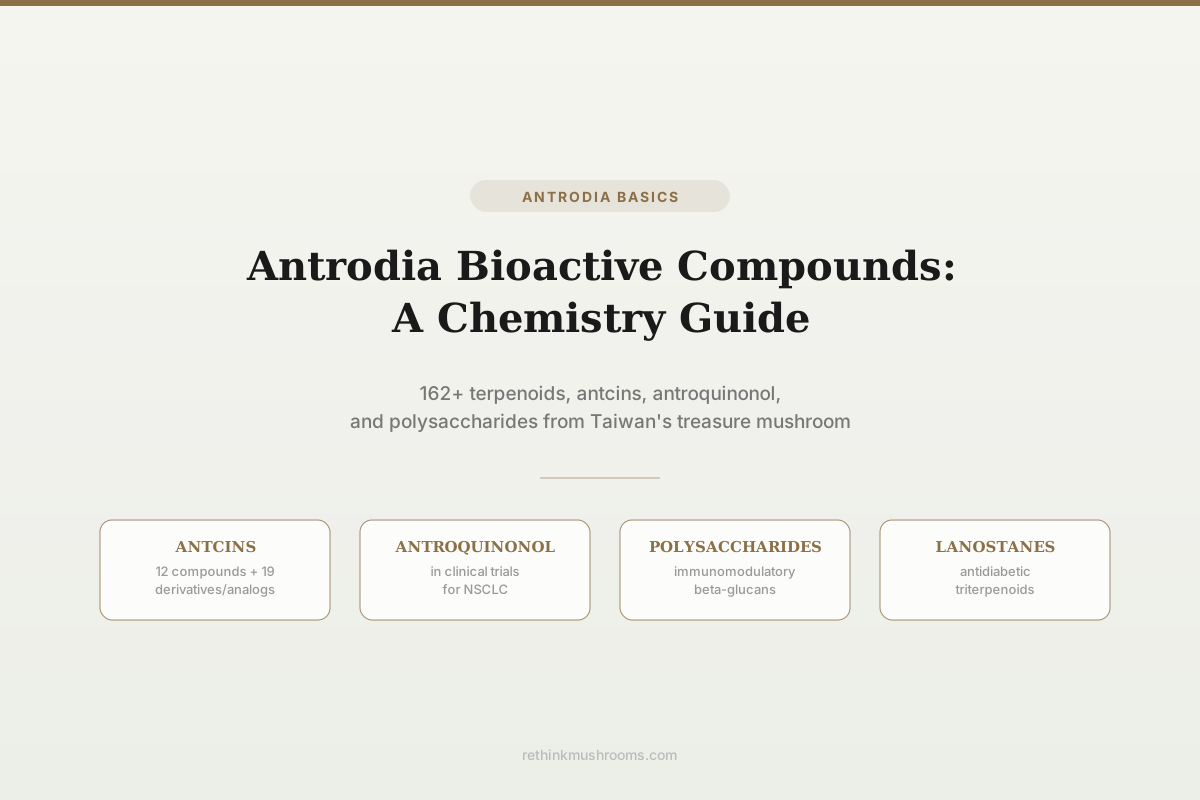
162+ terpenoids identified
Between 1995 and 2020, researchers isolated and characterized over 162 terpenoid compounds from Antrodia camphorata, making it one of the most chemically diverse medicinal mushrooms ever studied.
Kuang et al., Natural Product Reports, 2021
12 antcins
plus 12 derivatives and 7 analogs
4 compound classes
terpenoids, polysaccharides, benzenoids, maleics
1 in clinical trials
antroquinonol (phase I/II for NSCLC)
Kuang et al., Natural Product Reports, 2021
 View as image ↗
Most medicinal mushrooms are studied for one or two compound classes. Antrodia camphorata produces at least four distinct categories of bioactive molecules: ergostane-type triterpenoids (the antcins), meroterpenoids (antroquinonol and its derivatives), polysaccharides (primarily beta-glucans), and a collection of benzenoids, maleic acid derivatives, and succinic acid derivatives found in few other fungi.[1] A 2021 review in Natural Product Reports catalogued 162 terpenoid structures alone, isolated between 1995 and 2020.[1]
This chemical diversity is the reason Antrodia appears in cancer, liver disease, diabetes, inflammation, and neurodegeneration research simultaneously. Different compound classes target different biological pathways. Understanding which compounds do what is essential for interpreting the literature, because a finding about antroquinonol tells you nothing about antcin K, and a polysaccharide study has no relevance to triterpenoid pharmacology. For the mushroom's cultural and ecological background, see what is Antrodia camphorata? and why Antrodia only grows on Taiwanese camphor trees.
Key Takeaways
- Antrodia camphorata has yielded 162+ characterized terpenoids across five structural subclasses: triterpenoids, meroterpenoids, sesquiterpenoids, diterpenoids, and steroids (Kuang et al., 2021)
- Twelve distinct antcins (A through N) plus 12 derivatives/epimers and 7 methylated analogs have been isolated, all sharing an ergostane steroid-like skeleton (Senthil Kumar et al., 2020)
- Antroquinonol, a ubiquinone-derived meroterpenoid, is the only Antrodia compound to reach human clinical trials (phase I/II for non-small cell lung cancer)
- Polysaccharides from Antrodia mycelia possess immunomodulatory activity distinct from the terpenoid fraction, activating dendritic cells and modulating T-helper cell responses (Chen et al., 2008)
- Compound profiles vary depending on cultivation method: wild fruiting bodies, wood-cultivated fruiting bodies, dish cultures, and submerged fermentation each produce different chemical profiles
- Eleven triterpenoids tested against 14 cancer cell lines showed that methyl antcinate A had the broadest anticancer spectrum (Lee et al., 2012)
Terpenoids: the largest and most studied compound class
Ergostane triterpenoids (the antcins)
The antcins are ergostane-type steroids unique to Antrodia species. As of 2020, twelve individual antcins had been characterized: antcins A, B, C, D, E, F, G, H, I, K, M, and N. Adding their stereoisomers (25R and 25S epimers of antcins A, B, C, H, I, and K) and methylated analogs (methyl antcinates A, B, G, H, K, L, and N) brings the total to over thirty distinct compounds from this single structural class.[2]
All antcins share a four-ring ergostane backbone structurally similar to human steroid hormones. The differences between individual antcins lie in their side chains: the number, position, and stereochemistry of hydroxyl groups attached to the core skeleton. These seemingly minor structural variations produce dramatically different biological activities. Antcin A mimics glucocorticoids and has anti-inflammatory effects. Antcin B induces cancer cell apoptosis through dual-pathway activation. Antcin K has antidiabetic, anti-metastatic, and anti-inflammatory properties. Antcin C protects hepatocytes from oxidative damage.[2]
For detailed profiles of each compound, see antcins A, B, C, and K: individual compound research. For the anticancer data specifically, see antcin anti-cancer activity: preclinical research.
Lee et al. (2012) conducted the broadest pharmacological screen, testing eleven Antrodia triterpenoids against 14 human cancer cell lines and two normal cell types. Methyl antcinate A showed the widest anticancer spectrum with IC50 values ranging from 30.2 to 286.4 micromolar across oral, breast, prostate, ovarian, cervical, and bone cancer cells. High selectivity indices indicated preferential toxicity to cancer cells over normal cells.[3]
The screening approach matters: testing multiple compounds from the same organism against many cell types reveals structure-activity relationships that single-compound studies cannot. In this case, the data showed that side chain modifications to the ergostane skeleton predictably altered both potency and selectivity. Methyl antcinate A (the methylated form of antcin A) was consistently more potent than the unmethylated parent compound, suggesting that methylation enhances membrane permeability or target binding affinity. These structure-activity patterns guide efforts to develop more potent synthetic analogs.
Lanostane triterpenoids
Beyond the antcins, Antrodia produces lanostane-type triterpenoids including eburicoic acid, dehydroeburicoic acid, and sulphurenic acid. These compounds appear primarily in metabolic research. Eburicoic acid and dehydroeburicoic acid have shown antidiabetic and antihyperlipidemic effects in high-fat-diet mice through AMPK activation and GLUT4 translocation.[1] For details on their metabolic effects, see Antrodia and metabolic syndrome: multi-target effects.
The distinction between ergostane (antcin) and lanostane triterpenoids matters because they target partially different biological pathways. Ergostanes tend toward anti-inflammatory, anticancer, and hepatoprotective activity. Lanostanes lean toward metabolic regulation. Both classes activate AMPK, but their downstream effects diverge. Ergostatrien-3beta-ol, another lanostane compound, reduced fasting blood glucose and improved insulin sensitivity in high-fat-diet mice through GLUT4 translocation in skeletal muscle.
The structural relationship between these two triterpenoid classes reflects their shared biosynthetic origin. Both derive from squalene through the mevalonate pathway, but branch at the cyclization step: ergostanes follow the lanosterol-to-ergosterol pathway, while lanostanes retain the lanosterol scaffold. Understanding this biosynthetic divergence helps explain why Antrodia produces such a large number of structurally related but pharmacologically distinct compounds.
Meroterpenoids: antroquinonol and the clinical pipeline
Antroquinonol is a ubiquinone-derived meroterpenoid (a compound containing both terpenoid and non-terpenoid structural elements) that has attracted more pharmaceutical attention than any other Antrodia compound. It is the only Antrodia-derived molecule to reach human clinical trials.
Chemical identity and mechanism
Antroquinonol is structurally related to coenzyme Q (ubiquinone), the mitochondrial electron transport chain component. Wang et al. (2014) characterized antroquinonol D, a derivative with DNA demethylation activity, which induced re-expression of tumor suppressor genes silenced by hypermethylation in cancer cells.[4]
Lin et al. (2017) demonstrated that antroquinonol inhibited colon cancer stem cell-like properties, targeting the self-renewal capacity that makes cancer stem cells resistant to conventional chemotherapy.[5]
Chang et al. (2015) showed antroquinonol lowered brain amyloid-beta levels and improved spatial learning and memory in a transgenic Alzheimer's disease mouse model, expanding its pharmacological profile beyond oncology.[6]
Clinical development
Antroquinonol entered phase I clinical trials for metastatic non-small cell lung cancer in patients who had failed at least two prior treatment regimens. No dose-limiting toxicities were reported. Phase II trials have been conducted in Taiwan and the United States, though published results from later-phase trials remain limited.
Yen et al. (2022) published clinical data on an Antrodia preparation containing antroquinonol for liver protection in patients with alcoholic hepatitis, demonstrating clinical benefits in liver fat reduction and liver enzyme normalization.[7]
Antroquinonol's path toward clinical use is farther along than any other Antrodia compound, but it remains early-stage. The gap between phase I safety data and phase III efficacy evidence is where most drug candidates fail. The development timeline also illustrates a broader challenge: antroquinonol was first identified in the early 2000s, entered phase I trials around 2011, and over a decade later has not completed phase III. This pace is typical for natural product drug development, where the chemical complexity and supply chain challenges of fungal-derived compounds add years to the standard pharmaceutical timeline.
The relationship between antroquinonol and the coenzyme Q family is structurally informative but pharmacologically distinct. Ubiquinone (CoQ10) functions as an electron carrier in mitochondrial respiration. Antroquinonol shares the quinone ring structure but has different side chain modifications that give it pharmacological properties absent from dietary CoQ10 supplements. Confusing the two would be a category error.
Polysaccharides: the immunomodulatory fraction
Antrodia polysaccharides operate through entirely different biological mechanisms than the terpenoids. Where terpenoids act as small molecules that bind specific protein targets, polysaccharides interact with pattern recognition receptors on immune cells, particularly toll-like receptors and dectin-1 on macrophages and dendritic cells.
Chen et al. (2008) demonstrated that polysaccharides extracted from Antrodia camphorata mycelia possessed immunomodulatory activity, activating macrophages and modulating immune responses. The same preparation inhibited Schistosoma mansoni infection, suggesting immune-enhancing rather than immune-suppressing effects.[8]
The polysaccharide fraction and the terpenoid fraction are complementary rather than redundant. Terpenoids provide direct pharmacological activity (killing cancer cells, lowering blood sugar, suppressing inflammation). Polysaccharides modulate the immune system's capacity to respond to threats. This dual capacity may explain why whole Antrodia preparations sometimes show effects that neither fraction alone can fully account for.
Polysaccharide content varies even more than terpenoid content depending on how Antrodia is cultivated. Submerged fermentation mycelia tend to be richer in polysaccharides, while fruiting bodies grown on wood substrates concentrate triterpenoids. This means different Antrodia products may have fundamentally different pharmacological profiles depending on their source material.
The molecular weight and branching patterns of Antrodia polysaccharides also affect their biological activity. Higher molecular weight beta-glucans tend to show stronger immunomodulatory effects, while lower molecular weight fractions may be more easily absorbed. Research on Antrodia polysaccharides lags behind terpenoid research, partly because polysaccharide characterization requires different analytical techniques (size exclusion chromatography, NMR of sugar linkages) than the mass spectrometry and HPLC methods used for terpenoids.
Minor compound classes
Benzenoids
Antrodia produces a range of benzenoid compounds including 4-acetyl-antroquinonol B, antrocinnamomin, and related structures. These compounds appear less frequently in pharmacological studies than the terpenoids, but some show anti-inflammatory and antioxidant activity.[1]
Maleic and succinic acid derivatives
These small organic acids are produced primarily in submerged fermentation cultures. They include antrodin A, antrodin B, and related compounds with documented anti-inflammatory and hepatoprotective effects. Their pharmacological significance relative to the terpenoids remains less well characterized, though some researchers have proposed that these compounds contribute to Antrodia's hepatoprotective reputation in Taiwanese folk medicine.[2]
Lignans and nucleic acid derivatives
Small quantities of lignans and modified nucleic acid bases have been detected in Antrodia extracts. These represent a minor fraction of the total chemical output and have received limited individual study. Their presence adds to the overall chemical complexity of the mushroom but is unlikely to drive its major pharmacological effects at the concentrations typically found in preparations.
Why cultivation method determines compound profile
Not all Antrodia is chemically equivalent. The same species produces radically different compound mixtures depending on how it is grown:
Wild fruiting bodies (on Cinnamomum kanehirae heartwood) contain the highest triterpenoid concentrations, particularly antcins. These are the rarest and most expensive source material, harvested from an endangered tree species.
Wood-cultivated fruiting bodies (on basswood or other substrates) produce triterpenoid profiles similar to wild specimens but with different ratios. Antcin K content is highest in basswood-cultivated fruiting bodies.
Dish cultures (solid-state fermentation on agar or grain substrates) produce triterpenoids at lower concentrations than fruiting bodies but are more scalable and reproducible.
Submerged fermentation (liquid culture of mycelia) produces primarily polysaccharides and maleic/succinic acid derivatives, with lower triterpenoid content.
This variation has direct implications for research interpretation and product quality. A study using fruiting body extract is testing primarily triterpenoids. A study using fermentation broth is testing primarily polysaccharides. Results from one source cannot be extrapolated to the other. For the economic and conservation dimensions, see niu-chang-chih: the rarest and most expensive medicinal mushroom.
Commercial Antrodia products rarely disclose which cultivation method was used or which compound classes are present at what concentrations. Without this information, a consumer cannot know whether a product contains the compounds shown to be active in published research. A certificate of analysis showing total triterpenoid content, specific antcin concentrations, and polysaccharide fraction percentages would be the minimum standard for meaningful product evaluation. Few products currently meet this standard.
The conservation dimension adds another layer. Wild Antrodia grows exclusively on the heartwood of Cinnamomum kanehirae Hayata, an endangered tree endemic to Taiwan. Harvesting wild Antrodia fruiting bodies accelerates the decline of this host species. Cultivation methods that produce pharmacologically active preparations without relying on wild harvest are both a commercial and ecological priority. For the full story on this tension, see Antrodia camphorata: Taiwan's national treasure mushroom.
The Bottom Line
Antrodia camphorata produces over 162 characterized terpenoids (including ergostane antcins and lanostane triterpenoids), the meroterpenoid antroquinonol (the only compound in clinical trials), immunomodulatory polysaccharides, and minor compound classes including benzenoids and maleic/succinic acid derivatives. The biological activities attributed to "Antrodia" span cancer, liver disease, diabetes, inflammation, and neurodegeneration, but different compound classes drive different effects. Cultivation method determines which compounds predominate, making source material specification essential for both research and product evaluation.
Frequently Asked Questions
Sources & References
- 1RTHM-00695·Kuang, Yi et al. (2021). “Terpenoids from the medicinal mushroom Antrodia camphorata: chemistry and medicinal potential..” Natural product reports.Study breakdown →PubMed →↩
- 2RTHM-00652·Senthil Kumar, K J et al. (2020). “A mechanistic and empirical review of antcins, a new class of phytosterols of formosan fungi origin..” Journal of food and drug analysis.Study breakdown →PubMed →↩
- 3RTHM-00252·Lee, Yi-Pang et al. (2012). “Anticancer effects of eleven triterpenoids derived from Antrodia camphorata..” Anticancer research.Study breakdown →PubMed →↩
- 4RTHM-00355·Wang, Sheng-Chao et al. (2014). “Antroquinonol D, isolated from Antrodia camphorata, with DNA demethylation and anticancer potential..” Journal of agricultural and food chemistry.Study breakdown →PubMed →↩
- 5RTHM-00481·Lin, Hsien-Chun et al. (2017). “Antroquinonol, a Ubiquinone Derivative from the Mushroom Antrodia camphorata, Inhibits Colon Cancer Stem Cell-like Properties: Insights into the Molecular Mechanism and Inhibitory Targets..” Journal of agricultural and food chemistry.Study breakdown →PubMed →↩
- 6RTHM-00366·Chang, Wen-Han et al. (2015). “Antroquinonol Lowers Brain Amyloid-β Levels and Improves Spatial Learning and Memory in a Transgenic Mouse Model of Alzheimer's Disease..” Scientific reports.Study breakdown →PubMed →↩
- 7RTHM-00805·Yen, Yu-Ting et al. (2022). “Clinical Benefits of Golden-Antrodia Camphorata Containing Antroquinonol in Liver Protection and Liver Fat Reduction After Alcoholic Hepatitis..” Frontiers in pharmacology.Study breakdown →PubMed →↩
- 8RTHM-00129·Chen, Yu-Jen et al. (2008). “Polysaccharides from Antrodia camphorata mycelia extracts possess immunomodulatory activity and inhibits infection of Schistosoma mansoni..” International immunopharmacology.Study breakdown →PubMed →↩