Antcins
4 distinct mechanisms
Antcins A, B, C, and K are ergostane-type triterpenoids unique to Antrodia camphorata. Each has a different primary research profile: anti-inflammatory, pro-apoptotic, hepatoprotective, and antidiabetic.
Li et al., Journal of Ethnopharmacology, 2017
Antcin A
mimics glucocorticoids at 10 μmol/L
Antcin K
matched metformin's glucose-lowering effect at 40 mg/kg
Antcin B
induced apoptosis in hepatocellular carcinoma cells
Li et al., Journal of Ethnopharmacology, 2017
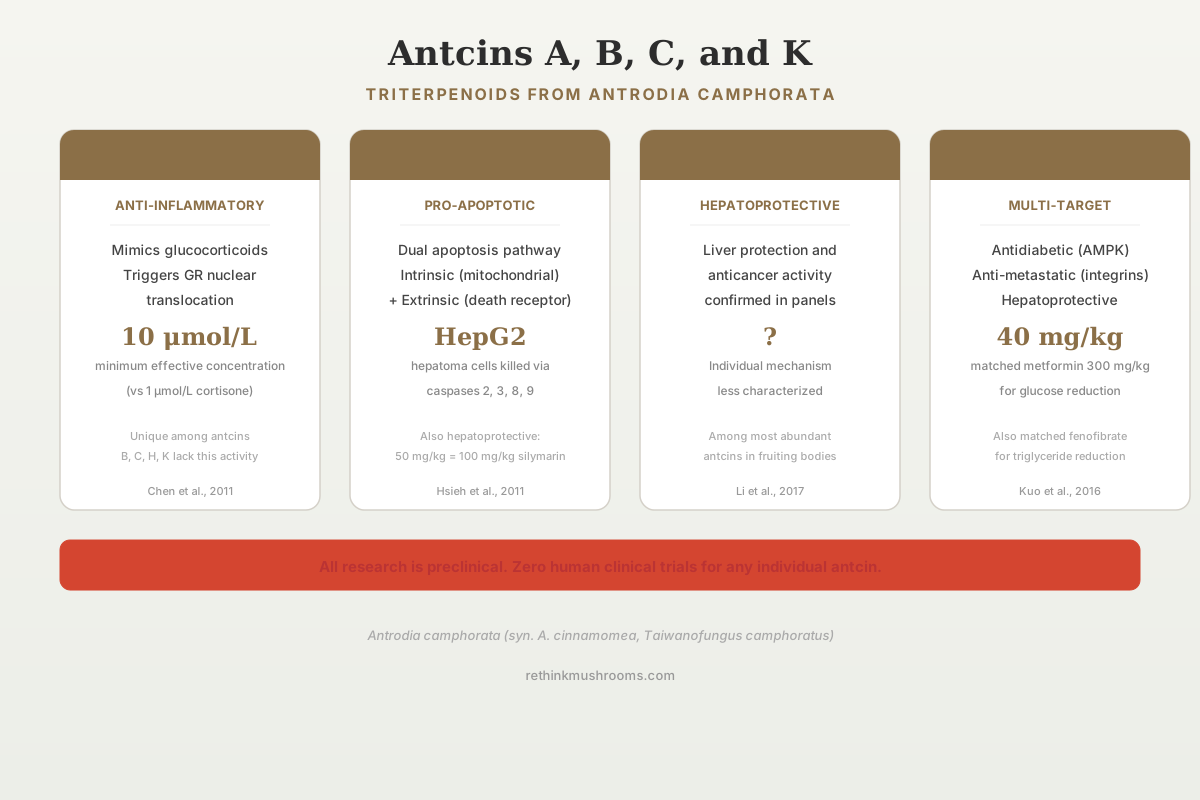 View as image ↗
Antrodia camphorata (also called Antrodia cinnamomea or niu-chang-chih in Mandarin) produces a class of triterpenoids found nowhere else in nature: the antcins. These ergostane-type compounds share a steroid-like backbone but differ in their side chains and hydroxylation patterns, and those structural differences translate into distinct biological activities.[1] Antcin A mimics glucocorticoids. Antcin B induces cancer cell death through both intrinsic and extrinsic apoptotic pathways. Antcin K has been tested against diabetes, liver injury, and tumor metastasis. Antcin C appears in hepatoprotection and cancer research but with less individual characterization than the others.
This article breaks down the research on each compound individually. For the broader context of how antcins protect the liver or antcin anticancer research, see our companion articles.
Key Takeaways
- Antcin A triggers glucocorticoid receptor translocation into the nucleus at 10 micromol/L, mimicking cortisone and dexamethasone in anti-inflammatory signaling (Chen et al., 2011)
- Antcin B induced apoptosis in HepG2 hepatocellular carcinoma cells via mitochondrial membrane depolarization, cytochrome c release, and activation of caspases 2, 3, 8, and 9 (Hsieh et al., 2011)
- Antcin K at 40 mg/kg/day matched metformin (300 mg/kg/day) for blood glucose reduction and fenofibrate (250 mg/kg/day) for triglyceride reduction in diabetic mice (Kuo et al., 2016)
- Antcin K inhibited adhesion, migration, and invasion of Hep 3B hepatoma cells by suppressing integrin beta-1, beta-3, alpha-5, and alpha-v expression (Huang et al., 2015)
- 50 mg/kg of antcin K or antcin B matched 100 mg/kg silymarin for hepatoprotection against CCl4-induced liver injury in mice (Li et al., 2017)
- All research is preclinical: cell culture and animal models only, with no human clinical trials for any individual antcin compound
Antcin A: the glucocorticoid mimic
Antcin A is structurally the most steroid-like of the antcin family, and its biology reflects that similarity. Chen et al. (2011) demonstrated that antcin A exerts anti-inflammatory effects by directly mimicking glucocorticoid hormones.[2]
The mechanism is specific: antcin A crosses cell membranes due to its lipophilic character, binds to the cytosolic glucocorticoid receptor (GR), causes GR to dissociate from heat-shock proteins, and triggers the GR complex to translocate into the nucleus. Once in the nucleus, the complex binds glucocorticoid response elements and suppresses pro-inflammatory gene expression while enhancing anti-inflammatory gene expression.[2]
The minimum effective concentration was 10 micromol/L, compared to 1 micromol/L for cortisone and 0.1 micromol/L for dexamethasone. Antcin A is therefore roughly 10 times less potent than cortisone and 100 times less potent than dexamethasone at triggering GR nuclear translocation. However, the significance is that a natural fungal compound activates the same receptor and signaling pathway as pharmaceutical corticosteroids.
This specificity was demonstrated by comparison: antcins B, C, H, and K did not induce GR nuclear translocation at the concentrations tested.[2] The anti-inflammatory mechanism through glucocorticoid mimicry appears unique to antcin A among the antcin family.
The practical implications are unclear. Glucocorticoid drugs are powerful anti-inflammatory agents but cause significant side effects with chronic use (bone loss, immunosuppression, metabolic disruption). Whether antcin A, at lower potency, could provide anti-inflammatory benefit without these side effects has not been tested in any animal model of chronic inflammation.
Antcin B: the apoptosis inducer
Antcin B has the most developed anticancer research profile among the antcins. Hsieh et al. (2011) published a detailed mechanistic study of antcin B-induced apoptosis in HepG2 and Hep 3B hepatocellular carcinoma cell lines.[3]
The apoptotic pathway activated by antcin B involves both intrinsic (mitochondrial) and extrinsic (death receptor) routes:
- Increased DNA fragmentation
- Cleavage of PARP (poly ADP-ribose polymerase)
- Accumulation of cells in the sub-G1 population (indicating apoptosis)
- Chromatin condensation
- Loss of mitochondrial membrane potential
- Release of cytochrome c from mitochondria
- Activation of caspase-2, caspase-3, caspase-8, and caspase-9
The mechanism also involved enhanced oxidative stress in the cancer cells. Antcin B's ester derivative (methylantcinate B) showed similar activity, suggesting the antcin scaffold itself is responsible for the pro-apoptotic effect.[3]
This is preclinical cell culture data. Cancer cells in a dish respond differently than tumors in a living organism, where drug delivery, metabolism, immune system interactions, and tumor microenvironment all modify compound activity. No animal tumor model or human trial has tested antcin B as an anticancer agent. The data establishes mechanism, not efficacy.
The dual pathway activation (both intrinsic and extrinsic apoptosis) is pharmacologically notable because it reduces the likelihood that cancer cells can develop resistance through a single escape mechanism. Many chemotherapeutic agents activate only one pathway, and resistance often develops when cells upregulate anti-apoptotic proteins in that pathway. A compound that activates both routes simultaneously is harder to evade, at least in theory. Whether this translates to clinical advantage cannot be determined from cell culture experiments alone.
For broader context on Antrodia compounds in cancer research, the preclinical landscape extends across multiple mushroom species.
Antcin C: hepatoprotective but less characterized
Antcin C appears in the Antrodia camphorata literature primarily in the context of hepatoprotection and anticancer activity, but with less individual mechanistic detail than antcins A, B, or K.[1]
Li et al. (2017) included antcin C in a panel of triterpenoids tested against CCl4-induced liver injury in mice, confirming hepatoprotective activity, but the study focused more on antcins K and B as the primary active hepatoprotective compounds.[1]
The structural difference between antcin C and its siblings lies in the hydroxylation pattern and side chain configuration. These differences are enough to change receptor binding affinity and metabolic fate, but systematic structure-activity relationship (SAR) studies comparing all four antcins in the same assay system have not been published.
What can be said is that antcin C, like all antcins, is an ergostane-type triterpenoid with the general Antrodia bioactive scaffold. It likely shares some overlapping activity with the better-characterized antcins, but its specific contribution to the biological effects of whole Antrodia extracts has not been isolated.
This gap is notable because antcin C is among the most abundant antcins in Antrodia fruiting bodies. Its concentration in wild-harvested Antrodia can exceed that of antcin K in some growth conditions. A compound that abundant in a medicinal mushroom deserves more individual characterization than it has received. The research focus on antcins A, B, and K may reflect the historical sequence of discovery and early positive results rather than a rational assessment of which compounds contribute most to Antrodia's biological effects.
Antcin K: the most versatile
Antcin K has the broadest research profile, with published data on antidiabetic, antihyperlipidemic, hepatoprotective, anti-metastatic, and anti-inflammatory activities.
Diabetes and lipid metabolism. Kuo et al. (2016) demonstrated that antcin K at 40 mg/kg/day in diabetic mice displayed both antihyperglycemic effects comparable to metformin (300 mg/kg/day) and antihypertriglyceridemic effects comparable to fenofibrate (250 mg/kg/day).[4] The mechanism involves increased glucose transporter 4 (GLUT4) expression in muscle cells through AMP-activated protein kinase (AMPK) phosphorylation. In vitro, antcin K at 5, 10, and 25 microg/mL significantly increased GLUT4 membrane expression in C2C12 myoblast cells.
This dual glucose-lowering and lipid-lowering activity from a single compound is pharmacologically interesting, because type 2 diabetes patients frequently require separate medications for glycemic and lipid control. The AMPK pathway that antcin K activates is the same pathway targeted by metformin, the world's most prescribed diabetes drug. If antcin K genuinely activates AMPK at achievable oral doses in humans, it would have biological plausibility as an antidiabetic agent. But "if" carries considerable weight: the jump from mouse pharmacology to human medicine has a failure rate exceeding 90% across all therapeutic areas, and metabolic diseases are no exception.
Anti-metastatic activity. Huang et al. (2015) showed that antcin K inhibited adhesion, migration, and invasion of Hep 3B hepatoma cells within 24 hours of treatment.[5] The mechanism was specific: antcin K reduced protein expression of integrins beta-1, beta-3, alpha-5, and alpha-v, suppressing integrin-mediated signaling. It also reduced MMP-2 and MMP-9 activity (matrix metalloproteinases that enable tumor invasion), down-regulated vimentin (a mesenchymal marker), and up-regulated E-cadherin (an epithelial marker), collectively suggesting reversal of epithelial-mesenchymal transition.
Hepatoprotection. Li et al. (2017) tested multiple Antrodia triterpenoids against CCl4-induced acute liver injury in mice and found that antcin K and antcin B were the two most hepatoprotective compounds.[1] At 50 mg/kg, both matched the hepatoprotective effect of 100 mg/kg silymarin, the pharmaceutical standard for liver protection research. The mechanism was anti-inflammatory, consistent with antcin K's activity in other contexts.
Limitations and the human evidence gap
Every study cited in this article is preclinical. Cell culture experiments demonstrate mechanism. Animal models suggest in vivo activity. Neither proves human efficacy.
Specific limitations include:
Bioavailability unknown. Oral absorption, metabolism, tissue distribution, and elimination of individual antcins have not been characterized in humans. Triterpenoids as a class often have poor oral bioavailability, though the ergostane-type backbone may confer better absorption than some larger polycyclic structures.
Dose translation uncertain. The 40 mg/kg/day dose of antcin K that matched metformin in mice translates to roughly 3.2 mg/kg in a human using standard allometric scaling. For a 70 kg person, that is approximately 225 mg of pure antcin K per day. Whether Antrodia supplements deliver this dose in their antcin K fraction is unknown, as most products report total triterpenoid content rather than individual antcin concentrations.
No head-to-head human comparison. Antcin K's comparison to metformin and fenofibrate was in a mouse model. Metformin's efficacy in humans is supported by decades of clinical trial data. Antcin K has zero human data. The comparison is suggestive, not equivalent.
Whole extract vs. isolated compound. Most Antrodia supplements are whole extracts containing a mixture of antcins, zhankuic acids, antroquinonol, and polysaccharides. The biological activity of a whole extract may differ from isolated compounds due to synergistic or antagonistic interactions. Attributing specific health effects to individual antcins based on isolated compound studies may not predict whole extract behavior.
Species nomenclature. The source organism has been called Antrodia camphorata, Antrodia cinnamomea, and Taiwanofungus camphoratus in the literature. The International Mycological Association recognizes Antrodia cinnamomea as the current accepted name, though most published research uses A. camphorata. This naming inconsistency complicates literature searches and should be considered when evaluating the completeness of any review.
Cultivation method matters. Antcin content varies dramatically depending on whether Antrodia is wild-harvested (from Cinnamomum kanehirae trees, now extremely rare), cultivated on basswood logs, grown on grain substrates, or produced in submerged fermentation. Wild fruiting bodies typically contain the highest antcin concentrations. Disc-cultivated fruiting bodies approximate wild-type chemistry more closely than mycelial fermentation products. Most supplements use the cheaper fermentation methods, which may produce different antcin ratios than the preparations used in published research.
For the broader picture of antcins as a compound class and their role in Antrodia's value as Taiwan's most studied medicinal mushroom, see our companion articles.
The Bottom Line
Antcins A, B, C, and K are structurally related triterpenoids from Antrodia camphorata with distinct biological profiles. Antcin A mimics glucocorticoids at 10 micromol/L. Antcin B induces cancer cell apoptosis via both intrinsic and extrinsic pathways. Antcin K shows antidiabetic, anti-metastatic, and hepatoprotective activity, matching pharmaceutical comparators in mouse models. All data is preclinical, with no human clinical trials for any individual antcin compound. The gap between cell culture mechanism and human therapeutic value remains unbridged.
Frequently Asked Questions
Sources & References
- 1RTHM-00479·Li, Zi-Wei et al. (2017). “Hepatoprotective activities of Antrodia camphorata and its triterpenoid compounds against CCl4-induced liver injury in mice..” Journal of ethnopharmacology.Study breakdown →PubMed →↩
- 2RTHM-00210·Chen, Yi-ching et al. (2011). “Antcin A, a steroid-like compound from Antrodia camphorata, exerts anti-inflammatory effect via mimicking glucocorticoids..” Acta pharmacologica Sinica.Study breakdown →PubMed →↩
- 3RTHM-00217·Hsieh, Yun-Chih et al. (2011). “Antcin B and its ester derivative from Antrodia camphorata induce apoptosis in hepatocellular carcinoma cells involves enhancing oxidative stress coincident with activation of intrinsic and extrinsic apoptotic pathway..” Journal of agricultural and food chemistry.Study breakdown →PubMed →↩
- 4RTHM-00430·Kuo, Yueh-Hsiung et al. (2016). “Antcin K, a Triterpenoid Compound from Antrodia camphorata, Displays Antidiabetic and Antihyperlipidemic Effects via Glucose Transporter 4 and AMP-Activated Protein Kinase Phosphorylation in Muscles..” Evidence-based complementary and alternative medicine : eCAM.Study breakdown →PubMed →↩
- 5RTHM-00377·Huang, Ya-Ling et al. (2015). “Antcin K, an Active Triterpenoid from the Fruiting Bodies of Basswood-Cultivated Antrodia cinnamomea, Inhibits Metastasis via Suppression of Integrin-Mediated Adhesion, Migration, and Invasion in Human Hepatoma Cells..” Journal of agricultural and food chemistry.Study breakdown →PubMed →↩