Agaricus blazei and Liver Health
4 patients
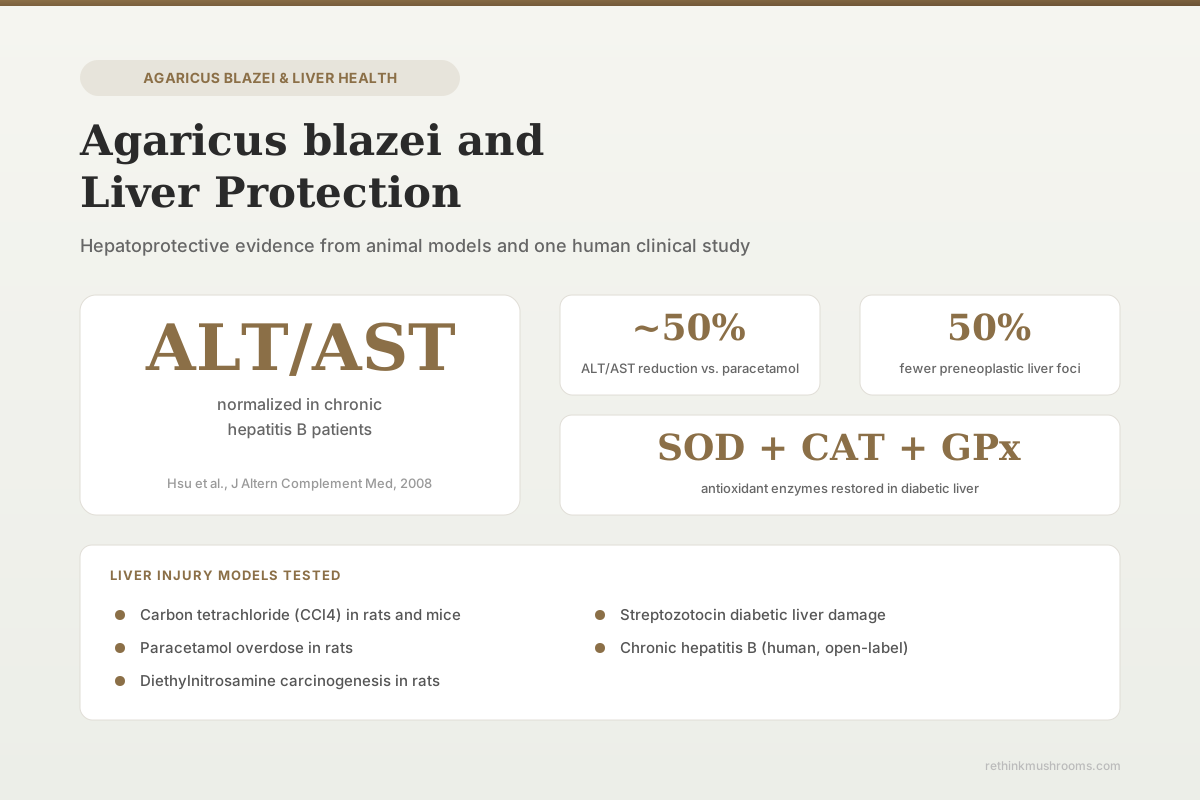
The entire human evidence base for Agaricus blazei and liver protection is one 12-month open-label pilot in four chronic hepatitis B patients, where ALT fell from 151 to 46 IU/L. Every other finding is rodent work.
Hsu et al., Journal of Alternative and Complementary Medicine, 2008
5 injury models
CCl4, paracetamol, DEN, diabetic, human hepatitis B
3 CCl4 studies
across two research groups, rats and mice
5 case reports
of serious liver injury, including 2 deaths
Hsu et al., Journal of Alternative and Complementary Medicine, 2008
 View as image ↗
Agaricus blazei liver protection research spans about two decades, covering chemical injury models, drug-induced hepatotoxicity, carcinogen exposure, diabetic liver damage, and one human study in chronic hepatitis B. The recurring finding across these studies is that ABM extracts reduce markers of liver damage, most often alongside improvements in antioxidant status — though, as the sections below show, the antioxidant result is not reproduced in every model.[8]
This body of evidence is entirely preclinical except for a single open-label pilot in four patients. The animal models use standardized chemical insults (carbon tetrachloride, paracetamol, diethylnitrosamine) that produce predictable liver damage, making them useful for measuring protection but limited in relevance to the chronic, multifactorial liver diseases that affect humans. Read closely, most of the individual findings also come with conditions attached — a dose threshold, a specific carcinogen dose, a particular mushroom strain — that tend to disappear when the literature is summarized. Those conditions are the subject of much of what follows. For the human evidence, see Agaricus blazei for Hepatitis B and C: Clinical Evidence.
Key Takeaways
- The only human data is a 12-month open-label pilot in four chronic hepatitis B patients taking 1,500 mg/day, where ALT fell from 151 to 46 IU/L and AST from 246 to 61 IU/L, with no control group and no viral-load measurement (Hsu et al., 2008)
- CCl4-induced hepatic necrosis and fibrosis were reduced by ABM across three rodent studies, though the transaminase benefit appeared only at the high 2,000 mg/kg dose (Chang et al., 2011; Wu et al., 2011; Al-Dbass et al., 2012)
- ABM aqueous extract pretreatment largely prevented the rise in plasma ALT, AST, LDH and ALP after paracetamol in rats, but gave little or no protection to liver function itself, measured as gluconeogenesis (Soares et al., 2013)
- ABM improved the hepatic antioxidant panel (SOD, catalase, glutathione) in streptozotocin-induced diabetic rats, with the ethyl acetate extract outperforming the ethanol extract (Wei et al., 2020)
- Dietary ABM reduced the number and size of preneoplastic liver foci in DEN-exposed rats, but the effect depended on which mushroom strain was fed and when it was harvested — one of four diet arms showed no activity at all (Pinheiro et al., 2003)
- ABM lowered ALT, hepatocyte proliferation and GST-P positive preneoplastic cells after DEN, but only at the moderate 100 mg/kg carcinogen dose (Barbisan et al., 2002)
- Five published case reports describe serious ABM-associated liver injury in cancer patients, including two deaths from fulminant hepatitis (Mukai et al., 2006; Hisamochi et al., 2013)
The Only Human Study: Chronic Hepatitis B
Hsu et al. (2008) conducted a one-year open-label pilot study in which chronic hepatitis B patients received 1,500 mg of Agaricus blazei Murill extract daily for 12 months.[1] Alanine aminotransferase (ALT) was the major outcome measurement, alongside aspartate aminotransferase (AST) — the standard blood markers for liver cell damage. Enrolled patients were long-term hepatitis B carriers with ALT above 100 IU/L who were not taking lamivudine, interferon, or other hepatitis drugs.
Four patients completed the study. That number deserves to be stated plainly, because it is the entire human evidence base for this topic. Mean AST fell from 246.0 (SD 138.9) to 61.3 (SD 32.6) IU/L, and mean ALT from 151.0 (SD 86.9) to 46.1 (SD 22.5) IU/L. The authors describe this as normalization of liver function, and ALT did land back inside the usual reference range; AST at 61 IU/L remained modestly above it.
The design limitations are severe enough to be disqualifying on their own. The study was open-label, so both patients and investigators knew who was receiving treatment. There was no placebo arm and no control group of any kind. Chronic hepatitis B is a disease that flares and remits spontaneously, and ALT tracks those cycles — over 12 months, four patients drifting down from a flare is exactly what you would expect to see without any intervention. The authors themselves call for controlled studies with larger samples. This is a hypothesis-generating observation, not evidence of efficacy.
It is worth contrasting this with the same group's earlier work. Hsu et al. (2007) ran a genuinely rigorous randomized, double-blind, placebo-controlled trial of the same 1,500 mg/day ABM extract in 72 type 2 diabetes patients, and found improved insulin resistance versus placebo.[9] The team clearly knew how to run a controlled trial. The hepatitis B work was published as a four-patient pilot anyway, and no controlled follow-up has appeared in the years since.
The study also did not measure hepatitis B viral load, so it is unclear whether ABM affected viral replication or simply reduced inflammation-driven liver damage while the virus remained active. This distinction matters clinically: reducing liver enzymes without controlling viral replication could mask ongoing disease progression. Modern hepatitis B management prioritizes viral suppression with nucleoside analogs (entecavir, tenofovir), and enzyme normalization alone is not considered an adequate treatment endpoint. For the broader picture of liver enzyme changes with ABM, see our dedicated analysis.
Carbon Tetrachloride Liver Injury Models
Carbon tetrachloride (CCl4) is the standard chemical used to induce liver damage in research animals. It generates free radicals that attack hepatocyte membranes, causing necrosis and fibrosis through a well-characterized oxidative mechanism. Three rodent studies tested ABM against this model.
Chang et al. (2011) and Wu et al. (2011): The Matched Mouse and Rat Pair
Chang et al. tested ABM extract in BALB/c mice given intraperitoneal CCl4 twice weekly for eight weeks, with ABM tube-fed at either 200 or 2,000 mg/kg on the remaining four days.[3] The result was partial rather than uniform. Only the high dose significantly abrogated the CCl4-induced rise in AST and ALT. Both doses reduced hepatic necrosis and fibrosis on histological analysis. Notably, ABM did not significantly reverse the CCl4-induced alterations in glutathione peroxidase and catalase — a result that cuts against the simple "ABM restores antioxidant enzymes" story told elsewhere in this literature.
Wu et al. (2011) published a rat version of the same experiment in the same journal, using the same eight-week protocol and the same 200 versus 2,000 mg/kg doses.[10] High-dose ABM again reduced hepatic necrosis and fibrosis relative to CCl4 controls, with lower plasma ALT and AST. Because these two reports share a journal, a protocol, and a dose structure, they are best read as companion papers from one research program rather than as independent replications of each other.
Al-Dbass et al. (2012): The Independent Rat Study
The genuinely independent replication comes from a Saudi group.[2] Male albino rats were divided into five groups, including a protective arm (ABM extract first, then CCl4) and a therapeutic arm (CCl4 first, then ABM). The team measured serum transaminases, lactate dehydrogenase, glutathione reductase, non-enzymatic antioxidants (glutathione, vitamin C, vitamin E), and malondialdehyde as a lipid peroxidation index.
The reported finding is that ABM-treated animals showed increased non-enzymatic antioxidants and decreased malondialdehyde, and the authors conclude that ABM is an efficient hepatoprotective and antioxidant agent. It is worth being precise about what the paper does and does not report: the published abstract describes enzyme and antioxidant changes in CCl4-treated rats relative to normal controls, and antioxidant changes in ABM-treated animals, but it does not report a head-to-head transaminase reduction for ABM against the CCl4-only control group. Nor does it report a comparison of the protective against the therapeutic arm. The conclusion of hepatoprotection is the authors'; the granular enzyme comparison that would most directly support it is not in the abstract.
Five models, one human study
How Far Each Liver Model Actually Reaches
The liver protection literature is consistent, but consistency across four rodent models is not the same as evidence in people. Four of the five streams below stop at the animal stage.
Carbon tetrachloride
Free-radical membrane injury, necrosis and fibrosis
Evidence
3 rodent studies (Chang 2011, Wu 2011, Al-Dbass 2012)
What was found
Less hepatic necrosis and fibrosis on histology; transaminase benefit only at the high 2,000 mg/kg dose
ABM did not significantly reverse glutathione peroxidase or catalase in the mouse study. Two of the three reports share a journal and protocol.
Paracetamol overdose
Acute drug-induced liver failure, the commonest cause in the West
Evidence
1 rat pretreatment study (Soares 2013)
What was found
Largely prevented the rise in ALT, AST, LDH and ALP; practically normalized TBARS in liver and brain
Little or no protection of gluconeogenesis, and morphological signs of inflammation persisted. Pretreatment only.
Diethylnitrosamine
Chemically initiated liver carcinogenesis
Evidence
2 rat studies (Barbisan 2002, Pinheiro 2003)
What was found
Fewer and smaller preneoplastic GST-P positive foci; lower ALT and hepatocyte proliferation
Barbisan saw protection at one DEN dose only (100 mg/kg). Pinheiro found the effect depended on mushroom strain and harvest stage. Foci are not cancer.
Diabetic oxidative stress
Sustained low-grade metabolic liver injury
Evidence
1 rat study (Wei 2020)
What was found
Hepatic SOD, catalase and glutathione assessed alongside AST and ALT; ethyl acetate extract outperformed ethanol extract
The abstract reports which extract did better, not the direction or size of each marker change. No clinical endpoint.
Chronic hepatitis B
Actual human liver disease
Evidence
1 open-label pilot, 4 patients (Hsu 2008)
What was found
Over 12 months at 1,500 mg/day: ALT 151 → 46 IU/L, AST 246 → 61 IU/L
Four patients, no control arm, no blinding, no viral-load data. ALT in chronic hepatitis B flares and remits without treatment.
Sources: Chang et al., 2011 (RTHM-00383); Wu et al., 2011 (RTHM-00445); Al-Dbass et al., 2012 (RTHM-00450); Soares et al., 2013 (RTHM-00555); Barbisan et al., 2002 (RTHM-00086); Pinheiro et al., 2003 (RTHM-00118); Wei et al., 2020 (RTHM-01298); Hsu et al., 2008 (RTHM-00255)
Al-Dbass administered crushed wet fruiting bodies suspended in distilled water, and Soares used an aqueous extract in the paracetamol model below — which matters because different extraction methods yield different compound profiles. To the extent the hepatoprotective compounds are water-soluble, that points toward polysaccharides and phenolic compounds rather than lipid-soluble ergosterol derivatives. Wei's diabetic study cuts the other way, finding an ethyl acetate fraction outperformed an ethanol one, so the active material is unlikely to sit in a single solvent class.
The CCl4 model, while standard in hepatology research, has a specific limitation: it produces acute necrotic injury through a single mechanism (trichloromethyl free radical generation). Human liver diseases typically involve multiple overlapping mechanisms operating over years or decades. Alcoholic liver disease involves direct ethanol toxicity, acetaldehyde formation, immune activation, and gut barrier dysfunction. Non-alcoholic fatty liver disease involves insulin resistance, lipotoxicity, and inflammatory signaling. CCl4 protection does not predict protection against these complex, chronic processes.
Paracetamol (Acetaminophen) Liver Injury
Soares et al. (2013) tested whether ABM aqueous extract pretreatment could protect against paracetamol-induced liver damage in rats.[4] Paracetamol overdose is the most common cause of acute liver failure in Western countries, making this a clinically relevant model.
Rats received ABM aqueous extract before a hepatotoxic dose of paracetamol. On the classical damage indicators, the extract performed well: pretreatment largely prevented the increases in plasma hepatic enzymes (AST, ALT, LDH and alkaline phosphatase) and practically normalized TBARS, a lipid peroxidation marker, in both liver and brain tissue. The study measured brain as well as liver injury, and found the pretreatment protective for both.
This is where the paper becomes genuinely instructive, and where most summaries of it stop too early. Soares and colleagues deliberately went beyond the classical markers to measure whether the liver still worked — specifically gluconeogenesis, a core hepatic function — and looked at tissue morphology. On those measures the extract "provided little or no protection." Morphological signs of inflammation persisted, and paracetamol-impaired gluconeogenesis was not rescued.
The authors turn that into a warning to the field: given how many substances are called hepatoprotective on the strength of enzyme panels alone, functional parameters belong in these protocols. A normal-looking transaminase panel over a liver that is not doing its metabolic work is not a protected liver. No percentage reduction in ALT or AST appears anywhere in the paper's abstract.
The presumed mechanism involves glutathione. Paracetamol toxicity occurs when its reactive metabolite (NAPQI) depletes hepatic glutathione, leaving the liver unable to neutralize oxidative damage; an extract with free radical scavenging activity could plausibly help. This is also a pretreatment model, so it shows that having ABM on board before an injury blunts some markers of that injury — not that ABM treats established damage.
Diabetic Liver Damage
Wei et al. (2020) examined ABM's effects on liver antioxidant enzymes in streptozotocin-induced diabetic rats.[5] Diabetes causes chronic oxidative stress in the liver, depleting protective enzymes over time. The diabetic model produces a different pattern of liver injury than acute chemical exposure, involving sustained low-grade damage rather than a single catastrophic insult.
The hepatic panel analyzed was superoxide dismutase (SOD), catalase, glutathione, AST and ALT, alongside histopathology of pancreatic tissue. The headline result is comparative rather than absolute: the ethyl acetate extract protected hepatic antioxidant activity and impaired pancreatic tissue better than the ethanol extract did, consistent with specific solvent fractions concentrating the most bioactive compounds. What the paper does not give is the direction or magnitude of change for each individual marker — so the frequently repeated claim that ABM "restored SOD, catalase and glutathione peroxidase to normal values" runs ahead of the source, and glutathione peroxidase was not among the markers measured.
This study bridges the liver protection and blood sugar research. If ABM both lowers blood glucose and protects the liver from diabetes-related oxidative damage, the dual action could be relevant for metabolic syndrome. But this remains an animal finding.
Carcinogen-Induced Liver Damage
Two studies examined ABM's effects on livers exposed to diethylnitrosamine (DEN), a potent chemical carcinogen.
Barbisan et al. (2002): Protection Within a Dose Window
Barbisan et al. gave male Wistar rats aqueous ABM extract in their drinking water for two weeks, then a single intraperitoneal DEN injection at 50, 100 or 200 mg/kg, and examined the livers 48 hours later.[6] The endpoints were ALT, the proliferating cell nuclear antigen (PCNA) labeling index as a measure of hepatocyte replication, and counts of hepatocytes expressing glutathione S-transferase placental form (GST-P), a standard marker of putative preneoplastic change.
All three endpoints were lower in ABM-treated rats — but only at the 100 mg/kg DEN dose. The authors scope their conclusion accordingly, describing a hepatoprotective effect against "a moderately toxic dose" of the carcinogen. The variable being escalated in this experiment was the carcinogen dose, not the ABM dose, so this study does not establish a dose-response relationship for the mushroom. What it suggests is a window: too little carcinogen and there may be too little damage to measurably prevent; too much and the protection is overwhelmed.
Pinheiro et al. (2003): Chemoprevention, With Conditions
Pinheiro et al. took the carcinogenesis model further by examining preneoplastic foci, the earliest identifiable precursors to liver cancer.[7] Rats were initiated with DEN at 200 mg/kg, then fed for six weeks on a basal diet containing 10% dry powdered mushroom, with partial hepatectomy at week three and assessment at week eight.
The design is what makes this study unusually informative. Rather than testing "Agaricus blazei," the team tested four different preparations: two strains, Ab 29 and Ab 26, each harvested with an opened or a closed basidiocarp. The results diverged across those arms. Three of the four reduced the number of preneoplastic foci; only two reduced their size and inhibited foci cell proliferation; one arm showed no chemopreventive activity on any endpoint. The authors' conclusion is that the protective influence depends on both the strain and the period of harvest.
The conditions attached
When Agaricus blazei Reduced Precancerous Foci — And When It Did Not
Both diethylnitrosamine studies report a conditional result. The chemoprevention depended on which mushroom strain was fed and when it was harvested; the acute protection appeared at one carcinogen dose and not the others.
Pinheiro 2003 · strain and harvest stage
| Diet arm | Fewer foci | Smaller foci | Less proliferation |
|---|---|---|---|
Ab 29 · OB Strain 29, opened basidiocarp | ✓ | ✓ | ✓ |
Ab 29 · CB Strain 29, closed basidiocarp | ✓ | – | – |
Ab 26 · CB Strain 26, closed basidiocarp | ✓ | ✓ | ✓ |
Ab 26 · OB Strain 26, opened basidiocarp | – | – | – |
One of the four arms showed no chemopreventive activity on any endpoint. The authors concluded the effect depends on both strain and period of harvest.
Barbisan 2002 · carcinogen dose
50 mg/kg
Low DENNo protective effect reported
100 mg/kg
Moderate DENALT, PCNA index and GST-P+ hepatocytes all lower
200 mg/kg
High DENNo protective effect reported
Sources: Pinheiro et al., 2003 (RTHM-00118, PMID 12963007); Barbisan et al., 2002 (RTHM-00086, PMID 12413704). Neither abstract reports a percentage reduction in foci.
That conditionality matters well beyond this experiment. It means the active material is not a stable property of the species but varies with genetics and with when the fruiting body is picked — which is precisely the kind of variability that makes commercial supplement products difficult to reason about. Neither DEN study reports a percentage reduction in foci, and the "50% fewer foci" figure that circulates in secondary summaries of this work does not appear in the source.
Neither study claims ABM prevents liver cancer. They show that ABM reduces some of the early cellular changes that precede cancer development in a chemical carcinogenesis model. The gap between reducing preneoplastic foci in DEN-exposed rats and preventing cancer in humans is enormous, involving decades of disease progression, different carcinogen exposures, and fundamentally different biology.
The DEN model is also worth contextualizing. DEN is a direct-acting chemical carcinogen rarely encountered in everyday human exposure. Human liver cancer most commonly develops from chronic hepatitis B or C infection, alcohol-related cirrhosis, or MASH (metabolic-associated steatohepatitis). Whether ABM's protective effects against DEN translate to any of these disease pathways is unknown. The Hsu et al. (2008) hepatitis B study is the closest link, but it measured enzyme normalization, not cancer endpoints. For a discussion of this paradox alongside ABM's hepatotoxicity reports, see Agaricus blazei and Drug Interactions.
Mechanisms of Liver Protection
The evidence points to three overlapping mechanisms:
Antioxidant capacity. Several studies report improvements in hepatic antioxidant status — Al-Dbass found increased non-enzymatic antioxidants, and Wei assessed SOD, catalase and glutathione. These systems neutralize reactive oxygen species (ROS) before they can damage hepatocyte membranes and DNA. This mechanism is not, however, uniform across the literature. Chang's mouse CCl4 study specifically found that ABM did not significantly reverse glutathione peroxidase or catalase alterations, and the two DEN carcinogenesis studies did not measure antioxidant enzymes at all. The honest summary is that antioxidant restoration is the most frequently reported mechanism, not a finding replicated in every model.
Lipid peroxidation reduction. Malondialdehyde and TBARS, the standard markers of oxidative membrane damage, fell in the two studies that reported them — Al-Dbass in the CCl4 rat model and Soares in the paracetamol model, where TBARS was practically normalized in both liver and brain. Less membrane peroxidation plausibly means less hepatocyte destruction, which is what lowers ALT and AST release into the bloodstream.
Anti-inflammatory activity. Huang et al. (2022) noted that ABM polysaccharides reduce inflammatory cytokine production, particularly TNF-alpha and IL-6.[8] Since inflammation drives progression from acute liver injury to fibrosis and cirrhosis, anti-inflammatory effects could theoretically slow chronic liver disease progression. This mechanism has not been tested directly in a fibrosis or fatty liver model.
A plausible reading is that these mechanisms layer in the acute injury models. When CCl4 or paracetamol generates reactive oxygen species, antioxidant capacity neutralizes some of them before they reach hepatocyte membranes; where ROS escape, reduced lipid peroxidation limits membrane damage; and reduced cytokine production limits the inflammatory amplification that turns local injury into widespread necrosis. That layering would help explain protection across such different chemical insults. It is worth holding this loosely, though — it is an interpretation assembled across separate papers, not a mechanism any single study traced end to end. Soares' finding that enzyme markers improved while hepatic gluconeogenesis did not is a direct reminder that blunting the damage signal is not the same as preserving the organ's function.
What This Evidence Does and Does Not Support
The direction of the evidence is consistent: across CCl4, paracetamol, DEN and diabetic oxidative stress, ABM extracts partially blunt markers of liver damage through biologically plausible antioxidant pathways. That consistency is real and worth taking seriously as a research signal.
Read closely, though, each result is more conditional than the summary suggests. The CCl4 transaminase benefit appeared only at the high dose, and two of the three CCl4 reports come from what looks like a single research program. The paracetamol protection covered enzyme markers but not liver function. The chemoprevention depended on mushroom strain and harvest stage, with one of four diet arms showing nothing. The acute DEN protection appeared at one carcinogen dose out of three. None of this overturns the overall direction, but together it describes a body of work that is early and condition-dependent rather than settled.
What the evidence does not support is using ABM to treat established liver disease in humans. Nearly every animal study used a pretreatment protocol, the one human study was uncontrolled and enrolled four people, and no study has tested ABM in patients with active liver injury, cirrhosis, or hepatocellular carcinoma.
The hepatoprotection findings also sit in real tension with the hepatotoxicity case reports in cancer patients. Mukai et al. (2006) described three advanced cancer patients with severe hepatic damage, two of whom died of fulminant hepatitis; in one, liver function recovered after stopping ABM and deteriorated again when she resumed it — a positive rechallenge, which is among the stronger causal signals available in case reporting.[11] Hisamochi et al. (2013) added two further cases assessed as drug-induced liver injury by the Roussel Uclaf Causality Assessment Method, with histology closely resembling autoimmune hepatitis and rising serum IgG, and proposed that ABM's immunostimulating action was itself the trigger.[12]
Against that, the largest tolerability study is reassuring at the group level. Ohno et al. (2011) followed 78 cancer survivors in remission taking 1.8, 3.6 or 5.4 g of ABM powder daily for six months, finding adverse events in 9 patients (12%) — mostly nausea and diarrhea, with one liver-dysfunction-related food allergy — none dose-dependent.[13]
The two pictures need not contradict. A serious idiosyncratic reaction affecting a small fraction of susceptible people would not reliably surface in 78 patients, which is the familiar pattern in drug-induced liver injury. What stands out is that every published case occurred in a cancer patient — a population with altered immune status, concurrent hepatotoxic therapy, and often liver metastases. Whether the signal reflects that population, extract variability, dose, or an immune mechanism is unresolved.
If you have hepatitis B, cirrhosis, fatty liver disease or any active liver condition, or you are undergoing cancer treatment, this is a decision for your hepatologist or oncologist rather than one to make on the strength of rodent data. Liver function is easy to monitor with a blood test, and anyone taking ABM with a liver condition has a clear reason to do so. This article reviews published research and is not medical advice.
The Bottom Line
Agaricus blazei extracts blunt markers of chemical and oxidative liver damage across four rodent models, largely by improving antioxidant capacity and reducing lipid peroxidation — though each result is more conditional than usually reported, depending on dose, mushroom strain, or harvest stage. The only human data is a 12-month open-label pilot in four chronic hepatitis B patients, where ALT fell from 151 to 46 IU/L with no control group. The evidence is further limited by reliance on pretreatment protocols, by a paracetamol study showing enzyme protection without preserved liver function, and by five case reports of serious ABM-associated liver injury in cancer patients, including two deaths.
Frequently Asked Questions
Sources & References
- 1RTHM-00137·Hsu, Chung-Hua et al. (2008). “The mushroom Agaricus blazei Murill extract normalizes liver function in patients with chronic hepatitis B..” Journal of alternative and complementary medicine (New York.Study breakdown →PubMed →↩
- 2RTHM-00243·Al-Dbass, Abeer M et al. (2012). “Agaricus blazei Murill as an efficient hepatoprotective and antioxidant agent against CCl4-induced liver injury in rats..” Saudi journal of biological sciences.Study breakdown →PubMed →↩
- 3RTHM-00207·Chang, Jin-Biou et al. (2011). “Carbon tetrachloride-induced hepatotoxicity and its amelioration by Agaricus blazei Murrill extract in a mouse model..” In vivo (Athens.Study breakdown →PubMed →↩
- 4RTHM-00306·Soares, Andréia A et al. (2013). “Effects of an Agaricus blazei aqueous extract pretreatment on paracetamol-induced brain and liver injury in rats..” BioMed research international.Study breakdown →PubMed →↩
- 5RTHM-00661·Wei, Qi et al. (2020). “The beneficial effects of Agaricus blazei Murrill on hepatic antioxidant enzymes and the pancreatic tissue recovery in streptozotocin-induced diabetic rats..” Journal of food biochemistry.Study breakdown →PubMed →↩
- 6RTHM-00042·Barbisan, L F et al. (2002). “Influence of aqueous extract of Agaricus blazei on rat liver toxicity induced by different doses of diethylnitrosamine..” Journal of ethnopharmacology.Study breakdown →PubMed →↩
- 7RTHM-00061·Pinheiro, F et al. (2003). “Chemoprevention of preneoplastic liver foci development by dietary mushroom Agaricus blazei Murrill in the rat..” Food and chemical toxicology : an international journal published for the British Industrial Biological Research Association.Study breakdown →PubMed →↩
- 8RTHM-00765·Huang, Kaiyuan et al. (2022). “Critical review on chemical compositions and health-promoting effects of mushroom Agaricus blazei Murill..” Current research in food science.Study breakdown →PubMed →↩
- 9RTHM-00114·Hsu, Chung-Hua et al. (2007). “The mushroom Agaricus Blazei Murill in combination with metformin and gliclazide improves insulin resistance in type 2 diabetes: a randomized, double-blinded, and placebo-controlled clinical trial..” Journal of alternative and complementary medicine (New York.Study breakdown →PubMed →↩
- 10RTHM-00445·Wu, Ming-Fang et al. (2011). “Agaricus blazei Murill extract abrogates CCl4-induced liver injury in rats..” In vivo (Athens.Study breakdown →PubMed →↩
- 11RTHM-00105·Mukai, Hirofumi et al. (2006). “An alternative medicine, Agaricus blazei, may have induced severe hepatic dysfunction in cancer patients..” Japanese journal of clinical oncology.Study breakdown →PubMed →↩
- 12RTHM-00287·Hisamochi, Akiko et al. (2013). “Drug-induced liver injury associated with Agaricus blazei Murill which is very similar to autoimmune hepatitis..” Clinical journal of gastroenterology.Study breakdown →PubMed →↩
- 13RTHM-00229·Ohno, Satoshi et al. (2011). “Phase I Clinical Study of the Dietary Supplement, Agaricus blazei Murill, in Cancer Patients in Remission..” Evidence-based complementary and alternative medicine : eCAM.Study breakdown →PubMed →↩