Agaricus blazei and Diabetes
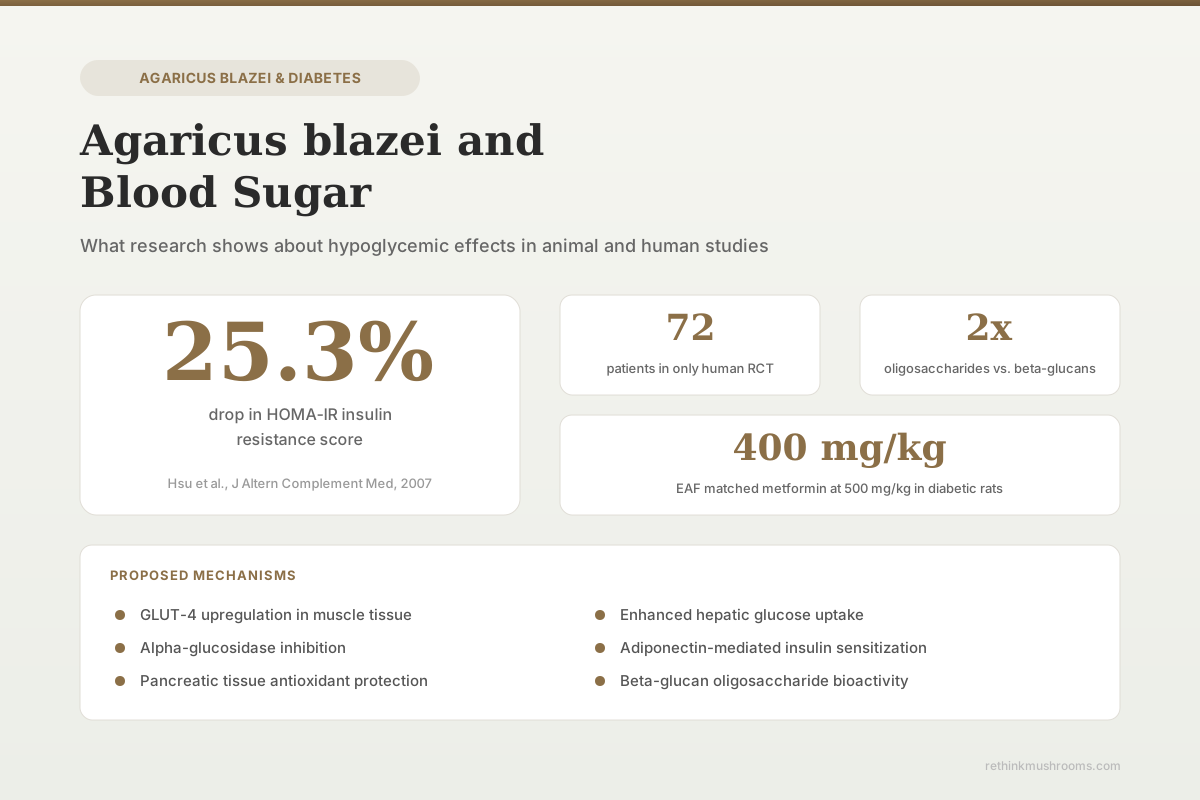
3.6 vs 6.6 HOMA-IR
A 12-week RCT (60 completers of 72 randomized) found Agaricus blazei extract lowered HOMA-IR insulin resistance scores versus placebo in type 2 diabetes patients already on metformin and gliclazide. Insulin resistance was the primary outcome and the trial's headline glycemic finding.
Hsu et al., Journal of Alternative and Complementary Medicine, 2007
60 completers
of 72 randomized in the only human RCT
400 mg/kg
EAF matched metformin in diabetic rats
2x activity
oligosaccharides vs. intact beta-glucans
Hsu et al., Journal of Alternative and Complementary Medicine, 2007
 View as image ↗
Agaricus blazei blood sugar research has produced one randomized controlled trial in humans and over a dozen animal studies, all pointing in the same direction: extracts from this mushroom lower blood glucose in diabetic models. The Brazilian mushroom, also called Agaricus blazei Murill (ABM) or "cogumelo do sol," contains beta-glucans, polysaccharides, and isoflavonoids that appear to act through multiple glucose-lowering pathways.[9] For a broader look at the clinical picture, see Agaricus blazei for Type 2 Diabetes: Clinical Evidence.
The question is not whether ABM extracts lower glucose in rats. That has been demonstrated repeatedly across different extract types, dosing protocols, and diabetes models. The real question is whether any of this translates to humans, and the answer so far rests on a single 72-person trial from 2007.
Key Takeaways
- A 12-week RCT (60 completers of 72 randomized) found ABM extract (1,500 mg/day) lowered HOMA-IR to 3.6 versus 6.6 in placebo (p = 0.04) in type 2 diabetes patients already on metformin and gliclazide; insulin resistance was the trial's primary and headline outcome (Hsu et al., 2007)
- An ethyl acetate fraction of ABM at 400 mg/kg produced glucose-lowering effects comparable to metformin at 500 mg/kg in diabetic rats (Oh et al., 2010)
- Beta-glucan oligosaccharides from ABM showed approximately twice the antidiabetic activity of intact beta-glucans in diabetic rats (Kim et al., 2005)
- ABM ethyl acetate extract inhibited alpha-glucosidase and increased glucose uptake in HepG2 liver cells at levels comparable to metformin in vitro (Wei et al., 2020)
- ABM supplementation prevented diet-induced obesity and insulin resistance in rats fed a high-fat diet for 20 weeks (Vincent et al., 2013)
- ABM ethyl acetate extract restored hepatic antioxidant markers and contributed to pancreatic tissue recovery in streptozotocin-induced diabetic rats (Wei et al., 2020)
Evidence Hierarchy
Agaricus blazei & Blood Sugar — An Upside-Down Evidence Pyramid
A normal evidence pyramid is widest at the bottom (mechanisms) and narrows to a decisive, replicated human trial at the top. Here it is inverted: the mechanistic and animal tiers are crowded with studies, while the tier that would confirm real treatment value — an independent human trial — is empty, and the single existing trial tested ABM only as an add-on to standard diabetes drugs. Bar width reflects how much direct evidence exists at each tier, not the size of any effect.
Independent human replication
gapDoes not yet exist
The evidence that would move Agaricus blazei from "promising" to "established" — a second, independent trial confirming the 2007 result — has never been published, and review literature notes that ABM clinical trials remain limited
Single human RCT (adjunct)
evidenceHsu 2007
One 12-week randomized, double-blind, placebo-controlled trial (60 completers of 72 randomized) found ABM 1,500 mg/day lowered HOMA-IR to 3.6 versus 6.6 on placebo (p = 0.04) — but only as an add-on to metformin and gliclazide, and only insulin resistance improved
Animal diabetes models
evidenceOh 2010 · Kim 2005 · Niwa 2011 · Vincent 2013
A deep, consistent tier: in streptozotocin-diabetic rats an ethyl acetate fraction at 400 mg/kg matched metformin at 500 mg/kg, oligosaccharides showed roughly twice the activity of intact beta-glucans, and both whole-mushroom powder and a 20-week high-fat-diet prevention model improved glucose control — yet these models poorly mirror human type 2 diabetes
Cell & mechanistic pathways
evidenceWei 2020 · Oh 2010
The widest tier: in vitro, the ethyl acetate extract inhibited alpha-glucosidase (the same target as acarbose) and raised HepG2 liver-cell glucose uptake to metformin-comparable levels, while animal work links the effect to GLUT-4 upregulation
How to read it: the bars grow wider toward the bottom because the mechanistic and animal literature is deep and converges on several plausible glucose-lowering pathways. But every step upward toward a person with type 2 diabetes loses evidence — the one human trial is small, tested ABM only alongside metformin and gliclazide, and has never been independently replicated. The gap at the top, not the quality of the mechanisms, is the honest limit of the Agaricus blazei blood-sugar claim.
Sources: Hsu 2007 [1]; Oh 2010 [2]; Kim 2005 [3]; Vincent 2013 [5]; Niwa 2011 [6]; Wei 2020 [8]; Huang 2022 [9]. Bar widths are illustrative of evidence depth per tier, not quantitative effect sizes.
What Is Agaricus blazei?
Agaricus blazei Murill is a medicinal mushroom native to the Piedade mountains of southeastern Brazil, where locals called it "cogumelo de Deus" (mushroom of God). It was brought to Japan in 1965 for cultivation and research, and most of the published science on this species comes from Japanese, Brazilian, and Taiwanese laboratories.[9]
The mushroom's fruiting body contains beta-glucans with a characteristic 1,3/1,6 branching structure, proteoglycans, and ergosterol. Submerged-culture broth fractions of the same species also yield isoflavonoids including genistein, genistin, daidzein, and daidzin, which is unusual for a mushroom and likely reflects the liquid-culture growth conditions rather than typical fruiting-body chemistry.[2] Most ABM research has focused on immune modulation and cancer, but a smaller body of work examines its effects on glucose metabolism. The compounds responsible for immune effects overlap partially with those driving glucose-lowering activity, particularly the beta-glucan polysaccharides.
Beta-Glucans and Oligosaccharides: The Key Compounds
The most direct evidence for which ABM compounds lower blood sugar comes from Kim et al. (2005), who tested purified beta-glucans and their enzymatically hydrolyzed oligosaccharides in diabetic rats.[3]
Both beta-glucans and oligosaccharides reduced blood glucose, but the oligosaccharides, shorter sugar chains produced by breaking down the larger beta-glucan polymers, showed roughly twice the antidiabetic activity of the intact beta-glucans. The oligosaccharides also demonstrated anti-hypertriglyceridemic, anti-hypercholesterolemic, and anti-arteriosclerotic effects in the same diabetic rats.
This finding matters because it suggests the active glucose-lowering compounds may be generated during digestion. When beta-glucans are partially broken down in the gut, the resulting oligosaccharide fragments could be the actual bioactive molecules. It also raises questions about extract preparation: hot-water extraction versus enzymatic hydrolysis may produce extracts with different potencies.
A separate line of evidence points to isoflavonoids. Oh et al. (2010) identified genistein, genistin, daidzein, and daidzin in the ethyl acetate fraction of ABM submerged-culture broth. These same isoflavonoids are found in soy and have established glucose-lowering properties in other research contexts.[2] Whether the glucose-lowering effects come primarily from the polysaccharides, the isoflavonoids, or the combination remains unresolved.
Animal Evidence: Streptozotocin-Induced Diabetes Models
Dose-Dependent Glucose Lowering
Oh et al. (2010) hot-water extracted submerged-culture ABM broth, stripped out beta-glucans and glycoproteins with ethanol, and fractionated the residue into hexane, chloroform, ethyl acetate, and butanol fractions, which were tested in STZ-induced diabetic male Sprague-Dawley rats.[2] The ethyl acetate fraction (EAF) produced the strongest effects. In oral glucose tolerance tests, EAF reduced blood glucose spikes in a dose-dependent manner. Over a 14-day treatment period, diabetic rats receiving EAF showed suppressed blood glucose levels, elevated plasma insulin, and increased GLUT-4 (glucose transporter type 4) protein expression, with the response scaling between the 200 and 400 mg/kg doses.
The 400 mg/kg EAF dose produced hypoglycemic efficacy described as similar to metformin at 500 mg/kg in this single-study comparison. Because the active EAF was prepared after the beta-glucan and glycoprotein fractions had been removed, this preparation is chemically distinct from a typical mushroom-extract supplement, and the activity may reflect the isoflavonoids identified in the fraction.
Prevention of Diet-Induced Metabolic Dysfunction
Vincent et al. (2013) took a different approach, testing whether ABM extract could prevent insulin resistance rather than treat established diabetes.[5] Rats were fed a high-fat diet for 20 weeks. Those receiving concurrent ABM extract supplementation gained less weight, accumulated less visceral fat, and maintained better insulin sensitivity than unsupplemented controls on the same diet.
This prevention model suggests ABM may act on early metabolic dysfunction before beta-cell damage occurs. For more on how ABM may protect insulin-producing cells, see Agaricus blazei and Pancreatic Islet Protection.
Whole-Mushroom Powder in Diabetic Rats
Niwa et al. (2011) tested whole Agaricus blazei fruiting-body powder (1 g/kg/day) as a separate arm alongside Ipomoea batatas (sweet potato, 5 g/kg/day) and Smallanthus sonchifolius (yacon, 4 g/kg/day) in STZ-induced diabetic rats over 8 weeks.[6] ABM and sweet potato (but not yacon) significantly reduced fasting plasma glucose and HbA1c, raised serum insulin during oral glucose tolerance, lowered oxidative-stress markers, and improved pancreatic beta-cell mass on histology. The botanicals were tested as separate arms, so the design did not test a combined ABM-plus-sweet-potato condition.
Consistent Direction, Variable Magnitude
Across these animal studies, the glucose-lowering effect size varies depending on the extract type, dose, and model. Ethyl acetate fractions consistently outperform crude hot-water extracts, suggesting that concentration of specific bioactive compounds matters. The STZ model produces severe hyperglycemia, and ABM extracts consistently produce substantial glucose reductions in treated versus untreated diabetic animals. These are large effect sizes, but STZ rats have almost no residual insulin production, which makes the model better suited for testing direct glucose-disposal mechanisms than for predicting effects in early-stage human type 2 diabetes where insulin resistance is the primary issue.
The Only Human Clinical Trial
The entire human evidence base for ABM and blood sugar rests on one study. Hsu et al. (2007) conducted a randomized, double-blinded, placebo-controlled trial in Taiwan with 72 patients aged 20 to 75 who had established type 2 diabetes and were already taking metformin and gliclazide.[1]
Patients received either 1,500 mg of ABM extract or a matching cellulose placebo daily for 12 weeks. The primary outcome was HOMA-IR, a calculated index of insulin resistance derived from fasting glucose and fasting insulin levels.
After 12 weeks, HOMA-IR was 3.6 (standard deviation 2.5) in the ABM group versus 6.6 (standard deviation 7.4) in placebo (p = 0.04). Plasma adiponectin, an anti-inflammatory hormone that improves insulin sensitivity, rose 20.0% in the ABM group while falling 12.0% on placebo (p < 0.001). The trial's reported benefits were confined to insulin resistance and adiponectin; it did not report improvements in broader glycemic endpoints such as HbA1c or fasting glucose, so the win was narrow rather than a broad glycemic-control result.
The trial has real strengths: randomization, double-blinding, and a placebo control (cellulose capsules). But it also has limitations. Results were reported on 60 completers (29 ABM, 31 placebo) of the 72 randomized — an analysis of completers rather than an explicit intention-to-treat analysis. The sample was small, and all patients were Taiwanese, so the results may not generalize across populations. Patients were already on two diabetes medications, so the trial cannot show whether ABM would have any effect as a standalone intervention. No independent group has replicated these findings in the 19 years since publication. For context on what this means for clinical applications, see Agaricus blazei for Type 2 Diabetes: Clinical Evidence.
How ABM Extracts May Lower Blood Glucose
Research points to at least four distinct mechanisms, though none has been confirmed in human tissue.
GLUT-4 Upregulation
Oh et al. (2010) reported that the ethyl acetate fraction increased GLUT-4 protein expression in diabetic rats treated for 14 days.[2] GLUT-4 is the insulin-regulated glucose transporter responsible for moving glucose from the bloodstream into muscle and fat cells. Low GLUT-4 expression is a hallmark of insulin resistance. By increasing GLUT-4 levels, this fraction could theoretically improve glucose uptake in peripheral tissues, though the active fraction had been stripped of beta-glucans before testing and is not chemically equivalent to most commercial ABM products.
Alpha-Glucosidase Inhibition
Wei et al. (2020) tested ABM ethanol and ethyl acetate extracts for their ability to inhibit alpha-glucosidase, the enzyme that breaks down complex carbohydrates into absorbable glucose in the small intestine.[8] The ethyl acetate extract showed significant alpha-glucosidase inhibitory activity. This is the same mechanism used by the diabetes drug acarbose: slowing carbohydrate digestion reduces post-meal glucose spikes. To understand how ABM improves insulin sensitivity through these pathways, the signaling cascade matters.
Enhanced Hepatic Glucose Uptake
The same Wei et al. (2020) study measured glucose uptake by HepG2 cells (a human liver cell line).[8] The ethyl acetate extract increased glucose uptake at levels comparable to metformin. The liver is a major site of glucose disposal, and improved hepatic glucose uptake would help clear excess blood glucose after meals.
Adiponectin-Mediated Insulin Sensitization
The Hsu et al. (2007) human trial found that adiponectin rose 20.0% in the ABM group while falling 12.0% on placebo over 12 weeks (p < 0.001).[1] Adiponectin activates AMP-activated protein kinase (AMPK) in muscle and liver, which increases fatty acid oxidation and glucose uptake. Low adiponectin levels are consistently associated with insulin resistance and type 2 diabetes. The trial's authors proposed this adiponectin increase as a plausible mechanism for the improved insulin resistance, though whether it translates into durable clinical benefit remains untested.
Antioxidant Protection in Diabetic Tissue
Diabetes causes oxidative stress that damages organs. Several studies have examined whether ABM's antioxidant properties protect diabetic tissue from this damage.
Wei et al. (2020) found that ABM ethyl acetate extract restored hepatic antioxidant markers (superoxide dismutase, catalase, glutathione) and reduced AST and ALT in STZ-induced diabetic rats, with the ethyl acetate extract outperforming the ethanol extract on pancreatic tissue restoration.[4] The pancreatic recovery is particularly relevant because STZ destroys insulin-producing beta cells, and any preservation of pancreatic tissue could help maintain residual insulin secretion.
Di Naso et al. (2010) examined a different target organ: the lungs.[7] Diabetic lung disease is an underrecognized complication, and ABM treatment reduced oxidative stress markers in pulmonary tissue of STZ-diabetic rats. Niwa et al. (2011) similarly reported improved antioxidant status with ABM treatment.[6]
These findings suggest ABM's effects extend beyond glucose numbers to potential organ protection, a relevant consideration for diabetic complications. But organ protection demonstrated in rat models with chemically induced diabetes does not confirm the same effect occurs in human type 2 diabetes.
What This Evidence Does and Does Not Show
The evidence for ABM and blood sugar is consistent in direction but limited in scope. Every study that measured blood glucose in a diabetic animal model found a reduction. The single human trial found improved insulin resistance. Multiple mechanisms have been identified in vitro and in vivo.
What the evidence does not show: whether ABM lowers blood glucose in humans who are not already on diabetes medication, whether the effect size is clinically meaningful enough to change HbA1c over months or years, what dose is optimal for humans, or whether long-term use is safe. The 2007 Hsu trial used 1,500 mg daily for 12 weeks. No study has tested longer durations.
The rat studies overwhelmingly use STZ-induced diabetes, which destroys beta cells to create a type 1 diabetes-like state. This is a poor model for type 2 diabetes, where insulin resistance, not beta-cell destruction, is the primary problem. The Vincent et al. (2013) high-fat-diet model is more relevant to human type 2 diabetes, but it tested prevention rather than treatment.
Extract preparation varies dramatically between studies: hot-water extracts, ethyl acetate fractions, ethanol extracts, and whole mushroom powder all appear in the literature. Different preparations contain different ratios of beta-glucans, oligosaccharides, and isoflavonoids, making it difficult to compare results across studies or translate findings to commercially available supplements.
The Bottom Line
Agaricus blazei extracts lower blood glucose across every animal model tested, and one 72-person RCT found reduced insulin resistance in type 2 diabetes patients over 12 weeks. Beta-glucans, their oligosaccharide fragments, and isoflavonoids appear to act through GLUT-4 upregulation, alpha-glucosidase inhibition, hepatic glucose uptake, and adiponectin signaling. The animal evidence is consistent but relies heavily on STZ models with limited relevance to human type 2 diabetes, and no second human trial has appeared in nearly two decades.
Frequently Asked Questions
Sources & References
- 1RTHM-00114·Hsu, Chung-Hua et al. (2007). “The mushroom Agaricus Blazei Murill in combination with metformin and gliclazide improves insulin resistance in type 2 diabetes: a randomized, double-blinded, and placebo-controlled clinical trial..” Journal of alternative and complementary medicine (New York.Study breakdown →PubMed →↩
- 2RTHM-00195·Oh, Tae W et al. (2010). “Semipurified fractions from the submerged-culture broth of Agaricus blazei Murill reduce blood glucose levels in streptozotocin-induced diabetic rats..” Journal of agricultural and food chemistry.Study breakdown →PubMed →↩
- 3RTHM-00082·Kim, Yea-Woon et al. (2005). “Anti-diabetic activity of beta-glucans and their enzymatically hydrolyzed oligosaccharides from Agaricus blazei..” Biotechnology letters.Study breakdown →PubMed →↩
- 4RTHM-00661·Wei, Qi et al. (2020). “The beneficial effects of Agaricus blazei Murrill on hepatic antioxidant enzymes and the pancreatic tissue recovery in streptozotocin-induced diabetic rats..” Journal of food biochemistry.Study breakdown →PubMed →↩
- 5RTHM-00308·Vincent, Mylène et al. (2013). “Dietary supplementation with Agaricus blazei murill extract prevents diet-induced obesity and insulin resistance in rats..” Obesity (Silver Spring.Study breakdown →PubMed →↩
- 6RTHM-00227·Niwa, Atsuko et al. (2011). “Ipomoea batatas and Agarics blazei ameliorate diabetic disorders with therapeutic antioxidant potential in streptozotocin-induced diabetic rats..” Journal of clinical biochemistry and nutrition.Study breakdown →PubMed →↩
- 7RTHM-00179·Di Naso, Fábio Cangeri et al. (2010). “Effect of Agaricus blazei Murill on the pulmonary tissue of animals with streptozotocin-induced diabetes..” Experimental diabetes research.Study breakdown →PubMed →↩
- 8RTHM-00662·Wei, Qi et al. (2020). “Assessment of antioxidant and antidiabetic properties of Agaricus blazei Murill extracts..” Food science & nutrition.Study breakdown →PubMed →↩
- 9RTHM-00765·Huang, Kaiyuan et al. (2022). “Critical review on chemical compositions and health-promoting effects of mushroom Agaricus blazei Murill..” Current research in food science.Study breakdown →PubMed →↩