Agaricus blazei and Diabetes
Insulin Resistance Improved
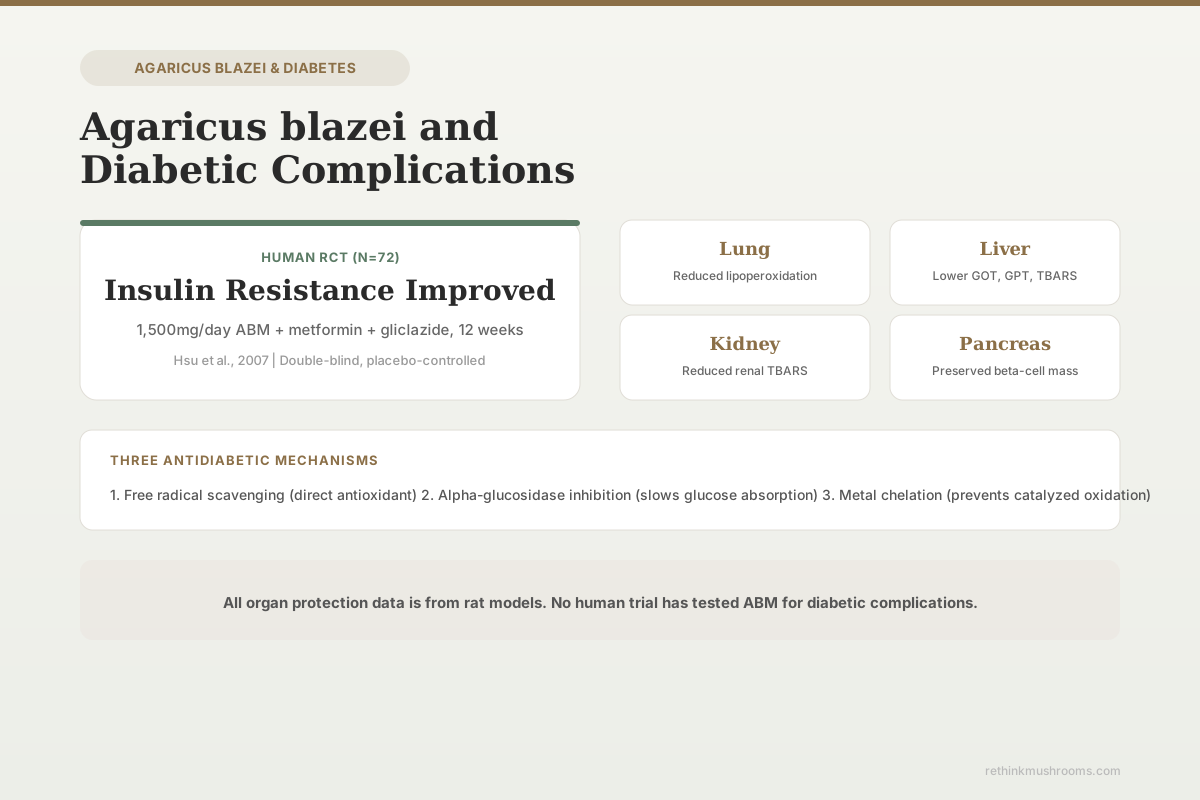
A randomized, double-blind, placebo-controlled trial of 72 type 2 diabetes patients found that Agaricus blazei Murill extract (1,500mg/day for 12 weeks) improved insulin resistance when combined with metformin and gliclazide. Animal studies show protection against diabetic organ damage.
Hsu et al., Journal of Alternative and Complementary Medicine, 2007
72 Patients
randomized, double-blind, placebo-controlled
1,500mg/day
ABM extract for 12 weeks
Organ Protection
lung, liver, kidney in diabetic rats
Hsu et al., Journal of Alternative and Complementary Medicine, 2007
 View as image ↗
Diabetes kills through its complications, not through blood sugar itself. Chronically elevated glucose damages blood vessels, nerves, kidneys, eyes, and lungs through oxidative stress, advanced glycation end-products (AGEs), and chronic inflammation. Controlling blood sugar slows these complications but does not eliminate them. Roughly half of people with type 2 diabetes develop at least one serious complication despite treatment.
Agaricus blazei Murill (ABM) has been studied for two overlapping diabetic applications: improving insulin resistance (which addresses the root metabolic problem) and reducing the oxidative organ damage that high glucose causes. One randomized human trial exists for insulin resistance. The complication-prevention data is entirely from animal models. Both lines of evidence point in the same direction. For the clinical evidence for ABM and type 2 diabetes and the insulin sensitivity mechanism, those topics are covered in dedicated articles.
Key Takeaways
- A randomized, double-blind, placebo-controlled trial of 72 type 2 diabetes patients found ABM extract (1,500mg/day for 12 weeks) improved insulin resistance alongside metformin and gliclazide (Hsu et al., Journal of Alternative and Complementary Medicine, 2007)
- ABM reduced pulmonary lipoperoxidation and protected lung tissue in streptozotocin-induced diabetic rats (Di Naso et al., Experimental Diabetes Research, 2010)
- ABM fractions reduced blood glucose, triglycerides, cholesterol, liver enzymes, and kidney/liver oxidative damage markers in diabetic rats, with efficacy comparable to metformin (Oh et al., Journal of Ethnopharmacology, 2010)
- In a five-arm streptozotocin-diabetic rat study, ABM fruiting-body powder (1 g/kg/day for 8 weeks, as its own arm) suppressed oxidative stress markers and improved pancreatic beta-cell mass (Niwa et al., Journal of Clinical Biochemistry and Nutrition, 2011)
- ABM extract prevented diet-induced obesity and insulin resistance in rats fed a high-fat diet, reducing body weight gain and improving glucose tolerance (Vincent et al., Obesity, 2013)
- All complication-prevention data is from rat models; no human trial has tested ABM for diabetic organ protection
The Human Trial: Insulin Resistance
Hsu and colleagues conducted the only randomized controlled trial testing ABM in people with diabetes.[1] Published in 2007, the study enrolled 72 patients aged 20-75 with type 2 diabetes who had been taking metformin and gliclazide (a sulfonylurea) for at least 6 months. Participants were randomized to receive either 1,500mg/day of ABM extract or placebo for 12 weeks, while continuing their existing diabetes medications.
The primary finding: ABM extract improved insulin resistance as measured by HOMA-IR (Homeostatic Model Assessment for Insulin Resistance), a standard clinical index. HOMA-IR incorporates fasting glucose and fasting insulin to estimate how resistant cells are to insulin's effects.
The improvement in insulin resistance is meaningful because insulin resistance is the core pathological feature of type 2 diabetes. It drives elevated blood sugar, which in turn drives every diabetic complication. An adjunct that reduces insulin resistance, even modestly, could theoretically slow the progression of complications.
Limitations: HbA1c (the 3-month blood sugar average and clinical standard for diabetes management) was measured but did not separate between groups (8.3% in ABM vs 8.9% in placebo, p = 0.24). Fasting glucose and lipids also did not significantly differ. The clear between-group win was the surrogate insulin-resistance marker (HOMA-IR 3.6 vs 6.6, p = 0.04) and fasting insulin (7.8 vs 13.5 UI/L, p = 0.05). Twelve of 72 participants withdrew, and the paper analyzes 60 completers (29 ABM, 31 placebo) rather than running an explicit intention-to-treat analysis. The 12-week duration is too short to assess complications, which develop over years. The extract was supplied and the study funded by the same company (Eng Chiao Bio-Technology), a sponsor-product linkage that limits product-level generalization.
Lung Protection in Diabetic Rats
Diabetic lung disease is an underrecognized complication. Chronic hyperglycemia damages pulmonary microvessels, reduces lung elasticity, and impairs gas exchange. People with diabetes have lower lung function and higher rates of respiratory infections.
Di Naso and colleagues tested ABM's effects on lung tissue in streptozotocin (STZ)-induced diabetic rats.[2] STZ destroys pancreatic beta cells, creating a model of insulin-deficient diabetes with severe hyperglycemia.
ABM treatment effectively reduced lipoperoxidation in pulmonary tissue. Lipoperoxidation is the oxidative destruction of lipids in cell membranes, a direct measure of oxidative damage. By reducing this process, ABM protected lung cell membranes from glucose-driven oxidative destruction. The treated animals showed histological evidence of tissue recovery, meaning the lung tissue structure improved compared to untreated diabetic controls.
Liver and Kidney Protection
Oh and colleagues took a more detailed approach in 2010, testing semipurified fractions from ABM submerged-culture broth in STZ-diabetic rats.[3]
The results across multiple organ systems:
- Blood glucose: Reduced. The ethyl acetate fraction showed hypoglycemic efficacy comparable to metformin
- Blood lipids: Triglycerides and cholesterol in plasma decreased
- Liver: Glutamate-oxaloacetate transaminase (GOT) and glutamate-pyruvate transaminase (GPT) decreased, indicating reduced liver damage. Thiobarbituric acid reactive substances (TBARS) in the liver decreased, indicating reduced oxidative stress
- Kidney: TBARS in kidney tissue decreased, indicating reduced renal oxidative damage
The liver enzyme findings are clinically relevant. Elevated GOT and GPT are markers of hepatocellular damage, which is common in diabetes (non-alcoholic fatty liver disease affects 60-70% of people with type 2 diabetes). The reduction in these markers suggests ABM protected liver cells from glucose-driven damage.
The kidney findings matter because diabetic nephropathy is the leading cause of kidney failure worldwide. Oxidative stress in renal tissue is a primary driver of nephropathy progression. ABM's reduction of renal TBARS suggests a protective effect against the oxidative component of diabetic kidney disease. For a deeper look at the blood sugar and hypoglycemic effects and pancreatic beta-cell protection, those mechanisms have dedicated articles.
Pancreatic Beta-Cell Preservation
Niwa and colleagues published a five-arm streptozotocin-diabetic rat study in 2011 that connected ABM's antioxidant effects to beta-cell preservation.[4] The arms were non-diabetic control, untreated diabetic, Agaricus blazei (1 g/kg/day fruiting-body powder), Ipomoea batatas (Caiapo, 5 g/kg/day), and Smallanthus sonchifolius (Yacon, 4 g/kg/day) — each n = 5, fed for 8 weeks. ABM was tested as its own arm, not in combination.
The ABM and Ipomoea batatas arms (but not Smallanthus sonchifolius) significantly suppressed the increases in fasting plasma glucose and HbA1c, and the ABM arm specifically:
- Reduced superoxide production from leukocytes and vascular homogenates
- Reduced serum 8-oxo-2'-deoxyguanosine (a DNA oxidative damage marker)
- Reduced vascular nitrotyrosine formation (a marker of nitric oxide-related oxidative damage)
- Improved pancreatic beta-cell mass on histology
The p38 MAPK and TNF-α reductions reported in this paper were specifically attributed to the Ipomoea batatas arm, not the ABM arm. The beta-cell mass finding is significant on its own merits. In type 2 diabetes, beta cells progressively die due to glucotoxicity, lipotoxicity, and oxidative stress. Once beta cells are lost, the body produces less insulin, and diabetes worsens. ABM's antioxidant protection appeared to reduce the oxidative destruction of beta cells, maintaining a larger functional mass — although the group sizes (n = 5 per arm) are very small.
Obesity and Insulin Resistance Prevention
Vincent and colleagues tested whether ABM could prevent metabolic damage before diabetes develops.[5] Rats fed a high-fat diet (to induce obesity and insulin resistance) were simultaneously given ABM extract. Compared to high-fat diet controls:
- Body weight gain was reduced
- Glucose tolerance improved
- Insulin resistance markers improved
This prevention study suggests ABM may be most effective before insulin resistance becomes entrenched. By the time type 2 diabetes is established, beta-cell loss and chronic vascular damage may be too advanced for an immunomodulatory mushroom extract to reverse.
The Proposed Antioxidant Mechanism
Wei and colleagues published a 2020 in vitro assessment of ABM's antioxidant and antidiabetic properties that offers a candidate mechanism for the broader animal findings.[6] The study compared ethanol and ethyl acetate extracts of ABM fruiting bodies in chemical antioxidant assays and a dexamethasone-induced insulin-resistant HepG2 liver-cell model — there were no animals or humans in this study.
ABM extracts (especially the ethyl acetate fraction) demonstrated:
- Free radical scavenging in DPPH, ABTS, and hydroxyl-radical assays
- Reducing power in the K3Fe(CN)6 assay
- Inhibition of alpha-glucosidase (the enzyme that breaks down carbohydrates into glucose, the same target as acarbose, a diabetes drug)
- Increased glucose consumption in dexamethasone-treated HepG2 cells, with the ethyl acetate fraction at 200 μg/mL not significantly different from metformin at 1 mmol/L in this single-condition comparison
These mechanisms are candidate explanations for the antioxidant and glycemic findings seen in the rat studies, but the evidence here is test-tube and cell-line only. The paper does not test metal chelation, intestinal carbohydrate handling in vivo, or any organ-protection endpoint, and the metformin comparison is a single in vitro reference point rather than a clinical-equivalence claim.
What Is Not Known
The gap between the animal evidence and clinical application is large:
No human complication trial exists. Every organ-protection finding comes from rat models. Rats are not humans. STZ-induced diabetes (type 1 model) differs from human type 2 diabetes. Whether oral ABM at achievable human doses provides meaningful organ protection is completely untested.
The effective dose is unclear. The human insulin resistance trial used 1,500mg/day of ABM extract. The rat studies used various preparations at various concentrations. The optimal dose for organ protection in humans is unknown.
Duration matters. Diabetic complications develop over years to decades. The longest human ABM diabetes study was 12 weeks. Whether ABM provides sustained benefit with long-term use, or whether tolerance develops, is not characterized.
Drug interactions are unstudied. People with diabetes typically take metformin, sulfonylureas, GLP-1 agonists, SGLT2 inhibitors, insulin, statins, and antihypertensives. How ABM interacts with this polypharmacy is unknown.
The Bottom Line
Agaricus blazei Murill shows a consistent pattern in diabetic research: one small, sponsor-funded human RCT demonstrates improved insulin resistance on a surrogate marker, and multiple rat studies demonstrate reduced oxidative organ damage (lung, liver, kidney) alongside preserved pancreatic beta-cell mass. The candidate mechanisms — direct free-radical scavenging and alpha-glucosidase inhibition — sit mostly in vitro and in animal data. The evidence positions ABM as a possible adjunct for type 2 diabetes management, but the translation from rat models to human complication prevention remains entirely unconfirmed. No human trial has tested ABM for any diabetic complication.
Frequently Asked Questions
Sources & References
- 1RTHM-00114·Hsu, Chung-Hua et al. (2007). “The mushroom Agaricus Blazei Murill in combination with metformin and gliclazide improves insulin resistance in type 2 diabetes: a randomized, double-blinded, and placebo-controlled clinical trial..” Journal of alternative and complementary medicine (New York.Study breakdown →PubMed →↩
- 2RTHM-00179·Di Naso, Fábio Cangeri et al. (2010). “Effect of Agaricus blazei Murill on the pulmonary tissue of animals with streptozotocin-induced diabetes..” Experimental diabetes research.Study breakdown →PubMed →↩
- 3RTHM-00195·Oh, Tae W et al. (2010). “Semipurified fractions from the submerged-culture broth of Agaricus blazei Murill reduce blood glucose levels in streptozotocin-induced diabetic rats..” Journal of agricultural and food chemistry.Study breakdown →PubMed →↩
- 4RTHM-00227·Niwa, Atsuko et al. (2011). “Ipomoea batatas and Agarics blazei ameliorate diabetic disorders with therapeutic antioxidant potential in streptozotocin-induced diabetic rats..” Journal of clinical biochemistry and nutrition.Study breakdown →PubMed →↩
- 5RTHM-00308·Vincent, Mylène et al. (2013). “Dietary supplementation with Agaricus blazei murill extract prevents diet-induced obesity and insulin resistance in rats..” Obesity (Silver Spring.Study breakdown →PubMed →↩
- 6RTHM-00662·Wei, Qi et al. (2020). “Assessment of antioxidant and antidiabetic properties of Agaricus blazei Murill extracts..” Food science & nutrition.Study breakdown →PubMed →↩