Agaricus blazei and Diabetes
45% lower HOMA-IR
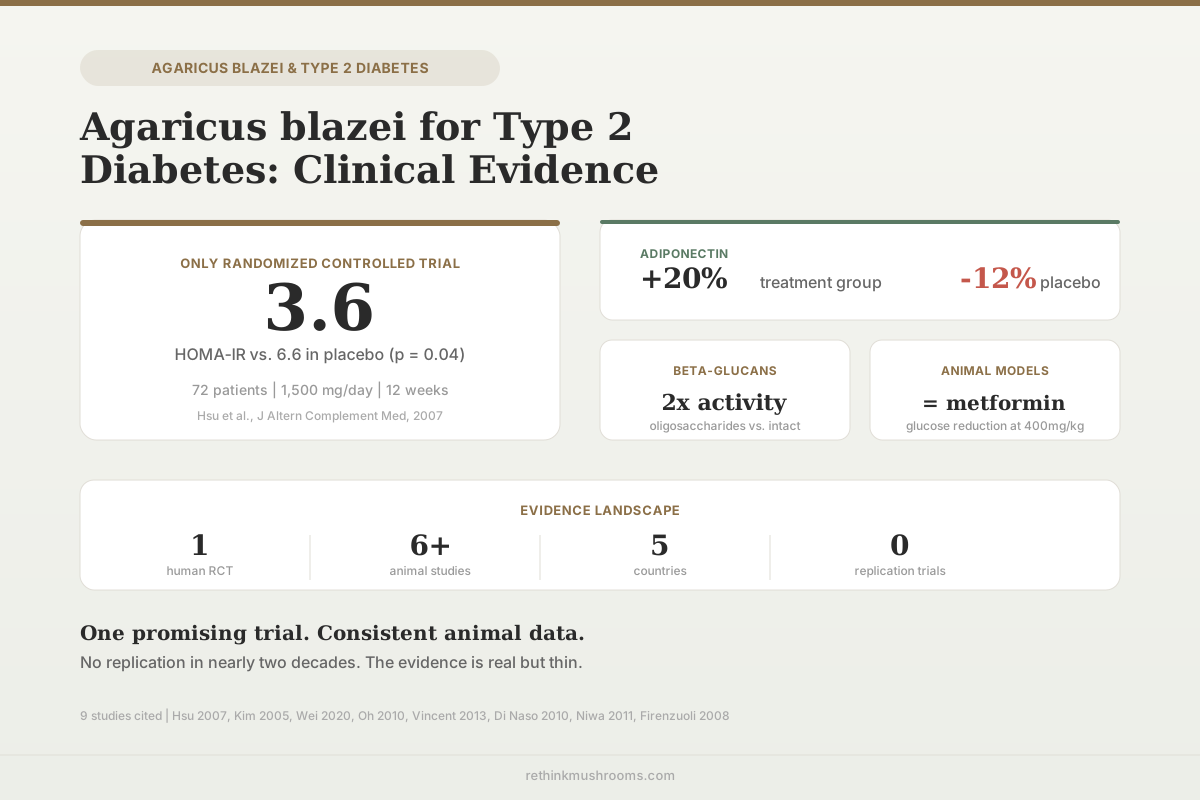
In the only randomized trial, patients taking Agaricus blazei extract had a HOMA-IR of 3.6 versus 6.6 in the placebo group after 12 weeks.
Hsu et al., Journal of Alternative and Complementary Medicine, 2007
72 patients
enrolled in the RCT
+20%
adiponectin increase
1,500 mg/day
extract dose tested
Hsu et al., Journal of Alternative and Complementary Medicine, 2007
 View as image ↗
Exactly one randomized, double-blind, placebo-controlled trial has tested Agaricus blazei in people with type 2 diabetes. That trial, published in 2007, enrolled 72 patients in Taiwan and found that 1,500 mg of Agaricus blazei extract daily for 12 weeks lowered insulin resistance scores by roughly 45% compared to placebo.[1] The result is real and statistically significant. It is also a single study, conducted at one site, with a modest sample size. That gap between a genuinely promising finding and definitive proof defines the entire evidence base for Agaricus blazei and blood sugar. The animal and in vitro data are extensive. The human data are thin. This article lays out both.
Key Takeaways
- In the only RCT, patients on Agaricus blazei extract had a HOMA-IR of 3.6 vs. 6.6 in placebo (p = 0.04) after 12 weeks (Hsu et al., 2007)
- Adiponectin rose 20% in the treatment group and fell 12% in placebo (p < 0.001), suggesting improved insulin signaling (Hsu et al., 2007)
- Beta-glucan oligosaccharides from Agaricus blazei showed twice the anti-diabetic activity of intact beta-glucans in diabetic rats (Kim et al., 2005)
- Ethyl acetate fractions matched metformin's blood glucose reduction at 400 mg/kg body weight in rats (Oh et al., 2010)
- Two months of oral Agaricus blazei feeding restored pancreatic beta-cell mass in streptozotocin-diabetic rats (Niwa et al., 2011)
- In vitro, Agaricus blazei ethyl acetate extract inhibited alpha-glucosidase and matched metformin in HepG2 glucose uptake (Wei et al., 2020)
The Only Human Trial: 72 Patients, 12 Weeks, 1,500 mg Daily
The trial by Hsu and colleagues at National Yang-Ming University in Taiwan remains the sole randomized controlled trial of Agaricus blazei in type 2 diabetes.[1] From a registry of 536 diabetes patients, 72 met the inclusion criteria: aged 20 to 75, Chinese ethnicity, diagnosed with type 2 diabetes for at least one year, and already taking metformin and gliclazide for at least six months.
Patients were randomly assigned to receive either 500 mg of Agaricus blazei Murill extract three times daily (1,500 mg total) or a cellulose placebo for 12 weeks. Both groups continued their existing diabetes medications. The primary outcome was the homeostasis model assessment for insulin resistance (HOMA-IR), a standard calculation derived from fasting glucose and fasting insulin levels.
Of the 72 enrolled, 60 completed the study (29 in the treatment group, 31 in placebo). At 12 weeks, the treatment group's HOMA-IR averaged 3.6 (SD 2.5) compared to 6.6 (SD 7.4) in the placebo group (p = 0.04). That is a meaningful difference in insulin resistance, though the wide standard deviation in the placebo group indicates substantial individual variation.
What the Trial Did Not Show
The trial did not demonstrate reductions in fasting blood glucose or HbA1c that reached statistical significance. It measured insulin resistance specifically, not glycemic control broadly. The study was conducted at a single center with a homogeneous ethnic population, enrolled only patients already on two medications, and ran for just 12 weeks. No long-term follow-up data exist. These limitations do not invalidate the finding. They define its boundaries. For a deeper look at the insulin resistance data from this trial, including the adiponectin mechanism, see the dedicated analysis.
Adiponectin: The Proposed Mechanism Behind the Insulin Resistance Improvement
The most mechanistically interesting finding from the Hsu trial was not the HOMA-IR score itself but what happened to adiponectin.[1] In the treatment group, plasma adiponectin increased by 20.0% (SD 40.7%) over 12 weeks. In the placebo group, adiponectin decreased by 12.0% (SD 20.0%). The difference was highly significant (p < 0.001).
Adiponectin is a protein hormone secreted by fat cells that enhances insulin sensitivity in muscle and liver tissue. Low adiponectin levels are consistently associated with insulin resistance and type 2 diabetes. The fact that Agaricus blazei extract raised adiponectin provides a plausible biological pathway for the observed improvement in HOMA-IR. The animal data supports this interpretation. Vincent and colleagues found that rats on a high-fat diet supplemented with Agaricus blazei extract maintained higher adiponectin levels while avoiding the insulin resistance that developed in unsupplemented controls.[6]
How Agaricus blazei improves insulin sensitivity likely involves multiple mechanisms beyond adiponectin alone, including direct effects on glucose transporter proteins and alpha-glucosidase inhibition.
How Beta-Glucans and Polysaccharides Affect Blood Sugar
The bioactive compounds most studied for anti-diabetic effects are the beta-glucans unique to Agaricus blazei. Kim and colleagues extracted beta-glucans from Agaricus blazei and then enzymatically hydrolyzed them into smaller oligosaccharides (mainly di- and tri-saccharides). Both forms showed anti-hyperglycemic, anti-hypertriglyceridemic, anti-hypercholesterolemic, and anti-arteriosclerotic activity in streptozotocin-induced diabetic rats.[2] The oligosaccharides were roughly twice as potent as intact beta-glucans for anti-diabetic activity. This suggests that molecular weight matters and that smaller polysaccharide fragments may be more bioavailable or biologically active at receptor sites.
Separately, Wei and colleagues tested ethanol and ethyl acetate extracts of Agaricus blazei for alpha-glucosidase inhibition, the same enzyme targeted by the diabetes drug acarbose.[3] The ethyl acetate extract showed stronger inhibition than the ethanol extract and produced glucose uptake in HepG2 liver cells that was statistically equivalent to metformin. Alpha-glucosidase inhibition slows the breakdown of complex carbohydrates in the small intestine, reducing the post-meal glucose spike. This is a well-validated pharmaceutical target, and demonstrating comparable activity to an approved drug in cell culture is a notable (if preliminary) finding.
A 2008 review by Firenzuoli and colleagues noted that the polysaccharide complex of Agaricus blazei has traditionally been considered responsible for its biological activities, though the precise pathways remain incompletely mapped.[9]
Animal Evidence: Blood Glucose, Pancreatic Recovery, and Weight
The animal literature for Agaricus blazei and diabetes is substantially larger than the human data. Several studies stand out for their rigor and specificity.
Blood Glucose Reduction Comparable to Metformin
Oh and colleagues fractionated hot-water extracts from Agaricus blazei culture broth and identified an ethyl acetate fraction (EAF) that reduced blood glucose in oral glucose tolerance tests in diabetic rats.[4] Over 14 days, diabetic rats treated with EAF at 400 mg/kg body weight showed blood glucose reductions similar to metformin at 500 mg/kg. The EAF also elevated plasma insulin and increased glucose transporter-4 (GLUT4) protein expression in a dose-dependent manner. GLUT4 is the primary transporter responsible for insulin-stimulated glucose uptake in muscle and fat tissue, and its upregulation provides a direct mechanism for improved blood glucose clearance. Additionally, the EAF lowered triglycerides, cholesterol, and liver enzyme markers (GOT and GPT), indicating broader metabolic benefits beyond glucose control alone. The fraction contained isoflavonoids including genistein and daidzein, compounds with established metabolic activity in their own right, which may have contributed to the observed effect.
Pancreatic Beta-Cell Recovery
Two studies examined whether Agaricus blazei can protect or restore the insulin-producing cells of the pancreas. Niwa and colleagues fed streptozotocin-diabetic rats powdered Agaricus blazei (1 g/kg/day) for two months and found that fasting plasma glucose and HbA1c levels were significantly suppressed compared to untreated diabetic controls.[8] Serum insulin levels after oral glucose tests also increased. Histological examination revealed an increase in pancreatic beta-cell mass in the treated animals. The researchers attributed the hypoglycemic effect to suppression of oxidative stress and pro-inflammatory cytokine production, followed by beta-cell regeneration.
Wei and colleagues confirmed the pancreatic protection finding, showing that Agaricus blazei ethyl acetate extract improved hepatic antioxidant enzyme activity (SOD, catalase, glutathione) and promoted recovery of impaired pancreatic tissue in diabetic rats.[5] For the full preclinical evidence on pancreatic islet protection by Agaricus blazei, see the dedicated review.
Prevention of Diet-Induced Obesity and Insulin Resistance
Vincent and colleagues at Université Paris Cité tested whether Agaricus blazei could prevent metabolic dysfunction from developing in the first place.[6] Wistar rats were fed a high-fat diet for 20 weeks, with or without Agaricus blazei extract. The high-fat diet induced weight gain, increased fat mass, hyperleptinemia, hyperinsulinemia, insulin resistance, and glucose intolerance. Agaricus blazei supplementation prevented all of these. The protective effect was not due to reduced food intake, which remained equally high in supplemented and unsupplemented high-fat groups. Instead, supplemented rats showed increased energy expenditure, increased locomotor activity, and decreased pancreatic lipase activity in the jejunum, suggesting reduced lipid absorption. This prevention model is mechanistically distinct from the treatment models above and raises different questions about how early intervention might alter metabolic trajectory.
Protection Against Diabetic Organ Damage
Diabetes damages tissues far beyond the pancreas, and two studies examined Agaricus blazei's protective effects against diabetic complications.
Di Naso and colleagues studied the pulmonary tissue of streptozotocin-diabetic rats treated with an aqueous Agaricus blazei extract for 40 days after disease onset.[7] Diabetic animals showed elevated lipid peroxidation (LPO) in lung tissue (0.43 vs. 0.18 in controls, p < 0.001) and increased expression of inducible nitric oxide synthase (iNOS). Agaricus blazei treatment reduced pulmonary LPO to 0.33 (p < 0.05 vs. diabetic controls) and lowered iNOS expression. The extract contained alkaloids and saponins and demonstrated significant antioxidant activity in DPPH-scavenging and xanthine oxidase assays.
Niwa and colleagues also found that Agaricus blazei treatment reduced superoxide production from leukocytes and vascular tissue, lowered serum 8-oxo-2'-deoxyguanosine (a marker of oxidative DNA damage), and reduced vascular nitrotyrosine formation in diabetic rats to levels comparable to normal controls.[8] These findings suggest that the antioxidant capacity of Agaricus blazei may be relevant to preventing the vascular and organ damage that makes diabetes dangerous over time.
What This Evidence Does and Does Not Prove
The clinical evidence for Agaricus blazei in type 2 diabetes rests on a single randomized controlled trial with 60 completers. That trial showed a statistically significant reduction in insulin resistance (HOMA-IR) and a significant increase in adiponectin after 12 weeks at 1,500 mg daily. The finding is real, published in a peer-reviewed journal, and biologically plausible.
It is also insufficient to establish Agaricus blazei as an evidence-based treatment for diabetes. One trial, one center, one ethnic population, 12 weeks of follow-up, and no direct evidence of improved glycemic control (fasting glucose and HbA1c did not significantly change). The animal data is consistent and comes from multiple independent labs across South Korea, Japan, France, Brazil, and China, which reduces the chance of a single-lab artifact. But animal models of diabetes (particularly streptozotocin-induced models) do not reliably predict human outcomes.
The mechanistic picture is coherent: beta-glucans and their fragments inhibit alpha-glucosidase, enhance glucose uptake, increase adiponectin, reduce oxidative stress, and may protect pancreatic beta-cells. That coherence is encouraging but does not substitute for clinical replication. The absence of a second clinical trial nearly two decades after Hsu et al. is itself informative. Agaricus blazei is not a patentable molecule, which limits the commercial incentive to fund expensive multi-center trials. The existing preclinical evidence would justify such trials, but justification and funding are different things.
For practical information on Agaricus blazei dosing, the clinical trial used 500 mg of extract three times daily.
The Bottom Line
A single randomized controlled trial found that 1,500 mg daily of Agaricus blazei extract reduced insulin resistance (HOMA-IR 3.6 vs. 6.6) and raised adiponectin by 20% over 12 weeks in type 2 diabetes patients already on metformin and gliclazide. Animal studies consistently show blood glucose reduction comparable to metformin, beta-cell protection, and antioxidant effects across multiple diabetic models. The human evidence is promising but remains limited to one small trial with no long-term follow-up.
Frequently Asked Questions
Sources & References
- 1RTHM-00114·Hsu, Chung-Hua et al. (2007). “The mushroom Agaricus Blazei Murill in combination with metformin and gliclazide improves insulin resistance in type 2 diabetes: a randomized, double-blinded, and placebo-controlled clinical trial..” Journal of alternative and complementary medicine (New York.Study breakdown →PubMed →↩
- 2RTHM-00082·Kim, Yea-Woon et al. (2005). “Anti-diabetic activity of beta-glucans and their enzymatically hydrolyzed oligosaccharides from Agaricus blazei..” Biotechnology letters.Study breakdown →PubMed →↩
- 3RTHM-00662·Wei, Qi et al. (2020). “Assessment of antioxidant and antidiabetic properties of Agaricus blazei Murill extracts..” Food science & nutrition.Study breakdown →PubMed →↩
- 4RTHM-00195·Oh, Tae W et al. (2010). “Semipurified fractions from the submerged-culture broth of Agaricus blazei Murill reduce blood glucose levels in streptozotocin-induced diabetic rats..” Journal of agricultural and food chemistry.Study breakdown →PubMed →↩
- 5RTHM-00661·Wei, Qi et al. (2020). “The beneficial effects of Agaricus blazei Murrill on hepatic antioxidant enzymes and the pancreatic tissue recovery in streptozotocin-induced diabetic rats..” Journal of food biochemistry.Study breakdown →PubMed →↩
- 6RTHM-00308·Vincent, Mylène et al. (2013). “Dietary supplementation with Agaricus blazei murill extract prevents diet-induced obesity and insulin resistance in rats..” Obesity (Silver Spring.Study breakdown →PubMed →↩
- 7RTHM-00179·Di Naso, Fábio Cangeri et al. (2010). “Effect of Agaricus blazei Murill on the pulmonary tissue of animals with streptozotocin-induced diabetes..” Experimental diabetes research.Study breakdown →PubMed →↩
- 8RTHM-00227·Niwa, Atsuko et al. (2011). “Ipomoea batatas and Agarics blazei ameliorate diabetic disorders with therapeutic antioxidant potential in streptozotocin-induced diabetic rats..” Journal of clinical biochemistry and nutrition.Study breakdown →PubMed →↩
- 9RTHM-00131·Firenzuoli, F et al. (2008). “The Medicinal Mushroom Agaricus blazei Murrill: Review of Literature and Pharmaco-Toxicological Problems..” Evidence-based complementary and alternative medicine : eCAM.Study breakdown →PubMed →↩