Mushrooms and Insulin Sensitivity
3.6 vs 6.6 HOMA-IR
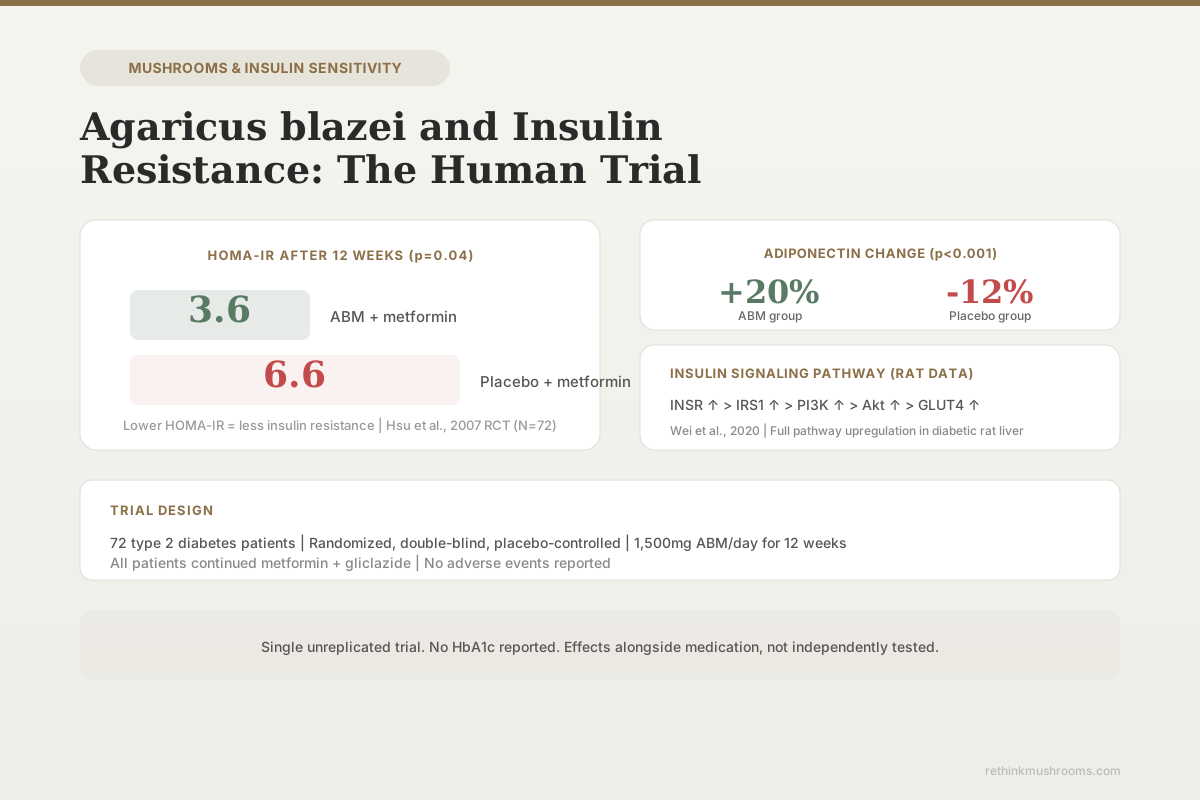
In a 12-week randomized, double-blind, placebo-controlled trial, type 2 diabetes patients taking Agaricus blazei extract alongside metformin and gliclazide had a HOMA-IR of 3.6, compared to 6.6 in the placebo group (p=0.04). Adiponectin increased 20% in the ABM group while decreasing 12% in placebo.
Hsu et al., Journal of Alternative and Complementary Medicine, 2007
+20% Adiponectin
vs -12% in placebo (p<0.001)
72 Patients
randomized, double-blind, placebo-controlled
1,500mg/day
ABM extract for 12 weeks
Hsu et al., Journal of Alternative and Complementary Medicine, 2007
 View as image ↗
Insulin resistance is the core metabolic defect in type 2 diabetes. Cells stop responding normally to insulin, forcing the pancreas to produce more and more of it. Blood sugar rises. The pancreas eventually fails to keep up. Every downstream complication of diabetes, from kidney failure to blindness to cardiovascular disease, traces back to this initial resistance.
One randomized controlled trial has tested Agaricus blazei Murill (ABM) for insulin resistance in humans. The results were striking: nearly a 50% difference in HOMA-IR between the ABM and placebo groups, plus a significant increase in adiponectin, the hormone that sensitizes cells to insulin. This is a single trial with 72 participants. It has not been replicated. But the findings are internally consistent with a growing body of preclinical evidence showing exactly how ABM polysaccharides improve insulin signaling at the molecular level. For the broader context of how mushroom beta-glucans modulate insulin signaling pathways and the general mechanisms of mushroom insulin sensitivity, those topics have their own articles.
Key Takeaways
- ABM-treated patients had HOMA-IR of 3.6 versus 6.6 in placebo (p=0.04) after 12 weeks, indicating substantially less insulin resistance (Hsu et al., Journal of Alternative and Complementary Medicine, 2007)
- Plasma adiponectin increased 20% in the ABM group but decreased 12% in placebo (p<0.001), a 32-percentage-point divergence over 12 weeks
- ABM activates the PI3K/Akt signaling pathway and upregulates GLUT4 glucose transporters in diabetic rat liver tissue (Wei et al., Food and Function, 2020)
- ABM fractions reduced blood glucose with efficacy comparable to metformin in diabetic rats and inhibited alpha-glucosidase enzyme activity (Oh et al., Journal of Ethnopharmacology, 2010)
- ABM prevented diet-induced insulin resistance in rats fed high-fat diets when given prophylactically (Vincent et al., Obesity, 2013)
- The trial used ABM alongside metformin and gliclazide, not as a replacement; independent effects of ABM alone are unknown
The Hsu 2007 Trial: Design and Results
Hsu and colleagues at Taipei Medical University conducted the definitive human trial.[1] The study design was rigorous: randomized, double-blind, placebo-controlled. Seventy-two patients with established type 2 diabetes were enrolled. All had been taking metformin and gliclazide (a sulfonylurea that stimulates insulin secretion) for at least 6 months, meaning their diabetes was being actively treated but not fully controlled.
Patients were randomized to receive either 1,500mg/day of ABM extract or matched placebo for 12 weeks. Both groups continued their existing diabetes medications unchanged.
HOMA-IR: The Primary Outcome
HOMA-IR (Homeostatic Model Assessment for Insulin Resistance) is calculated from fasting glucose and fasting insulin levels. A HOMA-IR below 1.0 indicates normal insulin sensitivity. Values above 2.5-3.0 indicate insulin resistance. Most type 2 diabetes patients have HOMA-IR values between 3 and 10.
After 12 weeks:
- ABM group: HOMA-IR = 3.6
- Placebo group: HOMA-IR = 6.6
- Difference: p = 0.04
A HOMA-IR of 3.6 versus 6.6 means the ABM group had roughly 45% less insulin resistance than the placebo group. Both groups were taking the same background medications. The only difference was ABM versus placebo.
Adiponectin: The Mechanism Marker
Adiponectin is a hormone secreted by fat cells that increases insulin sensitivity. Higher adiponectin levels are associated with better insulin action, less inflammation, and reduced cardiovascular risk. In type 2 diabetes, adiponectin levels are typically low.
After 12 weeks:
- ABM group: Adiponectin increased 20.0%
- Placebo group: Adiponectin decreased 12.0%
- Difference: p < 0.001
The 32-percentage-point divergence in adiponectin between groups is large. It suggests ABM is not just lowering insulin resistance through a generic effect but actively increasing production of a specific insulin-sensitizing hormone. This is a mechanistically informative result, not just a clinical endpoint.
What Else Was Measured
The trial also reported:
- Fasting blood glucose: Lower in the ABM group, but the difference did not reach statistical significance
- HbA1c: Not reported (a notable omission, since HbA1c is the clinical standard for diabetes management)
- Body weight: Not significantly different between groups
- Adverse events: None reported in either group
The absence of HbA1c data is the trial's most significant limitation. HOMA-IR is a valid research biomarker but not used in routine clinical practice. Clinicians manage diabetes by HbA1c. Without that number, the clinical relevance of the HOMA-IR improvement is harder to assess.
Why Adiponectin Matters
The adiponectin finding deserves its own section because it connects the human trial result to a specific molecular pathway.
Adiponectin binds to AdipoR1 and AdipoR2 receptors on muscle and liver cells. Activation of these receptors triggers AMPK (AMP-activated protein kinase), which increases glucose uptake, fatty acid oxidation, and insulin sensitivity. Low adiponectin is not just a marker of insulin resistance; it is a driver of insulin resistance. Increasing adiponectin is one of the few therapeutic strategies that addresses the root cause of type 2 diabetes rather than just managing blood sugar.
Thiazolidinediones (pioglitazone, rosiglitazone), a class of diabetes drugs, work in part by increasing adiponectin levels. The fact that ABM increased adiponectin by 20% over 12 weeks places it in the same mechanistic category as this drug class, though at a presumably weaker magnitude.
For more on the AMPK activation pathway through chaga and other mushrooms, that connection is explored separately.
The Molecular Pathway: PI3K/Akt and GLUT4
Wei and colleagues published the most detailed mechanistic study in 2020, mapping exactly which insulin signaling genes ABM affects in diabetic rat liver tissue.[2]
After 4 weeks of dietary ABM supplementation in STZ-induced diabetic rats, they measured gene and protein expression for the entire insulin signaling cascade:
- Insulin receptor (INSR): Increased
- IRS1 (Insulin Receptor Substrate 1): Increased
- PI3K (Phosphoinositide 3-Kinase): Increased
- Akt (Protein Kinase B): Phosphorylation increased
- GLUT4 (Glucose Transporter 4): Increased
- GSK3-beta: Decreased (this enzyme inhibits glycogen synthesis; reducing it means more glucose is stored as glycogen)
This is the complete canonical insulin signaling pathway. When insulin binds its receptor, the signal passes through IRS1 to PI3K to Akt, which triggers GLUT4 translocation to the cell surface. GLUT4 is the gate that lets glucose enter muscle and fat cells. More GLUT4 on the cell surface means more glucose enters cells and blood sugar falls.
ABM upregulated every step of this cascade while downregulating the inhibitory enzyme GSK3-beta. The effect was not a vague "antioxidant benefit" but a specific restoration of the molecular pathway that insulin resistance disrupts.
Supporting Preclinical Evidence
Three additional animal studies fill out the picture:
Oh et al. (2010) tested semipurified ABM fractions in STZ-diabetic rats.[3] The ethyl acetate fraction reduced blood glucose with efficacy comparable to metformin. It also reduced plasma triglycerides and cholesterol, and decreased liver and kidney oxidative stress markers. The alpha-glucosidase inhibition finding is notable: ABM blocks the enzyme that digests complex carbohydrates into glucose, slowing the post-meal glucose spike. This is the same mechanism as acarbose, an approved diabetes drug.
Vincent et al. (2013) asked a prevention question: can ABM stop insulin resistance from developing?[4] Rats were fed a high-fat diet (to induce obesity and insulin resistance) with or without ABM extract. The ABM group had reduced body weight gain, improved glucose tolerance, and better insulin sensitivity markers. This suggests ABM may be more effective at preventing insulin resistance than reversing established disease.
Niwa et al. (2011) showed that ABM (combined with sweet potato extract) preserved pancreatic beta-cell mass in diabetic rats by reducing oxidative stress and pro-inflammatory cytokines.[5] Beta-cell preservation is critical because once beta cells die, the body produces less insulin and diabetes becomes irreversible. Protecting beta cells extends the window during which dietary and lifestyle interventions can still work. And the impact of mushroom dietary fiber on post-meal blood sugar spikes adds another dimension to how mushrooms affect glucose metabolism.
What the Bioactive Compounds Are
Da Silva de Souza and colleagues cataloged ABM's bioactive compounds in a 2017 review.[6] The compounds relevant to insulin sensitivity include:
- Beta-glucans: (1,3)- and (1,6)-linked polysaccharides that activate immune cells and may directly modulate insulin signaling through AMPK activation
- Ergosterol: A vitamin D precursor. Vitamin D deficiency is associated with insulin resistance, and ergosterol may contribute to vitamin D-dependent insulin sensitization
- Proteoglycans: Protein-carbohydrate complexes that may have insulin-mimetic activity
- Phenolic compounds: Antioxidants that reduce the oxidative stress that worsens insulin resistance
Wei and colleagues confirmed in a separate 2020 study that ABM extracts demonstrate alpha-glucosidase inhibitory activity alongside their antioxidant properties.[7] The dual action (improving insulin signaling while slowing carbohydrate absorption) creates two simultaneous glucose-lowering mechanisms.
The Limitations That Matter
Single unreplicated trial. The Hsu 2007 study is the only human RCT. No independent group has repeated it. In science, a finding is not established until it has been independently replicated.
No HbA1c data. Without the clinical gold-standard measure of blood sugar control, the practical significance of the HOMA-IR improvement cannot be fully evaluated.
Background medication confound. All participants were taking metformin and gliclazide. ABM may interact with these drugs (enhancing their effect) rather than working independently. The trial cannot distinguish between ABM improving insulin resistance directly versus ABM enhancing the drugs' effectiveness.
Small sample, single site. Seventy-two patients at one center in Taiwan. Generalizability across different populations, diets, and genetic backgrounds is not established.
Preclinical-clinical gap. The PI3K/Akt/GLUT4 pathway data comes from rats. Whether ABM activates this pathway in human liver and muscle tissue at the doses used in the human trial is assumed but not proven.
No dose-response data. Only one dose (1,500mg/day) was tested. Whether lower doses are effective or higher doses are more effective is unknown.
The Bottom Line
The Hsu 2007 trial provides the strongest human evidence for any medicinal mushroom in diabetes. ABM extract reduced HOMA-IR from 6.6 to 3.6 (p=0.04) and increased adiponectin by 20% (p<0.001) over 12 weeks in 72 type 2 diabetes patients already taking metformin and gliclazide. The preclinical mechanism maps to the complete insulin signaling pathway: ABM upregulates INSR, IRS1, PI3K, Akt, and GLUT4 while downregulating the inhibitory GSK3-beta. The evidence is mechanistically coherent but clinically unreplicated. One trial, one dose, one population, no HbA1c data.
Frequently Asked Questions
Sources & References
- 1RTHM-00114·Hsu, Chung-Hua et al. (2007). “The mushroom Agaricus Blazei Murill in combination with metformin and gliclazide improves insulin resistance in type 2 diabetes: a randomized, double-blinded, and placebo-controlled clinical trial..” Journal of alternative and complementary medicine (New York.Study breakdown →PubMed →↩
- 2RTHM-00663·Wei, Qi et al. (2020). “Enhancement of glucose homeostasis through the PI3K/Akt signaling pathway by dietary with Agaricus blazei Murrill in STZ-induced diabetic rats..” Food science & nutrition.Study breakdown →PubMed →↩
- 3RTHM-00195·Oh, Tae W et al. (2010). “Semipurified fractions from the submerged-culture broth of Agaricus blazei Murill reduce blood glucose levels in streptozotocin-induced diabetic rats..” Journal of agricultural and food chemistry.Study breakdown →PubMed →↩
- 4RTHM-00308·Vincent, Mylène et al. (2013). “Dietary supplementation with Agaricus blazei murill extract prevents diet-induced obesity and insulin resistance in rats..” Obesity (Silver Spring.Study breakdown →PubMed →↩
- 5RTHM-00227·Niwa, Atsuko et al. (2011). “Ipomoea batatas and Agarics blazei ameliorate diabetic disorders with therapeutic antioxidant potential in streptozotocin-induced diabetic rats..” Journal of clinical biochemistry and nutrition.Study breakdown →PubMed →↩
- 6RTHM-00468·da Silva de Souza, Aline Cristine et al. (2017). “Agaricus blazei Bioactive Compounds and their Effects on Human Health: Benefits and Controversies..” Current pharmaceutical design.Study breakdown →PubMed →↩
- 7RTHM-00662·Wei, Qi et al. (2020). “Assessment of antioxidant and antidiabetic properties of Agaricus blazei Murill extracts..” Food science & nutrition.Study breakdown →PubMed →↩