Mushrooms and Insulin Sensitivity
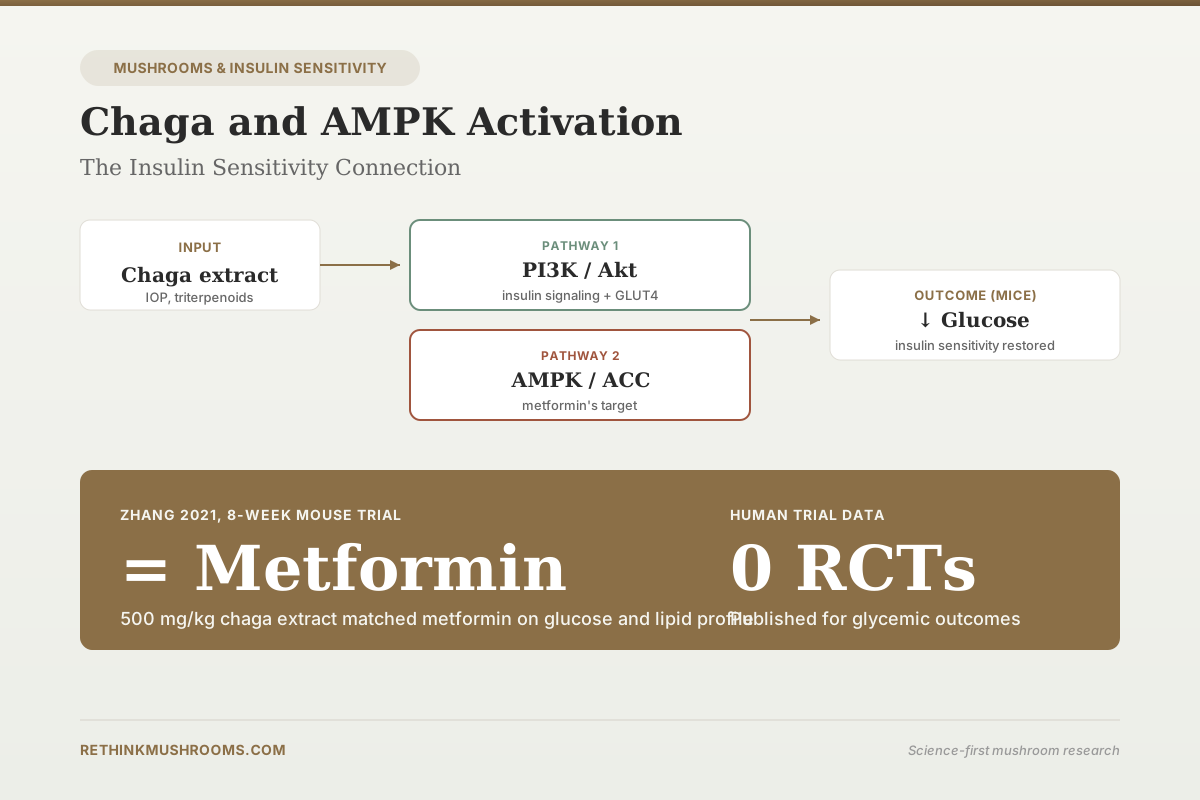
500 mg/kg Chaga extract
At 500 mg/kg daily in type 2 diabetic mice, chaga extract produced anti-diabetic effects equivalent to metformin, with upregulated p-AMPK and p-Akt protein expression driving the response.
Zhang et al., Journal of Ethnopharmacology, 2021
2 Pathways
PI3K/Akt and AMPK/ACC both activated by chaga extract
GLUT4↑
glucose transporter translocation documented in mouse muscle
0 Human RCTs
no controlled trial in humans has tested chaga for insulin sensitivity
Zhang et al., Journal of Ethnopharmacology, 2021
 View as image ↗
Chaga (Inonotus obliquus) shows up in diabetes-focused supplement marketing because of a real mechanistic story: in mouse models of type 2 diabetes, chaga extract activates AMPK, a central metabolic sensor that improves insulin sensitivity and glucose uptake. The mechanism is well-characterized across multiple independent labs. What is missing from the record is any randomized controlled trial in humans with diabetes or insulin resistance. This article walks through exactly what the mouse data shows, what AMPK activation means at the molecular level, and why that gap between preclinical signal and clinical evidence matters. For the broader picture of how mushrooms affect glucose handling, see our insulin sensitivity mechanisms article.
The short version: chaga polysaccharides and extracts reliably activate two parallel insulin-relevant signaling pathways in rodent muscle and liver, producing dose-dependent reductions in fasting glucose comparable to metformin at the higher tested doses. Human trials have not confirmed this. Chaga also carries a documented kidney safety signal at chronic use, which constrains any extrapolation to long-term daily intake.
Key Takeaways
- Oral I. obliquus extract at 500 mg/kg for 8 weeks produced anti-diabetic effects equivalent to metformin in type 2 diabetic mice, with upregulated p-PI3K, p-Akt, p-AMPK, and p-ACC protein expression (Zhang et al., Journal of Ethnopharmacology, 2021)
- I. obliquus polysaccharides at 900 mg/kg restored body weight, reduced fasting blood glucose, improved glucose tolerance, and increased GLUT4 expression in STZ-induced type 2 diabetic mice (Wang et al., Biomedicine & Pharmacotherapy, 2017)
- Network pharmacology analysis of chaga identified 30 bioactive compounds (21 triterpenoids, 4 flavonoids, 2 diterpenoids) and predicted 432 anti-diabetic targets, with PI3K/Akt as the central pathway (Randeni et al., IJMS, 2025)
- Chaga polysaccharide treatment partially restored STZ-damaged pancreatic β-cells over 6 weeks, suggesting both insulin sensitization and β-cell preservation contribute to the effect (Diao et al., Evidence-Based Complementary and Alternative Medicine, 2014)
- End-stage renal disease developed in a 49-year-old after four years of chaga powder, with measured oxalate content of 14.2g per 100g - the practical ceiling on chronic dosing (Lee et al., Journal of Korean Medical Science, 2020)
- Zero randomized controlled trials have tested chaga for insulin sensitivity, HbA1c, or glycemic control in humans
What AMPK Does and Why It Matters for Insulin Sensitivity
AMP-activated protein kinase (AMPK) is the cell's fuel gauge. When cellular energy runs low (high AMP to ATP ratio, fasting, exercise, caloric restriction), AMPK activates. When it activates, a cascade of metabolic shifts follows: glucose uptake increases, fatty acid oxidation rises, glycogen synthesis drops, cholesterol synthesis drops, and the cell moves from storage mode to burn mode.
AMPK is also the molecular target of metformin, the first-line pharmaceutical for type 2 diabetes. Metformin activates AMPK in liver and skeletal muscle, which is a significant part of how it lowers blood glucose. Any compound that can activate AMPK independently is therefore of pharmacological interest for metabolic disease.
Separately, the PI3K/Akt pathway carries the classical insulin signal from the receptor to the inside of the cell. When insulin binds, PI3K activates Akt, Akt triggers the translocation of GLUT4 glucose transporters to the cell membrane, and glucose enters. In insulin resistance, this signaling is blunted. Compounds that restore PI3K/Akt signaling improve insulin-stimulated glucose uptake without necessarily raising insulin levels.
Chaga extracts have now been shown in multiple independent mouse studies to upregulate both of these pathways simultaneously. That is an unusual combination. Most plant-derived compounds target one or the other.
The Zhang 2021 Finding: Chaga Matched Metformin
The most mechanistically detailed chaga diabetes study comes from Zhang and colleagues, published in the Journal of Ethnopharmacology in 2021.[1] C57BL/6 mice were induced into a type 2 diabetic state using a high-fat diet combined with low-dose streptozotocin. Animals were then gavaged daily with chaga extract at 250 mg/kg or 500 mg/kg for 8 weeks, with metformin as a positive control comparator.
The extract, prepared via high-pressure water extraction, contained β-glucans, triterpenoids, and polyphenols as its major components. Outcomes at both doses included:
- Reduced fasting blood glucose
- Improved insulin resistance indices
- Increased hepatic glycogen content (indicating glucose being stored normally again)
- Increased HDL cholesterol
- Decreased total cholesterol, triglycerides, and LDL cholesterol
Western blot analysis of liver tissue showed upregulated phosphorylated PI3K, phosphorylated Akt, phosphorylated AMPK, and phosphorylated ACC (the AMPK downstream effector for fatty acid oxidation). Downregulated markers included SREBP-1c and fatty acid synthase, both drivers of hepatic lipogenesis. At 500 mg/kg, the effect on glucose and lipid profiles was equivalent to the metformin control arm.
In rodent-to-human dose conversion terms, 500 mg/kg in a mouse translates to roughly 40 mg/kg in a human using standard allometric scaling, or about 2.8 grams daily for a 70 kg adult. That is a high dose but within the range used in traditional chaga preparation and some commercial powders, though also within the zone that raises the chaga-specific oxalate concerns discussed below.
GLUT4 Translocation: The Wang 2017 Data
Wang and colleagues tested a polysaccharide fraction of chaga (IOPS) at 900 mg/kg in streptozotocin-induced type 2 diabetic mice.[2] The results followed the same general pattern, with one important mechanistic addition: upregulated GLUT4 expression and evidence of increased GLUT4 translocation to the membrane.
This matters because GLUT4 is the insulin-responsive glucose transporter. In a healthy insulin-responsive cell, the PI3K/Akt signal triggers GLUT4 vesicles to fuse with the plasma membrane, creating glucose entry points. In insulin resistance, this step is impaired even when insulin is present. Wang's data suggests chaga polysaccharides restore that translocation step.
Additional findings:
- Restored body weight and fat mass toward controls
- Reduced fasting blood glucose
- Improved glucose tolerance
- Increased hepatic glycogen content
- Lower total cholesterol, triglycerides, and LDL; higher HDL
- Improved hepatic antioxidant activity
- Partial preservation of liver, kidney, and pancreas tissue integrity against STZ damage
Wang's study tested a purified polysaccharide fraction rather than a whole extract, which means the active compound in this particular branch of the mechanism is within the β-glucan-like polysaccharide family rather than the triterpenoid or polyphenol fractions. For a focused treatment of this polysaccharide mechanism across species, see our article on how mushroom beta-glucans modulate insulin signaling.
β-Cell Protection: The Diao 2014 Finding
Diao and colleagues took a different angle.[3] In STZ-induced diabetic rats, they examined not just blood glucose but also pancreatic β-cell histology. Streptozotocin directly destroys β-cells, producing an insulin-deficient model. The question was whether chaga polysaccharide (PIO) could help the pancreas recover.
Six weeks of PIO administration produced partial recovery of STZ-damaged β-cells. Oxidative stress markers normalized. Proinflammatory cytokines decreased. The mechanism the authors proposed involves antioxidant protection and anti-inflammatory action reducing ongoing β-cell injury, allowing partial regeneration.
This is biologically important because type 2 diabetes involves both insulin resistance (peripheral) and progressive β-cell dysfunction (central). A compound that hits insulin signaling AND supports β-cell survival addresses both arms. The PIO finding adds β-cell protection to chaga's profile on top of the AMPK and PI3K/Akt activation seen in Zhang and Wang's muscle and liver data.
Serum Profiling and Oxidative Stress
Two further studies fill in the metabolic picture. Xu and colleagues in 2021 used broader serum metabolite profiling in STZ-induced diabetic mice treated with IOP.[4] Multiple serum metabolites associated with glucose dysregulation normalized after chaga treatment, supporting a systemic rather than tissue-isolated effect.
Wang and colleagues in a separate 2017 study focused specifically on oxidative stress modulation.[5] Chronic hyperglycemia generates reactive oxygen species, and oxidative stress contributes to insulin resistance and β-cell death. Chaga polysaccharides reduced markers of oxidative stress in the diabetic mice, consistent with the antioxidant mechanism proposed in the Diao β-cell work.
Ern and colleagues' 2024 review summarized the chaga bioactive compound landscape: polysaccharides (including the β-glucans driving the polysaccharide fraction effects), triterpenoids (particularly inotodiol and betulinic acid derivatives), polyphenols, and melanin pigments all contribute to the antioxidant profile.[6]
Network Pharmacology: Randeni 2025
Randeni and colleagues brought a different methodology in 2025.[7] Rather than in vivo dosing, they used LC-MS to identify the bioactive compounds in a 95% ethanol chaga extract and then built a network pharmacology model predicting which compounds bind which human disease targets.
The analysis identified 30 bioactive compounds: 21 triterpenoids, 4 flavonoids, and 2 diterpenoids. Target prediction software and the GeneCards diabetes target database converged on 432 predicted anti-diabetic targets, with 167 core targets enriched in a specific set of pathways. The top enriched pathway was PI3K/Akt signaling. Molecular docking confirmed strong binding affinities for five key chaga compounds across seven core targets.
Network pharmacology is not a substitute for clinical data. It cannot tell you whether a compound reaches its target at a physiological dose. What it does well is generate hypotheses for mechanism and identify which compounds within a complex extract deserve targeted follow-up. The Randeni analysis reinforced what the in vivo work had already suggested: PI3K/Akt is the central route, and multiple chaga constituents can plausibly hit targets within it.
The Clinical Evidence Gap
Six independent rodent studies agree that chaga extracts and polysaccharides activate AMPK and PI3K/Akt, improve insulin sensitivity indices, upregulate GLUT4, protect β-cells, reduce oxidative stress, and at higher doses approach metformin's effect. Zero randomized controlled trials have tested chaga for any glycemic outcome in humans.
This gap is not unique to chaga. Most medicinal mushroom research follows the same pattern: strong preclinical mechanism, few or no clinical trials. The reasons include lack of pharmaceutical sponsorship (chaga cannot be patented), regulatory classification as a supplement (which does not require efficacy trials), and the cost of well-powered trials.
What it means practically: the published evidence base supports a biological plausibility claim ("chaga components can activate AMPK and PI3K/Akt in mammalian cells") but not an efficacy claim in humans ("chaga lowers HbA1c in people with type 2 diabetes"). These are different claims with different evidence standards. For a contrasting case where human trial data does exist for a mushroom's insulin effect, see Agaricus blazei and insulin resistance human trial evidence.
Dose, Form, and Safety Constraints
Chaga carries a species-specific safety signal that limits dosing assumptions. Two case reports have linked chronic chaga powder use to kidney injury.
Kikuchi and colleagues reported oxalate nephropathy requiring hemodialysis in a 72-year-old who consumed 4-5 teaspoons of chaga powder daily for 6 months.[8] Lee and colleagues reported end-stage renal disease after four years of chaga powder use, with measured oxalate content of 14.2g per 100g and estimated daily oxalate intake 2-5 times above normal.[9]
This matters for any insulin-sensitivity extrapolation in three ways. First, the doses used in the AMPK mouse studies (500-900 mg/kg) scale to human equivalents that sit in the same territory as the intakes that produced renal oxalate deposition over time. Second, people with diabetes have a higher baseline risk of kidney disease, meaning the population most likely to consider chaga for glycemic control is also the population most vulnerable to chaga-induced kidney injury. Third, no chaga preparation currently standardizes oxalate content, so the therapeutic dose and the toxic dose cannot be cleanly separated from the supplement label alone. For a deeper look at long-term chaga dosing considerations, see taking chaga long-term safely and the broader safety of combining multiple mushroom species.
The distinction between chaga extract, water-extracted polysaccharide fraction, and chaga powder matters here. Most of the oxalate sits in the raw material. Well-controlled extracts can reduce oxalate content, but most commercial products do not report this number. The in vivo diabetes studies used prepared extracts, not whole powder.
What Would Confirm the Effect
A meaningful human trial of chaga for insulin sensitivity would need to include: standardized extract with characterized β-glucan, triterpenoid, and oxalate content; a defined dose based on mouse-to-human scaling; duration of at least 12 weeks (the minimum for HbA1c change); baseline and endpoint HbA1c, fasting glucose, fasting insulin, HOMA-IR, and lipid panel; and kidney function monitoring given the oxalate signal. Until such a trial exists, any claim that chaga "improves insulin sensitivity in humans" rests on mouse data. The mouse data is good. It is not the same as clinical evidence. For a companion article on how mushroom fiber affects glucose after meals, see mushroom dietary fiber and postprandial blood sugar.
The Bottom Line
Chaga (Inonotus obliquus) extracts and polysaccharides consistently activate AMPK and PI3K/Akt signaling in mouse models of type 2 diabetes, with effects at 500 mg/kg approaching metformin in one head-to-head comparison. The mechanism includes GLUT4 translocation, β-cell protection, and oxidative stress reduction. Network pharmacology analyses converge on PI3K/Akt as the central pathway. No randomized controlled trial has tested chaga for glycemic outcomes in humans. Chaga also carries documented kidney risk from oxalate content at chronic high intake, which constrains the dose-duration space that could be used in any future human trial.
Frequently Asked Questions
Sources & References
- 1RTHM-00736·Zhang, Zhe et al. (2021). “Effect of Inonotus obliquus (Fr.) Pilat extract on the regulation of glycolipid metabolism via PI3K/Akt and AMPK/ACC pathways in mice..” Journal of ethnopharmacology.Study breakdown →PubMed →↩
- 2RTHM-00495·Wang, Jia et al. (2017). “Anti-diabetic effects of Inonotus obliquus polysaccharides in streptozotocin-induced type 2 diabetic mice and potential mechanism via PI3K-Akt signal pathway..” Biomedicine & pharmacotherapy = Biomedecine & pharmacotherapie.Study breakdown →PubMed →↩
- 3RTHM-00319·Diao, Bao-Zhong et al. (2014). “Protective Effect of Polysaccharides from Inonotus obliquus on Streptozotocin-Induced Diabetic Symptoms and Their Potential Mechanisms in Rats..” Evidence-based complementary and alternative medicine : eCAM.Study breakdown →PubMed →↩
- 4RTHM-00729·Xu, Tanye et al. (2021). “Inonotus obliquus polysaccharide ameliorates serum profiling in STZ-induced diabetic mice model..” BMC chemistry.Study breakdown →PubMed →↩
- 5RTHM-00498·Wang, Juan et al. (2017). “Antidiabetic activities of polysaccharides separated from Inonotus obliquus via the modulation of oxidative stress in mice with streptozotocin-induced diabetes..” PloS one.Study breakdown →PubMed →↩
- 6RTHM-01886·Ern, Phoebe Tee Yon et al. (2024). “Chaga Therapeutic Properties: What This 2024 Review Actually Shows.” Mycology.Study breakdown →PubMed →↩
- 7RTHM-00948·Randeni, Nidesha et al. (2025). “Elucidating the Anti-Diabetic Mechanisms of Mushroom Chaga (Inonotus obliquus) by Integrating LC-MS, Network Pharmacology, Molecular Docking, and Bioinformatics..” International journal of molecular sciences.Study breakdown →PubMed →↩
- 8RTHM-00329·Kikuchi, Yuko et al. (2014). “Chaga mushroom-induced oxalate nephropathy..” Clinical nephrology.Study breakdown →PubMed →↩
- 9RTHM-00630·Lee, Sua et al. (2020). “Development of End Stage Renal Disease after Long-Term Ingestion of Chaga Mushroom: Case Report and Review of Literature..” Journal of Korean medical science.Study breakdown →PubMed →↩