Mushrooms & Blood Sugar
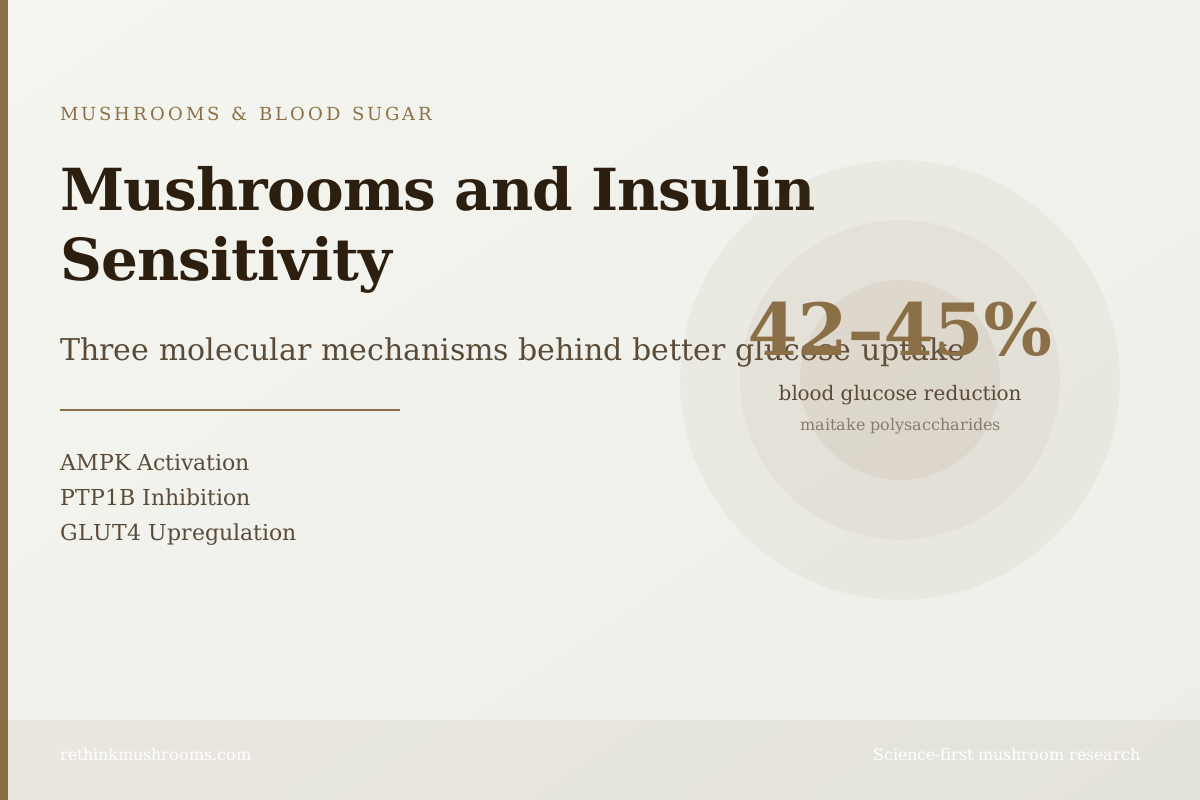
42–45% reduction in blood glucose
Maitake polysaccharides F2 and F3 reduced blood glucose in diabetic mice by 42–45% by activating the same PI3K/Akt/GLUT4 pathway insulin uses.
Anonymous et al., Journal, 2015
4 pathways
converge in the 2025 Semmelweis review
6 species
with mechanistic evidence: button, shiitake, oyster, maitake, reishi, chaga
AMPK + PTP1B
two insulin-independent routes to glucose uptake
Anonymous et al., Journal, 2015
 View as image ↗
Most writing about mushrooms and blood sugar stops at "they lower glucose." That observation is correct, but it skips the more interesting question: how? Mushrooms don't work through one mechanism. They engage at least three separate molecular entry points in the system that controls how cells absorb glucose. A January 2025 review from Semmelweis University, published in the International Journal of Molecular Sciences, mapped four convergent pathways across six common edible species: gut microbiome remodeling, decreased intestinal glucose absorption, lowered serum glucose, and increased GLUT4-mediated cellular uptake.[1] The fact that multiple pathways converge on the same endpoint helps explain why blood glucose reductions in some studies are large enough to be striking. The full species-level overview is covered in the mushrooms and type 2 diabetes research guide. This article focuses on the molecular mechanisms behind the mushrooms insulin sensitivity connection.
Key Takeaways
- Maitake polysaccharides F2 and F3 reduced blood glucose by 42–45% in diabetic mice by activating the PI3K/Akt/GLUT4 signaling cascade, the same pathway insulin drives
- Cordycepin from Cordyceps acts as a chemical mimic of AMP, binding the AMPK regulatory subunit directly to activate insulin-independent glucose uptake (documented in Cell Chemical Biology in 2020)
- Two Ganoderma (reishi) compounds inhibit PTP1B, the enzyme that shuts down insulin signaling; blocking it means the same amount of insulin produces a stronger, longer-lasting effect
- Cordyceps inhibits ceramide biosynthesis; ceramides block a key step in the insulin signaling cascade, and reducing them restores normal glucose uptake, a 2022 mechanism absent from most summaries
- A 2025 Semmelweis University review identified four converging pathways through which six common edible mushroom species reduce insulin resistance
- The mechanistic picture is detailed and consistent, but most evidence comes from animal models and cell studies; human clinical data for these specific pathway endpoints remains limited
What "Insulin Sensitivity" Means, and Why Mushrooms Can Affect It
Insulin sensitivity describes how effectively cells respond to insulin's signal to pull glucose out of the bloodstream. When sensitivity is high, a small amount of insulin moves a large amount of glucose. When it drops, cells become sluggish in their response, blood glucose stays elevated, and the pancreas compensates by producing more insulin.
The core mechanism involves a protein called GLUT4, a glucose transporter that sits inside muscle and fat cells under resting conditions. When insulin binds its receptor on the cell surface, it triggers a chain reaction: the receptor activates PI3K, PI3K activates Akt, and Akt sends the signal for GLUT4 to relocate from inside the cell to the cell membrane. Once on the membrane, GLUT4 pulls glucose in from the bloodstream. Insulin resistance means this chain reaction starts failing, often because of interference at several points simultaneously.
Mushrooms improve insulin sensitivity through at least three separate entry points in this system. A comprehensive 2021 review by Aramabašić Jovanović and colleagues in the Journal of Fungi mapped each major mushroom compound class to its specific glucose-control mechanism, covering polysaccharides, terpenoids, and phenolics.[2] The 2025 Nemeth review from Semmelweis built on that framework with the most current synthesis available.[1]
The three mechanisms are: activating AMPK, inhibiting PTP1B, and directly upregulating GLUT4 via the PI3K/Akt cascade. A fourth route, disrupting the ceramide pathway, was identified more recently. Each operates at a different point in the molecular machinery, and each is driven by different mushroom species and compounds.
The AMPK Switch: How Cordyceps Tells Cells to Take Up Glucose Without Waiting for Insulin
AMPK, the AMP-activated protein kinase, is the cell's internal energy sensor. When a cell is running low on fuel, AMP accumulates and binds to AMPK, activating it. One of AMPK's key responses is to move GLUT4 glucose transporters to the cell membrane, increasing glucose uptake independent of whether insulin is present. This insulin-independent route is the same mechanism partly responsible for why exercise lowers blood sugar even in people with type 2 diabetes.
Cordycepin, a compound found in Cordyceps mushrooms, activates AMPK through a specific and well-characterized molecular mechanism. In 2020, Hawley and colleagues at the Medical Research Council published findings in Cell Chemical Biology showing that cordycepin is metabolized inside cells into a form that chemically resembles AMP. This AMP mimic binds directly to AMPK's regulatory gamma subunit, the same site where real AMP binds, and activates the enzyme.[3] This is not a nonspecific or incidental effect. The molecular interaction is precise, and it bypasses the insulin receptor entirely.
Reishi (Ganoderma lucidum) also activates AMPK in living animals. A 2020 study found that Ganoderma extract reduced insulin resistance in high-fat-diet mice by enhancing AMPK activation, suppressing hepatic glucose output, and upregulating GLUT4 expression in muscle tissue.[4] Both effects (the liver releasing less glucose and muscle absorbing more) reduce circulating blood glucose through the same underlying signaling event.
The significance of AMPK activation for insulin resistance is that it creates a functional backup for the insulin receptor pathway. In conditions where the normal receptor-to-GLUT4 cascade is impaired, AMPK can still drive glucose into cells. Mushroom compounds that activate AMPK are working around the dysfunction rather than trying to repair it directly.
The PTP1B Brake: How Reishi Lets Insulin Signals Run Longer
PTP1B is a phosphatase, an enzyme that removes phosphate groups from other proteins. Its function in insulin signaling is to terminate the signal: after insulin binds its receptor and sets off the activation cascade, PTP1B dephosphorylates the receptor and several downstream proteins, shutting the system down. In people with insulin resistance, PTP1B is often overactive. The brake engages earlier and harder than it should.
A 2018 study identified two specific bioactive compounds from Ganoderma lucidum, labeled N2 and N3, that act as PTP1B inhibitors.[5] In insulin-resistant animals, these compounds improved insulin sensitivity and reduced fasting blood glucose. They didn't do this by adding more insulin or by activating the receptor more strongly. They did it by blocking the enzyme that shuts the signal off. Less braking means the same insulin dose produces a more complete and longer-lasting response.
This mechanism is largely absent from mainstream mushroom coverage. The common framing is that mushrooms "mimic insulin" or "stimulate insulin secretion," but PTP1B inhibition is a different concept entirely. It doesn't add to the insulin signal; it preserves the signal that's already there by removing what's cutting it short. For readers who want to go deeper on reishi's glucose effects specifically, the article on Ganoderma lucidum and insulin resistance covers the full picture.
The caveat: the Ganoderma PTP1B data is from animal models, and whether compounds N2 and N3 reach relevant target tissues at effective concentrations through food or standard supplement doses in humans is not established.
The PI3K/Akt/GLUT4 Cascade: How Maitake Gets Glucose Into Cells Through the Normal Route
The most quantified numbers in the mushroom insulin sensitivity literature come from maitake (Grifola frondosa). A 2015 study tested two specific polysaccharide fractions from maitake, labeled F2 and F3, in diabetic mice. Blood glucose dropped 42–45% compared to controls, and the mechanism was confirmed as activation of the PI3K/Akt/GLUT4 signaling pathway.[6]
To understand why this matters, it helps to walk through the pathway. The maitake polysaccharides activate the insulin receptor on the cell surface. That receptor activates PI3K, a phospholipid enzyme. PI3K activates Akt, a protein kinase. Akt sends the signal for GLUT4 to relocate from inside the cell to the membrane. GLUT4, now on the surface, pulls glucose in from the blood. The polysaccharides are activating the same signaling chain that insulin itself uses, entering at the receptor rather than replacing insulin.
The 42–45% glucose reduction figure is notable not just for its size but for what it tells us mechanistically. It's not a modest modulation at the edge of the system. The pathway appears to be engaged substantially.
A 2007 study by Preuss and colleagues added another dimension to the maitake picture: a specific glycoprotein from maitake, distinct from its beta-glucan fraction, also enhanced insulin-hypoglycemic activity in rats, producing greater fasting glucose reduction than controls.[7] This suggests that multiple components of maitake, not just one, are contributing to insulin sensitivity effects, potentially through related but not identical mechanisms. The species-specific maitake evidence is covered in more depth at maitake and blood sugar.
The detailed breakdown of how mushroom beta-glucans specifically engage these signaling pathways is in the companion article on how mushroom beta-glucans modulate insulin signaling pathways.
A 2022 Discovery: The Ceramide Pathway That Competitors Haven't Reported
Ceramides are lipid molecules that accumulate in fat and liver tissue during high-fat-diet conditions and obesity. They disrupt insulin signaling at a specific step: ceramides inhibit Akt phosphorylation, the handoff point in the PI3K/Akt/GLUT4 cascade where the upstream signal gets passed forward. Even if the insulin receptor fires normally and PI3K activates, high ceramide levels block the chain from continuing. GLUT4 stays inside the cell. Glucose stays in the blood.
A 2022 study tested whether Cordyceps could address this ceramide-driven block.[8] The results showed that Cordyceps inhibited ceramide biosynthesis in high-fat-diet animals. With fewer ceramides present, Akt phosphorylation was restored, the insulin signaling cascade could complete normally, and insulin sensitivity improved. The researchers also observed improvement in hepatic steatosis, accumulated fat in the liver, which is tightly linked to ceramide-driven insulin resistance.
This is a distinct mechanism from the AMPK activation that cordycepin produces. Cordyceps appears to work on insulin sensitivity through at least two separate routes: AMPK activation, which bypasses insulin signaling, and ceramide reduction, which clears a block inside the insulin signaling cascade itself. The combination means Cordyceps is acting on glucose uptake from two angles simultaneously, though both findings are preclinical and the in vivo human relevance remains to be tested.
None of the major consumer health articles covering mushrooms and blood sugar cite this ceramide research. It was published in 2022 and represents a mechanistic angle that is genuinely new in this literature.
Which Mushrooms Have Evidence for Which Mechanisms
The mechanistic evidence is not evenly distributed across species. Three mushrooms stand out clearly; the rest have broader but thinner coverage.
Maitake (Grifola frondosa) has the most concentrated insulin sensitivity evidence: direct PI3K/Akt/GLUT4 activation with quantified blood glucose reductions (42–45%), and a separate glycoprotein showing insulin-hypoglycemic effects. The polysaccharide fraction drives the signaling; the glycoprotein appears to act through a related mechanism.
Reishi (Ganoderma lucidum) has evidence across two separate pathways. AMPK activation via the 2020 study reduced insulin resistance and upregulated GLUT4 expression in muscle. PTP1B inhibition via the N2 and N3 compounds extended insulin signal duration. These are additive mechanisms, not redundant ones.
Cordyceps similarly shows two mechanisms: AMPK activation via cordycepin (the most molecularly precise result in this entire literature, with the binding site identified), and ceramide pathway disruption via the 2022 study. An early fermentation-product study from 2002 provided the first evidence that Cordyceps increased whole-body insulin sensitivity with improvements in GLUT4 translocation in skeletal muscle,[9] and the later work confirmed and extended those findings with molecular detail.
White button, shiitake, oyster, and chaga all appear in the 2025 Nemeth review as species with evidence for GLUT4-mediated glucose uptake through their polysaccharide content, but the species-specific mechanistic depth for these four is considerably thinner than for maitake, reishi, and cordyceps.[1] Chaga's AMPK data is covered in more detail at chaga and AMPK activation.
One observation worth noting: the species with the deepest mechanistic evidence, maitake, reishi, and cordyceps, are not the species most commonly eaten. Button, oyster, and shiitake dominate culinary use. The research priority and the dietary reality don't overlap as neatly as the coverage might suggest.
What the Evidence Shows, and What It Doesn't
The mechanisms described above are well-characterized at the molecular level. The AMPK activation, PTP1B inhibition, PI3K/Akt/GLUT4 upregulation, and ceramide disruption evidence is consistent across multiple research groups and species. The pathways are not in serious scientific dispute.
What remains less clear is how this translates to humans. A 2023 review examining edible mushrooms across diabetes prevention and treatment contexts noted that polysaccharides enhance insulin receptor sensitivity, terpenoids inhibit gluconeogenesis, and phenolics reduce oxidative stress, while acknowledging that human clinical data testing these specific pathway endpoints is limited.[10] The Aramabašić 2021 review drew the same conclusion: detailed mechanistic picture in animals, sparse human RCT data for the signaling outcomes specifically.[2]
The practical gap is not about whether the pathways exist. It's about bioavailability, dose, and form. Whether eating food-form mushrooms, or taking standard supplement doses, delivers enough active compounds to reach the relevant tissues (skeletal muscle, liver, fat cells) and produce meaningful AMPK activation or PTP1B inhibition in humans has not been rigorously tested.
Human evidence for mushroom effects on blood sugar does exist, but it comes primarily from postprandial blood glucose studies rather than pathway-specific trials. Published human trials have found reductions in postprandial blood glucose when mushroom powder was added to meals, but these effects operate through a separate dietary fiber mechanism, not through the receptor signaling pathways described here. That evidence is reviewed in mushroom dietary fiber and postprandial blood sugar spikes.
The honest summary: the molecular mechanisms are real and well-documented in preclinical research. The translation to human doses and outcomes is the open question, and honest coverage of mushrooms and insulin sensitivity has to hold both things at once.
The Bottom Line
Mushrooms engage insulin sensitivity through at least three distinct molecular mechanisms: AMPK activation, which bypasses the insulin receptor to drive glucose uptake; PTP1B inhibition, which extends how long insulin signals last by blocking the enzyme that shuts them off; and direct PI3K/Akt/GLUT4 activation, which engages the same cascade insulin uses. A 2022 study identified a fourth mechanism in Cordyceps: ceramide pathway inhibition, which removes a downstream block in the signaling cascade. A 2025 Semmelweis University review confirms these pathways across six common edible species. The mechanistic evidence is consistent; the translation to human doses remains the primary open question.
Frequently Asked Questions
Sources & References
- 1. Source details for this reference are not yet available.
- 2. Source details for this reference are not yet available.
- 3. Source details for this reference are not yet available.
- 4. Source details for this reference are not yet available.
- 5. Source details for this reference are not yet available.
- 6. Source details for this reference are not yet available.
- 7. Source details for this reference are not yet available.
- 8. Source details for this reference are not yet available.
- 9. Source details for this reference are not yet available.
- 10. Source details for this reference are not yet available.