Mushrooms & Diabetes / Blood Sugar
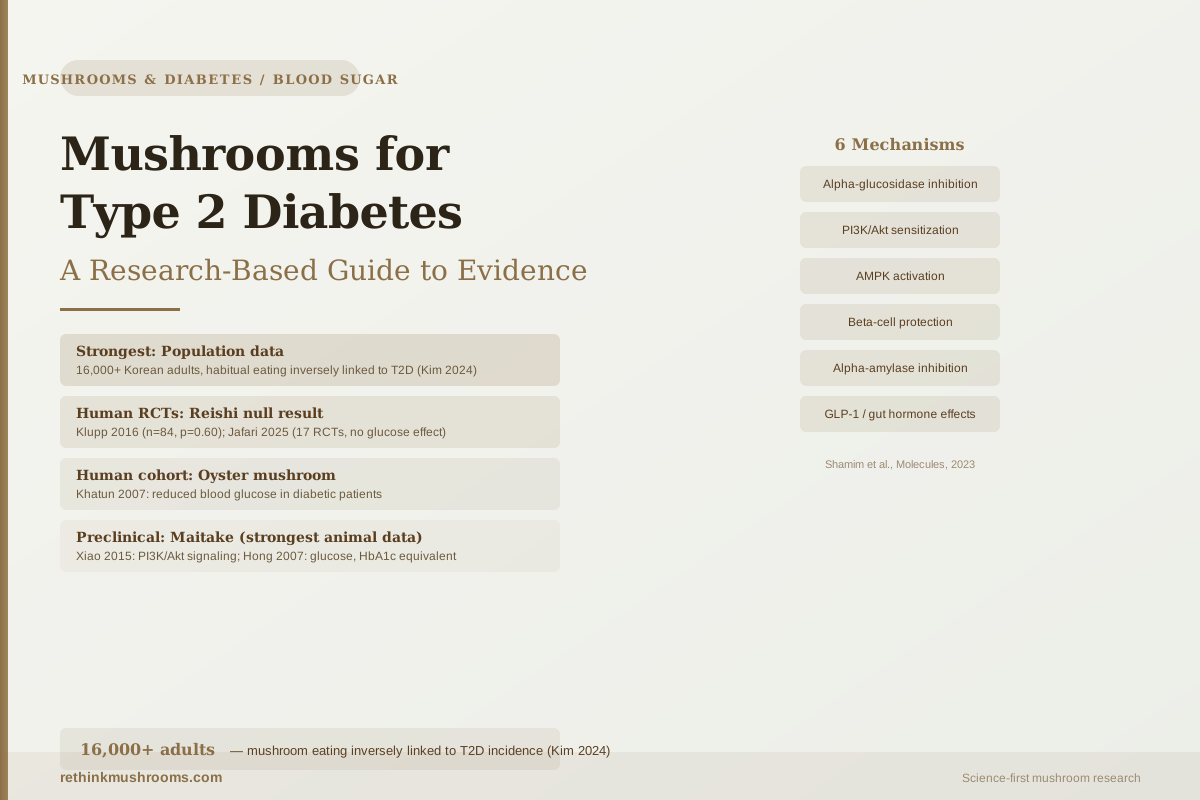
16,666 adults — habitual mushroom eating tracked with lower type 2 diabetes incidence
A prospective study of 16,666 Korean adults aged 40 and over found that the highest quartile of mushroom intake recorded significantly fewer new type 2 diabetes cases than the lowest quartile, in both men and women.
Kim et al., Epidemiol Health, 2024
17 RCTs
reishi trials pooled in a 2025 GRADE meta-analysis — no significant fasting glucose effect, and certainty rated very low across all outcomes
IRR 0.65
highest vs. lowest quartile of mushroom intake in men (95% CI 0.47–0.90); 0.70 in women (95% CI 0.54–0.93)
Null result
Klupp 2016 RCT — 84 patients, 3 g/day of reishi for 16 weeks, no significant change in HbA1c (p=0.60) or fasting glucose (p=0.95)
Kim et al., Epidemiol Health, 2024
 View as image ↗
In a prospective study following 16,666 Korean adults aged 40 and over, researchers found that the people who ate mushrooms most regularly developed type 2 diabetes at a significantly lower rate than the people who ate them least. That held in both men and women.[10] It doesn't prove mushrooms prevent diabetes — cohort associations have many confounders. But it is the most direct large-scale population evidence yet that habitual mushroom consumption and diabetes risk move in opposite directions.
What it doesn't answer is the question most people are actually asking: which species, at what dose, through what mechanism, with what quality of human clinical evidence?
Several mushroom species have shown glucose-lowering effects in research, with maitake, reishi, and oyster mushroom carrying the most studied evidence — though the quality of that evidence differs sharply by species, and in reishi's case points the opposite way from its reputation. Maitake has the strongest preclinical case and small uncontrolled human pilots. Reishi has extensive animal data but the most rigorous human trials found no significant effect on HbA1c or fasting glucose. Oyster mushroom is the most underappreciated: a small human study measured reduced blood glucose in diabetic patients eating it as food.
This article presents each major species alongside its honest evidence tier: population data, human trials, animal studies, and the null results that most consumer content ignores.
Key Takeaways
- A prospective study of 16,666 Korean adults aged 40+ found the highest quartile of mushroom intake had significantly lower type 2 diabetes incidence than the lowest, in both sexes (men IRR 0.65, 95% CI 0.47–0.90; women IRR 0.70, 95% CI 0.54–0.93) (Kim 2024)
- Maitake (Grifola frondosa) has a strong mechanistic case, with insulin-signaling improvement documented across multiple animal studies, but human evidence is limited to small uncontrolled pilots (Kubo 1994, Hong 2007, Xiao 2015, Ulbricht 2009)
- Reishi (Ganoderma lucidum) lowers glucose in animal models, but an 84-patient double-blind RCT found no significant effect on HbA1c (p=0.60) or fasting plasma glucose (p=0.95) after 16 weeks at 3 g/day (Klupp 2016)
- A 2025 GRADE meta-analysis of 17 reishi RCTs covering 971 participants found no significant fasting glucose reduction, and rated evidence certainty "very low" across every outcome — including its positive findings (Jafari 2025)
- Oyster mushroom (Pleurotus ostreatus) showed significantly reduced fasting and post-meal glucose in a 24-day withdrawal-rechallenge study of 30 diabetic patients — weak design, but one of very few direct human glucose measurements (Khatun 2007)
- Mushroom compounds act on blood sugar through several recurring routes, including alpha-glucosidase and amylase inhibition, insulin sensitization, beta-cell protection, and antioxidant effects (Shamim 2023)
- No mushroom preparation has human evidence sufficient to justify changing prescribed diabetes treatment, and several may add to the glucose-lowering effect of medication
16,666 People: What Population Data Shows
Two large population studies provide the broadest context for mushrooms and diabetes risk. They don't test a mushroom extract against a clinical outcome. They describe what happens to diabetes risk in people who regularly eat mushrooms as part of their normal diet.
Kim and colleagues followed 16,666 adults aged 40 and over enrolled in the Korean Genome and Epidemiology Study's Cardiovascular Disease Association Study.[10] Everyone included had normal fasting blood glucose at baseline and was not taking diabetes medication or insulin, so the study was measuring who went on to develop diabetes rather than who already had it. Mushroom intake was assessed by food frequency questionnaire and re-measured at every follow-up, then averaged cumulatively — a more robust exposure measure than a single baseline snapshot.
Comparing the highest quartile of mushroom intake against the lowest, the incidence rate ratio for type 2 diabetes was 0.65 in men (95% CI 0.47–0.90) and 0.70 in women (95% CI 0.54–0.93). Both intervals exclude 1.0. The authors also reported no significant interaction between mushroom intake and sex, meaning the finding is better read as one consistent direction across the cohort than as a men-only effect.
The Headline Number, Unpacked
What “16,666 People” Actually Measured
The comparison is the top quarter of mushroom eaters against the bottom quarter — quartiles, not quintiles, a detail secondary write-ups often get wrong. Both contrasts clear statistical significance. Only one of the two also shows a significant step-by-step dose-response across the quartiles.
IRR = incidence rate ratio, from a modified Poisson model with a robust error estimator. An IRR of 0.65 means the top quartile recorded 35% fewer new diabetes cases per person-time than the bottom quartile, after adjustment. The authors report no significant interaction between mushroom intake and sex, so the two rows are better read as one consistent direction than as a men-only finding.
All figures as reported by Kim 2024 (see references)
One nuance worth keeping: the test for a stepwise dose-response across quartiles reached significance in men (p=0.043) but not in women (p=0.114). The top-versus-bottom contrast was significant in both; the smooth "more is better" gradient was only demonstrated in one. That is a real limit on how far the finding stretches.
A separate prospective study by Jung and colleagues in 2023 examined edible mushroom intake against mortality in the broader KoGES cohort — 152,828 participants aged 40 and over, followed for a mean of 11.6 years.[8] In men, eating mushrooms less than once a week or one to three times a week was associated with lower all-cause and cardiovascular mortality than not eating them at all. In women, the same intake levels were associated with lower all-cause mortality, but a cardiovascular-specific reduction was not among the reported significant findings.
The detail most summaries drop: the significant associations appeared at low and medium intake, not at the highest category of three or more servings per week. That could reflect a genuine ceiling, or simply fewer people eating at that level and less statistical power to detect an effect there — the study does not settle which. Either way, it is a caution against assuming more mushrooms is straightforwardly better, and worth holding alongside the Kim quartile result rather than merging the two into a single "mushrooms are good" conclusion.
Population cohort studies cannot establish cause and effect. People who eat more mushrooms may differ from people who eat fewer in diet quality, physical activity, socioeconomic status, and healthcare access. What cohort associations establish is biological plausibility and motivation for intervention trials.
The Mechanistic Toolkit: How Mushroom Compounds Reach Blood Sugar
Shamim and colleagues reviewed the antidiabetic evidence for edible mushrooms in 2023, working through eight species in depth — Ganoderma lucidum, Lentinus edodes, Ophiocordyceps sinensis, Agaricus blazei, Grifola frondosa, Pleurotus, Panellus serotinus, and Auricularia auricula-judae — and surveying the compounds and pathways behind their reported hypoglycemic effects.[9] Several mechanisms recur across species:
Alpha-glucosidase inhibition. Alpha-glucosidase is an enzyme in the small intestine that breaks down complex carbohydrates into simple sugars for absorption. Inhibiting it slows glucose absorption after meals — the same mechanism used by the diabetes drug acarbose. It is among the most frequently reported mushroom mechanisms in the review, recurring across multiple species.
Alpha-amylase inhibition. Alpha-amylase is another carbohydrate-digesting enzyme, produced in saliva and by the pancreas and acting on starch in the mouth and small intestine. Inhibiting it further slows the release of glucose from dietary starch.
Insulin sensitization. Insulin signals cells to absorb glucose through an intracellular relay that includes the insulin receptor, IRS-1, and the PI3K/Akt pathway. When that relay is impaired — insulin resistance — glucose stays in the blood. Maitake polysaccharide fractions have been shown to act on this relay in diabetic animals.[6]
Pancreatic beta-cell protection. Type 2 diabetes involves progressive loss of beta-cell function — the pancreatic cells that produce insulin. Several mushroom compounds have shown protective effects against beta-cell damage in laboratory and animal models.
Antioxidant and anti-inflammatory effects. Oxidative stress and chronic low-grade inflammation both contribute to insulin resistance. Free-radical scavenging and reduced lipid peroxidation appear repeatedly among the mechanisms attributed to mushroom polysaccharides.
One further mechanism is frequently claimed but sits on weaker ground. Mushroom polysaccharides act as dietary fibers, and fermentable fiber can influence gut hormones including GLP-1 — the pathway targeted by drugs like semaglutide. That is a biologically reasonable idea, but it is not among the mechanisms documented in the Shamim review, and it should be treated as a hypothesis carried over from the general fiber literature rather than an established mushroom mechanism. For a fuller look at whether mushroom compounds meaningfully engage that pathway, see Mushrooms and GLP-1: Can Fungi Mimic the Ozempic Effect?.
Maitake: The Most Convincing Preclinical Story, Limited Human Evidence
Maitake (Grifola frondosa) has the most detailed mechanistic evidence trail of any mushroom for antidiabetic activity. The story starts in 1994, when Kubo and colleagues fed powdered maitake fruit body to genetically diabetic KK-Ay mice and observed blood glucose reduction, alongside changes in plasma insulin and triglycerides.[1] Fractionating the mushroom, they located the activity in an ether-ethanol-soluble lipid fraction and in a peptidoglycan they labelled the X-fraction; other water-soluble fractions were inactive. The commercial "SX-fraction" sold today descends from this line of work, though the 1994 paper itself describes only the X-fraction.
Hong and colleagues extended the evidence in 2007, again using KK-Ay mice. Oral MT-alpha-glucan reduced fasting plasma glucose, glycosylated serum protein (the murine analogue of HbA1c), serum insulin, triglycerides, and cholesterol simultaneously, while increasing hepatic glycogen and antioxidant enzyme activity.[2] The authors traced the effect to improved insulin sensitivity, measuring increased insulin binding capacity at liver plasma membranes.
Xiao and colleagues added mechanistic detail in 2015, isolating two maitake polysaccharide fractions (F2 and F3) and testing them in diabetic rats.[6] Both significantly reduced fasting serum glucose, fasting serum insulin, and HOMA-IR. Notably, they did so by different routes: F3 increased PI3K and Akt expression, while F2 acted by inhibiting PTP1B, a phosphatase that brakes insulin signaling. Two fractions from one mushroom converging on insulin resistance through separate mechanisms is a more interesting result than a simple potency ranking would be.
Ulbricht and colleagues conducted a systematic review of maitake in 2009 for the Natural Standard Research Collaboration, covering cancer, diabetes, and immunostimulation.[4] Their conclusion was blunt: there was a lack of systematic study of maitake's safety and effectiveness in humans, and randomized controlled trials were warranted. That situation has not meaningfully changed since. Widely repeated SX-fraction pilot figures come from small uncontrolled case series without a comparison group — suggestive at best, and not a substitute for trial evidence.
The honest summary for maitake: the mechanistic case is the most developed of any mushroom species for antidiabetic activity, and it is genuinely impressive work. But no adequately powered, double-blind, placebo-controlled RCT of maitake in type 2 diabetes has been published. The evidence ladder has a missing top rung.
- Cell studiescompleted
Fraction-level activity on insulin-signaling components including PI3K, Akt and PTP1B
- Animal studiescompleted
KK-Ay mice and diabetic rats: reduced fasting glucose, insulin, HOMA-IR and glycosylated serum protein across independent labs (Kubo 1994, Hong 2007, Xiao 2015)
- Uncontrolled human pilotscurrent
Small case-series reports without randomization, blinding or a control group — the current ceiling
- Randomized controlled trialmissing
Not published. Called for by Ulbricht 2009 and still absent
- Adequately powered RCTmissing
Not published
- Meta-analysismissing
No trial base to pool
Maitake has the deepest preclinical mechanism story in this literature and the thinnest human record. The gap between those two facts is the entire point: strong animal evidence is a reason to run a trial, not a substitute for one.
Kubo 1994 [1], Hong 2007 [2], Ulbricht 2009 [4], Xiao 2015 [6]
For the full maitake evidence review including the SX-fraction vs. D-fraction distinction, see Maitake and Type 2 Diabetes: The SX-Fraction Clinical Trials.
Reishi: Strong Animal Data, Disappointing Human Trials
Reishi (Ganoderma lucidum) is the species most prominently featured in mushroom supplement marketing for blood sugar support. The preclinical case is real — reishi polysaccharides and triterpenoids have documented alpha-glucosidase inhibitory activity and pancreatic beta-cell protective effects in animal models.
The human clinical picture is different.
Klupp and colleagues published a Cochrane systematic review in 2015 examining Ganoderma lucidum for pharmacologically modifiable cardiovascular risk factors, with blood glucose, blood pressure, and lipid profile as primary outcomes.[5] Five trials with 398 participants met inclusion criteria. The review found insufficient evidence to support Ganoderma for cardiovascular risk factor management, and flagged the small size and methodological quality of the available trials.
The same group then published a standalone RCT in 2016 designed specifically to resolve the question.[7] Eighty-four participants with type 2 diabetes and metabolic syndrome were randomized to Ganoderma lucidum, Ganoderma plus Cordyceps sinensis, or placebo, at 3 grams per day for 16 weeks. The primary outcomes were HbA1c and fasting plasma glucose.
Klupp et al. (2016) · Scientific Reports
- Population
- 84 adults with type 2 diabetes mellitus and metabolic syndrome
- Intervention
- 3 g/day Ganoderma lucidum, or Ganoderma lucidum plus Cordyceps sinensis, for 16 weeks
- Comparator
- Matched placebo, double-blind randomized allocation
- Finding
- No effect on either primary outcome. HbA1c: baseline-adjusted difference in means 0.13%, 95% CI −0.35 to 0.60, p=0.60. Fasting plasma glucose: 0.03 mmol/L, 95% CI −0.90 to 0.96, p=0.95. No secondary outcome moved either, and there was no overall increase in adverse events.
null A well-designed trial that asked the question directly and got a clean negative answer. The authors concluded the evidence does not support using Ganoderma lucidum for cardiovascular risk factors in people with diabetes or metabolic syndrome.
Klupp et al. (2016), ref [7]
Jafari and colleagues confirmed the picture in 2025 with the most comprehensive synthesis yet: a GRADE-assessed meta-analysis pooling 17 reishi RCTs across 971 participants, covering doses from 200 to 11,200 mg/day and durations from 1 to 24 weeks.[11] The pooled analysis found significant changes in BMI, creatinine, glutathione peroxidase, and heart rate. It found no significant effect on fasting glucose, lipid profile, blood pressure, inflammatory markers, or liver enzymes.
The Human Ceiling
Four Findings, Seven Nulls, and One Rating That Covers Them All
Jafari 2025 is the most rigorous human read on reishi available — 17 randomized trials, 971 participants. Its four positive results get quoted often. The sentence that governs all of them, including the positives, gets quoted far less: the certainty of the evidence was rated very low across every outcome.
All values as reported by Jafari 2025 [11]. WMD = weighted mean difference. Subgroup analyses found additional improvements in BMI, total cholesterol, creatinine and MDA in specific strata — lower doses (<1,400 mg/day) and participants under 50 — but those are subgroup findings carrying the same very-low certainty.
All figures from ref [11] (see references)
Two qualifications matter when reading that meta-analysis. First, it pooled trials in healthy, at-risk, and chronic-disease populations — it is a general health-indices synthesis, not a diabetes-specific one, so the fasting glucose null is an average across populations with varying room to improve. Second, and more importantly, the GRADE certainty was rated very low across all outcomes. That rating applies to the four positive findings just as much as to the nulls.
The honest conclusion for reishi: the animal evidence is biologically plausible. The human clinical evidence, now spanning 17 RCTs and nearly 1,000 participants plus a dedicated 84-person trial in exactly the right population, does not support meaningful blood glucose effects at commonly used doses. The gap could reflect differences in dose, preparation, patient selection, or the limitations of animal diabetes models. Those are genuine unknowns. But the clinical trial data, taken together, does not support the glucose-lowering claims made in most reishi supplement marketing.
Fact Check
Reishi and blood sugar
The claim
“Reishi supports healthy blood sugar levels.”
A staple claim in reishi supplement marketing, generally supported by citing animal studies and in vitro enzyme assays.
What research shows
UnsupportedIn humans, this is the most thoroughly tested and most clearly negative claim in the mushroom-and-diabetes literature. A dedicated 84-person double-blind RCT at 3 g/day for 16 weeks found no change in HbA1c (p=0.60) or fasting glucose (p=0.95), and a 2025 meta-analysis of 17 RCTs in 971 participants found no significant fasting glucose effect.
The animal data is real and the mechanisms are plausible — reishi compounds do inhibit alpha-glucosidase in the lab. The claim isn't fabricated; it just hasn't survived testing in people. Whether other doses, preparations, or durations would perform differently is genuinely unknown.
Klupp 2015 [5], Klupp 2016 [7], Jafari 2025 [11]
For the full reishi blood glucose evidence review, see Reishi Polysaccharides and Blood Glucose Control in Diabetic Patients.
Oyster Mushroom: The Underrated — and Widely Miscited — Human Study
Oyster mushroom (Pleurotus ostreatus) rarely appears in mushroom-and-diabetes discussions despite having one of the very few direct human glucose measurements. It is also the study in this article most often described incorrectly, so the design is worth stating precisely.
Khatun and colleagues recruited 89 diabetic subjects at BIRDEM hospital in Bangladesh between July 2005 and January 2006.[3] Thirty subjects (17 men, 13 women, mean age 46.3 years) completed the full protocol. That protocol was not a comparison against a separate control group. It was a 24-day within-subject sequence: seven days eating mushroom, seven days without, then seven days with it again, with measurements at each seven-day boundary.
Eating mushroom significantly lowered both fasting and two-hour post-breakfast plasma glucose (both p<0.001), along with total cholesterol and triglycerides. Systolic blood pressure fell (p<0.01), as did diastolic (p<0.05). Body weight and HDL cholesterol did not change. When mushroom was withdrawn during the middle week, fasting and post-meal glucose rose again.
Reading the Source, Not the Summary
What the Khatun Trial Actually Was
Khatun et al. (2007) is the human trial most often cited for oyster mushrooms and blood sugar. The one-line version of it that circulates is wrong in four places. Here is the shorthand beside the paper.
- Number of peopleMiscited
How it gets cited
89 diabetic subjects
What the paper reports
89 were recruited, but only 30 completed the full 24-day protocol. The results come from those 30.
- LengthMiscited
How it gets cited
7-day trial
What the paper reports
24 days in total, built as three consecutive 7-day blocks: mushroom, then no mushroom, then mushroom again.
- ComparatorMiscited
How it gets cited
versus placebo
What the paper reports
There was no placebo and no separate control group. Each participant was compared against their own readings during the withdrawal week.
- DesignMiscited
How it gets cited
randomized controlled trial
What the paper reports
A withdrawal-and-rechallenge study. The paper describes no randomisation and no blinding of participants or investigators.
- Direction of the resultsHolds up
How it gets cited
glucose, cholesterol and blood pressure fell
What the paper reports
This part holds. Fasting and 2-hour glucose (p<0.001), systolic (p<0.01) and diastolic (p<0.05) blood pressure, total cholesterol and triglycerides all fell on mushroom, rose again on withdrawal, and fell on restart.
- What did not moveIncomplete
How it gets cited
usually omitted
What the paper reports
Body weight and HDL cholesterol showed no significant change at any point in the 24 days.
Why this matters: the withdrawal-and-rechallenge pattern is genuinely informative — markers fell, rose when the mushroom stopped, and fell again when it restarted, which is harder to explain by drift or seasonality than a single before-and-after reading would be. But it is not placebo-controlled evidence, and 30 completers is a small base. The finding is a reason to keep studying oyster mushrooms, not a reason to treat the effect as established.
Source: Khatun et al. (2007), Mymensingh Medical Journal [ref 3]. All design details and P-values are as reported by the authors. Educational summary of a published trial, not medical advice.
That withdrawal-and-rechallenge shape is the study's real strength, and it is exactly what gets lost when the trial is summarized as a cohort comparison. Each participant served as their own control, and the outcome tracked the exposure in both directions — harder to explain away as seasonal drift or regression to the mean than a single before-and-after reading would be.
The limitations are still serious, and they are not the ones usually cited. There was no placebo and no blinding, so expectation effects are uncontrolled. Thirty completers out of 89 recruited is a small analysis set with substantial attrition. Each exposure window was only seven days. And it is a single-center study that has not been replicated. The Khatun study is a good reason to run a proper randomized trial of oyster mushroom for glycemic control. It is not, on its own, evidence that the effect is established.
Evidence Quality by Species: An Honest Map
The research landscape for mushrooms and type 2 diabetes has a structure that most consumer content obscures: a steep gradient from strong preclinical evidence to weak human clinical evidence, with the human evidence quality varying considerably by species — and running almost inverse to how loudly each species is marketed.
The Inversion
The Loudest Blood-Sugar Claim Has the Strongest Evidence Against It
Across these three species, shelf presence and evidence quality run in opposite directions. That inversion — not any single trial — is the most useful thing to carry out of the mushroom-and-diabetes literature.
Marketing prominence is a qualitative ordering of how prominently each species is promoted for blood sugar in the supplement category, not a measured market-share figure. Every evidence claim above is sourced in the references: reishi from Klupp 2016, Jafari 2025 and the 2015 Cochrane review; maitake from Kubo 1994, Hong 2007, Xiao 2015 and Ulbricht 2009; oyster from Khatun 2007; the population band from Kim 2024.
Educational summary of published research, not medical advice
Population/epidemiological level. Any mushroom, eaten habitually as food, was associated with lower type 2 diabetes incidence in a 16,666-person prospective study (Kim 2024). This is the broadest and most practical finding.
Human interventional data — small and weak, but real. Oyster mushroom has a 30-completer withdrawal-rechallenge study showing significant fasting and post-meal glucose reduction (Khatun 2007). Uncontrolled, unblinded, unreplicated — but it measured glucose in humans with diabetes eating a whole mushroom as food.
Human RCTs — null results. Reishi has the most rigorous human RCT data and the most clearly negative results: Klupp 2016 (n=84, null on HbA1c and FPG) and Jafari 2025 (17 RCTs, 971 participants, null on fasting glucose, very low certainty throughout). The rigorous clinical evidence for reishi does not support its blood glucose reputation.
Animal studies with mechanistic depth. Maitake has the most developed preclinical mechanistic evidence: specific fractions, specific pathways, specific biomarkers measured across multiple independent studies. Its human evidence is markedly weaker than its animal evidence.
In vitro (cell study) only. Most species covered in the Shamim 2023 review have evidence primarily at the cell level: compounds that inhibit glucose-metabolizing enzymes or act on insulin signaling in isolated cells. Cell studies establish mechanism; they don't predict clinical effect.
Why the Gap Between Animal and Human Evidence Exists
The preclinical-to-clinical translation problem for mushrooms and diabetes reflects several specific issues.
Animal models of diabetes are created artificially. Streptozotocin and alloxan destroy pancreatic beta cells to induce insulin-deficient diabetes. KK-Ay mice carry a genetic mutation causing obesity-related insulin resistance. These models allow controlled experiments but they don't replicate human type 2 diabetes, which develops over years against a complex background of genetics, lifestyle, and environment.
Dose translation from rodent studies to humans is complicated. Hong 2007 used 150–450 mg/kg in mice; scaled naively to body weight, that lands far above what a typical capsule delivers. Extraction methods, compound concentrations, and bioavailability all differ between animal model conditions and a commercial supplement.
Preparation standardization is largely absent across the clinical literature. Different reishi preparations, different polysaccharide extracts, different whole-mushroom powders — pooling them as "Ganoderma lucidum" for a meta-analysis creates heterogeneity that may obscure real effects of specific well-characterized preparations. Jafari's own subgroup analyses hinted at this, finding effects that varied by dose, duration, and population.
Finally, baseline matters. Many mushroom trials enroll relatively healthy participants whose glucose has little room to fall. Klupp 2016 is a notable exception — it enrolled people who actually had type 2 diabetes and metabolic syndrome, which is part of why its null result carries more weight than a null in a healthy cohort would.
These are not reasons to dismiss the animal evidence. They are reasons to interpret it carefully and weight the human clinical evidence heavily when it exists.
Safety: The Part Most Articles Skip
An article about mushrooms and blood sugar has an obligation the wellness framing tends to obscure. Several of the compounds discussed here lower glucose. Many readers with type 2 diabetes are already taking medication that lowers glucose. Those two facts interact.
Safety
ModerateCombining glucose-lowering mushrooms with diabetes medication
Concern
Mushroom preparations with genuine hypoglycemic activity can add to the effect of diabetes medication. Khatun 2007 measured significant reductions in fasting and post-meal glucose in patients who were being managed for diabetes, and also recorded significant reductions in systolic and diastolic blood pressure. An additive effect on top of insulin, sulfonylureas, or antihypertensives is a plausible route to hypoglycemia or low blood pressure.
What the research says
This is a monitoring and coordination issue, not a reason for blanket avoidance — mushrooms as food are associated with favorable outcomes in large cohorts. Anyone taking glucose-lowering or blood-pressure medication who adds a concentrated mushroom supplement should tell their prescriber and watch their readings, particularly in the first few weeks and after any change in preparation or dose.
Particularly relevant for: People with type 2 diabetes taking insulin, sulfonylureas, or other glucose-lowering drugs; people on antihypertensives
What to do
Discuss any concentrated mushroom supplement with the clinician managing your diabetes before starting, and monitor blood glucose more closely than usual after starting or changing one.
Khatun 2007 [3]; Klupp 2016 [7] reported no overall increase in adverse events at 3 g/day of reishi
Two further points belong here. First, the safety record in the trials discussed is reassuring as far as it goes: Klupp 2016 found no overall increased risk of adverse events with either active treatment over 16 weeks. Second, that reassurance covers the specific preparations, doses, and durations tested — it does not extend automatically to concentrated extracts sold at other doses, or to long-term use, which has not been studied.
Nothing in this article is medical advice. It is a summary of published research, and it is not a substitute for the judgment of the clinician managing your care.
Across the Cluster: Deeper Species Coverage
The sibling articles in this cluster go deeper on the species with the most complex evidence pictures:
-
Maitake and Type 2 Diabetes: The SX-Fraction Clinical Trials — covers the SX-fraction vs D-fraction distinction, the full mechanistic arc from discovery to human pilots, and what a well-designed RCT would need to show
-
Reishi Polysaccharides and Blood Glucose Control in Diabetic Patients — presents the preclinical mechanism case, then the Klupp 2016 RCT and Jafari 2025 GRADE meta-analysis in full detail
-
Comparing Mushroom Species for Diabetes Management: Which Has the Strongest Evidence? — side-by-side species comparison with evidence tier rankings
-
Cordyceps and Blood Sugar: How Cordycepin Affects Glucose Metabolism — AMPK activation mechanism and Cordyceps-specific glucose metabolism evidence
For species-specific evidence on Agaricus and Chaga for glucose outcomes, see Agaricus blazei and Insulin Resistance: Human Trial Evidence and Chaga and AMPK Activation: The Insulin Sensitivity Connection.
The Bottom Line
The population evidence for mushrooms and type 2 diabetes is real and meaningful: a prospective study of 16,666 Korean adults found the highest quartile of mushroom intake had significantly lower diabetes incidence than the lowest, in both sexes (Kim 2024). The clinical trial evidence by species is more complicated, and it runs almost inverse to how loudly each species is marketed. Maitake has the strongest preclinical mechanism case, documented across multiple independent animal studies, but its human evidence stops at small uncontrolled pilots — no adequately powered RCT exists. Reishi is the most marketed and the most thoroughly falsified: Klupp 2016 (n=84, null on both primary outcomes) and Jafari 2025 (17 RCTs, 971 participants, no significant fasting glucose effect, very low certainty across all outcomes) consistently show no blood glucose benefit at standard supplement doses. Oyster mushroom, rarely marketed for blood sugar at all, has the one direct human glucose measurement — a 24-day withdrawal-rechallenge study in 30 diabetic patients showing significant reductions that reversed when the mushroom was withdrawn, weak in design but real in outcome. For people managing diabetes with medication, no mushroom supplement has human evidence sufficient to justify altering prescribed therapy, and concentrated preparations with genuine glucose-lowering activity warrant a conversation with the prescriber. Eating mushrooms as food, as part of an overall dietary pattern, is where the evidence is strongest and the risk is lowest.
Frequently Asked Questions
Sources & References
- 1RTHM-00015·Kubo, K et al. (1994). “Anti-diabetic activity present in the fruit body of Grifola frondosa (Maitake). I..” Biological & pharmaceutical bulletin.Study breakdown →PubMed →↩
- 2RTHM-00113·Hong, Lei et al. (2007). “Anti-diabetic effect of an alpha-glucan from fruit body of maitake (Grifola frondosa) on KK-Ay mice..” The Journal of pharmacy and pharmacology.Study breakdown →PubMed →↩
- 3RTHM-00115·Khatun, K et al. (2007). “Oyster mushroom reduced blood glucose and cholesterol in diabetic subjects..” Mymensingh medical journal : MMJ.Study breakdown →PubMed →↩
- 4RTHM-00319·Ulbricht, Catherine et al. (2009). “Maitake mushroom (Grifola frondosa): systematic review by the natural standard research collaboration..” Journal of the Society for Integrative Oncology.Study breakdown →PubMed →↩
- 5RTHM-00380·Klupp, Nerida L et al. (2015). “Ganoderma lucidum mushroom for the treatment of cardiovascular risk factors..” The Cochrane database of systematic reviews.Study breakdown →PubMed →↩
- 6RTHM-00410·Xiao, Chun et al. (2015). “Hypoglycemic effects of Grifola frondosa (Maitake) polysaccharides F2 and F3 through improvement of insulin resistance in diabetic rats..” Food & function.Study breakdown →PubMed →↩
- 7RTHM-00429·Klupp, Nerida L et al. (2016). “A double-blind, randomised, placebo-controlled trial of Ganoderma lucidum for the treatment of cardiovascular risk factors of metabolic syndrome..” Scientific reports.Study breakdown →PubMed →↩
- 8RTHM-00833·Jung, Hyein et al. (2023). “Edible mushroom intake and risk of all-cause and cause-specific mortality: results from the Korean Genome and Epidemiology Study (KoGES) Cohort..” Food & function.Study breakdown →PubMed →↩
- 9RTHM-00850·Shamim, Mohammad Zaki et al. (2023). “Exploring Edible Mushrooms for Diabetes: Unveiling Their Role in Prevention and Treatment..” Molecules (Basel.Study breakdown →PubMed →↩
- 10RTHM-01918·Kim, Yu-Mi et al. (2024). “A prospective association between dietary mushroom intake and the risk of type 2 diabetes: the Korean Genome and Epidemiology Study-Cardiovascular Disease Association Study..” Epidemiology and health.Study breakdown →PubMed →↩
- 11RTHM-02098·Jafari, Ali et al. (2025). “The Nutritional Significance of Ganoderma lucidum on Human Health: A GRADE-Assessed Systematic Review and Meta-Analysis of Clinical Trials..” Food science & nutrition.Study breakdown →PubMed →↩