Mushrooms & Diabetes / Blood Sugar
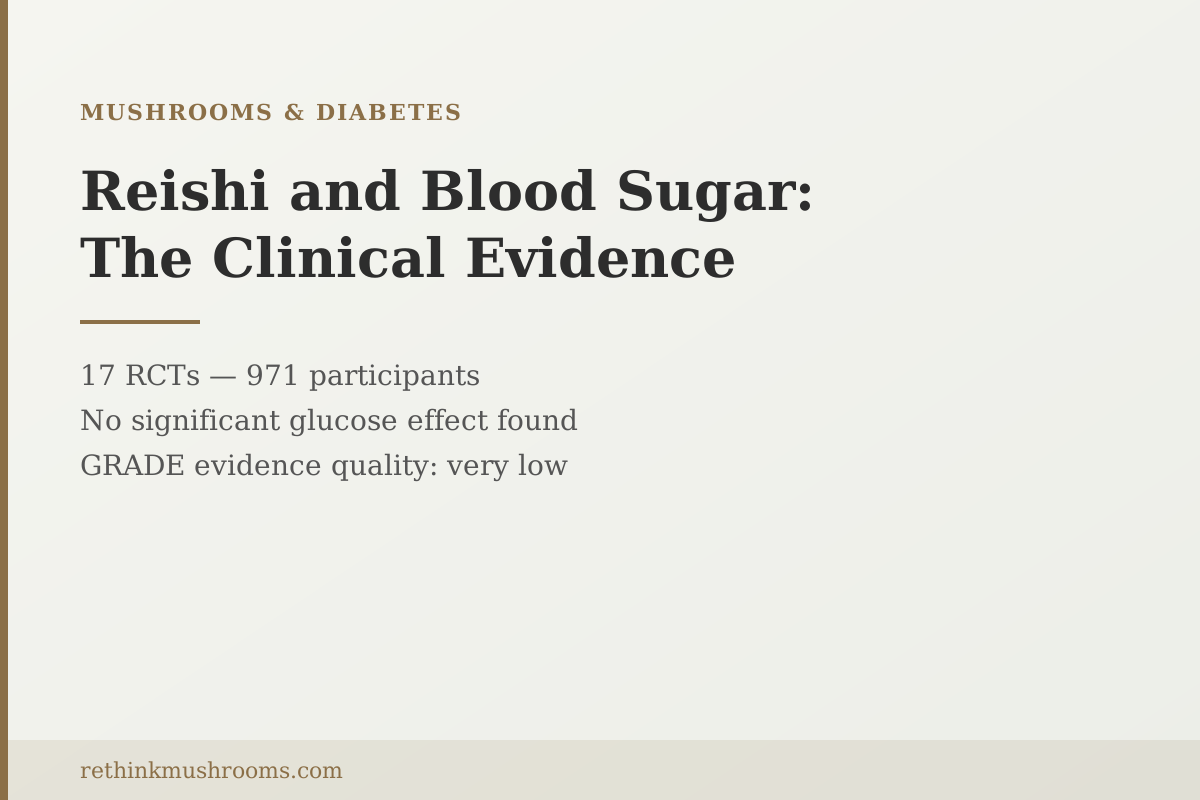
17 RCTs, no significant fasting glucose effect
A 2025 GRADE meta-analysis pooling 17 clinical trials and 971 participants found Ganoderma lucidum produced no significant reduction in fasting blood glucose across any dosage or duration tested.
Jafari et al., Food Sci Nutr, 2025
n=84
patients in the largest reishi diabetes RCT — 16 weeks, null result
Very low
GRADE evidence quality rating for glucose outcomes across all 17 trials
p=0.95
significance value for fasting glucose in the most rigorous trial (Klupp 2016)
Jafari et al., Food Sci Nutr, 2025
 View as image ↗
Reishi mushroom has real, mechanistically plausible reasons to affect blood glucose. Its polysaccharides can inhibit the enzymes that break down dietary starch. Its triterpenoids may activate a cellular pathway — called PPAR-gamma — that improves how efficiently muscle cells respond to insulin. Animal studies have shown meaningful glucose reductions. The biology makes sense.
But when the most rigorous human trials tested these mechanisms directly in diabetic patients, the results were not what the preclinical data predicted. A double-blind randomized controlled trial in 84 people with type 2 diabetes, run for 16 weeks, found no significant effect on HbA1c (the 3-month blood sugar average) or fasting blood glucose.[2] A 2025 meta-analysis of 17 clinical trials confirmed no significant fasting glucose reduction across 971 total participants.[4]
This is an honest article about what reishi does and does not do for blood sugar — including the evidence that most sources skip.
For the comparative picture across all mushroom species for diabetes management, see Mushrooms for Type 2 Diabetes: A Research-Based Guide to Evidence and Species.
Key Takeaways
- Reishi polysaccharides can inhibit alpha-glucosidase (the enzyme that breaks down dietary starch) and its triterpenoids can activate PPAR-gamma pathways that improve insulin sensitivity — biologically plausible mechanisms supported by preclinical research (Shamim et al., Molecules, 2023).
- The most rigorous human trial: 84 type 2 diabetes patients randomized to 3 g/day Ganoderma lucidum for 16 weeks showed no significant effect on HbA1c (p=0.60) or fasting plasma glucose (p=0.95) compared to placebo (Klupp et al., Sci Rep, 2016).
- A Cochrane systematic review of 5 RCTs concluded there was no evidence of benefit on HbA1c, fasting blood glucose, triglycerides, cholesterol, or blood pressure in patients with cardiovascular risk factors (Klupp et al., Cochrane, 2015).
- A 2025 GRADE meta-analysis of 17 RCTs (971 participants, doses 200–11,200 mg/day, 1–24 weeks) found no significant reductions in fasting glucose, lipid profile, or blood pressure; evidence quality was rated very low to low across all outcomes (Jafari et al., 2025).
- The gap between preclinical and clinical evidence may reflect dose, formulation, disease severity, or duration differences — these are genuine unknowns, not excuses. The research story is not closed.
- Reishi has not been associated with significant drug interactions at studied doses in RCTs, but its theoretical additive effect with hypoglycemic medications warrants awareness for people already managing glucose with medication.
Why Reishi Theoretically Could Lower Blood Sugar: The Mechanisms
The biological case for reishi's antidiabetic potential is not invented. It rests on several identified mechanisms that Shamim and colleagues described in a comprehensive 2023 review of 23 edible mushroom species.[3]
The first mechanism is alpha-glucosidase inhibition. Alpha-glucosidase is the enzyme in your small intestine that breaks down complex carbohydrates into glucose. When this enzyme is slowed down, less glucose enters the bloodstream at once after a meal. Reishi polysaccharides and some triterpenoids have shown alpha-glucosidase inhibitory activity in laboratory studies. This is the same mechanism exploited by acarbose, a pharmaceutical diabetes medication.
The second mechanism involves PPAR-gamma, a protein inside cells that acts like a master switch for insulin sensitivity. When PPAR-gamma is activated, cells — particularly muscle cells — become better at responding to insulin and taking up glucose from the blood. This is also the mechanism behind the thiazolidinedione class of diabetes drugs (rosiglitazone, pioglitazone). Laboratory studies have shown that certain Ganoderma compounds can activate this pathway.
The third mechanism is direct beta-cell protection. Beta cells are the insulin-producing cells in the pancreas. In type 2 diabetes, these cells progressively fail. Some Ganoderma compounds have shown protective effects on beta cells under conditions of high glucose or oxidative stress in preclinical models.
These mechanisms are biologically real. They provide a rational hypothesis for human trials. The question the clinical evidence answers is whether these laboratory-demonstrated mechanisms translate into meaningful blood glucose changes when a person takes a reishi supplement at a standard dose.
The Early Positive Data: A Sponsored Trial and an Open Question
Before the rigorous null results, there was a positive signal.
In 2004, Gao and colleagues published a trial of a proprietary Ganoderma polysaccharide extract called Ganopoly in 71 patients with type 2 diabetes over 12 weeks. Fasting blood glucose and HbA1c both improved compared to placebo. This study attracted attention as the first human evidence that reishi could affect blood sugar markers in diabetic patients.
The Ganopoly trial had important limitations that later reviewers noted. It was conducted by researchers with a financial relationship to the product's manufacturer. It was never independently replicated in an adequately powered randomized trial. The Cochrane reviewers who later evaluated the reishi evidence landscape flagged the trial quality issues across the early reishi diabetes literature — including concerns about blinding, allocation concealment, and sponsor relationships in multiple studies.
This is not to say the Ganopoly trial's findings were fabricated. Single sponsored trials sometimes produce real findings. But a positive result from a single sponsored trial is a hypothesis, not an established fact — and the subsequent trials would test whether the hypothesis held up.
The Cochrane Review: 5 RCTs, No Effect Found
In 2015, Klupp and colleagues published a Cochrane systematic review specifically on Ganoderma lucidum for cardiovascular risk factors, including blood glucose.[1]
Cochrane reviews are the gold standard of systematic evidence synthesis. They follow rigorous protocols for identifying studies, assessing quality, and pooling results. Klupp's team identified 5 randomized controlled trials that met their inclusion criteria, including 3 that involved type 2 diabetes patients.
Their finding: no significant effect on HbA1c, fasting blood glucose, triglycerides, cholesterol profile, or blood pressure.
The Cochrane reviewers did not conclude that reishi definitely does not work for blood glucose. Their conclusion was more precise: the available evidence was insufficient to recommend Ganoderma lucidum for managing cardiovascular risk factors, including blood sugar, in patients with type 2 diabetes. The trials that existed were too small, too variable in design, or too limited in quality to support a positive conclusion.
The distinction matters: "no proven effect" and "proven no effect" are different claims. The 2015 Cochrane review was the first, not the second.
The Best Reishi RCT: 84 Patients, 16 Weeks, Null Result
The most rigorous test of reishi for blood glucose to date was published in 2016 by the same lead investigator, Klupp and colleagues, in Scientific Reports.[2]
The trial enrolled 84 participants with type 2 diabetes and randomized them into three groups: Ganoderma lucidum extract alone (3 g/day), Ganoderma plus Cordyceps, or placebo. The intervention ran for 16 weeks — a duration long enough to see HbA1c changes if they were occurring.
The primary outcomes were HbA1c and fasting plasma glucose. The results:
For HbA1c: the difference between Ganoderma and placebo was 0.13 percentage points (95% confidence interval: -0.35 to 0.60). The p-value was 0.60. This is far from statistical significance and the effect size is clinically negligible.
For fasting plasma glucose: the difference was 0.03 mmol/L. The p-value was 0.95 — essentially no difference at all.
The trial was double-blind and placebo-controlled. It was adequately powered. It used a commercially available Ganoderma product at a dose (3 g/day) consistent with common supplement usage. The 16-week duration was sufficient. By the standards that define a rigorous clinical test, this trial was well-designed.
Its result was unambiguous: no meaningful effect on blood glucose by either primary measure.
17 Trials, 971 Patients: What the 2025 Meta-Analysis Found
In 2025, Jafari and colleagues published the most comprehensive synthesis of Ganoderma clinical trial evidence to date, using the GRADE system to rate evidence quality.[4]
GRADE (Grading of Recommendations, Assessment, Development and Evaluations) is an internationally recognized framework for rating how confident we can be in evidence. Rather than simply counting positive and negative studies, it weights studies by design quality, consistency, directness, precision, and risk of bias.
The Jafari meta-analysis pooled 17 randomized controlled trials, with 971 total participants. Doses ranged from 200 to 11,200 mg per day, and trial durations ranged from 1 to 24 weeks.
The findings for metabolic outcomes were consistent with the Klupp 2016 null result:
- Fasting glucose: no significant reduction
- Lipid profile (LDL, HDL, triglycerides): no significant effect
- Blood pressure: no significant effect
- Inflammatory markers: no significant effect
- Liver enzymes: no significant effect
Where Jafari's team did find statistically significant effects: reductions in BMI, creatinine, and heart rate. These are not the glucose outcomes this article's readers are asking about.
The GRADE quality assessment rated the evidence across all outcomes as very low to low. This rating reflects the body of evidence as a whole — it does not say studies were poor quality, but that inconsistency between studies, risk of bias across trials, and indirectness of outcomes collectively reduce confidence in the pooled estimates.
The practical implication: even if you combined all 17 trials' worth of data, the evidence base does not support a confident conclusion that reishi significantly lowers blood glucose in people with type 2 diabetes at the doses studied.
What "No Significant Effect" Doesn't Mean
This article would be less honest than it aims to be if it stopped at "the trials found nothing."
There are genuine reasons the preclinical-to-clinical translation may have failed that don't mean the biology is wrong.
Dose and formulation are the most plausible gap. The 3 g/day used in Klupp 2016 is a standard commercial dose, but the polysaccharide and triterpenoid content of commercial products varies enormously — from undetectable to 7.8% triterpenes and 1.1-5.8% polysaccharides across brands. A trial using a product at the low end of that range is not testing the same thing as a study that specifically measured compound content.
Patient selection matters. Type 2 diabetes is not a single homogeneous condition. Patients with different disease stages, different durations of diabetes, different baseline HbA1c, and different medication backgrounds might respond differently. The null result across the whole RCT population could mask a genuine response in a subgroup not yet identified.
Duration may matter. 12-16 weeks is long enough to see HbA1c changes, but some compound-level effects (particularly on beta-cell protection or gut microbiome remodeling) might require longer exposure.
None of these points reverse the clinical trial data. They are genuine unknowns that would need to be specifically tested to shift the conclusion. What they mean is that the story is not definitively closed — just that current human evidence at standard doses does not support reishi as a blood glucose intervention.
For how maitake compares as a species with different evidence at each stage, see Maitake and Type 2 Diabetes: The SX-Fraction Clinical Trials. For how reishi's broader metabolic effects compare, see Comparing Mushroom Species for Diabetes Management: Which Has the Strongest Evidence?.
The Bottom Line
Reishi has biologically plausible mechanisms for lowering blood glucose, including alpha-glucosidase inhibition, PPAR-gamma activation, and beta-cell protection, all supported by preclinical data. When rigorously tested in humans, however, the glucose effect has not materialized. The most rigorous RCT (n=84, 16 weeks) found no significant effect on HbA1c (p=0.60) or fasting glucose (p=0.95). A 2025 GRADE meta-analysis of 17 RCTs and 971 participants confirmed no significant fasting glucose reduction, with evidence quality rated very low to low across outcomes. The clinical picture is not definitively closed — dose, formulation, and patient selection remain genuine variables — but current human trial evidence does not support reishi as a blood glucose intervention at standard commercial doses.
Frequently Asked Questions
Sources & References
- 1. Source details for this reference are not yet available.
- 2. Source details for this reference are not yet available.
- 3. Source details for this reference are not yet available.
- 4. Source details for this reference are not yet available.