Mushrooms & Blood Sugar
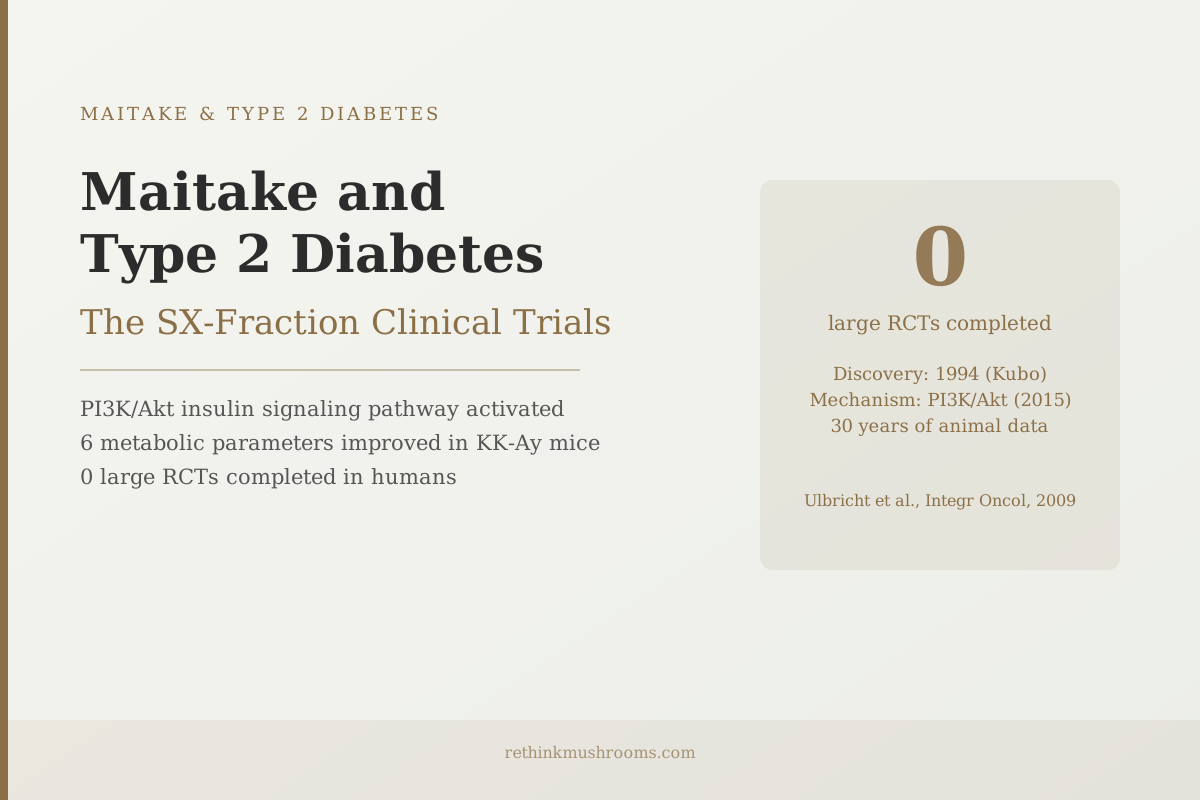
0 large RCTs completed
Despite 30 years of animal research showing maitake reduces blood glucose via the PI3K/Akt insulin signaling pathway, no large randomized controlled trial has tested SX-fraction in human type 2 diabetes patients.
Ulbricht et al., Journal of the Society for Integrative Oncology, 2009
1994
year Kubo discovered anti-diabetic activity in maitake fruiting body
PI3K/Akt
insulin signaling pathway activated by maitake polysaccharides (Xiao 2015)
6 markers
metabolic parameters improved in KK-Ay T2DM mice (Hong 2007)
Ulbricht et al., Journal of the Society for Integrative Oncology, 2009
 View as image ↗
Important note: Type 2 diabetes is a serious medical condition. This article reports research findings. Nothing here constitutes medical advice. People taking medications for diabetes should not add supplements without medical supervision, as interactions are possible.
Maitake mushroom — Grifola frondosa — has one of the better-documented preclinical records in the mushroom-diabetes literature. The anti-diabetic activity was discovered in 1994, the active compound class was progressively characterized over the following two decades, and the insulin signaling mechanism was identified down to a specific molecular pathway. The story is scientifically rigorous through the animal phase.
The human trial phase is a different story. The "clinical trials" cited in most supplement-focused content on maitake and type 2 diabetes are not randomized controlled trials. They are small pilots, some unpublished in peer-reviewed form. No large RCT exists. The mechanistic case is robust; the clinical evidence base is not.
For the broader picture of which mushroom species have the strongest evidence for diabetes, see Mushrooms for Type 2 Diabetes: A Research-Based Guide to Evidence and Species.
Key Takeaways
- SX-fraction (maitake SX, or MSX) is a water-soluble glycoprotein extract from maitake specifically developed for glucose metabolism; it is distinct from D-fraction, which targets immune function
- Kubo et al. (1994) first identified anti-diabetic activity in maitake fruiting body extract in genetically diabetic KK-Ay mice — a type 2 diabetes model — and isolated the peptidoglycan "X-fraction" that later became SX-fraction
- Horio and Ohtsuru (2001) confirmed glucose tolerance improvement in diabetic rats; Hong et al. (2007) extended this to KK-Ay type 2 diabetic mice with improvements across 6 metabolic parameters
- Xiao et al. (2015) identified PI3K/Akt insulin signaling pathway upregulation as the mechanism — the same pathway activated by insulin itself
- Human clinical evidence for SX-fraction is limited to small, uncontrolled pilot studies — Konno's group reported fasting glucose reductions in type 2 diabetics within roughly two weeks to a month — and no large randomized controlled trial has been completed (Ulbricht 2009 systematic review; Konno 2020)
- Maitake may potentiate blood glucose-lowering medications — a theoretical but mechanistically plausible interaction that warrants attention for anyone taking metformin or insulin
D-Fraction vs SX-Fraction: Two Extracts, Two Research Tracks
This distinction matters because the two fractions are often conflated in popular writing, but they target different biological systems and have different bodies of evidence.
D-fraction is a beta-1,6-glucan-protein complex from maitake that has been studied primarily for immune activation and NK cell stimulation. The "D" originally referred to the chromatography fraction designation in early Japanese research. It is the maitake extract most commonly associated with cancer research and immune support.
SX-fraction (also written MSX or Maitake SX) is a distinct glycoprotein-polysaccharide extract that was specifically isolated and developed for glucose metabolism research. Where D-fraction targets immune cells, SX-fraction targets insulin-responsive tissues — muscle cells, adipocytes, and the liver. The two fractions share some structural features (both are water-soluble polysaccharide complexes) but they are not interchangeable and they do not have the same research records.
When evaluating any article about "maitake and diabetes," the first question is which fraction is being discussed. Many articles do not distinguish between them, which produces confusing recommendations.
The 1994 Discovery That Started Thirty Years of Research
Kubo, Aoki, and Nanba published the foundational paper in 1994 in Biological and Pharmaceutical Bulletin.[1] Working with genetically diabetic KK-Ay mice — an inbred strain that develops insulin resistance and type 2-like diabetes spontaneously — they gave one gram per day of powdered maitake fruiting body by mouth. Blood glucose fell in the maitake group while it climbed with age in untreated controls, and plasma insulin and triglyceride levels shifted in parallel. They then fractionated the fruiting body and traced the blood glucose-lowering activity to two components: an ether-ethanol-soluble lipid fraction and a water-soluble peptidoglycan they labeled the X-fraction (roughly 65% sugar, 35% protein).
Nanba had earlier developed D-fraction; this 1994 paper extended his work into metabolic disease. The X-fraction identified here was the direct precursor of what is now standardized and sold as SX-fraction.
The KK-Ay model matters because it is driven by insulin resistance and obesity rather than by chemical destruction of pancreatic beta cells — the metabolic environment of human type 2 diabetes. In other words, the very first maitake diabetes study already used a type 2-relevant model, and later researchers built on it with additional diabetic models and progressively more detailed biochemistry.
What Happened in Diabetic Rat and Mouse Models (2001–2015)
The research continued for two decades after the Kubo 1994 discovery, progressively refining the biochemistry and testing additional diabetic models.
Horio and Ohtsuru (2001) used rats made diabetic by neonatal streptozotocin injection, fed a diet containing 20% maitake for 100 days.[2] Compared with untreated diabetic rats, the maitake group had markedly lower peak blood glucose on a glucose tolerance test, a higher post-load insulin response, lower fructosamine (a marker of longer-term glycemic control), and better-preserved insulin staining in the pancreatic islets. This was an important step because it documented several specific physiological responses — improved glucose handling, insulin secretion, and islet integrity — rather than a single blood glucose number.
Hong, Xun, and Wutong (2007) used the KK-Ay mouse model — a genetically obese, type 2 diabetic strain that more closely resembles the metabolic environment of human type 2 diabetes than chemical models.[3] The active compound they identified was an alpha-glucan from the maitake fruiting body. In KK-Ay mice, the alpha-glucan significantly decreased fasting plasma glucose, glycated serum protein (the rodent equivalent of HbA1c), serum insulin, triglycerides, cholesterol, and free fatty acids. It also reduced body weight and improved a liver oxidative stress marker. Six metabolic parameters, all in a type 2 diabetes-relevant model.
Xiao et al. (2015) went a layer deeper, isolating two polysaccharide-enriched fractions — F2 and F3 — from maitake and testing them in diabetic rats.[5] Both fractions significantly lowered fasting serum glucose and insulin and improved HOMA-IR, a calculated index of insulin resistance. When the researchers examined the insulin signaling machinery in liver tissue, the two fractions worked through partly different routes: F3 raised the expression of PI3K and Akt — the core insulin signaling cascade — while F2 mainly suppressed PTP1B, an enzyme that normally brakes insulin signaling. Both reactivated the insulin receptor and its substrate IRS-1.
The PI3K/Akt Mechanism: How Maitake Polysaccharides Affect Insulin Signaling
The PI3K/Akt pathway is the primary intracellular signaling route through which insulin stimulates glucose uptake in muscle and fat cells. When insulin binds to its receptor on the cell surface, it triggers a cascade: PI3K (phosphoinositide 3-kinase) activates, which activates Akt (also called protein kinase B), which in turn causes GLUT4 glucose transporters to move to the cell membrane and pull glucose out of the bloodstream.
In type 2 diabetes, this pathway becomes impaired — insulin is present but the downstream signaling is blunted, so cells do not take up glucose efficiently. This is insulin resistance at the molecular level.
What Xiao et al.'s 2015 data shows is that maitake polysaccharide fractions engage this same pathway in the liver — F3 by raising PI3K and Akt expression directly, F2 by removing a brake (PTP1B) on the cascade.[5] Separately, Konno et al. (2013) tested the SX-fraction itself in cultured skeletal muscle cells (the L6 line) and found it acted on the insulin signal transduction pathway in muscle.[7] Together these are mechanistically coherent findings: they explain why maitake extracts improve insulin sensitivity (not just blood glucose) and why the effect would be most relevant in insulin-resistant states rather than in healthy individuals.
Shamim et al.'s 2023 comprehensive review of 23 edible mushroom species for diabetes listed PI3K/Akt signaling as one of the primary mechanisms shared across multiple mushroom species with antidiabetic activity.[6] Other mechanisms identified for mushrooms broadly include alpha-glucosidase inhibition (slows post-meal glucose absorption), alpha-amylase inhibition (reduces starch digestion), AMPK activation (a metabolic master switch), and gut microbiome-mediated hormone effects. Maitake's specific contribution to this landscape is primarily through the PI3K/Akt route based on the available mechanistic data.
For more on how mushroom beta-glucans affect insulin signaling pathways, see How Mushroom Beta-Glucans Modulate Insulin Signaling Pathways.
The Human Evidence: What "Clinical Trials" Actually Means Here
Ulbricht et al.'s 2009 systematic review in the Journal of the Society for Integrative Oncology remains the most comprehensive English-language synthesis of maitake evidence.[4] The review identified SX-fraction as the most studied bioactive fraction for glucose metabolism. It also reached the conclusion that the Natural Standard Research Collaboration consistently applies to promising supplements: preclinical data is strong; human clinical evidence is limited to small pilots.
The "clinical trials" cited in most consumer-facing content on SX-fraction are not randomized controlled trials. The human data that does exist comes from small pilot clinical studies run by Konno and colleagues, whose 2020 review reported that SX-fraction produced significant reductions in fasting blood glucose in type 2 diabetes patients within roughly two weeks to a month.[8] These were small and uncontrolled — no placebo arm, no blinding, and no large enrolled cohort. Pilots at this scale are not evidence of clinical efficacy in the sense required for medical recommendation; they are signals that larger trials are worth pursuing, not proof that the intervention works.
No large, blinded, randomized controlled trial of maitake SX-fraction in type 2 diabetes patients has been completed and published in peer-reviewed form. This is the central limitation of the SX-fraction evidence base, and it is rarely acknowledged in the content that ranks for this topic.
Evidence Hierarchy
Maitake SX-Fraction & Type 2 Diabetes — An Upside-Down Evidence Pyramid
A normal evidence pyramid is widest at the bottom (mechanisms) and narrows to a single, decisive human trial at the top. Here it is inverted: the mechanistic and animal tiers are crowded with studies spanning thirty years, while the tier that would guide real treatment — a placebo-controlled trial in people — is empty. Bar width reflects how much direct evidence exists at each tier, not the size of any effect.
Placebo-controlled human RCT
gapDoes not yet exist
The evidence a clinician would actually act on — a randomised, blinded trial testing SX-fraction against placebo on HbA1c or fasting glucose in people with type 2 diabetes — has never been run
Uncontrolled human pilot
preliminaryKonno 2013 · Konno 2020
Konno and colleagues reported that SX-fraction lowered fasting blood glucose in type 2 diabetes patients within roughly two weeks to a month — but these were small pilot studies with no placebo arm, no blinding, and no large enrolled cohort
Genetic type 2 diabetes animal model (KK-Ay)
evidenceKubo 1994 · Hong 2007
In KK-Ay mice — an inbred strain whose insulin resistance and obesity resemble human type 2 diabetes rather than chemically-destroyed beta cells — powdered maitake and a purified alpha-glucan lowered glucose, insulin, and triglycerides, with Hong 2007 improving six metabolic parameters at once
Other diabetic-animal models
evidenceHorio 2001 · Xiao 2015
A neonatal-streptozotocin rat study fed 20% maitake for 100 days improved glucose tolerance, post-load insulin, and pancreatic islet integrity, and two purified fractions (F2, F3) cut fasting glucose and insulin resistance in diabetic rats
Cell & mechanistic pathways
evidenceKonno 2013 · Xiao 2015 · Shamim 2023
The widest, cleanest tier: the SX-fraction acts on the insulin signal transduction pathway in cultured skeletal muscle cells, while maitake polysaccharides engage PI3K/Akt and inhibit the counter-regulator PTP1B in liver tissue — a biologically coherent route to improved insulin sensitivity
How to read it: the bars grow wider toward the bottom because the mechanistic and animal literature is deep and converges on a coherent insulin-signaling story. But every step upward toward a person with diabetes loses evidence — the only human studies are small, uncontrolled pilots, and the placebo-controlled trial that would settle the question has never been run. The gap at the top, not the quality of the mechanisms, is the honest limit of the SX-fraction claim.
Sources: Kubo 1994 [1]; Horio 2001 [2]; Hong 2007 [3]; Ulbricht 2009 [4]; Xiao 2015 [5]; Shamim 2023 [6]; Konno 2013 [7]; Konno 2020 [8]. Bar widths are illustrative of evidence depth per tier, not quantitative effect sizes.
This is not unusual in the mushroom research landscape — see Comparing Mushroom Species for Diabetes Management: Which Has the Strongest Evidence? for how maitake's evidence compares to other species. The same gap between robust animal data and sparse human trial data exists for most mushroom species with antidiabetic research.
Why the Gap Exists — and What It Means for the Evidence
The absence of large RCT data for maitake SX-fraction is not because researchers tried and failed. No large trial has been funded. Maitake cannot be patented in its natural form, which limits pharmaceutical company investment. Academic funding agencies have historically prioritized other areas. The result is a research pipeline that advanced through animal models and small pilots but has not reached the phase of large, rigorous clinical testing.
This matters for interpreting the existing data. The animal evidence — particularly the KK-Ay data from Hong 2007 and the mechanistic detail from Xiao 2015 — is genuinely encouraging. Type 2-relevant animal models showed consistent glucose reduction through a biologically coherent mechanism. But the translation from animal to human is where most pharmaceutical compounds fail, and there is no clinical trial data to confirm that maitake SX-fraction survives that translation.
The Shamim 2023 review, which surveyed the broader landscape of 23 mushroom species for diabetes, placed maitake (Grifola frondosa) among the species with the most evidence — alongside Pleurotus (oyster mushroom) and Agaricus — while also noting that well-designed RCTs remain the outstanding need across the entire field.[6]
Drug Interactions and Safety Considerations
The same mechanism that makes SX-fraction potentially useful for type 2 diabetes also creates a meaningful interaction risk.
If maitake polysaccharides enhance insulin signaling and lower blood glucose, combining them with medications that also lower blood glucose — metformin, sulfonylureas, GLP-1 agonists, or insulin itself — could theoretically produce additive hypoglycemic effects. Unexpectedly low blood glucose is a medical emergency.
This interaction has not been documented in controlled human studies with SX-fraction (because large human studies have not been done). It is a theoretical interaction based on mechanism. But mechanism-based interactions are real and clinically significant. The Ulbricht 2009 systematic review listed this as a potential concern.[4]
People taking any medication for type 2 diabetes should not add maitake supplements without discussing it with their prescriber.
The general safety profile of maitake as food is well established — it has been eaten in Japan for centuries without reported toxicity. Extract concentrations are higher than dietary consumption, which is why the interaction risk is specifically relevant to supplements, not to eating maitake mushrooms in meals.
The Bottom Line
Maitake's SX-fraction has one of the stronger mechanistic cases in mushroom diabetes research — 30 years of animal data culminating in Xiao et al.'s 2015 identification of PI3K/Akt insulin signaling pathway upregulation as the specific mechanism. Hong et al. (2007) showed consistent improvement across six metabolic parameters in KK-Ay mice, the closest animal model to human type 2 diabetes. The gap is human evidence: no large randomized controlled trial has been completed. Ulbricht et al.'s 2009 systematic review reached this conclusion, and nothing in the subsequent literature has changed it. The mechanistic rationale is sound; the clinical evidence base required to support medical recommendations does not yet exist.
Frequently Asked Questions
Sources & References
- 1RTHM-00015·Kubo, K et al. (1994). “Anti-diabetic activity present in the fruit body of Grifola frondosa (Maitake). I..” Biological & pharmaceutical bulletin.Study breakdown →PubMed →↩
- 2RTHM-00035·Horio, H et al. (2001). “Maitake (Grifola frondosa) improve glucose tolerance of experimental diabetic rats..” Journal of nutritional science and vitaminology.Study breakdown →PubMed →↩
- 3RTHM-00113·Hong, Lei et al. (2007). “Anti-diabetic effect of an alpha-glucan from fruit body of maitake (Grifola frondosa) on KK-Ay mice..” The Journal of pharmacy and pharmacology.Study breakdown →PubMed →↩
- 4RTHM-00319·Ulbricht, Catherine et al. (2009). “Maitake mushroom (Grifola frondosa): systematic review by the natural standard research collaboration..” Journal of the Society for Integrative Oncology.Study breakdown →PubMed →↩
- 5RTHM-00410·Xiao, Chun et al. (2015). “Hypoglycemic effects of Grifola frondosa (Maitake) polysaccharides F2 and F3 through improvement of insulin resistance in diabetic rats..” Food & function.Study breakdown →PubMed →↩
- 6RTHM-00850·Shamim, Mohammad Zaki et al. (2023). “Exploring Edible Mushrooms for Diabetes: Unveiling Their Role in Prevention and Treatment..” Molecules (Basel.Study breakdown →PubMed →↩
- 7RTHM-00533·Konno, Sensuke et al. (2013). “Possible hypoglycemic action of SX-fraction targeting insulin signal transduction pathway..” International journal of general medicine.Study breakdown →PubMed →↩
- 8RTHM-01222·Konno, Sensuke (2020). “SX-fraction: Promise for novel treatment of type 2 diabetes..” World journal of diabetes.Study breakdown →PubMed →↩