Mushrooms and Type 2 Diabetes
1 RCT vs. drug-combo control
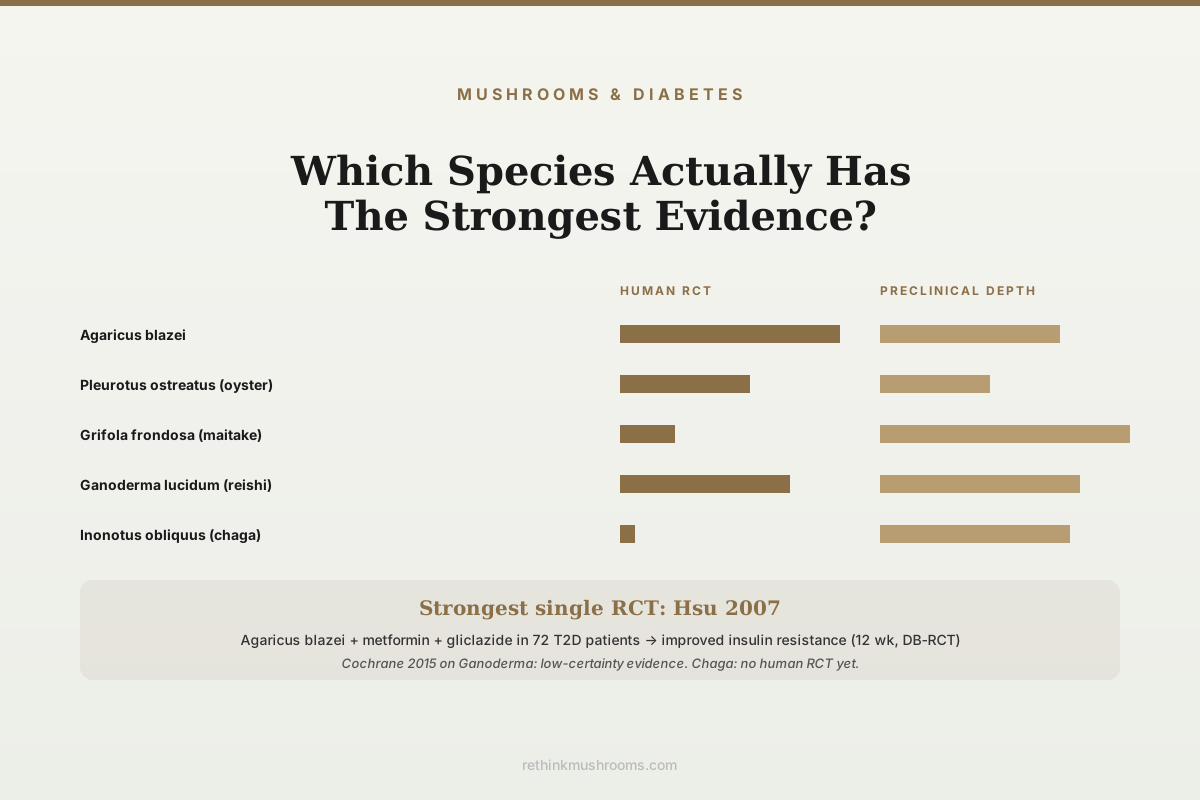
Hsu et al. (2007) ran the strongest human study in the mushroom-diabetes literature: a randomised, double-blinded, placebo-controlled trial of Agaricus blazei Murill on top of metformin and gliclazide in 72 type 2 diabetic patients, reporting improved insulin resistance.
Hsu et al., J. Alt. Complement. Med., 2007
Human RCT Evidence
thin; mostly Agaricus, oyster, Ganoderma
Preclinical Depth
maitake and Agaricus strongest
Mechanism Diversity
β-glucans, insulin sensitisation, oxidative stress
Hsu et al., J. Alt. Complement. Med., 2007
 View as image ↗
The question "which mushroom is best for blood sugar" has been asked more often than it has been answered rigorously. The peer-reviewed evidence is dominated by preclinical work in rodent diabetes models, with a smaller but non-trivial set of human trials concentrated on three species (Agaricus blazei, Pleurotus ostreatus, Ganoderma lucidum). The honest comparison requires tiering the evidence by study design (RCT in diabetic humans versus STZ-rat versus cell culture), mapping the mechanisms each species targets (β-glucan-mediated insulin sensitisation, α-glucan effects, polysaccharide-mediated oxidative stress reduction, gut microbiota modulation) and being explicit about where the literature falls short. Shamim and colleagues (2023) in Molecules provided a recent scoping review across all edible-mushroom diabetes evidence and is a useful anchor for the comparative landscape.[1]
For dedicated deep-dives see mushrooms for type 2 diabetes: a research-based guide to evidence and species, maitake and type 2 diabetes: the sx-fraction clinical trials, reishi polysaccharides and blood glucose control in diabetic patients and cordyceps and blood sugar: how cordycepin affects glucose metabolism.
Key Takeaways
- Hsu et al. (2007) provides the highest-quality human trial: RCT of Agaricus blazei on top of metformin and gliclazide in 72 type 2 diabetics, reporting improved insulin resistance
- Khatun et al. (2007) reported reduced blood glucose and cholesterol in diabetic patients given oyster mushroom (Pleurotus ostreatus)
- Klupp et al. (2015) is a Cochrane systematic review concluding evidence for Ganoderma lucidum in glucose control is low-certainty, and Klupp 2016 ran a dedicated RCT with limited effect
- Maitake has the deepest preclinical evidence base (Kubo 1994, Horio 2001, Hong 2007, Xiao 2015, Preuss 2012) but limited RCT-quality human data
- Chaga (Inonotus obliquus) polysaccharide studies (Diao 2014, Chen 2022, Sun 2008) show consistent effects in rodent T2D models, with no comparable human RCT
- Shamim et al. (2023) provides the most recent systematic overview of the edible-mushroom diabetes literature, reinforcing that RCT-quality human evidence is thin across species
Tiering The Evidence
Before comparing species, the evidence itself needs tiers, because a preclinical rodent study and a human RCT are not interchangeable data points. The relevant hierarchy for diabetes management:
- RCT in diabetic humans with hard endpoints. HbA1c, fasting plasma glucose, insulin resistance (HOMA-IR), postprandial glucose.
- Non-randomised human studies with hard endpoints. Case series, open-label trials, cohort data.
- Preclinical studies in established diabetes models. STZ-induced diabetic rodents, db/db and KK-Ay genetic models, high-fat diet + STZ combined models.
- In vitro mechanistic studies. Cell culture effects on insulin signalling, glucose uptake, enzyme inhibition.
A species with five tier-3 studies and no tier-1 does not necessarily outrank a species with one well-designed tier-1 trial. Ranking mushroom species for diabetes requires placing each in its tier stack rather than counting papers.
Tier-1 Evidence: The Three Human RCTs That Matter
Agaricus blazei Murill has the best-designed single trial. Hsu and colleagues (2007) ran a randomised, double-blinded, placebo-controlled trial of Agaricus blazei extract on top of metformin and gliclazide in 72 patients with type 2 diabetes.[2] The intervention arm showed improved insulin resistance compared with the placebo arm over 12 weeks. The design is strong because it tests the supplement as an add-on to standard care, which is the relevant clinical question, and the sample size is large enough to detect meaningful effects on HOMA-IR. Adverse events were comparable between arms.
Pleurotus ostreatus has direct human diabetic data. Khatun and colleagues (2007) reported that oyster mushroom consumption reduced blood glucose and cholesterol in diabetic subjects.[3] The study is smaller and less rigorously designed than Hsu 2007, and the reporting is less detailed, but the endpoint is direct and the intervention is a whole-food mushroom rather than a concentrated extract.
Ganoderma lucidum has a Cochrane review and a dedicated RCT. Klupp and colleagues (2015) published the Cochrane systematic review on Ganoderma lucidum for cardiovascular risk factors and concluded that evidence for effects on glucose control is low-certainty.[4] The same group (Klupp 2016) then ran their own double-blind randomised placebo-controlled trial of Ganoderma for cardiovascular risk factors of metabolic syndrome and reported limited effect.[5] This is a case where more rigorous testing produced a more muted result than the preclinical literature had suggested.
On tier-1 evidence alone, Agaricus blazei has the strongest single study, Pleurotus ostreatus has a direct-endpoint study with human diabetics, and Ganoderma lucidum has the most rigorous evaluation returning a muted positive-to-null result.
Maitake (Grifola Frondosa): Strongest Preclinical Depth
Maitake has a deeper preclinical literature than any other species, starting with the foundational work of Kubo and colleagues (1994) who first demonstrated antidiabetic activity in the fruit body of Grifola frondosa.[6] Horio and Ohtsuru (2001) showed that maitake improved glucose tolerance in experimentally induced diabetic rats.[7] Hong and colleagues (2007) isolated an α-glucan from the maitake fruit body and demonstrated antidiabetic effects in KK-Ay mice, a genetic model of type 2 diabetes.[8]
Two later studies refined the mechanistic picture. Xiao and colleagues (2015) isolated maitake polysaccharide fractions F2 and F3 and demonstrated hypoglycaemic effects through improvement of insulin resistance in diabetic rats.[9] Preuss and colleagues (2012) tested fraction SX of maitake in streptozotocin-induced diabetic rats and reported favourable effects on both blood glucose and blood pressure.[10] Talpur and colleagues (2002) had earlier characterised antihypertensive and metabolic effects of whole maitake powder and its fractions in two rat strains.[11]
Maitake therefore has the strongest multi-study preclinical stack for diabetes among cultivated medicinal mushrooms. The tier-1 gap is that rigorous RCT-level evidence in human type 2 diabetes is still limited. The preclinical case for maitake's insulin-sensitisation pathway is scientifically robust, and the clinical translation is the weaker link.
Agaricus Blazei Murill: Strongest Human Trial, Extensive Preclinical
Agaricus blazei has both a strong tier-1 study (Hsu 2007) and substantial preclinical backup. Kim and colleagues (2005) demonstrated that β-glucans and their enzymatically hydrolysed oligosaccharides from Agaricus blazei had antidiabetic activity in rodent models.[12] The mechanistic stack extends through work on insulin sensitivity and pancreatic function in multiple rodent diabetes models, and the safety profile has been reviewed in the pharmaco-toxicological literature.
The combination of a well-designed human RCT (Hsu 2007) and a deep preclinical base makes Agaricus blazei the most defensible single choice on current evidence for anyone prioritising RCT-tier data. The tier-1 to tier-3 stack aligns coherently.
Pleurotus Ostreatus (Oyster): Whole-Food Evidence
Oyster mushroom has the distinctive advantage of being both an extensively consumed culinary mushroom and a documented hypoglycaemic intervention. Khatun 2007 tested whole-mushroom intake in diabetic humans and reported reduced blood glucose and cholesterol.[3] The intervention is whole food, not an extract, which means the dose-response relationship is harder to define but the practical implementation is straightforward.
The mechanistic evidence for oyster mushroom in diabetes includes effects on lipid metabolism, insulin sensitivity and intestinal glucose uptake. The tier-1 human evidence is thinner than Agaricus blazei but uniquely whole-food, which is a relevant axis for some readers.
Ganoderma Lucidum (Reishi): The Trial-Evidence Downgrade
Ganoderma is the species where rigorous testing produced more muted results than the preclinical literature had suggested. The Cochrane review by Klupp 2015 explicitly graded the glucose-control evidence as low-certainty.[4] The dedicated Klupp 2016 RCT ran a double-blind placebo-controlled trial in metabolic syndrome patients and reported limited effect on key cardiovascular risk factors.[5]
The downgrade is instructive. The preclinical Ganoderma diabetes literature is extensive (multiple rodent models, multiple polysaccharide fractions, plausible mechanistic accounts) and the in-animal effect sizes are often substantial. The human trial signal is smaller. This is the pattern of a species where cellular mechanisms are real but the translation to intact-human physiology is mediated by factors (dose, extract quality, baseline diabetic severity, interactions with other interventions) that have not been fully identified.
For a diabetes-focused practical decision, Ganoderma ranks below Agaricus and Pleurotus on the current human evidence, despite the popularity of reishi supplementation for metabolic concerns.
Inonotus Obliquus (Chaga): Strong Preclinical, No Human RCT
Chaga has a consistent preclinical signal in rodent diabetes models but does not have a comparable human RCT. Sun and colleagues (2008) reported antihyperglycaemic and antilipidperoxidative effects of submerged-culture Inonotus obliquus in a rodent model.[13] Diao and colleagues (2014) demonstrated protective effects of Inonotus obliquus polysaccharides on streptozotocin-induced diabetic symptoms in rats.[14] Chen and colleagues (2022) extended this to a high-fat diet + streptozotocin combined T2D model and reported antidiabetic effects of the extract.[15]
The preclinical chaga evidence is consistent across multiple independent groups using different extract preparations and different diabetes models, which is a stronger signal than single-study preclinical evidence. The tier-1 gap is real: there is no published randomised controlled trial of Inonotus obliquus for diabetes in humans. Chaga also has the additional consideration of documented oxalate-nephropathy case reports (a safety issue particularly relevant to diabetic patients, who are at elevated risk for chronic kidney disease), which constrains how the preclinical promise should be translated.
A Comparative Summary
| Species | Strongest Human Evidence | Preclinical Depth | Overall Tier |
|---|---|---|---|
| Agaricus blazei | RCT add-on to drug therapy (Hsu 2007) | Strong (Kim 2005 et al.) | Tier 1 + deep tier 3 |
| Pleurotus ostreatus | Diabetic subjects intervention (Khatun 2007) | Moderate | Tier 1 + moderate tier 3 |
| Grifola frondosa (maitake) | Limited RCT-level data | Deepest (Kubo, Horio, Hong, Xiao, Preuss) | Weaker tier 1, deepest tier 3 |
| Ganoderma lucidum | Cochrane review, dedicated RCT (Klupp 2015, 2016) | Extensive but effects did not translate cleanly | Tier 1 present but muted |
| Inonotus obliquus (chaga) | No human RCT | Consistent rodent signal | Tier 3 only |
The ranking is not a simple ordering. A reader prioritising tier-1 quality would choose Agaricus blazei. A reader prioritising mechanism depth and preclinical coherence would consider maitake. A reader looking for whole-food integration would look at oyster mushroom. A reader interested in chaga should note the preclinical signal along with the tier-1 gap and the kidney-safety caveat.
Limits Of The Comparison
The published evidence supports several clear conclusions, but the limits are substantial.
Tier-1 evidence is thin across all species. Even Agaricus blazei, the best-evidenced, has one well-designed RCT (Hsu 2007) rather than a sustained trial programme. The Cochrane-level assessment of Ganoderma graded evidence as low-certainty, which is a meaningful red flag even for the species with the most formal systematic-review attention.
Extract preparations differ substantially across studies. Maitake D-fraction, SX-fraction, F2 and F3 fractions, and whole-mushroom powder are all distinct preparations, and effect sizes do not necessarily translate across them. A consumer taking a generic "maitake extract" is not automatically getting the fraction that was tested in any specific preclinical study.
Dosing is not standardised. RCT-level doses of Agaricus blazei, Ganoderma, and other species in the published human trials are often higher than the dose-per-capsule of typical consumer products, and the duration in the trials is often 8 to 16 weeks, which is longer than most consumers sustain supplementation.
Cross-species direct comparisons in a single study do not exist in humans. No published trial has randomised type 2 diabetics to maitake versus Agaricus versus reishi versus placebo at matched doses. The ranking above is a synthesis across studies with different designs, different populations and different endpoints, not a head-to-head assessment.
Combination with standard diabetes care is underexplored. Hsu 2007 is the clearest example of an add-on design, and the result was favourable, but the broader literature does not systematically test mushroom supplements as adjuncts to metformin, SGLT2 inhibitors, GLP-1 agonists and insulin. The clinically relevant question is almost always add-on, not replacement, and the evidence base has not caught up.
Finally, the diabetes-mushroom literature is not integrated with the emerging gut microbiota literature. Several of the proposed mechanisms (β-glucan-mediated gut microbiota modulation, short-chain fatty acid production, metabolic endotoxaemia reduction) are areas where 2020s research is changing the mechanistic picture, and the older preclinical studies did not have the analytical tools to characterise these pathways.
The Bottom Line
The comparative mushroom-diabetes evidence tiers cleanly: Agaricus blazei has the strongest single human RCT (Hsu 2007) plus substantial preclinical depth; Pleurotus ostreatus has direct whole-food human diabetic evidence (Khatun 2007); maitake has the deepest preclinical literature but thinner RCT data; Ganoderma lucidum has been tested most rigorously and produced muted results (Klupp 2015 Cochrane, Klupp 2016 RCT); chaga has consistent preclinical activity with no human RCT. Tier-1 evidence is thin across all species, extract preparations are not standardised, and head-to-head direct comparisons have not been done.
Frequently Asked Questions
Sources & References
- 1RTHM-00850·Shamim, Mohammad Zaki et al. (2023). “Exploring Edible Mushrooms for Diabetes: Unveiling Their Role in Prevention and Treatment..” Molecules (Basel.Study breakdown →PubMed →↩
- 2RTHM-00114·Hsu, Chung-Hua et al. (2007). “The mushroom Agaricus Blazei Murill in combination with metformin and gliclazide improves insulin resistance in type 2 diabetes: a randomized, double-blinded, and placebo-controlled clinical trial..” Journal of alternative and complementary medicine (New York.Study breakdown →PubMed →↩
- 3RTHM-00115·Khatun, K et al. (2007). “Oyster mushroom reduced blood glucose and cholesterol in diabetic subjects..” Mymensingh medical journal : MMJ.Study breakdown →PubMed →↩
- 4RTHM-00380·Klupp, Nerida L et al. (2015). “Ganoderma lucidum mushroom for the treatment of cardiovascular risk factors..” The Cochrane database of systematic reviews.Study breakdown →PubMed →↩
- 5RTHM-00429·Klupp, Nerida L et al. (2016). “A double-blind, randomised, placebo-controlled trial of Ganoderma lucidum for the treatment of cardiovascular risk factors of metabolic syndrome..” Scientific reports.Study breakdown →PubMed →↩
- 6RTHM-00015·Kubo, K et al. (1994). “Anti-diabetic activity present in the fruit body of Grifola frondosa (Maitake). I..” Biological & pharmaceutical bulletin.Study breakdown →PubMed →↩
- 7RTHM-00035·Horio, H et al. (2001). “Maitake (Grifola frondosa) improve glucose tolerance of experimental diabetic rats..” Journal of nutritional science and vitaminology.Study breakdown →PubMed →↩
- 8RTHM-00113·Hong, Lei et al. (2007). “Anti-diabetic effect of an alpha-glucan from fruit body of maitake (Grifola frondosa) on KK-Ay mice..” The Journal of pharmacy and pharmacology.Study breakdown →PubMed →↩
- 9RTHM-00410·Xiao, Chun et al. (2015). “Hypoglycemic effects of Grifola frondosa (Maitake) polysaccharides F2 and F3 through improvement of insulin resistance in diabetic rats..” Food & function.Study breakdown →PubMed →↩
- 10RTHM-00262·Preuss, Harry G et al. (2012). “Fraction SX of maitake mushroom favorably influences blood glucose levels and blood pressure in streptozotocin-induced diabetic rats..” Journal of medicinal food.Study breakdown →PubMed →↩
- 11RTHM-00053·Talpur, Nadeem A et al. (2002). “Antihypertensive and metabolic effects of whole Maitake mushroom powder and its fractions in two rat strains..” Molecular and cellular biochemistry.Study breakdown →PubMed →↩
- 12RTHM-00082·Kim, Yea-Woon et al. (2005). “Anti-diabetic activity of beta-glucans and their enzymatically hydrolyzed oligosaccharides from Agaricus blazei..” Biotechnology letters.Study breakdown →PubMed →↩
- 13RTHM-00145·Sun, Jun-En et al. (2008). “Antihyperglycemic and antilipidperoxidative effects of dry matter of culture broth of Inonotus obliquus in submerged culture on normal and alloxan-diabetes mice..” Journal of ethnopharmacology.Study breakdown →PubMed →↩
- 14RTHM-00319·Diao, Bao-Zhong et al. (2014). “Protective Effect of Polysaccharides from Inonotus obliquus on Streptozotocin-Induced Diabetic Symptoms and Their Potential Mechanisms in Rats..” Evidence-based complementary and alternative medicine : eCAM.Study breakdown →PubMed →↩
- 15RTHM-00750·Chen, Shanshan et al. (2022). “Anti-diabetic effects of Inonotus obliquus extract in high fat diet combined streptozotocin-induced type 2 diabetic mice..” Nutricion hospitalaria.Study breakdown →PubMed →↩